flagעברית
flagEnglish
3 Rabinovich St., Petah-Tikva, Israel
+972 3 9047744
office@amironic.co.il
Facebook
Twitter
LinkedIn
YouTube
  • Products
    • MEMS Inertial
      • Gyros & Accels
      • IMU
      • Inertial Navigation
      • AHRS
    • Circuit Breakers
      • Airpax Circuit Breakers
      • Electronic Circuit Breakers
      • Aircraft Circuit Breakers
      • Thermal Circuit Breakers
      • Sealing Solutions & Guards
    • Footswitches
      • Pedals & Bellows
      • USB
      • Air Switches
      • Medical
      • Modular Bases System
      • Industrial
      • Foot Potentiometers
      • Wireless
    • Mechanical & Transmisions
      • Gears
      • Sealing Solutions
      • Gearboxes
      • Couplings
      • Shafts & Bearings
      • Fasteners
      • Mechanical & Springs
      • Linear Motion
      • Anti-Vibration
    • Sensors
      • Thermostats
      • Temperature
      • Position
      • Pressure
      • Speed
      • Level Sensor
      • Load Cells
      • Flex Sensors
      • Membrane Potentiometer
    • Motors
      • Geared DC
      • Brushless DC
      • Step Motors with Gearbox
      • Torque Motors & Brushless Servo
      • AC Motors
      • DC Motors
    • Electronics
      • Xenon & IR Lamps
      • Counters & Meters
      • Microelectronics Packaging
      • Waterproof Switches
      • Micro Switches
    • Hand Control
      • Operator Controls (JOYSTICK)
      • Electrical
      • Pneumatic (Medical)
      • USB Hand Control
      • Air Push Button
      • Pressure Switch
      • IR Switch
    • Power Solutions
      • Rugged & Military Power Supply
      • Input Power Protection
      • Sealed Military Power Adaptor
      • Triple Output Military Power Supply Series – up to 250 W
    • Materials
      • Molybdenum and Advanced Alloys (TZM, MOLA, HCT)
      • Tungsten (Wolfram) and Advanced Alloys – High-Performance Materials for Extreme Conditions
      • Materials for Gears
  • Shop
  • Companies
  • About
  • News
  • Contact
Product was added to your cart

Cart

waze

When Is a Thermal Switch Better Than a Temperature Sensor + Logic?

Temperature Sensors26/01/2026amironicLTD

A Critical Design Consideration in Industrial, Medical, and Defense Systems

In many systems, the choice between a simple thermal switch and a temperature sensor combined with electronic logic is often perceived as a question of accuracy.
In practice, this decision is far deeper – involving reliability, safety, failure modes, and the system’s ability to survive edge-case scenarios.

In this article, we examine when the simpler solution – a thermal switch – is actually the correct engineering choice.


Two Approaches to the Same Problem

How Do We Protect a System Against Overheating?

At the architectural level, two common approaches are used for thermal protection:


Approach A – Temperature Sensor + Logic

The system includes:

  • A temperature sensor (NTC / PTC / PT100 / IC)

  • Measurement via MCU or PLC

  • Software-based decision making

  • Relay activation or load disconnection

Advantages:

  • High measurement accuracy

  • Operational flexibility

  • Continuous monitoring, logging, and diagnostics

Disadvantages:

  • Full dependency on software

  • Dependency on power availability

  • Sensitivity to EMI, resets, and watchdog behavior

  • Multiple potential failure points


Approach B – Thermal Switch (Thermostat / Thermal Cutoff)

The system includes:

  • A mechanical, bimetallic, or wax-based device

  • Physical disconnection at a predefined temperature

  • Autonomous operation, without code or logic

Advantages:

  • True fail-safe behavior

  • Operates even without power

  • Predictable and deterministic response

  • Independent of software

Disadvantages:

  • Lower temperature resolution

  • Fixed or limited adjustable setpoint

  • No continuous temperature information


The Real Question: Accuracy – or Survivability?

During the design phase, many engineers naturally gravitate toward the more accurate solution.
However, in safety-critical systems, the more important question is:

What happens when the system does not behave as expected?

  • What happens during an unexpected reset?

  • What happens under electromagnetic interference?

  • What happens during a power loss?

  • What happens when the software becomes unresponsive?

At this point, accuracy is no longer the primary parameter.


When a Thermal Switch Is Clearly the Better Choice

Scenarios Where Simplicity Wins

Fail-Safe Is a Fundamental Requirement

In medical equipment, safety systems, and unmanned platforms,
a device is required that can disconnect the system even when everything else has failed.

A thermal switch provides a protection layer that does not depend on any external condition.


Power Loss Is a Realistic Scenario

In battery-powered systems, automotive, rail, or field equipment,
thermal protection that does not require power is a critical advantage.


A “Noisy” Environment

EMI, transients, current surges, and voltage spikes can cause:

  • Incorrect sensor readings

  • MCU resets

  • Unpredictable logic behavior

The mechanical device continues to operate normally.


Regulatory Requirements

In many standards, the following is required:

  • An independent physical disconnect device

  • Not dependent on software

  • Not bypassable by firmware

In these cases, a sensor and logic alone are not sufficient.


Not Either-Or, but Both

In well-designed systems, the correct architecture is a combination:

Layer Function
Sensor + Logic Control, monitoring, prediction
Thermal Switch Emergency shutdown – last line of defense

As a result:

  • Software controls

  • Hardware protects


How to Select the Right Thermal Switch

Without diving into catalogs, key considerations include:

  • Trip temperature relative to ambient conditions

  • Hysteresis

  • Contact type (NO / NC)

  • Rated current and voltage

  • Installation method – true thermal coupling

  • Long-term reliability (number of cycles)


Summary

The choice between a temperature sensor and a thermal switch is not merely a technological decision –
it reflects the system’s risk philosophy.

In critical systems:
Simplicity = Survivability
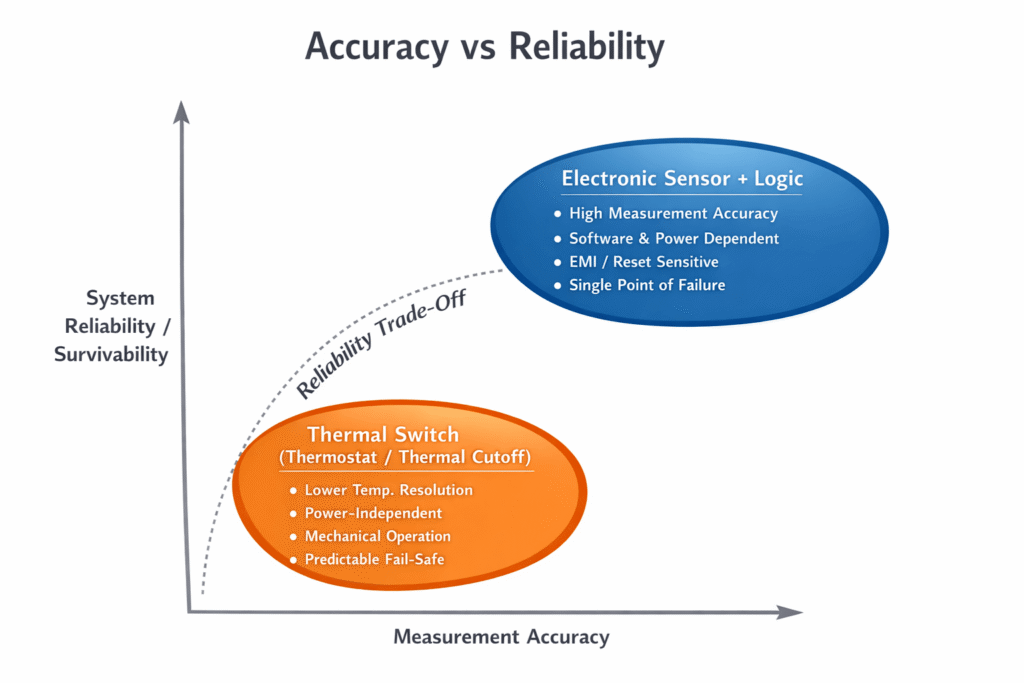
Accuracy vs Reliability

The graph illustrates a simple yet critical principle:

High measurement accuracy does not guarantee system survivability.

Sensor-based systems excel in accuracy and control,
but their reliability depends on multiple external conditions.

A thermal switch, despite lower measurement resolution, provides:

  • Predictable operation

  • Consistent behavior

  • High reliability under edge-case conditions

The correct choice is driven not by accuracy – but by risk.

Common Mistakes in Thermostat Selection
When Is a Thermal Switch Better Than a Sensor + Logic?
When Software-Based Protection Is Simply Not Enough
Fail-Safe and Layered Thermal Protection Architecture
Practical Selection Guidelines – An Engineering Perspective
Common Mistakes in Thermostat Selection

“We have a watchdog – that’s enough.”
A watchdog addresses software faults, not hardware failures.
If the temperature has already exceeded safe limits, a reset will not solve the problem.


“Our software is stable.”
Even stable software:

  • Depends on power availability

  • Is sensitive to EMI

  • Can become unresponsive under unexpected conditions

Thermal protection is not the place to rely on assumptions.


“This has never happened before.”
Thermal protection is designed for rare events – not for normal operation.


“We’ll fix it with a firmware update.”
When temperature limits are exceeded, there is no time for updates.


Improper Thermal Installation

Even a high-quality thermal switch will not perform correctly if:

  • There is insufficient thermal coupling

  • It is installed too far from the heat source

  • The trip temperature is selected without an adequate safety margin

When Is a Thermal Switch Better Than a Sensor + Logic?

In many systems, thermal protection is designed around a temperature sensor combined with software-based logic.
This approach is accurate, flexible, and convenient – but it is not always the safest solution.

The real engineering question is not “which solution is more accurate?”
but rather:
How does the system behave when things go wrong?

A thermal switch operates as an independent protection layer:

  • Independent of software

  • Independent of power

  • Independent of system state

In scenarios involving faults, resets, or loss of control, simplicity becomes an engineering advantage – not a compromise.

When Software-Based Protection Is Simply Not Enough

There are scenarios in which sensor-based protection combined with logic is insufficient:

  • MCU reset during an overtemperature event

  • Brown-out or complete power loss

  • EMI causing incorrect sensor readings

  • Long boot time relative to the rate of temperature rise

  • Race conditions between the sensor, software, and shutdown mechanism

In all of these cases, an independent thermal device continues to operate normally –
even when the rest of the system is effectively “blind”.

Fail-Safe and Layered Thermal Protection Architecture

In well-designed systems, the choice is not between a sensor and a thermal switch –
both are intentionally combined.

A proper separation of roles:

  • Sensor + logic: control, monitoring, and prediction

  • Thermal switch: emergency shutdown, the last line of defense

As a result:

  • Software manages

  • Hardware protects

This type of architecture is also preferred by certification and regulatory bodies because it:

  • Reduces single points of failure

  • Is not dependent on firmware

  • Provides true fail-safe behavior

Practical Selection Guidelines – An Engineering Perspective

When selecting a thermal switch, the following factors should be considered:

  • Trip temperature relative to ambient temperature

  • Safety margin (derating)

  • Hysteresis

  • Contact type (NO / NC)

  • Rated current and voltage

  • Installation method and effective thermal coupling

  • Service life and number of operating cycles

The goal is not simply to select a “component”,
but to ensure that thermal protection will operate even when everything else does not.

Thermal protection is not an add-on –
it is a statement of the system’s risk philosophy.

In critical systems:
Simplicity = Survivability

Tags: Amironic

Related Articles

Gears, Racks, Worms and Bevel Gears – From Engineering Design to Technical Procurement

25/01/2026amironicLTD

Upgrading Commercial Electronics for Airborne Military Platforms

25/01/2026amironicLTD

Recent Posts

  • Wireless Foot Switch in Medical Equipment – Design Considerations, Risks, and What Engineers Really Need to Know
  • When Is a Thermal Switch Better Than a Temperature Sensor + Logic?
  • Upgrading Commercial Electronics for Airborne Military Platforms
  • Gears, Racks, Worms and Bevel Gears – From Engineering Design to Technical Procurement
  • Cross-Reference for Circuit Breakers

Categories

  • Air Switch
  • Circuit Breakers
  • Elapsed Time Indicator
  • Footswitches
  • Gears & Transmission
  • Infra Red Switches
  • INFRARED LAMPS
  • Low Noise Inertial MEMS
  • Mechanics
  • MEMS Gyroscope
  • MEMS Inertial
  • Microelectronics
  • Motors
  • Position Sensors
  • Power Supply
  • Pressure Switch
  • Temperature Sensors
  • Tungsten and Molybdenum
  • Uncategorized
  • Vacuum Switches

Amironic Ltd.

3 Rabinovich Street, Petah Tikva 4928144 , Israel. Tel: +972-3-9047744 E-mail: office@amironic.co.il
Email
Facebook
Twitter
LinkedIn
YouTube
Press on the ISO Certificate below for download
ISO 9001:2015 Certification
  • MEMS Inertial
  • Circuit Breakers
  • Footswitches
  • Mechanical & Transmisions
  • Sensors
  • Motors
  • Electronics
  • Hand Control
  • Power Solutions

News

  • Wireless Foot Switch in Medical Equipment – Design Considerations, Risks, and What Engineers Really Need to Know
  • When Is a Thermal Switch Better Than a Temperature Sensor + Logic?
  • Upgrading Commercial Electronics for Airborne Military Platforms
  • Gears, Racks, Worms and Bevel Gears – From Engineering Design to Technical Procurement
  • Cross-Reference for Circuit Breakers
AboutContactעברית
© 2022 Amironic All rights reserved. All Trademarks are the property of their respective owners.
  • Increase Font
  • Decrease Font
  • Black & White
  • Inverse Colors
  • Highlight Links
  • Regular Font
  • Reset