flagעברית
flagEnglish
3 Rabinovich St., Petah-Tikva, Israel
+972 3 9047744
office@amironic.co.il
Facebook
Twitter
LinkedIn
YouTube
  • Products
    • MEMS Inertial
      • Gyros & Accels
      • IMU
      • Inertial Navigation
      • AHRS
    • Circuit Breakers
      • Airpax Circuit Breakers
      • Electronic Circuit Breakers
      • Aircraft Circuit Breakers
      • Thermal Circuit Breakers
      • Sealing Solutions & Guards
    • Footswitches
      • Pedals & Bellows
      • USB
      • Air Switches
      • Medical
      • Modular Bases System
      • Industrial
      • Foot Potentiometers
      • Wireless
    • Mechanical & Transmisions
      • Gears
      • Sealing Solutions
      • Gearboxes
      • Couplings
      • Shafts & Bearings
      • Fasteners
      • Mechanical & Springs
      • Linear Motion
      • Anti-Vibration
    • Sensors
      • Thermostats
      • Temperature
      • Position
      • Pressure
      • Speed
      • Level Sensor
      • Load Cells
      • Flex Sensors
      • Membrane Potentiometer
    • Motors
      • Geared DC
      • Brushless DC
      • Step Motors with Gearbox
      • Torque Motors & Brushless Servo
      • AC Motors
      • DC Motors
    • Electronics
      • Xenon & IR Lamps
      • Counters & Meters
      • Microelectronics Packaging
      • Waterproof Switches
      • Micro Switches
    • Hand Control
      • Operator Controls (JOYSTICK)
      • Electrical
      • Pneumatic (Medical)
      • USB Hand Control
      • Air Push Button
      • Pressure Switch
      • IR Switch
    • Power Solutions
      • Rugged & Military Power Supply
      • Input Power Protection
      • Sealed Military Power Adaptor
      • Triple Output Military Power Supply Series – up to 250 W
    • Materials
      • Molybdenum and Advanced Alloys (TZM, MOLA, HCT)
      • Tungsten (Wolfram) and Advanced Alloys – High-Performance Materials for Extreme Conditions
      • Materials for Gears
  • Shop
  • Companies
  • About Amironic
  • News
  • Contact
Product was added to your cart

Cart

waze

Category: MEMS Inertial

Home Archive by Category "MEMS Inertial"

Why Replacing an IMU Can Lead to Weeks of Recalibration

Gladiator_Technologies12/07/2026amironicLTD

Why can replacing an identical IMU lead to weeks of recalibration? Learn why Repeatability has become a critical design parameter for modern EO/IR, stabilization, navigation, and APNT systems, and how it helps reduce engineering effort, maintenance costs, and lifecycle risk.

Your Image Still Shakes Despite Choosing a Gyroscope with Excellent Bias Stability

Gladiator_Technologies02/07/2026amironicLTD

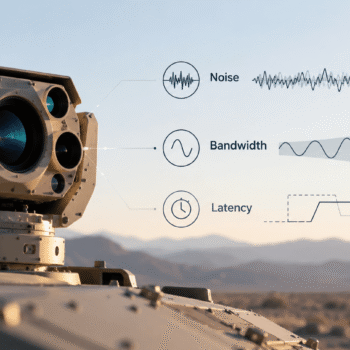
Is Bias Stability really the most important gyroscope specification? In many high-speed stabilization systems, Sensor Noise has a greater impact on image quality. Learn why Noise, Bandwidth, Output Rate, and Latency often determine real-world performance.

Why a Smaller IMU Can Save Months of Development

Gladiator_Technologies30/06/2026amironicLTD

Engineers typically compare IMUs based on performance, accuracy, bandwidth, and price. However, one critical factor is often overlooked: ease of integration. A sensor that’s just a few millimeters larger can trigger PCB redesigns, mechanical changes, additional prototypes, and costly project delays. Discover why a compact IMU can reduce integration risk, shorten development cycles, and lower the total cost of ownership- often saving far more than the difference in component price.

SX3: Pushing MEMS Beyond Traditional Stabilization

Gladiator_Technologies24/06/2026amironicLTD

The SX3 architecture represents a new generation of MEMS inertial sensing, combining ultra-low noise, high stability, 600 Hz bandwidth, 10 kHz output rates and sub-20 µs latency in a compact platform. Designed for advanced stabilization, tracking, autonomy and navigation-assisted applications, SX3 demonstrates how modern MEMS technology is evolving beyond traditional motion control toward systems where measurement quality itself becomes a critical factor in overall mission performance.

2000Hz IMU? Before You Get Impressed, Understand Three Completely Different Numbers

Gladiator_Technologies07/06/2026amironicLTD

When evaluating an IMU, many engineers focus on a single specification: update rate. A 2000Hz IMU must be better than a 200Hz IMU – right? Not necessarily. In real stabilization, tracking, and navigation systems, performance depends on much more than output frequency alone. This article explains the critical differences between Bandwidth, Output Rate, and Baud Rate, and shows why an IMU that sends data faster is not always the one that delivers better system performance. Through practical examples from EO/IR gimbals and UAVs, we explore how understanding these three parameters can prevent costly design mistakes and lead to more effective sensor selection.

The IMU Was Excellent. The Image Still Shook.

Gladiator_Technologies01/06/2026amironicLTD

Two MEMS IMUs with remarkably similar datasheet specifications were evaluated for a high-performance stabilization system. Both offered excellent bias stability, low noise, and impressive inertial performance. Yet one delivered noticeably better tracking, faster settling, and superior image stability. What caused the difference? This case study explores why latency, synchronization, bandwidth, and timing determinism often matter more than traditional navigation specifications when designing EO/IR, gimbal, antenna tracking, and UAV stabilization systems.

Scale Factor in MEMS IMUs – The Error That Quietly Destroys Accuracy

Gladiator_Technologies11/05/2026amironicLTD

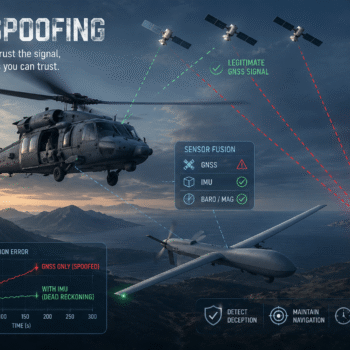
Scale factor error quietly distorts motion data long before a system completely fails.
In MEMS IMUs, even small scaling inaccuracies can degrade:
* Navigation accuracy
* EO/IR stabilization
* Dead reckoning
* GPS-denied performance
In high-end inertial systems, accuracy starts at the sensor level.

Bias Stability vs. Bias Instability: What really determines the performance of Gyro and IMU systems in stabilization, tracking, and navigation

Gladiator_Technologies09/04/2026amironicLTD

Bias Stability is often the first specification engineers look at when selecting a gyro or IMU, but it does not tell the full story. Bias Instability plays a critical role in short-term precision, stabilization performance, and small motion detection. This article explains the difference between the two parameters, how each affects system behavior, and why modern high-performance MEMS solutions – including those developed by Gladiator Technologies – are engineered to optimize both short-term stability and long-term accuracy.

Common Misconceptions About MEMS Inertial Sensors

Gladiator_Technologies15/03/2026amironicLTD

Many engineers still associate MEMS inertial sensors with early performance limitations or consumer-grade applications. In reality, modern high-performance MEMS IMUs have evolved dramatically, delivering the dynamic response, robustness, and stability required for demanding control, stabilization, and navigation-assisted systems. This article examines several common misconceptions about MEMS inertial sensors and explains how advanced architectures – including solutions developed by Gladiator Technologies – overcome these assumptions in real-world engineering environments.

Why Gladiator? What Truly Differentiates a High-End MEMS IMU Manufacturer

08/03/2026amironicLTD

In a market crowded with MEMS inertial sensors, the real differentiator is rarely the sensor alone – it is the engineering behind it.
True inertial performance depends on the integration of low-noise MEMS sensing, high-speed digital processing, deep temperature modeling, and tightly controlled manufacturing processes. Gladiator Technologies combines these elements into a coherent system architecture designed for stability, deterministic behavior, and predictable performance across dynamic environments and wide temperature ranges. When real-world performance matters, inertial accuracy is not just specified – it is engineered.

Posts pagination

1 2 3 >

Recent Posts

  • Why Replacing an IMU Can Lead to Weeks of Recalibration
  • Does Your Thermal Protector Really Solve the Problem? Or Just Give the System Another Chance to Fail?
  • Momentary or Latching? How to Choose the Right Switch for Industrial, Medical, and OEM Applications
  • A 30mA Ground Fault Could Bring Down Thousands of GPUs – Designing Ground Fault Protection for Data Center CDUs
  • Pneumatic Foot Bellows vs. Electrical Footswitch – Do You Really Need to Run Electricity to the Foot Pedal?

Categories

  • Air Switch
  • Circuit Breakers
  • Elapsed Time Indicator
  • Feedthrough
  • Footswitches
  • Gears & Transmission
  • Hour Meters
  • Infra Red Switches
  • INFRARED LAMPS
  • Low Noise Inertial MEMS
  • Mechanics
  • MEMS Gyroscope
  • MEMS Inertial
  • Microelectronics
  • Motors
  • Position Sensors
  • Power Supply
  • Pressure Sensors
  • Pressure Switch
  • Temperature Sensors
  • Tungsten and Molybdenum
  • Uncategorized
  • Vacuum Switches

Amironic Ltd.

3 Rabinovich Street, Petah Tikva 4928144 , Israel. Tel: +972-3-9047744 E-mail: office@amironic.co.il
Email
Facebook
Twitter
LinkedIn
YouTube
Press on the ISO Certificate below for download
ISO 9001:2015 Certification
  • MEMS Inertial
  • Circuit Breakers
  • Footswitches
  • Mechanical & Transmisions
  • Sensors
  • Motors
  • Electronics
  • Hand Control
  • Power Solutions

News

  • Why Replacing an IMU Can Lead to Weeks of Recalibration
  • Does Your Thermal Protector Really Solve the Problem? Or Just Give the System Another Chance to Fail?
  • Momentary or Latching? How to Choose the Right Switch for Industrial, Medical, and OEM Applications
  • A 30mA Ground Fault Could Bring Down Thousands of GPUs – Designing Ground Fault Protection for Data Center CDUs
  • Pneumatic Foot Bellows vs. Electrical Footswitch – Do You Really Need to Run Electricity to the Foot Pedal?
About AmironicContactעברית
© 2022 Amironic All rights reserved. All Trademarks are the property of their respective owners.
  • Increase Font
  • Decrease Font
  • Black & White
  • Inverse Colors
  • Highlight Links
  • Regular Font
  • Reset