A Critical Design Consideration in Industrial, Medical, and Defense Systems
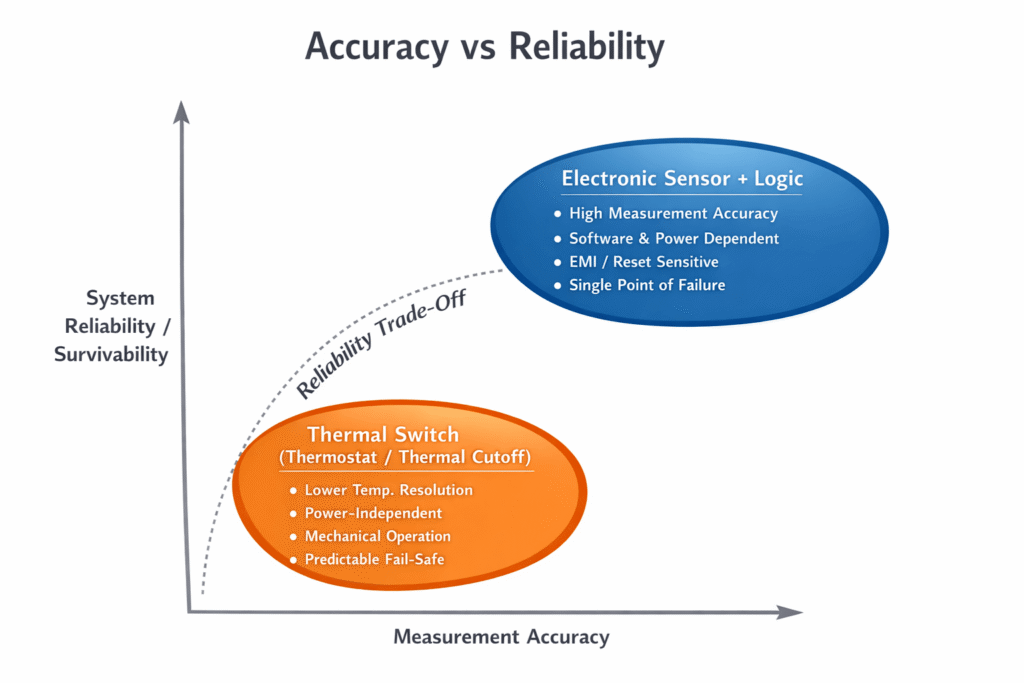
In many systems, the choice between a simple thermal switch and a temperature sensor combined with electronic logic is often perceived as a question of accuracy.
In practice, this decision is far deeper – involving reliability, safety, failure modes, and the system’s ability to survive edge-case scenarios.
In this article, we examine when the simpler solution – a thermal switch – is actually the correct engineering choice.
Two Approaches to the Same Problem
How Do We Protect a System Against Overheating?
At the architectural level, two common approaches are used for thermal protection:
Approach A – Temperature Sensor + Logic
The system includes:
-
A temperature sensor (NTC / PTC / PT100 / IC)
-
Measurement via MCU or PLC
-
Software-based decision making
-
Relay activation or load disconnection
Advantages:
-
High measurement accuracy
-
Operational flexibility
-
Continuous monitoring, logging, and diagnostics
Disadvantages:
-
Full dependency on software
-
Dependency on power availability
-
Sensitivity to EMI, resets, and watchdog behavior
-
Multiple potential failure points
Approach B – Thermal Switch (Thermostat / Thermal Cutoff)
The system includes:
-
A mechanical, bimetallic, or wax-based device
-
Physical disconnection at a predefined temperature
-
Autonomous operation, without code or logic
Advantages:
-
True fail-safe behavior
-
Operates even without power
-
Predictable and deterministic response
-
Independent of software
Disadvantages:
-
Lower temperature resolution
-
Fixed or limited adjustable setpoint
-
No continuous temperature information
The Real Question: Accuracy – or Survivability?
During the design phase, many engineers naturally gravitate toward the more accurate solution.
However, in safety-critical systems, the more important question is:
What happens when the system does not behave as expected?
-
What happens during an unexpected reset?
-
What happens under electromagnetic interference?
-
What happens during a power loss?
-
What happens when the software becomes unresponsive?
At this point, accuracy is no longer the primary parameter.
When a Thermal Switch Is Clearly the Better Choice
Scenarios Where Simplicity Wins
Fail-Safe Is a Fundamental Requirement
In medical equipment, safety systems, and unmanned platforms,
a device is required that can disconnect the system even when everything else has failed.
A thermal switch provides a protection layer that does not depend on any external condition.
Power Loss Is a Realistic Scenario
In battery-powered systems, automotive, rail, or field equipment,
thermal protection that does not require power is a critical advantage.
A “Noisy” Environment
EMI, transients, current surges, and voltage spikes can cause:
-
Incorrect sensor readings
-
MCU resets
-
Unpredictable logic behavior
The mechanical device continues to operate normally.
Regulatory Requirements
In many standards, the following is required:
-
An independent physical disconnect device
-
Not dependent on software
-
Not bypassable by firmware
In these cases, a sensor and logic alone are not sufficient.
Not Either-Or, but Both
In well-designed systems, the correct architecture is a combination:
| Layer | Function |
|---|---|
| Sensor + Logic | Control, monitoring, prediction |
| Thermal Switch | Emergency shutdown – last line of defense |
As a result:
-
Software controls
-
Hardware protects
How to Select the Right Thermal Switch
Without diving into catalogs, key considerations include:
-
Trip temperature relative to ambient conditions
-
Hysteresis
-
Contact type (NO / NC)
-
Rated current and voltage
-
Installation method – true thermal coupling
-
Long-term reliability (number of cycles)
Summary
The choice between a temperature sensor and a thermal switch is not merely a technological decision –
it reflects the system’s risk philosophy.
In critical systems:
Simplicity = Survivability