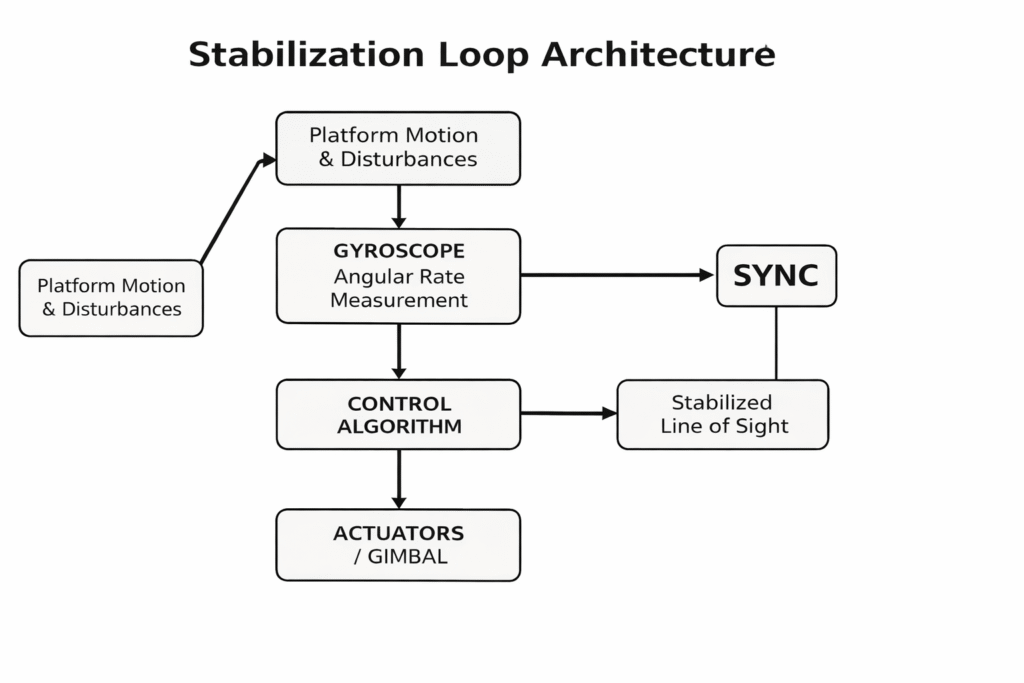
Modern tracking and stabilization systems operate in highly dynamic environments. Platform motion, structural vibration, shock events, and rapid directional changes create a complex engineering challenge: maintaining precise line-of-sight stability in real time.
While control algorithms and image processing continue to advance, true system performance begins with accurate, low-latency, and time-synchronized motion sensing.
The Engineering Challenge: Stability Under Motion and Disturbance
Dynamic platforms introduce multiple sources of error:
-
structural vibration and resonance frequencies
-
transient shock and impulsive motion
-
non-linear platform movement
-
high-frequency motion noise
-
changing environmental conditions
-
immediate readiness requirements
Even minute angular deviations can translate into significant pointing error, particularly in systems with narrow fields of view or high magnification optics.
The Gyroscope as the Core of Line-of-Sight Stabilization
A high-quality gyroscope enables the system to measure angular motion with precision and immediacy.
It provides the foundation for:
✔ line-of-sight stabilization
✔ real-time motion compensation
✔ accurate tracking of moving objects
✔ rejection of mechanical vibration disturbances
✔ high-quality motion data for control loops
When angular motion is measured accurately and without delay, every layer of control and processing performs more effectively.
What Defines a System-Grade MEMS Gyroscope
Modern high-performance MEMS gyroscopes — such as those developed by Gladiator Technologies — are engineered to deliver stable performance in demanding dynamic environments.
Bias Stability and Long-Term Accuracy
High bias stability reduces drift accumulation and maintains tracking accuracy during extended operation.
Low Angle Random Walk (ARW)
Low noise enables detection of subtle motion and improves fine stabilization performance.
Ultra-Low Latency
Minimal latency enables rapid control loop response, critical for real-time stabilization.
Shock and Vibration Survivability
Robust MEMS architecture supports reliable operation under shock events and sustained vibration.
Instantaneous Start-Up
No warm-up time ensures immediate operational readiness.
Thermal Stability
Advanced temperature compensation supports consistent performance across wide temperature ranges.