flagעברית
flagEnglish
3 Rabinovich St., Petah-Tikva, Israel
+972 3 9047744
office@amironic.co.il
Facebook
Twitter
LinkedIn
YouTube
  • Products
    • MEMS Inertial
      • Gyros & Accels
      • IMU
      • Inertial Navigation
      • AHRS
    • Circuit Breakers
      • Airpax Circuit Breakers
      • Electronic Circuit Breakers
      • Aircraft Circuit Breakers
      • Thermal Circuit Breakers
      • Sealing Solutions & Guards
    • Footswitches
      • Pedals & Bellows
      • USB
      • Air Switches
      • Medical
      • Modular Bases System
      • Industrial
      • Foot Potentiometers
      • Wireless
    • Mechanical & Transmisions
      • Gears
      • Sealing Solutions
      • Gearboxes
      • Couplings
      • Shafts & Bearings
      • Fasteners
      • Mechanical & Springs
      • Linear Motion
      • Anti-Vibration
    • Sensors
      • Thermostats
      • Temperature
      • Position
      • Pressure
      • Speed
      • Level Sensor
      • Load Cells
      • Flex Sensors
      • Membrane Potentiometer
    • Motors
      • Geared DC
      • Brushless DC
      • Step Motors with Gearbox
      • Torque Motors & Brushless Servo
      • AC Motors
      • DC Motors
    • Electronics
      • Xenon & IR Lamps
      • Counters & Meters
      • Microelectronics Packaging
      • Waterproof Switches
      • Micro Switches
    • Hand Control
      • Operator Controls (JOYSTICK)
      • Electrical
      • Pneumatic (Medical)
      • USB Hand Control
      • Air Push Button
      • Pressure Switch
      • IR Switch
    • Power Solutions
      • Rugged & Military Power Supply
      • Input Power Protection
      • Sealed Military Power Adaptor
      • Triple Output Military Power Supply Series – up to 250 W
    • Materials
      • Molybdenum and Advanced Alloys (TZM, MOLA, HCT)
      • Tungsten (Wolfram) and Advanced Alloys – High-Performance Materials for Extreme Conditions
      • Materials for Gears
  • Shop
  • Companies
  • About
  • News
  • Contact
Product was added to your cart

Cart

waze

Trip Coil – Turning a Standard Breaker into a Smart Relay

Circuit Breakers25/10/2025amironicLTD

💡 The Concept

In a conventional thermal-magnetic circuit breaker, the trip occurs only as a result of overcurrent or short circuit.
When a Trip Coil is added, the breaker gains an electrical control capability — it doesn’t just protect, it also becomes remotely controllable.
A small control-voltage pulse from a PLC or control system energizes the coil, triggering the internal mechanism to trip the breaker.
This turns a simple circuit breaker into a smart relay-breaker — combining protection, mechanical reliability, and remote operation.


⚙️ Types of Trip Coils

Shunt Trip – Activated by an external voltage pulse (typically 12 VDC / 24 VDC).
Used for remote shutdowns, E-STOP functions, or intentional disconnection by a control system.

Undervoltage Release (UVR) – Keeps the breaker latched as long as a “permission” voltage is present.
When the voltage drops, the breaker automatically opens — an ideal solution for Enable / Interlock / Fail-Safe logic.


🧠 Engineering Advantage

Adding a Trip Coil to a thermal-magnetic breaker creates a hybrid smart device:

  • A control relay with true mechanical disconnection

  • Built-in overcurrent and overload protection

  • Auxiliary contacts for monitoring and smart control

Instead of combining separate modules — relay, breaker, and control interface — you get one compact, precise, and durable unit.


⚙️ What Is a Trip Coil in Practice

The Trip Coil is an electromagnetic module integrated into the breaker housing and powered by an external control voltage (12 VDC, 24 VDC, 48 VDC, or 115/230 VAC).
When a short pulse is applied, the coil mechanically activates the trip mechanism and opens the breaker — just like an intelligent relay, but with the added benefit of built-in thermal-magnetic protection.


💡 Typical Applications

  • Smart power protection systems

  • Military power units – remote disconnect or enable logic from a controller

  • Industrial machinery and PLC control panels

  • Emergency stop and E-STOP circuits

  • Energy management and maintenance control systems


⚡ Amironic Ltd. – Official Representative of Sensata / Airpax in Israel

Amironic Ltd. is the authorized representative of Sensata Technologies / Airpax in Israel, providing:

  • Full technical support for breakers with Trip Coil and Undervoltage Release options

  • Assistance in defining voltage, current, timing, and environmental requirements

  • Custom integration in advanced control and protection systems

  • Available stock and engineering samples for evaluation and testing

The Sensata Airpax Trip Coil enables any thermal-magnetic breaker to become a smart protection solution – a relay, protector, and breaker in one compact device.
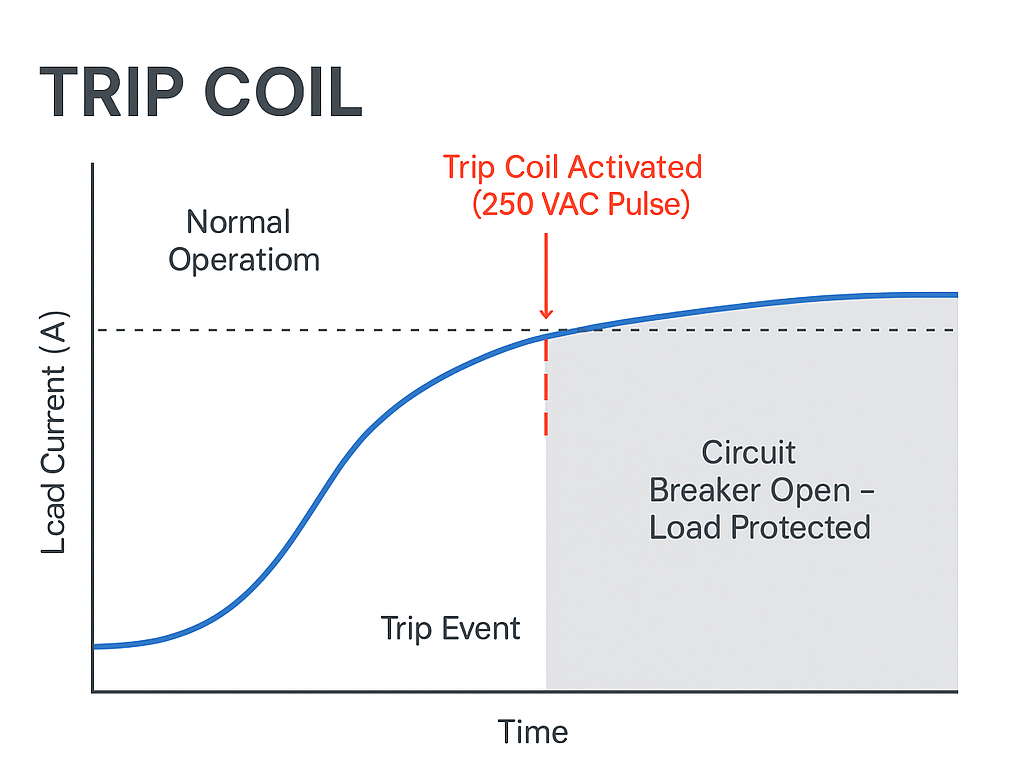
Trip Coil – Operating Principle

The graph illustrates the operation of a Trip Coil inside a thermal-magnetic breaker during an overcurrent event or a deliberate command from the operator.
During Normal Operation, the nominal current flows through the load.
When the current exceeds the threshold — or when a trip command is received from the control system — the Trip Coil is energized by a short 250 VAC Or DC pulse.
The pulse triggers the internal trip mechanism, opening the circuit immediately.
After the trip, the system enters a protected state (Circuit Breaker Open – Load Protected) with zero current and safe disconnection of the load.

Trip Coil Operation Sequence

This engineering graph shows the system’s response during an overload and trip sequence.

  • Top Graph – Load Current (A): The load current gradually increases until reaching the 10 A threshold, where the overload condition begins.

  • Middle Graph – Trip Coil Voltage (V): Upon detecting the overload (or receiving a remote command), a short 250 VAC pulse is sent to the Trip Coil.

  • Bottom Graph – Breaker State: Immediately after the coil is energized, the trip mechanism activates, opening the circuit and switching the breaker from ON to OFF.

The red vertical line marks the Trip Event — the exact moment when the coil is energized and the system transitions from normal operation to protection mode.
Afterward, the current drops to 0 A, and the load is safely isolated.

Trip Coil Wiring in a Circuit Breaker

The schematic illustrates the wiring principle of a Trip Coil (Shunt Trip Module) integrated within a three-phase circuit breaker (CB).

On the left is the main power circuit: three phases (L1, L2, L3) and neutral (N) feeding the load through the breaker.
On the right is the control circuit, where an external control supply is connected through a control or emergency-stop switch (E-STOP) to the internal Trip Coil module within the breaker.

When the breaker is closed, all three poles conduct and the load is powered.
When the control button is pressed — or a trip command is received from a remote system — a short voltage pulse is sent to the Trip Coil, which triggers the trip mechanism and disconnects all poles simultaneously.

This configuration allows remote, manual, or automatic tripping, ensuring full system safety and load protection.

How a Trip Coil Really Works
Integration into Control Systems
Protection vs Commanded Tripping
Common Engineering Mistakes
How to Specify a Trip Coil
FAQ
How a Trip Coil Really Works

A trip coil is an electromechanical actuator built into a circuit breaker.
When a control voltage is applied, the coil generates a magnetic force that releases the breaker’s internal latch and mechanically opens the contacts.

The trip coil does not measure current and does not provide protection by itself.
It simply converts an electrical command into a mechanical trip of the breaker.

This allows the breaker to be opened by a control system, not only by overload or short circuit.

Integration into Control Systems

The trip coil connects the power breaker to the system control logic.

It is typically driven by:

  • PLC outputs

  • Vehicle or platform controllers

  • Fire detection systems

  • Emergency stop circuits

  • BMS or SCADA systems

When the control system energizes the coil, the breaker opens immediately, disconnecting power.

This enables:

  • Remote shutdown

  • Automatic safety actions

  • Interlocks and lockouts

  • Event logging and alarms

The breaker becomes an active part of the control architecture.

Protection vs Commanded Tripping

A standard circuit breaker trips based on:

  • Overcurrent

  • Short circuit

A trip coil adds:

  • Tripping based on logic

  • Tripping based on sensors

  • Tripping based on safety or system rules

With a trip coil, the breaker no longer reacts only to electrical faults – it also reacts to system decisions.

This is essential in modern platforms where power must be controlled, not just protected.

Common Engineering Mistakes

Typical design errors include:

  • Supplying the wrong coil voltage

  • Driving the coil through undersized contacts

  • Assuming the coil provides electrical protection

  • Not supervising the trip circuit

  • Designing a system that cannot trip if the coil circuit fails

The trip coil is a critical shutdown path.
If it is misdesigned, the system may lose its ability to disconnect power when required.

How to Specify a Trip Coil

When ordering a breaker with a trip coil, the following must be defined:

  • Coil voltage (e.g. 12 VDC, 24 VDC, 115 VAC, 230 VAC)

  • Activation method (pulse or maintained voltage)

  • Fail-safe behavior

  • Whether trip-circuit supervision is required

The trip coil configuration is part of the breaker part number.
Selecting the wrong coil will lead to non-tripping or nuisance tripping in the field.

FAQ

Does the trip coil measure current?
No. It only triggers the mechanical trip mechanism.

Can the breaker be tripped without an overload?
Yes. That is exactly the purpose of the trip coil – controlled electrical tripping.

Is a trip coil suitable for safety systems?
Yes, if the overall system is designed accordingly. The coil is a control device, not a safety device by itself.

What happens if the coil circuit fails?
Without supervision, the breaker may not be able to trip remotely. Critical systems use trip-circuit supervision.

Is a trip coil the same as a shunt trip?
In most low-voltage breakers, these terms describe the same function: electrical tripping by an external command.

Tags: Airpax

Related Articles

Introducing the ROCB Remote Operated DIN Rail Circuit Breaker – The Future of Power Management

25/09/2024amironicLTD

Rail Mount Circuit Breaker

23/11/2016amironicLTD

Auxiliary Switch – The Eyes of the Circuit Breaker

05/11/2025amironicLTD

Recent Posts

  • Spring-Loaded Linear Position Sensors for Space-Limited and Harsh Environments
  • Circuit Breaker Solutions for Industrial and Military Power Systems – What Really Matters
  • How to Choose a Pressure Sensor for Harsh Field Conditions – and What Is Almost Always Missed
  • Why Your Circuit Breaker Works in the Lab – But Trips in the Field
  • MS3345-2 – The Small Bracket That Solves Big Military Panel Problems

Categories

  • Air Switch
  • Circuit Breakers
  • Elapsed Time Indicator
  • Footswitches
  • Gears & Transmission
  • Infra Red Switches
  • INFRARED LAMPS
  • Low Noise Inertial MEMS
  • Mechanics
  • MEMS Gyroscope
  • MEMS Inertial
  • Microelectronics
  • Motors
  • Position Sensors
  • Power Supply
  • Pressure Switch
  • Temperature Sensors
  • Tungsten and Molybdenum
  • Uncategorized
  • Vacuum Switches

Quick Contact

Fill out the form and our representatives will return to you

    Name (required)

    Email (required)

    Phone

    Message

    This site is protected by reCAPTCHA and the Google
    Privacy Policy and
    Terms of Service apply.

    Amironic Ltd.

    3 Rabinovich Street, Petah Tikva 4928144 , Israel. Tel: +972-3-9047744 E-mail: office@amironic.co.il
    Email
    Facebook
    Twitter
    LinkedIn
    YouTube
    Press on the ISO Certificate below for download
    ISO 9001:2015 Certification
    • MEMS Inertial
    • Circuit Breakers
    • Footswitches
    • Mechanical & Transmisions
    • Sensors
    • Motors
    • Electronics
    • Hand Control
    • Power Solutions

    News

    • Spring-Loaded Linear Position Sensors for Space-Limited and Harsh Environments
    • Circuit Breaker Solutions for Industrial and Military Power Systems – What Really Matters
    • How to Choose a Pressure Sensor for Harsh Field Conditions – and What Is Almost Always Missed
    • Why Your Circuit Breaker Works in the Lab – But Trips in the Field
    • MS3345-2 – The Small Bracket That Solves Big Military Panel Problems
    AboutContactעברית
    © 2022 Amironic All rights reserved. All Trademarks are the property of their respective owners.
    • Increase Font
    • Decrease Font
    • Black & White
    • Inverse Colors
    • Highlight Links
    • Regular Font
    • Reset