flagעברית
flagEnglish
3 Rabinovich St., Petah-Tikva, Israel
+972 3 9047744
office@amironic.co.il
Facebook
Twitter
LinkedIn
YouTube
  • Products
    • MEMS Inertial
      • Gyros & Accels
      • IMU
      • Inertial Navigation
      • AHRS
    • Circuit Breakers
      • Airpax Circuit Breakers
      • Electronic Circuit Breakers
      • Aircraft Circuit Breakers
      • Thermal Circuit Breakers
      • Sealing Solutions & Guards
    • Footswitches
      • Pedals & Bellows
      • USB
      • Air Switches
      • Medical
      • Modular Bases System
      • Industrial
      • Foot Potentiometers
      • Wireless
    • Mechanical & Transmisions
      • Gears
      • Sealing Solutions
      • Gearboxes
      • Couplings
      • Shafts & Bearings
      • Fasteners
      • Mechanical & Springs
      • Linear Motion
      • Anti-Vibration
    • Sensors
      • Thermostats
      • Temperature
      • Position
      • Pressure
      • Speed
      • Level Sensor
      • Load Cells
      • Flex Sensors
      • Membrane Potentiometer
    • Motors
      • Geared DC
      • Brushless DC
      • Step Motors with Gearbox
      • Torque Motors & Brushless Servo
      • DC Motors
    • Electronics
      • Xenon & IR Lamps
      • Counters & Meters
      • Microelectronics Packaging
      • Waterproof Switches
      • Micro Switches
    • Hand Control
      • Operator Controls (JOYSTICK)
      • Electrical
      • Pneumatic (Medical)
      • USB Hand Control
      • Air Push Button
      • Pressure Switch
      • IR Switch
    • Power Solutions
      • Rugged & Military Power Supply
      • Input Power Protection
      • Sealed Military Power Adaptor
      • Triple Output Military Power Supply Series – up to 250 W
    • Materials
      • Molybdenum and Advanced Alloys (TZM, MOLA, HCT)
      • Tungsten (Wolfram) and Advanced Alloys – High-Performance Materials for Extreme Conditions
      • Materials for Gears
  • Shop
  • Companies
  • About Amironic
  • News
  • Contact
Product was added to your cart

Cart

waze

Waterproof Switches for Military and Industrial Systems – CPI B2000 Series Overview and B2030-15 Case Study

Switches15/09/2026amironicLTD

In military systems, field equipment, and rugged industrial applications, even a seemingly simple component such as a Push Button Switch can become a potential point of failure.

Water, dust, Salt Spray, vibration, mechanical shock, and extreme temperatures can all be part of the system’s operating environment. When a switch is installed in an exposed location, selection is not limited to deciding whether a Normally Open or Normally Closed contact is required. The mechanical construction, sealing, jacket materials, environmental resistance, current-carrying capability, and method of connection to the system must also be considered.

The CPI B2000 Series from Control Products Inc. is a family of Military Grade Waterproof Switches designed specifically for these types of applications. The family includes the B2030, a High Button, Normally Open Momentary Switch. In this article, we will examine the B2000 Series from an engineering perspective and then move down to the individual part-number level with a detailed B2030-15 Case Study.

What Is the CPI B2000 Series?

The B2000 Series is a family of sealed, rugged switches based on a flexible elastomer-covered construction, without the exposed metal push button typically found on conventional Panel Mount Switches.

According to CPI, the switches are designed for harsh environments and provide resistance to high and low temperatures, acids, alkalis, Salt Spray, sand, dust, and fungus. The standard jacket material is Neoprene, while Buna-N is available for special chemical-resistance requirements, such as exposure to Aviation Fuel.

The switching mechanism itself is based on a Beryllium Copper sine spring. This may appear to be a relatively minor detail in the datasheet, but it helps illustrate that the switch was engineered as a rugged electromechanical assembly rather than simply as a conventional switch covered by a rubber boot.

The specified operating temperature range is:

-65°F to +165°F, approximately -54°C to +74°C.

More Than Waterproof – The Environmental Requirements Behind the Switch

The term Waterproof Switch can be somewhat misleading.

In a rugged engineering system, resistance to water is only one part of the environmental requirements. CPI’s specification table for the series addresses Water Proofness, Corrosion Resistance, Fungus Resistance, Extreme Temperature, Shock, and Vibration.

Among the requirements listed by CPI are:

Parameter Specification / Data Listed by CPI
Construction MS 39058
Corrosion Resistance MIL-S-8802, Method 101A
Fungus Resistance MIL-F-13927, 90 Days
Water Proofness MIL-S-13484B
Extreme Temperature MIL-S-13484B
Shock Resistance 202A MIL-STD-202A
Vibration Resistance 201A MIL-STD-202A
Mechanical Actuation Actuating Force 1-2 lb
Contact Voltage Drop 28 VDC, 15A resistive load
Open Circuit Resistance Open contacts not less than 1 megohm

The wording here is important. These are the standards and requirements as stated in the manufacturer’s documentation. When designing a specific military system, the program requirements and current manufacturer documentation should always be reviewed rather than automatically assuming Qualification for every standard or application.

What About Actual Underwater Operation?

This is where the series has a particularly interesting specification.

CPI states that its standard Waterproof Switches can be actuated under pressure equivalent to approximately 15 feet of water, or about 4.6 meters.

This is an important distinction. The design is not intended merely to withstand Splash or environmental moisture. It is designed to allow switch actuation under a specified level of water pressure.

Electrical Ratings – How Much Load Can the Switch Handle?

Here too, the B2000 differs from a typical small Signal Switch.

According to CPI, the standard ratings are:

28 VDC

  • 15A Resistive
  • 7.5A Inductive
  • 7.5A Lamp
  • 50,000 cycles

120 VAC

  • 5A Resistive
  • 2A Inductive
  • 2A Lamp
  • 100,000 cycles

The distinction between Resistive, Inductive, and Lamp Loads is not merely terminology. The type of load affects the electrical stress placed on the contacts during Make and Break operations. A switch should therefore not be selected simply according to the highest current rating shown in the datasheet.

CPI also notes that other ratings may be available as special-order configurations.

B2000 Series – One Family, Multiple Configurations

One of the advantages of the B2000 Series is the ability to select the same basic switch concept in several electrical and mechanical configurations.

CPI defines the following part-number configurations:

Low Button High Button Connection Action
B2002 B2030 2-Wire NO
B2003 B2031 2-Wire NC
B2004 B2032 3-Wire SPDT
B2005 B2046 Cable NO
B2006 B2047 Cable NC
B2007 B2048 Cable SPDT

This brings us to the B2030.

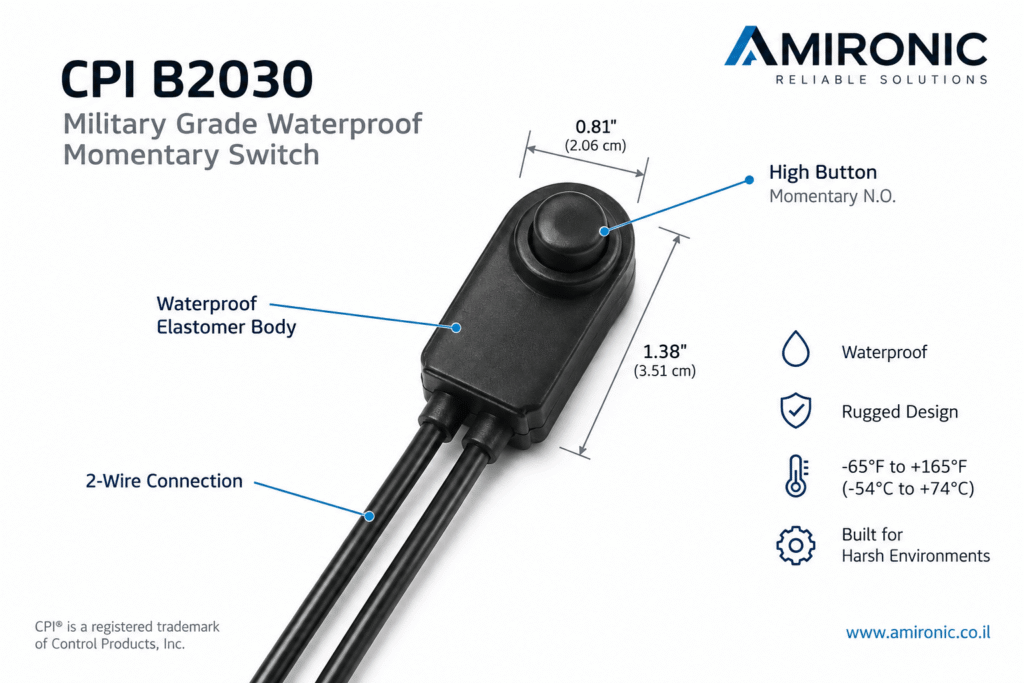
The B2030 represents a very specific combination within the B2000 family:

High Button + 2-Wire + Normally Open

In its normal state, the circuit is open. Pressing the button actuates the switch and changes the contact state.

Mechanically, CPI’s drawing shows the B2030 with a body width of approximately 0.81 in. (2.06 cm) and a body section approximately 1.38 in. (3.51 cm) long, with the High Button projecting above the switch body.
Why a High Button?

The difference between a Low Button and a High Button may seem like a minor mechanical detail, but it can have a significant impact on the user interface.

Within the B2000 Series, CPI offers the same basic contact configurations with two different button geometries. For example, the B2002 is the Low Button version with a Normally Open contact, while the B2030 is its High Button counterpart. Similarly, NC and SPDT versions are available in both configurations.

The High Button provides a more prominent actuation area above the switch body. In applications where the operator needs to physically locate and actuate the switch clearly and reliably, this can be an advantage.

However, choosing between a High Button and a Low Button is not simply a matter of convenience. Switch location, the possibility of accidental actuation, panel design, operating environment, and the way the system is used should all be considered.

Light Touch – When the Switch Is Actuated Repeatedly

The B2000 family is also available in a Light Touch configuration, which CPI describes as suitable for applications requiring repeated manual actuation and a lighter operating force.

For this configuration, CPI specifies:

  • Low Button: maximum actuation force of 1.1 lb
  • High Button: maximum actuation force of 1.8 lb
  • Low Button: minimum release force of 0.4 lb
  • High Button: minimum release force of 0.5 lb

The objective, therefore, is not only to create a sealed switch, but also to provide an actuation interface suitable for applications in which the operator may need to press the switch repeatedly.

Shock and Vibration – When the Switch Is Part of a Mobile System

In a stationary system operating inside a climate-controlled room, a switch may spend most of its service life under relatively comfortable conditions.

In a military vehicle, ground system, mobile equipment, or Heavy Duty industrial application, the situation can be very different. The switch and its connections may be continuously exposed to Vibration and, in some cases, mechanical Shock.

CPI lists Shock and Vibration testing for the series as part of the military requirements presented in its catalog.

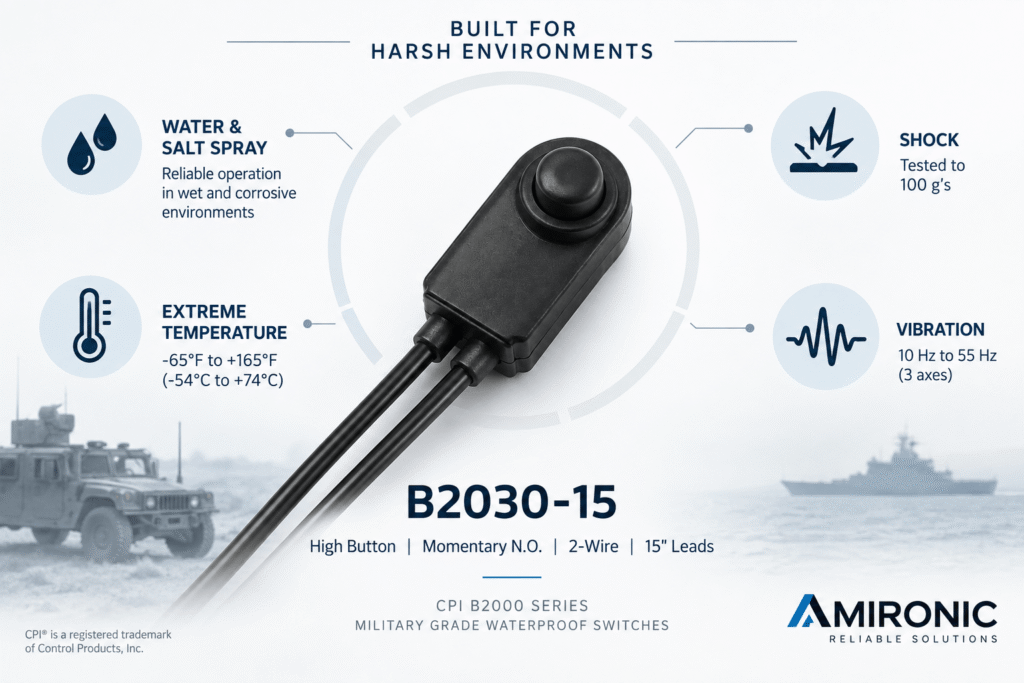
For Shock, the catalog specifies testing at 100 gravity units (“g’s”), with a 15A resistive load at 28VDC applied during the test.

For Vibration, CPI specifies a one-hour test involving three major axes over a frequency range of 10Hz to 55Hz, also with a 15A resistive load at 28VDC during the test.

From a system engineering perspective, this means that selecting a Push Button for a harsh environment should not end with an IP rating or a general Waterproof claim. The complete range of environmental conditions the component is expected to encounter throughout the system’s service life should be considered.

A Waterproof Switch Is Part of the System – Not Just a Component

Another important consideration is the electrical connection.

A switch can be extremely well sealed, but if the wire exit, Splice, connector, or Harness is not suitable for the environment, the sealing performance of the switch alone cannot ensure the environmental integrity of the complete system.

The B2000 Series is available with several connection configurations. Some versions use individual wires, while others use cable connections. CPI also lists Special Terminations, including special cables, wires, Coil Cords, and connectors.

For a rugged system, it therefore makes sense to consider the entire connection chain:

Switch → Leads → Harness → Connector → System

rather than treating the switch as an isolated component.

How to Read a CPI B2000 Part Number

This is where the B2000 Series becomes particularly interesting from an engineering perspective.

CPI uses a part-number system in which the first section identifies the switch configuration, while the number following the dash indicates the lead length in inches.

For example, CPI provides the following example in its catalog:

B2002-12

This means:

B2002 = Switch configuration
12 = 12-inch Lead Length

Dashes are used to separate the different elements of the part number.

This brings us to the specific part number at the center of our Case Study:

Case Study – CPI B2030-15

Consider a rugged system that requires a Momentary Push Button to activate a specific function.

The design requirements include a harsh operating environment, possible exposure to water and contamination, vibration, temperature variations, and the need for a relatively prominent physical button that can be clearly actuated by the operator.

One potential option within the B2000 family is:

B2030-15

One useful aspect of this part number is that much of its configuration can be understood directly from the designation.

B2030 – What Do We Get?

According to CPI’s B2000 part-number table:

B2030 = High Button + 2-Wire + Normally Open

For:

B2030-15

the -15 suffix specifies a Lead Length of 15 inches, or approximately 381 mm, according to the ordering convention defined by CPI.

The basic configuration is therefore:

Feature B2030-15
Series CPI B2000
Switch B2030
Operation Momentary
Contact Normally Open
Connection 2-Wire
Button High Button
Lead Length 15″ / approx. 381 mm
Jacket Material Neoprene – Standard
Mechanism Beryllium Copper Sine Spring
Operating Temperature -65°F to +165°F
28 VDC Resistive Rating 15A
28 VDC Inductive Rating 7.5A
28 VDC Lamp Rating 7.5A

Why Normally Open?

In its normal state, a Normally Open – N.O. contact does not complete the circuit.

The switching action occurs only when the operator presses the button.

This is a natural configuration for many applications in which the button provides a momentary command, such as a Trigger, Command, Enable, or another function that does not need to remain mechanically ON after the operator releases the switch.

However, it is important to distinguish between the contact configuration and the safety logic of the system.

The fact that the B2030 is Normally Open does not automatically make it suitable for an Emergency Stop or another Safety-Critical function. In such applications, the system architecture, Failure Modes, Redundancy requirements, and applicable standards must also be considered.

Why 15-Inch Leads?

This may be one of the least impressive-looking details in the part number, but in a real engineering project it can be highly relevant.

Lead Length determines, among other things, where the connection to the system Harness can be made.

The B2030-15 provides approximately 381 mm of leads. This length may allow the Splice or connection point to be positioned away from the switch installation area and in a more convenient or protected location within the system.

On the other hand, longer is not necessarily better.

Excess wiring may require additional Harness management, add weight, create unnecessary loops, and complicate Assembly. Lead Length should therefore be treated as part of the mechanical and electrical design rather than as an arbitrary ordering parameter.

When Could the B2030-15 Be a Suitable Candidate?

The B2030-15 becomes particularly relevant when several requirements come together in the same application.

The system requires a Momentary N.O. Switch, a High Button is preferred, the operating environment is harsh or exposed, water resistance is required, and the switch may encounter Shock, Vibration, contamination, or temperature conditions that make a conventional commercial switch less suitable.

This can make the B2030-15 relevant to military systems, ground equipment, mobile platforms, and Heavy Duty applications where a simple physical control must continue to function in conditions far removed from a laboratory environment.

Final suitability, however, should always be determined against the specific system requirements, including electrical load, load type, temperature, environmental exposure, lead length, actuation frequency, Qualification requirements, and installation method.

When Should You Choose the B2030-15, and When Should You Consider a Different Configuration?

The B2030-15 is a very specific solution: High Button, Momentary, Normally Open, 2-Wire, with 15-inch leads. The question, therefore, is not whether it is a “good switch”, but whether this particular configuration matches the system requirements.

If the system requires a momentary action in which the circuit closes only while the button is pressed, the B2030 is functionally suitable. If a Normally Closed or SPDT configuration is required, other options are available within the B2000 family, and there is no reason to force the B2030 into an application that does not match its contact logic.

The same principle applies to the button geometry. The B2030 is the High Button version. If a lower-profile button is required, the B2002 provides the same 2-Wire N.O. configuration with a Low Button.

Finally, lead length must also be considered. The -15 suffix is not part of the electrical function of the switch. It specifies a Lead Length of 15 inches. The selected length should therefore match the switch location and the intended connection point within the system.

Four Questions to Ask Before Specifying the B2030-15

Before adding the part number to the BOM, four areas should be reviewed.

Electrical: Is a Momentary Normally Open switch required? What are the operating voltage, current, and load type – Resistive, Inductive, or Lamp?

Mechanical: Is the High Button suitable for the operator interface and system design? Is there a risk of accidental actuation?

Environmental: What levels of water exposure, temperature, vibration, shock, Salt Spray, sand, dust, or chemical exposure will the switch encounter?

Integration: Is a 15-inch Lead Length appropriate, and where will the switch connect to the system Harness?

These questions are more important than the “Military Grade Waterproof Switch” label alone.

B2030-15 vs. a Standard Push Button

In a protected application, there may be no need to use a rugged switch such as the B2030-15. If the switch is installed inside a sealed enclosure, operates in a controlled environment, and is not subject to significant Shock, Vibration, or environmental exposure, a simpler commercial switch may be sufficient.

The B2030-15 becomes more relevant when the switch itself is exposed and must form part of the system’s environmental protection strategy.

CPI’s catalog goes beyond a general Waterproof claim. It lists requirements and tests covering Corrosion, Fungus, Water Proofness, Extreme Temperature, Shock, and Vibration. CPI also states that its standard Waterproof Switches can be actuated under pressure equivalent to approximately 15 feet of water.

This is the difference between selecting a Push Button based solely on its electrical function and selecting a Rugged Switch as part of the environmental design of the system.

What About Switch Life?

Switch life also depends on the electrical load conditions.

At 28VDC, CPI specifies ratings of 15A Resistive, 7.5A Inductive, and 7.5A Lamp, with 50,000 operating cycles under the specified conditions.

At 120VAC, the listed ratings are 5A Resistive, 2A Inductive, and 2A Lamp, with 100,000 cycles.

CPI also describes an Extended Life Option based on Contact Configurations developed for applications requiring greater Endurance, with more than five million Mechanical Cycles specified for these configurations. It is important to emphasize that this is an Extended Life Option and should not automatically be attributed to every standard B2030-15 configuration.

This distinction becomes particularly important in applications involving frequent actuation. The number of Mechanical Cycles alone does not tell the complete story. The electrical load being switched must also be considered.

Jacket Materials and Chemical Exposure

The standard Jacket material for the B2000 Series is Neoprene. According to CPI, Buna-N is also available for special chemical-resistance requirements, with Aviation Fuel given as one example.

There is an important engineering lesson here:

“Waterproof” does not necessarily mean “resistant to every liquid.”

Water, fuel, oils, cleaning agents, and industrial fluids can affect Elastomers differently. If the B2030-15 will be exposed to a specific chemical environment, that exposure should be defined as part of the component requirements rather than relying on a general Waterproof specification.

B2030-15 as Part of Human-Machine Interface Design

It is easy to think of the B2030-15 purely as an electrical component, but it is also part of the HMI – Human-Machine Interface.

The operator does not interact directly with the electrical circuit. The operator interacts with the button.

The choice of a High Button, actuation force, switch location, surrounding clearance, and the ability to identify the control by touch can therefore be just as relevant as its electrical rating.

In military systems, off-road vehicles, and Heavy Duty equipment in particular, a simple physical control can remain useful even when the operating environment is wet, dirty, or subject to vibration.

There is no universal solution, however. A High Button may improve accessibility in one application while increasing the risk of accidental actuation in another. The decision should be made at the system level.

Engineering Checklist – Before Specifying the B2030-15

Before adding the CPI B2030-15 to a drawing or BOM, the following points should be verified:

Parameter What to Check
Switch Function Is Momentary N.O. required?
Button Is a High Button appropriate?
Connection Is 2-Wire suitable for the architecture?
Lead Length Are 15″ leads suitable for the Harness?
Voltage What is the actual operating voltage?
Current What current must the switch carry?
Load Type Resistive, Inductive, or Lamp?
Temperature Does the range match the environment?
Water Exposure What level of water exposure is required?
Shock & Vibration What are the system requirements?
Chemical Exposure Water only, or also Fuel/Chemicals?
Mechanical Integration Where and how will the switch be integrated?
Qualification Which standards and program requirements apply?

This checklist also helps prevent a common engineering mistake: selecting a component simply because it is described as Military Grade, without verifying whether its specific characteristics meet the actual program requirements.

Conclusion – CPI B2030-15

The CPI B2030-15 is a Momentary Waterproof Switch from the B2000 family, configured as a High Button, Normally Open, 2-Wire switch with 15-inch leads.

Its engineering value goes beyond water resistance alone. The B2000 Series is designed for rugged operating environments, and CPI’s catalog specifically addresses resistance to water, extreme temperatures, Corrosion, Salt Spray, sand, dust, Shock, and Vibration. CPI also states that its standard Waterproof Switches can be actuated under pressure equivalent to approximately 15 feet of water.

For a system engineer, the advantage is the ability to implement a simple and clearly defined Physical Control where the switch itself must withstand the operating environment rather than relying entirely on a protective enclosure around it.

However, selecting the B2030-15 should always be based on the actual application requirements, including contact configuration, load type, current and voltage, operating environment, Shock and Vibration requirements, lead length, and system integration.

In other words, the right question is not simply:

“Is the B2030-15 a Waterproof Switch?”

but rather:

“Does the electrical, mechanical, and environmental configuration of the B2030-15 match the requirements of my system?”

Frequently Asked Questions – CPI B2030-15 FAQ

What is the CPI B2030-15?

The B2030-15 is a rugged Momentary Waterproof Switch from the CPI B2000 Series. It features a High Button, Normally Open contact configuration, two leads, and a Lead Length of 15 inches.

What does the -15 suffix mean in B2030-15?

The -15 suffix specifies a Lead Length of 15 inches, or approximately 381 mm. According to CPI’s ordering system, the number following the switch part number indicates the lead length in inches.

Is the B2030-15 Normally Open or Normally Closed?

The B2030 is Normally Open – N.O. In its normal state, the contact is open. Pressing the button actuates the switch.

Is the B2030-15 a Momentary Switch?

Yes. The B2030 is a Momentary Switch rather than a Maintained ON/OFF switch. Its switching action is associated with pressing the button and does not remain mechanically in the ON state after the button is released.

How many wires does the B2030-15 have?

The B2030 uses a 2-Wire configuration. The -15 suffix specifies the Lead Length and does not change the number of wires.

What is the operating temperature range of the B2030-15?

The operating temperature range listed for the Military Grade Waterproof Switch series is -65°F to +165°F, approximately -54°C to +74°C.

What is the current rating of the B2030-15 at 28VDC?

According to the general ratings listed for the series, the 28VDC ratings are 15A Resistive, 7.5A Inductive, and 7.5A Lamp. The appropriate rating must be selected according to the actual load type rather than relying solely on the 15A figure.

Can the B2030-15 be operated underwater?

CPI states that its standard Waterproof Switches can be actuated under pressure equivalent to approximately 15 feet of water, or about 4.6 meters. The requirements of the specific application and ordered configuration should be verified with the manufacturer before specifying the switch for underwater operation.

Is the B2030-15 suitable for Shock and Vibration environments?

The B2000 Series is presented by CPI as a family of Military Grade Waterproof Switches, and the catalog lists Shock and Vibration requirements and testing alongside other environmental requirements. Suitability for a specific military program should still be verified against the Qualification requirements of that system.

What is the jacket material of the B2030-15?

The standard Jacket material listed for the series is Neoprene. CPI also states that Buna-N is available for special chemical-resistance requirements, such as exposure to Aviation Fuel.

Is the B2030-15 suitable for military systems?

CPI describes the B2000 family as Military Grade Waterproof Switches and lists several military requirements and environmental tests that the series meets or exceeds. This should not be interpreted as automatic Qualification of the B2030-15 for every military system or standard. The specific program requirements, Qualification requirements, and ordered configuration should always be verified.

What is the difference between the B2030-15 and B2002?

Both use a 2-Wire Normally Open configuration. The B2030 uses a High Button, while the B2002 uses a Low Button. In the B2030-15, the -15 suffix additionally specifies a 15-inch Lead Length.

Tags: Variohm

Related Articles

How to Select Sensors for Harsh Environments: An Engineering Guide for Reliable Measurement in the Real World

18/02/2026amironicLTD

Tailor-Made Solutions for Accurate and Reliable Temperature Sensing

24/06/2025amironicLTD

When Space is Tight – Euro‑MXPK Fits Right In

30/07/2025amironicLTD

Recent Posts

  • Waterproof Switches for Military and Industrial Systems – CPI B2000 Series Overview and B2030-15 Case Study
  • When the Mission Goes High-Dynamic: What Happens to a Tactical IMU Under Extreme Motion?
  • Hands on the Patient, Foot on the System – Why Footswitches Are Still Essential in Medical Imaging
  • As AI Racks Demand More Power – What Happens to Circuit Breaker Protection?
  • Military Temperature Sensors – How to Choose the Right Temperature Sensor for Harsh Environments?

Categories

  • Air Switch
  • Circuit Breakers
  • Elapsed Time Indicator
  • Feedthrough
  • Footswitches
  • Gears & Transmission
  • Hour Meters
  • Infra Red Switches
  • INFRARED LAMPS
  • Low Noise Inertial MEMS
  • Mechanics
  • MEMS Gyroscope
  • MEMS Inertial
  • Microelectronics
  • Motors
  • Position Sensors
  • Power Supply
  • Pressure Sensors
  • Pressure Switch
  • Switches
  • Temperature Sensors
  • Tungsten and Molybdenum
  • Uncategorized
  • Vacuum Switches

Quick Contact

Fill out the form and our representatives will return to you

    Name (required)

    Email (required)

    Phone

    Message

    This site is protected by reCAPTCHA and the Google
    Privacy Policy and
    Terms of Service apply.

    Amironic Ltd.

    3 Rabinovich Street, Petah Tikva 4928144 , Israel. Tel: +972-3-9047744 E-mail: office@amironic.co.il
    Email
    Facebook
    Twitter
    LinkedIn
    YouTube
    Press on the ISO Certificate below for download
    ISO 9001:2015 Certification
    • MEMS Inertial
    • Circuit Breakers
    • Footswitches
    • Mechanical & Transmisions
    • Sensors
    • Motors
    • Electronics
    • Hand Control
    • Power Solutions

    News

    • Waterproof Switches for Military and Industrial Systems – CPI B2000 Series Overview and B2030-15 Case Study
    • When the Mission Goes High-Dynamic: What Happens to a Tactical IMU Under Extreme Motion?
    • Hands on the Patient, Foot on the System – Why Footswitches Are Still Essential in Medical Imaging
    • As AI Racks Demand More Power – What Happens to Circuit Breaker Protection?
    • Military Temperature Sensors – How to Choose the Right Temperature Sensor for Harsh Environments?
    About AmironicContactעברית
    © 2022 Amironic All rights reserved. All Trademarks are the property of their respective owners.
    • Increase Font
    • Decrease Font
    • Black & White
    • Inverse Colors
    • Highlight Links
    • Regular Font
    • Reset