flagעברית
flagEnglish
3 Rabinovich St., Petah-Tikva, Israel
+972 3 9047744
office@amironic.co.il
Facebook
Twitter
LinkedIn
YouTube
  • Products
    • MEMS Inertial
      • MEMS Gyroscopes
      • Inertial Measurement Units
      • MEMS Accelerometers
      • Inertial Navigation
      • AHRS
    • Circuit Breakers
      • Airpax Circuit Breakers
      • Electronic Circuit Breakers
      • Aircraft Circuit Breakers
      • Thermal Circuit Breakers
      • Sealing Solutions & Guards
    • Footswitches
      • Pedals & Bellows
      • USB
      • Air Switches
      • Medical
      • Modular Bases System
      • Industrial
      • Foot Potentiometers
      • Wireless
    • Mechanical & Transmissions
      • Gears
      • Sealing Solutions
      • Gearboxes
      • Couplings
      • Shafts & Bearings
      • Fasteners
      • Mechanical & Springs
      • Linear Motion
      • Anti-Vibration
    • Sensors
      • Thermostats
      • Temperature
      • Position
      • Pressure
      • Speed
      • Level Sensor
      • Load Cells
      • Flex Sensors
      • Membrane Potentiometer
    • Motors
      • Geared DC
      • Brushless DC
      • Step Motors with Gearbox
      • Torque Motors & Brushless Servo
      • DC Motors
    • Electronics
      • Xenon & IR Lamps
      • Counters & Meters
      • Microelectronics Packaging
      • Waterproof Switches
      • Micro Switches
    • Hand Control
      • Operator Controls (JOYSTICK)
      • Electrical
      • Pneumatic (Medical)
      • USB Hand Control
      • Air Push Button
      • Pressure Switch
      • IR Switch
    • Power Solutions
      • Rugged & Military Power Supply
      • Input Power Protection
      • Sealed Military Power Adaptor
      • Triple Output Military Power Supply Series – up to 250 W
    • Materials
      • Molybdenum and Advanced Alloys (TZM, MOLA, HCT)
      • Tungsten (Wolfram) and Advanced Alloys – High-Performance Materials for Extreme Conditions
      • Materials for Gears
  • Shop
  • Companies
  • About Amironic
  • News
  • Contact
Product was added to your cart

Cart

waze

Custom Pressure Sensors – When Standard Sensors Don’t Fit Your Application

Pressure Sensors17/11/2026amironicLTD
When developing machinery, industrial systems, and electronic equipment, selecting a pressure sensor may seem straightforward: define the pressure range, choose the output signal, check the dimensions, and proceed with the design.

But what happens when the sensor meets the electrical requirements but lacks the necessary ingress protection? What if the required measurement range is unavailable in the standard configuration? What if the electrical connector does not match the machine’s wiring harness, or the operating environment requires a different mechanical design?

In these situations, replacing one standard pressure sensor with another may not solve the problem.

A custom pressure sensor allows engineers to explore mechanical, electrical, and environmental configurations tailored to the system’s requirements, rather than compromising on a component that does not fully meet the application’s needs.

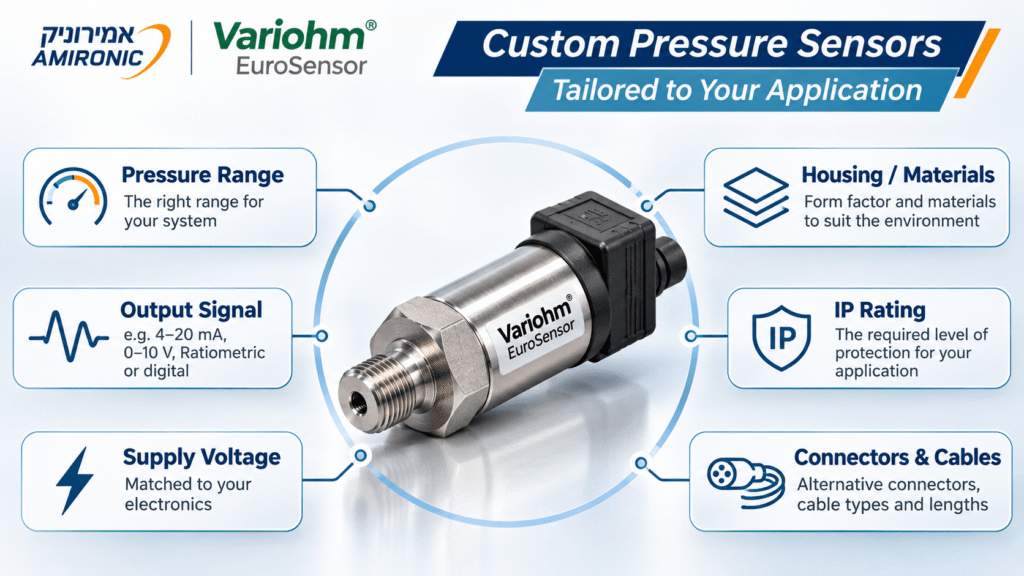
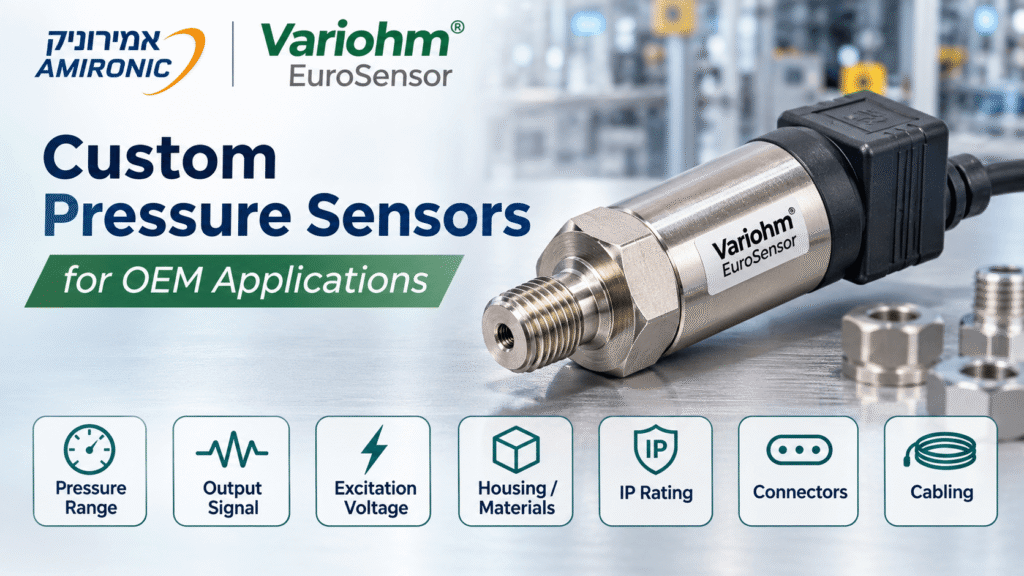
Variohm EuroSensor, represented in Israel by Amironic Ltd., offers a wide range of industrial pressure sensors and customization options for OEM applications, including pressure ranges, output signals, supply voltages, sensor housings, pressure connections, ingress protection ratings, electrical connectors, and cables.

Why Isn’t a Standard Pressure Sensor Always Enough?

Pressure sensor manufacturers typically offer product families with multiple measurement ranges, mechanical connections, and electrical configurations. For many applications, a standard pressure sensor provides a suitable, efficient, and cost-effective solution.

However, OEM applications, where sensors are integrated into products manufactured over an extended period, may involve more complex requirements.

For example:

  • A hydraulic machine operating in a wet environment requires a higher ingress protection rating.
  • A control system requires an output signal compatible with its existing electronics.
  • Industrial equipment has limited installation space and requires a different pressure connection or mechanical housing.
  • An automotive or motorsport application requires a specific electrical connector and cable length.
  • Thermal processing equipment requires a pressure measurement range outside the standard catalog options.

In each case, the problem is not necessarily the quality of the sensor. It may simply be a mismatch between the available product configuration and the system’s actual requirements.

This distinction is particularly important for equipment manufacturers: a high-quality pressure sensor is not necessarily the most suitable pressure sensor for every application.

Which Pressure Sensor Features Can Be Customized?

Customization options vary between product families and depend on engineering feasibility and project requirements. Variohm EuroSensor identifies several areas where customization can be evaluated for OEM customers.

1. Custom Pressure Range

The measurement range is one of the first parameters considered when selecting a pressure sensor.

However, choosing the correct range involves more than matching the sensor to the system’s nominal operating pressure.

Engineers must also consider peak pressures, pressure fluctuations, accuracy requirements, and the actual operating range.

For example, a system operating at a relatively low nominal pressure but experiencing occasional high-pressure events requires separate evaluation of the measurement range and the sensor’s overpressure capability.

Selecting an unnecessarily wide measurement range may reduce the effective measurement resolution of the system, depending on the sensor characteristics and associated electronics. Conversely, selecting a range that is too narrow may leave the sensor unsuitable for pressures encountered during operation.

Customizing the pressure range may allow engineers to evaluate a configuration that more closely matches the system’s actual operating conditions, subject to the limitations of the selected sensor family.

2. Custom Output Signal

Pressure sensors are integrated into a wide variety of control systems, from electronic circuit boards to industrial controllers.

Depending on the model, available output signals may include:

  • 4–20mA – A current output commonly used in industrial control systems.
  • 0–10V or other voltage ranges – Suitable for systems with compatible voltage inputs.
  • Ratiometric Output – An output signal that varies in proportion to the supply voltage, according to the sensor’s design.
  • Digital Outputs – Available in product families supporting digital interfaces.

When developing a new machine, engineers may have the flexibility to select a control interface that matches the sensor.

However, when integrating a pressure sensor into an existing product, modifying the electronic circuit or controller may be costly and complex.

In such cases, adapting the sensor’s output signal to the existing interface may help minimize changes to the overall system design.

Not every output signal is available for every sensor model, so the available configurations must be verified against the manufacturer’s specifications.

3. Custom Supply Voltage – Excitation / Supply Voltage

The pressure sensor’s supply voltage must be compatible with the electrical architecture of the system.

Some systems provide a dedicated power supply for sensors, while compact electronic systems may require the sensor to operate directly from the voltage available on the circuit board.

Proper integration requires evaluating the operating voltage range, current consumption, output signal type, and the relationship between supply voltage and measurement performance.

For OEM applications, selecting a suitable supply voltage configuration may simplify sensor integration and reduce the need for additional interface or power conditioning circuitry.

4. Custom Housing and Pressure Connections

A pressure sensor must fit physically into the machine, pipework, manifold, or vessel where the measurement takes place.

Therefore, beyond pressure range and electrical specifications, the mechanical configuration must also be considered.

Potential requirements include:

  • Pressure port thread type and dimensions.
  • Housing materials and materials in contact with the measured liquid or gas.
  • Sensor dimensions and available installation space.
  • Electrical connector orientation relative to the pressure connection.
  • Compatibility with installation conditions and expected mechanical stresses.

In systems where the mechanical interface is already defined, even a small modification to the sensor configuration may eliminate the need to redesign other machine components.

However, any alternative pressure connection must also be evaluated for sealing performance, material compatibility, and resistance to the system’s operating pressure.
5. Custom Ingress Protection – IP Rating

One of the most common challenges when integrating pressure sensors into industrial machinery and equipment is ensuring compatibility with the operating environment.

A pressure sensor may perform perfectly under laboratory conditions but encounter water, moisture, dust, oils, cleaning agents, or high-pressure washdown in the field.

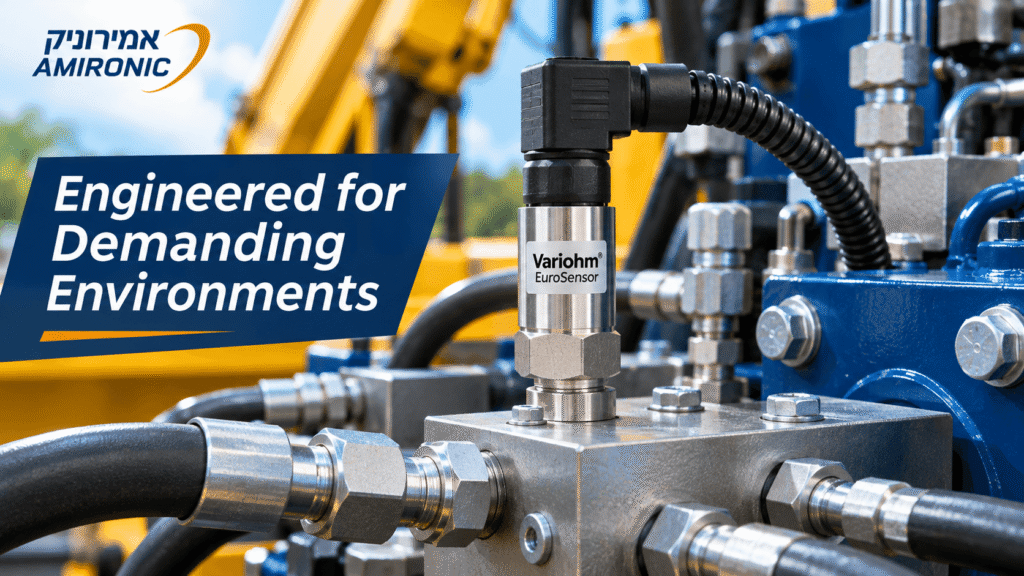
In hydraulic systems, mobile machinery, and outdoor industrial equipment, the sensor’s ingress protection rating can be an important factor in long-term reliability.

IP Rating (Ingress Protection) describes the level of protection provided by an equipment enclosure against the ingress of solid objects and water, according to the test conditions defined in IEC 60529.

For example:

  • IP65 – Dust-tight and protected against water jets under specified test conditions.
  • IP67 – Dust-tight and protected against temporary immersion in water under specified conditions.
  • IP68 – Dust-tight and protected against immersion in water under conditions specified by the manufacturer.

It is important to understand that a high IP rating does not automatically guarantee resistance to chemicals, oils, high-pressure washdown, or every possible environmental condition.

Engineers must also verify whether the stated protection rating applies to the sensor itself, the electrical connector, or the complete assembly with the connector properly installed.

As part of its pressure sensor customization capabilities, Variohm EuroSensor offers opportunities to evaluate different ingress protection requirements, depending on the sensor family and application.

For example, the manufacturer describes a hydraulic application where a higher IP rating was required.

For equipment manufacturers, evaluating ingress protection requirements early in the design process may reduce the need for additional protective measures and improve the sensor’s suitability for its intended operating environment.

6. Custom Electrical Connectors and Cabling

An electrical connection is much more than a secondary technical specification.

In OEM machinery and industrial equipment, connector type, cable length, cable exit orientation, and installation requirements can influence system design, assembly, and maintenance.

A pressure sensor with excellent electrical and measurement specifications may still be unsuitable if its connector is incompatible with the machine’s existing wiring harness.

Potential customization requirements include:

  • Electrical connector type and compatibility with the existing wiring harness.
  • Cable length and cable exit configuration.
  • Cable material and suitability for environmental conditions.
  • Ingress protection requirements at the electrical connection.
  • Installation space and mechanical constraints within the machine.

In applications involving vibration, repeated movement, or harsh environmental conditions, proper cable securing, strain relief, and connector selection are also important.

Variohm EuroSensor describes connector and cable adaptations developed for motorsport applications, where installation and environmental conditions can create specific integration challenges.

For manufacturers producing equipment in volume, a suitable electrical connection may also simplify assembly and reduce the need for adapters or modifications to existing wiring harnesses.

The objective is not simply to connect the sensor to the system, but to ensure proper mechanical and electrical integration from the earliest stages of development.

7. Three Applications Where Pressure Sensor Customization Can Make a Difference

Industrial Hydraulics – When Ingress Protection Is Part of the Design

In industrial hydraulic systems, pressure sensors are used to monitor and control fluid pressure.

Sensors may be installed near pumps, valves, hydraulic manifolds, or other components exposed to varying operating conditions.

Beyond pressure range, engineers must consider pressure fluctuations, vibration, material compatibility, and environmental conditions.

When the ingress protection rating of a standard pressure sensor is insufficient, a customized configuration with suitable environmental protection may be worth evaluating.

Such adaptations can be particularly relevant to mobile equipment, industrial machinery, and systems operating in wet environments.

Motorsport Applications – When the Electrical Connection Must Fit the System

In automotive and motorsport applications, pressure sensors may be integrated into measurement and control systems operating under dynamic conditions.

Limited installation space, vibration, temperature variations, and dedicated wiring harnesses can all influence sensor selection.

In these situations, adapting the electrical connector or cable configuration may be just as important as selecting the correct pressure measurement range.

Variohm EuroSensor describes connector and cable customizations for motorsport applications, demonstrating how integration requirements can be addressed as part of the pressure sensor selection process.

Thermal Processing Equipment – When Standard Pressure Ranges Are Not Suitable

In thermal processing equipment and industrial process systems, pressure measurement requirements may vary depending on the system design and operating conditions.

In some applications, the required measurement range may not be available among the standard configurations of a particular sensor family.

Variohm EuroSensor identifies pressure range customization for thermal processing equipment as one example of its application-specific capabilities.

In these applications, engineers must evaluate not only the pressure measurement range but also process temperature, ambient temperature, material compatibility, and installation requirements.

It is important to emphasize that customizing the pressure range does not automatically make a sensor suitable for high-temperature operation. The temperature limitations of the specific sensor model must always be verified.

8. Custom Pressure Sensors for OEM Manufacturers – What Should You Consider?

When developing a new machine or industrial system, selecting the right pressure sensor affects more than measurement performance. It can also influence product design, manufacturing, assembly, and maintenance.

In OEM (Original Equipment Manufacturer) applications, where the same component may be integrated into dozens, hundreds, or thousands of products throughout their production lifecycle, defining the correct requirements early in development is particularly important.

Customizing a pressure sensor does not necessarily mean developing an entirely new sensor from scratch.

In some cases, an existing sensor family can serve as the basis for modifying one or more characteristics, depending on the manufacturer’s capabilities.

For example, a machine manufacturer may identify a sensor with the correct pressure range and accuracy but require a different electrical connector. Another manufacturer may find a sensor with suitable dimensions and pressure connections but need a higher ingress protection rating.

The objective is to identify which requirements can already be met by a standard product and which may require a customized configuration.

Engineering Requirements Checklist for Custom Pressure Sensors

Before requesting a customized pressure sensor, it is helpful to define the following specifications:

Parameter What Should Be Specified?
Pressure Range Operating pressure, peak pressure, and expected overpressure
Pressure Reference Gauge, absolute, or differential pressure
Output Signal Current, voltage, ratiometric, or digital interface, as required
Supply Voltage Available operating voltage
Accuracy Required accuracy and relevant temperature conditions
Pressure Connection Thread type, mechanical interface, and sealing requirements
Housing Materials, dimensions, and installation constraints
IP Rating Required protection against dust and water
Electrical Connector Connector type, pin configuration, and wiring requirements
Cable Cable length, type, and environmental requirements
Media Compatibility Type of liquid or gas and compatibility with wetted materials
Temperature Ambient temperature and media temperature
Annual Quantity Initial quantity, annual consumption, and production forecast

The more clearly these requirements are defined, the easier it becomes to evaluate available sensor configurations and the feasibility of customization.

For volume-production projects, it is also useful to specify the development stage, expected production schedule, and estimated annual demand.

9. Custom Pressure Sensor vs. Standard Pressure Sensor – Which Is Better?

Not every application requires a customized pressure sensor.

When a standard sensor meets the electrical, mechanical, and environmental requirements, it may offer the simplest and most economical solution.

However, when the machine must be modified to accommodate an existing sensor, it may be worth considering the opposite approach: adapting the sensor to the machine.

Consideration Standard Pressure Sensor Custom Pressure Sensor
Availability Depends on model and stock Depends on configuration approval and production
Pressure Ranges Standard catalog options Additional ranges may be evaluated
Mechanical Connections Existing configurations Alternative connections may be evaluated
Output Signals According to the selected model Application-specific options may be evaluated
Connectors and Cables Standard configurations Customized configurations may be considered
IP Requirements According to product specifications Alternative protection requirements may be evaluated
Development Costs Generally no application-specific development Customization and validation costs may apply
Minimum Order Quantity According to manufacturer terms Special minimum quantities may apply

The availability of customized configurations, development costs, minimum order quantities, and lead times depends on the specific product and project. These conditions must be confirmed with the manufacturer.

Are Custom Pressure Sensors Always More Expensive?

Not necessarily.

A customized pressure sensor may have a higher unit price, particularly when special modifications, additional testing, or small production quantities are involved.

However, the overall system cost should also account for mechanical adapters, wiring modifications, assembly procedures, and maintenance requirements.

In some applications, a customized solution may reduce the total cost of integrating the sensor into the finished product.

For OEM manufacturers, the correct comparison is therefore not limited to the sensor’s purchase price but should also consider the Total Integration Cost.

10. Variohm EuroSensor – Industrial Pressure Measurement Solutions

Variohm EuroSensor offers a broad range of pressure measurement and pressure control solutions, including industrial pressure transducers, PCB-mounted pressure sensors, differential pressure sensors, submersible pressure sensors, and pressure switches.

Its product portfolio includes solutions for continuous pressure measurement, pressure switching, and applications involving specific mechanical, electrical, or environmental constraints.

For OEM manufacturers, one important advantage is the opportunity to evaluate adaptations of existing pressure sensor designs to meet application-specific requirements.

Potential customization areas include:

  • Pressure measurement ranges.
  • Output signal configurations.
  • Supply voltage requirements.
  • Sensor housing and mechanical design.
  • Pressure port connections.
  • Ingress protection requirements.
  • Electrical connectors.
  • Cable assemblies and wiring configurations.

Not every customization option is available for every product family. All special configurations are subject to technical evaluation and manufacturer approval.

For additional information, explore the Pressure Sensors & Pressure Switches product range from Variohm EuroSensor.

11. Custom Pressure Sensors in Israel – Amironic

Amironic Ltd., the Israeli representative of Variohm EuroSensor, supports equipment manufacturers, design engineers, system integrators, and purchasing professionals in identifying pressure sensing solutions that meet their application requirements.

When a standard pressure sensor cannot fully satisfy the system’s specifications, Amironic can help evaluate potential customization options with the manufacturer.

An inquiry may be based on an existing technical specification, mechanical drawing, electrical requirements, or the part number of a pressure sensor currently installed in the equipment.

Whether the application involves a hydraulic system, industrial machinery, automotive equipment, or a new OEM product, the objective is to identify a technically feasible solution that also meets the project’s commercial requirements.

Developing a New Product or Looking for an Alternative Pressure Sensor?

If your existing pressure sensor does not fully meet your requirements, send Amironic the relevant application details.

Useful information includes pressure range, output signal, supply voltage, mechanical connection, environmental conditions, and estimated quantities.

Already using a pressure sensor from another manufacturer? Send us the existing part number or datasheet, and we can evaluate whether a suitable standard or customized alternative is available from Variohm EuroSensor.

Our team will be pleased to review the requirements with the manufacturer and explore the available options.

Amironic Ltd. – Industrial Sensing, Measurement and Control Solutions in Israel

Website: https://www.amironic.co.il

Email: office@amironic.co.il

Phone: +972-3-9047744

12. Frequently Asked Questions – Custom Pressure Sensors

What Is a Custom Pressure Sensor?

A custom pressure sensor is a sensor whose configuration is evaluated or adapted to meet specific application requirements.

Customization may involve pressure range, output signal, supply voltage, mechanical housing, pressure connection, ingress protection, electrical connectors, or cables.

Developing an entirely new sensor is not always necessary. In some cases, an existing sensor family can be adapted to meet the application’s needs.

Can I Order a Pressure Sensor With a Non-Standard Measurement Range?

Some pressure sensor families allow engineers to evaluate alternative measurement ranges.

Availability depends on the sensing technology, design limitations, and manufacturer approval.

Can the Electrical Connector or Cable Length Be Customized?

Variohm EuroSensor offers connector and cable customization possibilities for certain product families.

The required connector type, wiring configuration, environmental conditions, and production quantity must be evaluated.

Can I Request a Pressure Sensor With a Higher IP Rating?

In some applications, alternative ingress protection requirements can be evaluated.

The selected configuration must meet the environmental requirements, and the IP rating must be verified for the actual sensor and electrical connection assembly.

Are Custom Pressure Sensors Available in Small Quantities?

This depends on the type of customization, product family, and manufacturer requirements.

Certain modifications may involve minimum order quantities, development costs, or extended lead times.

Can a Pressure Sensor Be Customized for an Existing Electronic System?

In some cases, output signals, supply voltage, or electrical connections can be adapted to facilitate integration into an existing system.

The available options must be evaluated against the interface requirements and the selected sensor family’s capabilities.

What Is the Difference Between a Custom Pressure Sensor and an OEM Pressure Sensor?

An OEM pressure sensor is a sensor intended for integration into equipment manufactured by an Original Equipment Manufacturer.

A custom pressure sensor refers to a sensor whose configuration is adapted or evaluated for specific application requirements.

An OEM pressure sensor may be a completely standard product or a customized version.

What Information Is Required to Request a Custom Pressure Sensor Quotation?

It is recommended to provide the pressure range, pressure reference type, output signal, supply voltage, mechanical connection, environmental conditions, IP requirements, electrical connector, required quantity, and estimated annual production volume.

An existing part number, technical datasheet, or mechanical drawing can also help accelerate the evaluation process.

13. Technical Glossary

Term Definition
Pressure Sensor A device that produces a signal related to the measured pressure
Pressure Transducer A device that converts pressure into a measurement signal, typically electrical
Custom Pressure Sensor A pressure sensor configured to meet specific application requirements
OEM Original Equipment Manufacturer – a company that integrates components into its own products
Pressure Range The specified range of pressures over which measurement is performed
Gauge Pressure Pressure measured relative to atmospheric pressure
Absolute Pressure Pressure measured relative to a perfect vacuum
Differential Pressure The pressure difference between two measurement points
Output Signal The electrical or digital signal provided by the sensor
Excitation Voltage The supply or excitation voltage required to operate the sensor
IP Rating A classification describing protection against the ingress of solid objects and water
Pressure Connection The mechanical interface connecting the sensor to the pressure system
Overpressure Pressure exceeding the specified measurement range
Media Compatibility Compatibility between the measured liquid or gas and the sensor’s wetted materials
Strain Relief A method or component used to reduce mechanical stress on cables and connections
Total Integration Cost The overall cost of incorporating a component into a complete system

14. Conclusion – When the Sensor Should Fit the System, Not the Other Way Around

Selecting a pressure sensor involves more than choosing the correct measurement range and output signal.

In industrial systems and OEM applications, the sensor housing, pressure connection, ingress protection, electrical connector, and cable configuration can all influence successful integration.

When a standard pressure sensor does not meet every requirement, customization may provide an engineering alternative worth exploring.

Variohm EuroSensor and Amironic offer equipment manufacturers in Israel the opportunity to evaluate pressure sensing solutions based on their specific application requirements – from standard products to customized configurations.

Because in well-engineered OEM systems, the question is not simply which pressure sensor is available in the catalog.

The real question is which pressure sensing solution is the right fit for your product.

The Proposed Solution: Variohm EuroSensor EPT9100 Pressure Transducer

When designing a hydraulic system for mobile machinery, selecting a sensor capable of measuring the operating pressure is only the beginning. The sensor must also integrate with the control system, match the mechanical and electrical connections, and withstand the environmental conditions in which the equipment operates.

The Variohm EuroSensor EPT9100 series is designed to measure pressure in gases and liquids compatible with stainless steel. Its intended applications include industrial hydraulic systems, agricultural machinery, construction equipment, automotive systems, and off-road vehicles.

The sensor combines piezoresistive sensing technology with ASIC signal conditioning electronics in a robust stainless steel housing. The series features EMI/RFI protection, resistance to vibration and mechanical shock, and multiple output signal, pressure connection, and electrical connector options.

Case Study – Integrating a Pressure Sensor into a Mobile Hydraulic System

Consider an illustrative engineering scenario involving an Israeli equipment manufacturer developing a hydraulic machine intended to operate in demanding field conditions.

The system is designed to operate at a nominal pressure of 180 bar and requires continuous pressure measurement for its control system. The selected sensor must also accommodate vibration, mechanical shock, environmental exposure, and the machine’s existing wiring harness.

How can the EPT9100 be evaluated against these requirements?

Engineering Challenge Potential EPT9100 Solution
Nominal operating pressure of 180 bar Evaluate a 0–250 bar configuration, subject to verification of peak pressures and accuracy requirements
Vibration and mechanical shock during operation Evaluate the specified vibration resistance of 25G peak and shock resistance of 1,000G
Integration with an existing control system Select an appropriate output, such as 4–20mA or 0.5–4.5V ratiometric, depending on the controller interface
Exposure to dust, moisture, and water Evaluate configurations rated up to IP67 or the optional IP69K protection
Connection to hydraulic pipework or a manifold Select a suitable pressure connection, such as G1/4 or 1/4 NPT
Compatibility with the machine’s wiring harness Evaluate connector options such as M12x1, AMP Superseal, or Packard Metripac
Requirement for fast pressure measurement Response time of less than 1ms, according to the manufacturer’s specifications

This table illustrates engineering options for evaluation, not a sensor configuration approved for a particular machine. Final selection requires verification against all application requirements.

Key Technical Specifications – EPT9100

Parameter Manufacturer’s Specification
Pressure ranges 1–1,000 bar, depending on configuration
Room-temperature accuracy Better than ±0.5%
Repeatability Up to 0.10% FS
Response time Less than 1ms
One-year stability Better than ±0.1%
Shock resistance 1,000G, 11ms half-sine
Vibration resistance 25G peak, 20–2,000Hz
Media temperature −40°C to +125°C; up to +150°C for the ratiometric version
Ingress protection Up to IP67, with an IP69K option
Housing and wetted materials 316 stainless steel
Pressure cycles More than 10 million, according to the manufacturer

These specifications refer to the EPT9100 product series. Their applicability to the selected configuration and actual operating conditions must be verified.

How Do You Select the Right EPT9100 Configuration for a Hydraulic System?

1. Selecting the Pressure Range – Beyond Nominal Operating Pressure

In our illustrative scenario, the hydraulic system operates at a nominal pressure of 180 bar.

An EPT9100 with a 0–250 bar measurement range may be a suitable option to evaluate, as this range is included among the series’ catalog configurations.

However, nominal operating pressure alone is not sufficient to determine the correct sensor range.

Hydraulic systems may experience transient pressure peaks, fluctuations, and overpressure events. These conditions must be considered alongside the required measurement accuracy.

According to the manufacturer’s specifications, the series offers overpressure capability of up to twice the rated pressure and burst pressure capability of up to five times the rated pressure, depending on configuration.

These ratings do not permit continuous operation beyond the specified measurement range and do not replace appropriate overpressure protection measures.

2. Matching the Output Signal to the Existing Controller

One of the key considerations when selecting a pressure transducer for OEM equipment is compatibility with the control system already designed into the machine.

The EPT9100 series offers several output configurations:

Output Signal Supply Voltage
4–20mA 10–32VDC
0–10V 12–32VDC
0–5V, non-ratiometric 8–32VDC
0.5–4.5V, ratiometric 5VDC

If the machine uses an industrial controller with a 4–20mA input, the current-output version may be appropriate.

Alternatively, if the control electronics are designed for a 5VDC-powered ratiometric sensor, the 0.5–4.5V configuration may be considered.

Selecting the appropriate output configuration can simplify integration and reduce the need for additional signal conditioning circuitry.

3. Selecting Mechanical Connections and Electrical Connectors

In mobile machinery, limited installation space and existing wiring harnesses can influence sensor selection just as much as measurement performance.

The EPT9100 series offers pressure connection options such as G1/4 and 1/4 NPT, alongside several electrical connection options:

  • M12x1
  • AMP Superseal
  • Packard Metripac
  • DIN EN 175301-803
  • Cable outlet

These options allow engineers to evaluate configurations that fit the existing hydraulic and electrical interfaces, potentially avoiding unnecessary modifications to pipework, manifolds, or wiring harnesses.

The availability of the required combination and its corresponding ordering code must be confirmed with the manufacturer.

4. Resistance to Vibration, Shock, and Environmental Conditions

Mobile machinery and hydraulic equipment operating in the field may be exposed to continuous vibration, mechanical shock, dust, moisture, and temperature variations.

Selecting a suitable pressure sensor therefore requires evaluating its ability to withstand the expected operating conditions.

According to the manufacturer’s specifications, the EPT9100 offers shock resistance of 1,000G and vibration resistance of 25G peak within the specified frequency range.

Configurations with ingress protection up to IP67 and an optional IP69K rating may also be evaluated.

However, an IP rating alone does not guarantee resistance to every oil, chemical, or washdown condition. Engineers must verify the installation environment, material compatibility, and ingress protection rating of the complete connected assembly.

The Engineering Outcome: Integrating Pressure Measurement into the Complete Machine

In this illustrative scenario, selecting an appropriate EPT9100 configuration may allow continuous pressure measurement to be integrated with the machine’s control, connection, and operating requirements.

The engineering value does not come from a single specification. It comes from selecting a combination of characteristics that work together:

  • A measurement range appropriate for the system.
  • An output signal compatible with the controller.
  • A mechanical connection that matches the hydraulic manifold or pipework.
  • An electrical connector compatible with the existing wiring harness.
  • Mechanical and environmental resistance suitable for the installation conditions.

A properly selected configuration may reduce the need for external adapters, simplify assembly, and minimize changes to the machine’s design.

However, claims regarding improved reliability, reduced failures, or extended equipment life require validation through application testing or field data.

The engineering conclusion: Selecting a pressure transducer for mobile hydraulic equipment should be based on compatibility with the complete system, not simply the pressure range or accuracy specification.

Hydraulic Pressure Sensors in Israel – Variohm EuroSensor Through Amironic

Amironic Ltd., the Israeli representative of Variohm EuroSensor, supports machinery manufacturers, design engineers, system integrators, and purchasing professionals in selecting pressure sensors for hydraulic systems and industrial equipment.

The EPT9100 series is intended for applications including industrial hydraulics, agricultural machinery, construction equipment, and off-road systems.

Looking for an Alternative to Your Existing Pressure Sensor?

Replacing an existing pressure sensor does not always require redesigning the entire system.

If you currently use a pressure sensor from another manufacturer, send Amironic the existing part number, datasheet, or engineering specifications. We can evaluate whether a suitable alternative is available from the Variohm EuroSensor product range.

The evaluation may include:

  • Pressure range and overpressure requirements.
  • Output signal and supply voltage.
  • Pressure port and mechanical dimensions.
  • Electrical connector and wiring configuration.
  • Environmental conditions and ingress protection.

Designing a new machine or searching for an alternative hydraulic pressure transducer?

Send us your application requirements or the part number of your existing sensor. We will be pleased to evaluate a technically and commercially suitable solution.

Amironic Ltd. – Industrial Pressure Sensors and Measurement Solutions in Israel

Website: https://www.amironic.co.il

Email: office@amironic.co.il

Phone: +972-3-9047744

Frequently Asked Questions – EPT9100 Pressure Transducer

Is the EPT9100 Suitable for Hydraulic Systems?

Yes. The manufacturer identifies industrial hydraulics, construction equipment, agricultural machinery, and off-road applications among the intended uses of the EPT9100 series.

Final suitability must be verified against the specific system requirements.

What Is the Maximum Pressure Range of the EPT9100?

The series includes measurement ranges up to 1,000 bar, depending on the selected configuration.

Is the EPT9100 Available With a 4–20mA Output?

Yes. A 4–20mA current output is one of the available configurations, alongside several voltage output options.

Can the EPT9100 Be Used in Wet Environments?

Configurations with ingress protection up to IP67 and an optional IP69K rating may be evaluated.

The protection rating of the selected configuration and its suitability for the actual operating environment must be verified.

Can I Select a Different Electrical Connector?

Yes. The series offers several electrical connection options, including M12x1, AMP Superseal, and Packard Metripac.

Availability of the required configuration is subject to manufacturer confirmation.

Can the EPT9100 Replace a Pressure Sensor From Another Manufacturer?

In some applications, the EPT9100 may be evaluated as an alternative, depending on the pressure range, output signal, supply voltage, connections, dimensions, and operating conditions.

Direct interchangeability should never be assumed without an engineering compatibility assessment.

Can the EPT9100 Be Used in a Safety-Related System?

The EPT9100 should not be considered a functionally safety-certified sensor without appropriate supporting documentation.

Where SIL or PL requirements apply, a solution meeting the relevant functional safety requirements must be evaluated.

Technical Glossary

Term Definition
Pressure Transducer A device that converts pressure into an electrical measurement signal
Industrial Hydraulics Hydraulic systems used in industrial machinery and equipment
Mobile Machinery Machinery and equipment designed to operate in mobile or field applications
Piezoresistive A sensing technology based on changes in electrical resistance caused by mechanical stress
ASIC Application-Specific Integrated Circuit used for dedicated signal processing
EMI/RFI Electromagnetic interference and radio-frequency interference
Full Scale – FS The full measurement span used as a reference for sensor performance specifications
Overpressure Pressure exceeding the sensor’s specified measurement range
IP Rating A classification describing protection against the ingress of solid objects and water
Ratiometric Output An output signal that varies proportionally with the supply voltage
Pressure Port The mechanical pressure connection of the sensor
Sensor Replacement Evaluation of an alternative sensor for an existing installation

Note: This Application Case Study is based on an illustrative engineering scenario and manufacturer specifications. It does not describe a completed customer installation or verified field performance. All technical data is subject to confirmation against the latest manufacturer datasheet and the selected sensor configuration.

Tags: Variohm

Related Articles

VARIOHM Position Sensors – Engineering Position as a System, Not Just a Signal

26/02/2026amironicLTD

Contactless Rotary Position Sensors – Why More and More Systems Are Moving to Non-Contact Sensing

24/05/2026amironicLTD

Why Every Battery Pack Needs a Temperature Sensor – Not Just Electric Vehicles

09/08/2026amironicLTD

Recent Posts

  • Custom Pressure Sensors – When Standard Sensors Don’t Fit Your Application
  • Medical USB Footswitches with IEC 60601-1 Approved Configurations – Smart Control for Healthcare Equipment
  • DC Gear Motors: The Complete Engineering Guide to Torque, Speed, Gear Ratios and Encoders
  • Inclinometers and Tilt Sensors – Precision Angle Measurement for Mobile Machinery and Heavy-Duty Equipment
  • Footswitches in Medical Imaging Systems and Surgical Robotics – Hands-Free Operation, Ergonomics, and Precision Control

Categories

  • Air Switch
  • Circuit Breakers
  • Elapsed Time Indicator
  • Feedthrough
  • Footswitches
  • Gears & Transmission
  • Hour Meters
  • Infra Red Switches
  • INFRARED LAMPS
  • Low Noise Inertial MEMS
  • Mechanics
  • MEMS Gyroscope
  • MEMS Inertial
  • Microelectronics
  • Motors
  • Position Sensors
  • Power Supply
  • Pressure Sensors
  • Pressure Switch
  • Sealing
  • Switches
  • Temperature Sensors
  • Tungsten and Molybdenum
  • Uncategorized
  • Vacuum Switches

Quick Contact

Fill out the form and our representatives will return to you

    Name (required)

    Email (required)

    Phone

    Message

    This site is protected by reCAPTCHA and the Google
    Privacy Policy and
    Terms of Service apply.

    Amironic Ltd.

    3 Rabinovich Street, Petah Tikva 4928144 , Israel. Tel: +972-3-9047744 E-mail: office@amironic.co.il
    Email
    Facebook
    Twitter
    LinkedIn
    YouTube
    Press on the ISO Certificate below for download
    ISO 9001:2015 Certification
    • MEMS Inertial
    • Circuit Breakers
    • Footswitches
    • Mechanical & Transmissions
    • Sensors
    • Motors
    • Electronics
    • Hand Control
    • Power Solutions

    News

    • Custom Pressure Sensors – When Standard Sensors Don’t Fit Your Application
    • Medical USB Footswitches with IEC 60601-1 Approved Configurations – Smart Control for Healthcare Equipment
    • DC Gear Motors: The Complete Engineering Guide to Torque, Speed, Gear Ratios and Encoders
    • Inclinometers and Tilt Sensors – Precision Angle Measurement for Mobile Machinery and Heavy-Duty Equipment
    • Footswitches in Medical Imaging Systems and Surgical Robotics – Hands-Free Operation, Ergonomics, and Precision Control
    About AmironicContactעברית
    © 2022 Amironic All rights reserved. All Trademarks are the property of their respective owners.
    • Increase Font
    • Decrease Font
    • Black & White
    • Inverse Colors
    • Highlight Links
    • Regular Font
    • Reset