In special-purpose vehicles, mobile equipment, and heavy-duty machinery, the driver’s or operator’s hands are a limited resource.
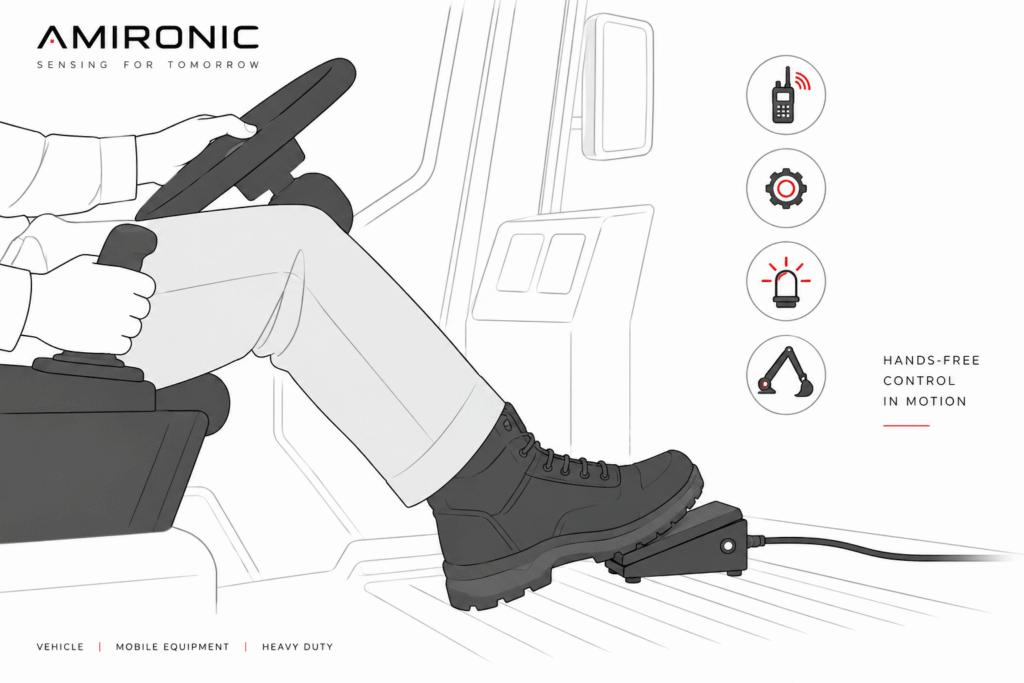
One hand may be on the steering wheel, while the other is operating a control lever, joystick, or another control device. At the same time, the operator may need to control additional system functions. In these situations, adding another push button or switch to the control panel is not always the right solution.
Sometimes, the most natural control interface is right under the operator’s foot.
A footswitch, or foot-operated switch, provides an additional control channel without requiring the driver or operator to take their hands away from the primary controls.
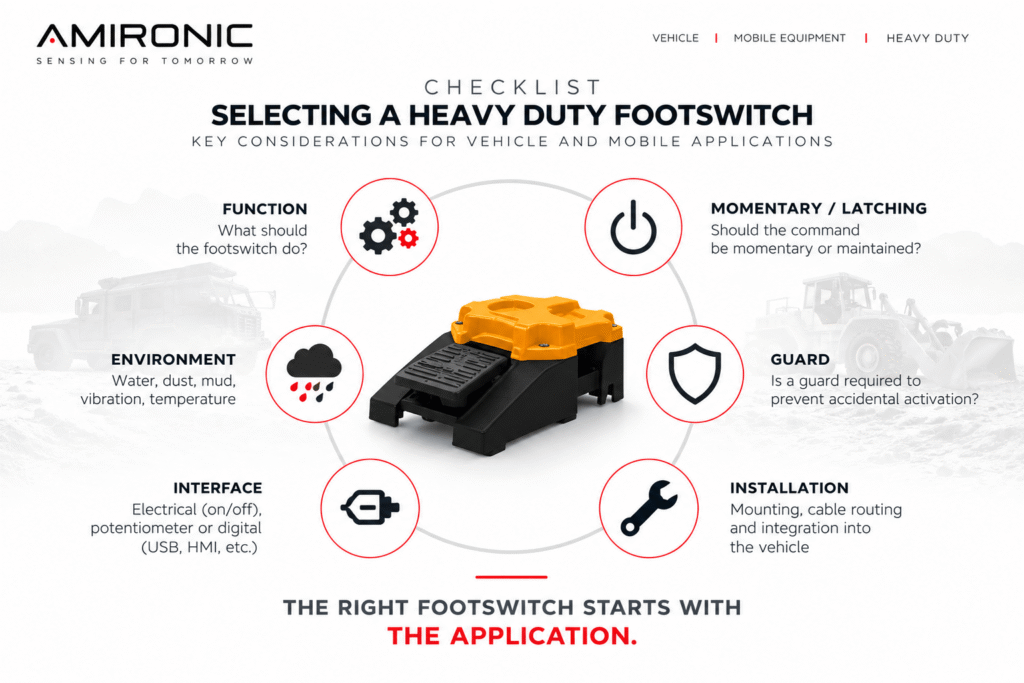
The principle is simple, but selecting a footswitch for a vehicle or mobile equipment involves much more than deciding whether the switch is ON/OFF. The operating method, risk of accidental activation, environmental conditions, exposure to water, dust and mud, mechanical loads, and expected number of operating cycles all need to be considered.
And when the application is industrial or transportation-related, there can be a significant difference between a basic footswitch and a Heavy Duty Footswitch designed for demanding environments.
Why Operate a System with Your Foot?
The main advantage of Foot Control is not that pressing something with your foot is easier than using your hand.
The advantage is the ability to distribute control tasks between the hands and feet.
In a system where both hands are already being used for control, a footswitch can allow the operator to perform an additional action without changing their operating position or searching for a switch on a panel or console.
This is particularly relevant in vehicles and mobile equipment, where operators may need to perform several tasks simultaneously.
Typical examples include:
- Activating PTT – Push To Talk in a communication system
- Momentary activation of an auxiliary function
- Operating a tool or hydraulic system
- Providing an Enable command for a specific function
- Starting or stopping a function on mobile equipment
- Controlling a repetitive function while the operator’s hands are required for another task
In these applications, the footswitch becomes part of the vehicle or machine’s HMI – Human Machine Interface.
The objective is not necessarily to replace an existing hand-operated switch, but rather to determine which operator input – hand or foot – is best suited to each function.
Hands-Free Control – When the Hands Need to Stay on the Controls
The term Hands-Free Control may sound like a matter of convenience, but in mobile equipment it can be an important operational consideration.
Consider the operator of a service vehicle or mobile machine. One hand controls the direction of movement, while the other operates a joystick or another mechanism. If the operator must release one of those controls every time radio communication is required in order to press a PTT button, this introduces an additional action that is unrelated to the primary control task.
A footswitch can transfer the PTT function to the operator’s foot.
The same principle can be applied to other functions that are simple, clearly defined, and repetitive.
This also leads to an important rule:
Not every function is suitable for foot operation.
Foot Control is particularly suitable when the required action is clear to the operator, does not require selection between multiple options, and the position and design of the pedal allow it to be identified and operated consistently.
When unintended activation could have safety implications, the guard, footswitch location, and system control logic should all be considered during the design stage.
The Footswitch as Part of the Driver and Operator Interface
When designing an HMI for a special-purpose vehicle or Heavy Duty equipment, the footswitch should be considered as part of the overall control system rather than as a standalone component.
Steering wheels, joysticks, push buttons, rocker switches, touchscreens, and foot controls are all intended to achieve essentially the same objective: allowing the operator to send commands to the system clearly, quickly, and in a way that suits the operating environment.
Each interface has different advantages.
A footswitch becomes particularly useful when the operator’s hands need to remain on the primary controls while a binary function, or a function with a limited number of states, is assigned to the foot.
But in a vehicle or mobile machine, there is another question that is far more important than it would be in a clean working environment:
What happens to a switch mounted on the floor after thousands of hours of operation?
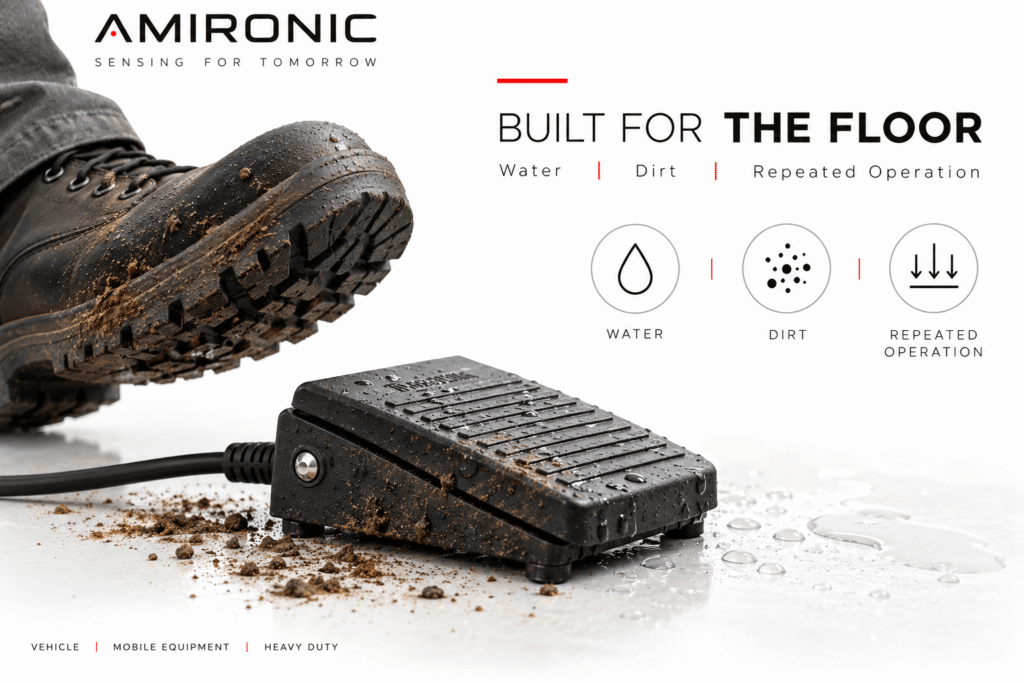
It may be exposed to work boots, dust, sand, water, mud, oil, and repeated mechanical loading. The operator will not necessarily press it gently or in exactly the same place every time.
For this reason, when moving from a standard industrial Foot Control to a Transportation or Mobile Equipment application, mechanical construction and environmental resistance become central considerations in the selection process.
So Why Not Use Just Any Footswitch?
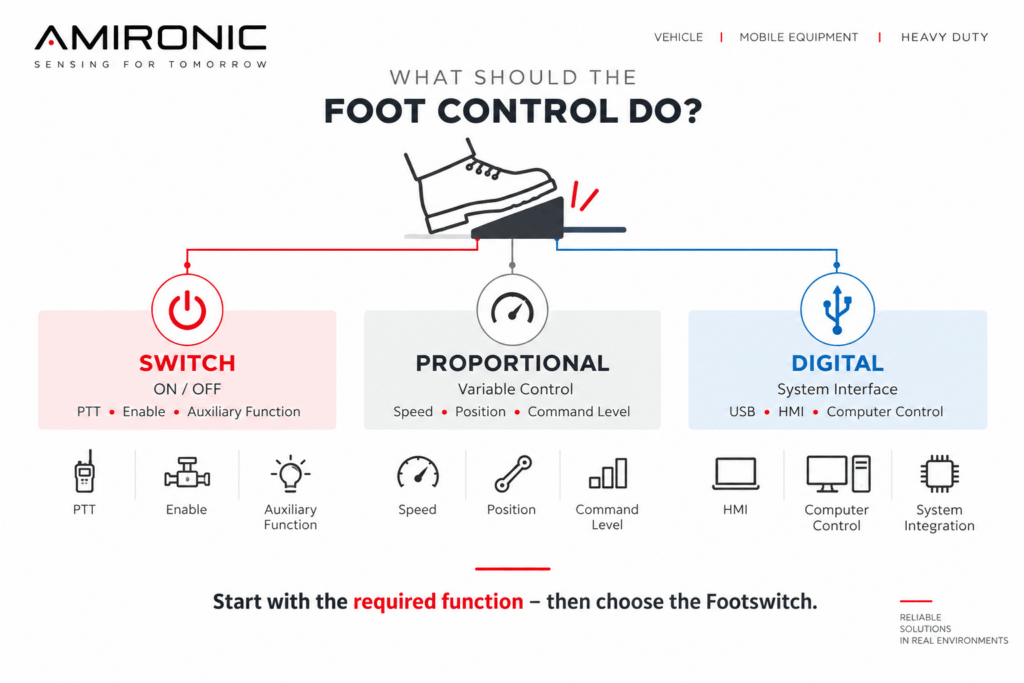
Electrically, a footswitch may appear to be a very simple component: press the pedal, an electrical contact changes state, and the system receives a command.
But the environment in which the switch operates can be far less simple.
A footswitch installed at a protected operator station inside a building does not necessarily face the same conditions as a switch mounted on the floor of a work vehicle, in the operator cab of mobile equipment, or in a machine operating in the field.
This is where the Heavy Duty Footswitch category becomes relevant.
The objective is not simply to generate a contact when the pedal is pressed. The goal is to provide a control interface capable of continuing to perform the same function after prolonged exposure to the operating conditions of the system.
This is also where significant differences between footswitch designs begin to matter: housing material, pedal design, guard options, sealing, switching mechanism, and electrical interface.