flagעברית
flagEnglish
3 Rabinovich St., Petah-Tikva, Israel
+972 3 9047744
office@amironic.co.il
Facebook
Twitter
LinkedIn
YouTube
  • Products
    • MEMS Inertial
      • Gyros & Accels
      • IMU
      • Inertial Navigation
      • AHRS
    • Circuit Breakers
      • Airpax Circuit Breakers
      • Electronic Circuit Breakers
      • Aircraft Circuit Breakers
      • Thermal Circuit Breakers
      • Sealing Solutions & Guards
    • Footswitches
      • Pedals & Bellows
      • USB
      • Air Switches
      • Medical
      • Modular Bases System
      • Industrial
      • Foot Potentiometers
      • Wireless
    • Mechanical & Transmisions
      • Gears
      • Sealing Solutions
      • Gearboxes
      • Couplings
      • Shafts & Bearings
      • Fasteners
      • Mechanical & Springs
      • Linear Motion
      • Anti-Vibration
    • Sensors
      • Thermostats
      • Temperature
      • Position
      • Pressure
      • Speed
      • Level Sensor
      • Load Cells
      • Flex Sensors
      • Membrane Potentiometer
    • Motors
      • Geared DC
      • Brushless DC
      • Step Motors with Gearbox
      • Torque Motors & Brushless Servo
      • DC Motors
    • Electronics
      • Xenon & IR Lamps
      • Counters & Meters
      • Microelectronics Packaging
      • Waterproof Switches
      • Micro Switches
    • Hand Control
      • Operator Controls (JOYSTICK)
      • Electrical
      • Pneumatic (Medical)
      • USB Hand Control
      • Air Push Button
      • Pressure Switch
      • IR Switch
    • Power Solutions
      • Rugged & Military Power Supply
      • Input Power Protection
      • Sealed Military Power Adaptor
      • Triple Output Military Power Supply Series – up to 250 W
    • Materials
      • Molybdenum and Advanced Alloys (TZM, MOLA, HCT)
      • Tungsten (Wolfram) and Advanced Alloys – High-Performance Materials for Extreme Conditions
      • Materials for Gears
  • Shop
  • Companies
  • About Amironic
  • News
  • Contact
Product was added to your cart

Cart

waze

Footswitches for Vehicles and Mobile Equipment – When Does Foot Control Make Sense?

Footswitches16/09/2026amironicLTD

In special-purpose vehicles, mobile equipment, and heavy-duty machinery, the driver’s or operator’s hands are a limited resource.

One hand may be on the steering wheel, while the other is operating a control lever, joystick, or another control device. At the same time, the operator may need to control additional system functions. In these situations, adding another push button or switch to the control panel is not always the right solution.

Sometimes, the most natural control interface is right under the operator’s foot.

A footswitch, or foot-operated switch, provides an additional control channel without requiring the driver or operator to take their hands away from the primary controls.

The principle is simple, but selecting a footswitch for a vehicle or mobile equipment involves much more than deciding whether the switch is ON/OFF. The operating method, risk of accidental activation, environmental conditions, exposure to water, dust and mud, mechanical loads, and expected number of operating cycles all need to be considered.

And when the application is industrial or transportation-related, there can be a significant difference between a basic footswitch and a Heavy Duty Footswitch designed for demanding environments.

Why Operate a System with Your Foot?

The main advantage of Foot Control is not that pressing something with your foot is easier than using your hand.

The advantage is the ability to distribute control tasks between the hands and feet.

In a system where both hands are already being used for control, a footswitch can allow the operator to perform an additional action without changing their operating position or searching for a switch on a panel or console.

This is particularly relevant in vehicles and mobile equipment, where operators may need to perform several tasks simultaneously.

Typical examples include:

  • Activating PTT – Push To Talk in a communication system
  • Momentary activation of an auxiliary function
  • Operating a tool or hydraulic system
  • Providing an Enable command for a specific function
  • Starting or stopping a function on mobile equipment
  • Controlling a repetitive function while the operator’s hands are required for another task

In these applications, the footswitch becomes part of the vehicle or machine’s HMI – Human Machine Interface.

The objective is not necessarily to replace an existing hand-operated switch, but rather to determine which operator input – hand or foot – is best suited to each function.

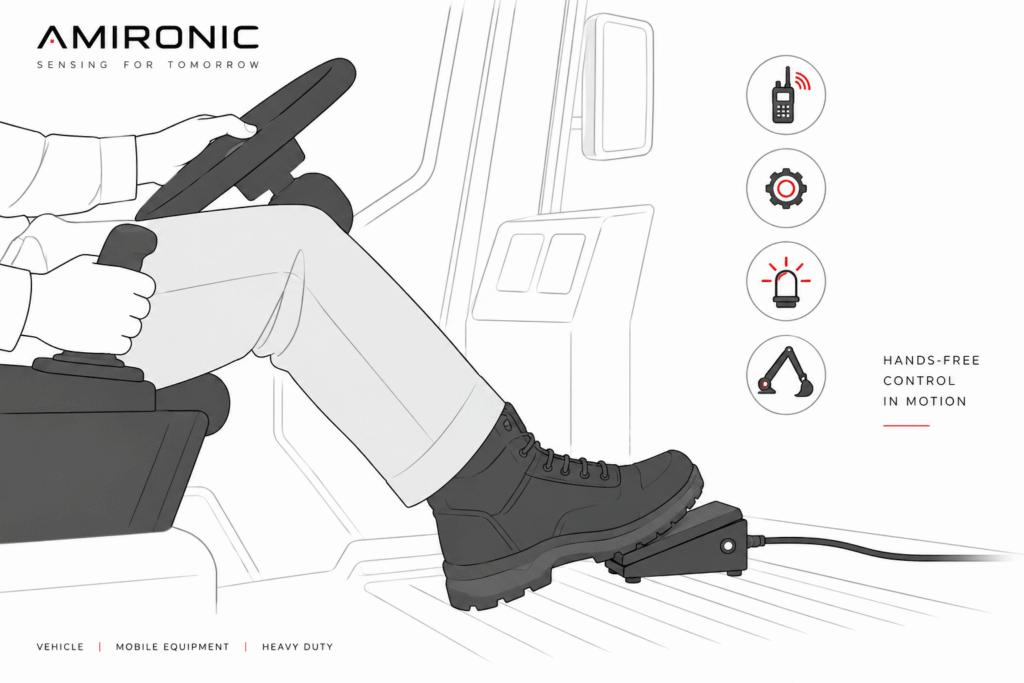
Hands-Free Control – When the Hands Need to Stay on the Controls

The term Hands-Free Control may sound like a matter of convenience, but in mobile equipment it can be an important operational consideration.

Consider the operator of a service vehicle or mobile machine. One hand controls the direction of movement, while the other operates a joystick or another mechanism. If the operator must release one of those controls every time radio communication is required in order to press a PTT button, this introduces an additional action that is unrelated to the primary control task.

A footswitch can transfer the PTT function to the operator’s foot.

The same principle can be applied to other functions that are simple, clearly defined, and repetitive.

This also leads to an important rule:

Not every function is suitable for foot operation.

Foot Control is particularly suitable when the required action is clear to the operator, does not require selection between multiple options, and the position and design of the pedal allow it to be identified and operated consistently.

When unintended activation could have safety implications, the guard, footswitch location, and system control logic should all be considered during the design stage.

The Footswitch as Part of the Driver and Operator Interface

When designing an HMI for a special-purpose vehicle or Heavy Duty equipment, the footswitch should be considered as part of the overall control system rather than as a standalone component.

Steering wheels, joysticks, push buttons, rocker switches, touchscreens, and foot controls are all intended to achieve essentially the same objective: allowing the operator to send commands to the system clearly, quickly, and in a way that suits the operating environment.

Each interface has different advantages.

A footswitch becomes particularly useful when the operator’s hands need to remain on the primary controls while a binary function, or a function with a limited number of states, is assigned to the foot.

But in a vehicle or mobile machine, there is another question that is far more important than it would be in a clean working environment:

What happens to a switch mounted on the floor after thousands of hours of operation?

It may be exposed to work boots, dust, sand, water, mud, oil, and repeated mechanical loading. The operator will not necessarily press it gently or in exactly the same place every time.

For this reason, when moving from a standard industrial Foot Control to a Transportation or Mobile Equipment application, mechanical construction and environmental resistance become central considerations in the selection process.

So Why Not Use Just Any Footswitch?

Electrically, a footswitch may appear to be a very simple component: press the pedal, an electrical contact changes state, and the system receives a command.

But the environment in which the switch operates can be far less simple.

A footswitch installed at a protected operator station inside a building does not necessarily face the same conditions as a switch mounted on the floor of a work vehicle, in the operator cab of mobile equipment, or in a machine operating in the field.

This is where the Heavy Duty Footswitch category becomes relevant.

The objective is not simply to generate a contact when the pedal is pressed. The goal is to provide a control interface capable of continuing to perform the same function after prolonged exposure to the operating conditions of the system.

This is also where significant differences between footswitch designs begin to matter: housing material, pedal design, guard options, sealing, switching mechanism, and electrical interface.
Momentary or Latching – What Should the Pedal Do?

One of the first decisions when selecting a footswitch is what should happen when the operator removes their foot from the pedal.

With a Momentary footswitch, the contact state changes only while the pedal is being operated. When the operator releases the pedal, the switch returns to its normal state.

This is a natural control logic for applications where a direct relationship is required between the operator’s action and the system command.

A good example is PTT – Push To Talk: the operator presses the pedal to talk and releases it to stop transmitting. The same principle can be applied to an Enable function, tool activation, or an auxiliary function that should remain active only while the operator is intentionally pressing the pedal.

With a Latching footswitch, on the other hand, pressing the pedal can change the switch to a new state that remains active even after the foot is removed. A second press or another mechanism returns it to its previous state, depending on the switch configuration.

Choosing between Momentary and Latching is therefore more than simply choosing between two types of switch.

The key question is:

What should the system do when the operator is no longer pressing the pedal?

If releasing the pedal should stop the function, Momentary operation will usually be the more natural choice. If the function needs to remain active without continuous pressure, a Latching footswitch or latching logic implemented within the control system can be considered.

In more complex systems, it is also important to distinguish between the role of the footswitch and the role of the controller. The footswitch may simply provide an input, while the PLC, ECU, or another controller determines how that input is interpreted and what should happen in the event of a fault, restart, or loss of power.

What About Accidental Activation?

A footswitch is located in an area where feet are constantly moving.

That may sound obvious, but from an HMI design perspective it is an important consideration.

An operator may move their foot, change seating position, enter or exit the vehicle, or rest their foot near the pedal without intending to activate a function.

So the question is not only whether the switch is easy to operate.

Sometimes the more important question is:

Is it too easy to operate?

When unintended activation could trigger an unwanted function, a Guard or another mechanical design feature can be used to reduce the likelihood of accidental operation.

The Guard effectively creates a physical boundary around the operating area. The operator can still intentionally reach and press the pedal, while an incidental movement of a work boot is less likely to activate it.

However, a Guard is not automatically the right solution for every application. It can affect pedal accessibility, the way the footswitch is operated, and compatibility with larger work or safety footwear.

The Guard should therefore be considered as part of the overall ergonomics of the operator station, rather than simply as an accessory to the switch.

Footswitch Location Is Part of the Design

Even the right footswitch can become a poor control interface if it is installed in the wrong location.

The operator should be able to locate and operate the pedal naturally, without accidentally pressing it every time they change position.

In a vehicle or mobile equipment application, the design should also consider seating position, seat distance, foot angle, footwear, and any other controls already located in the same area.

If multiple pedals are installed, clear differentiation between them becomes even more important.

In some applications, differences in shape, position, or Guard design can provide physical distinction between functions. In others, it may be better to reduce the number of Foot Controls rather than overload the operator with another control channel.

The principle is simple:

A good footswitch is not just a switch that meets the electrical requirements. It must also suit the operator, the working environment, and the task.

Heavy Duty Starts at Floor Level

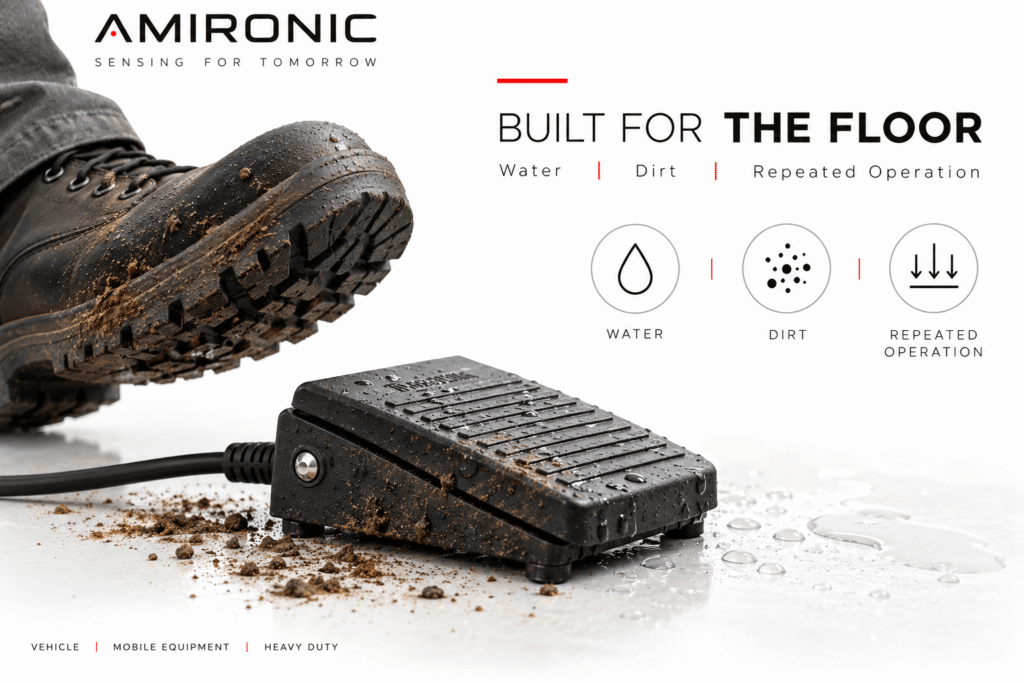
The floor of a work vehicle or mobile machine can be one of the most demanding locations for an HMI component.

Dust and sand naturally collect there. Water and mud can be carried in on the operator’s boots. Tools, equipment, and other objects may impact components in the area, while the footswitch itself is repeatedly subjected to direct mechanical loading from work footwear.

In this type of environment, selecting a Heavy Duty Footswitch requires looking at the complete assembly, not just the electrical contact inside it.

Some of the key questions to consider include:

  • What material is the footswitch housing made from?
  • What level of protection is provided against water and dust ingress?
  • Is the mechanical design suitable for repeated operation with work or safety footwear?
  • Is a Guard option available?
  • How does the cable exit the unit, and how is it protected?
  • What type of electrical contact or interface is required?
  • Does the application require only an ON/OFF command, or proportional control?
  • How will the footswitch be installed in the vehicle or machine?

This is also why not every Heavy Duty Footswitch needs to have the same type of construction.

One application may benefit from a rugged metal housing designed for demanding mechanical use. Another may require a robust polymer housing combined with greater flexibility in electrical interface options.

The system requirements should determine the footswitch design – not the other way around.

Heavy Duty Footswitch – Metal Housing or Polymer Solution?

Once the need for Foot Control has been established, the next step is selecting the right construction for the application.

There is no single solution that fits every vehicle or machine. The operating environment, type of operation, electrical interface, and mechanical requirements can all lead to different solutions.

A good example can be found in Herga’s 6251/6252 and 6256 families.

Both are designed for Heavy Duty applications, but they represent two different approaches to Footswitch design.

Herga 6251/6252 – Rugged Aluminium Heavy Duty Footswitch

The 6251/6252 family features a rugged aluminium construction and is designed for applications requiring a mechanically robust Foot Control.

In Transportation and Mobile Equipment applications, a metal housing can be particularly relevant when the footswitch is installed in an area exposed to intensive use and repeated contact with work footwear.

But the selection process does not end with the housing material.

When considering this type of Footswitch, the required operating configuration and installation environment should also be evaluated. Does the operator need Momentary operation? Is a Latching mechanism required? Is a Guard needed? How will the unit be mounted on the vehicle floor or within the operator station?

The advantage of this approach is a dedicated Heavy Duty Foot Control in which the mechanical construction is a central part of the solution.

This can be suitable, for example, for work vehicles, mobile equipment, service machinery, hydraulic systems, and operator stations where a simple and clearly defined foot-operated Input is required.

Guard – A Small Detail That Can Change the Way the Footswitch Is Operated

Within the 6251/6252 family, the difference between an open configuration and a guarded configuration demonstrates how significantly the mechanical design can affect the user interface.

With an open and accessible pedal, the operator can reach and activate it quickly.

When a Guard is added, the operator must place their foot within a more defined area before activating the pedal. This can help reduce the likelihood of an incidental movement of the foot activating the switch.

A Guard is therefore not only about physically protecting the Footswitch.

It can also be part of the HMI design.

In a system where frequent and rapid activation is required, a more open configuration may be preferred. Where accidental activation of the function is undesirable, a guarded configuration may be more appropriate.

Of course, if the function has safety implications, the Guard should not be relied upon as the sole protective measure. Prevention of hazardous operation should be addressed as part of the overall system safety design.

Herga 6256 – When Foot Control Is More Than an ON/OFF Switch

The 6256 family takes a different approach.

It is a Robust ABS Heavy Duty Footswitch with a range of interface options that can extend its use beyond a simple electrical switching command.

Depending on the configuration, the family is available with Electrical, Potentiometer, and USB options.

This distinction is important.

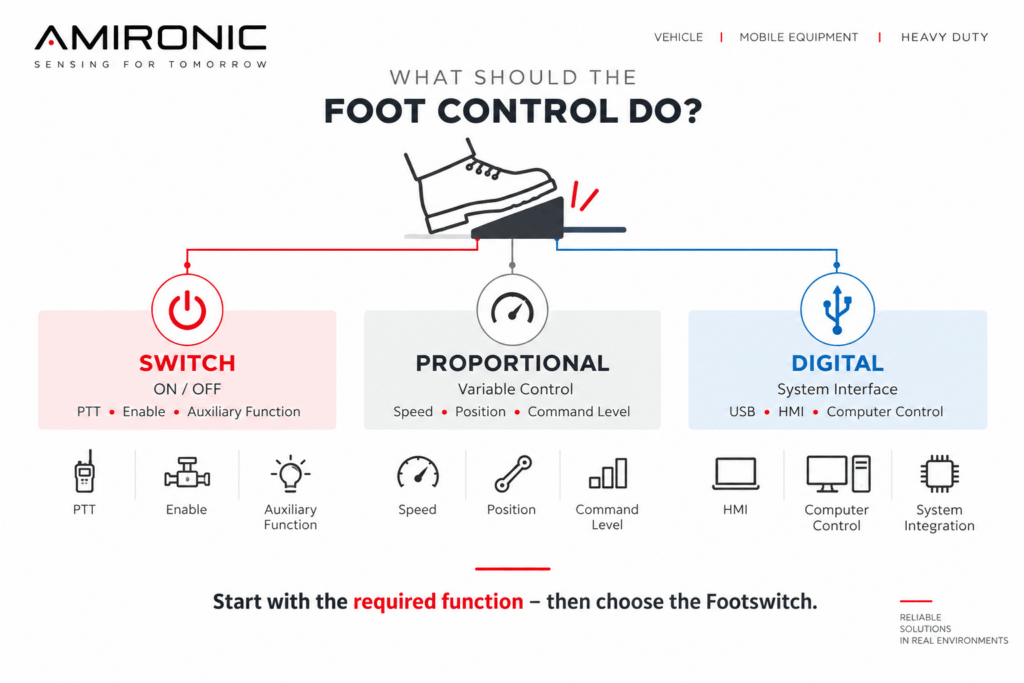
Foot Control does not always have to answer a simple question: “Is the pedal pressed or not?”

In some applications, a discrete electrical command is required. In others, the operator may need to control a variable value with their foot. And in computer-based or digital HMI systems, the way the command is communicated to the system may itself be an important consideration.

Electrical

An electrical configuration is suitable when the Footswitch is used as an Input for activating a defined function.

For example, PTT, Enable, or an Auxiliary Function can be based on a simple switching command, depending on the system design.

Potentiometer

When proportional control is required, Foot Control takes on a very different role.

Instead of providing an ON/OFF command, the pedal position can be used to generate a variable signal.

This approach can be relevant when the operator needs to control a continuous value with their foot rather than simply switching a function on or off.

The electrical interface, pedal travel, and control logic must of course be matched to the specific requirements of the system.

USB

A USB option can be particularly useful when the Foot Control interfaces with a computer-based system or an HMI that does not rely solely on conventional switch wiring.

In suitable applications, the Foot Control can become part of the digital control system without requiring a traditional switch interface between the pedal and the computer.

This means that the question “Which Footswitch should I choose?” actually begins with a different question:

What type of Input does the system need to receive from the operator’s foot?

PTT Is a Good Example, but Foot Control Goes Beyond PTT

One of the most intuitive applications for a Footswitch in a vehicle is PTT – Push To Talk.

When the driver or operator needs to keep their hands on the steering wheel, joystick, or another primary control, foot operation can allow them to activate the communication system without adding another task for the hands.

But the same principle can be applied to many other functions.

A Footswitch can serve as an Auxiliary Control for lighting, tools, mechanisms, Enable commands, or other functions defined within the system.

In mobile equipment, Foot Control can also be used as part of a hydraulic or mechanical control system, where the application and control logic allow it.

And where a variable Input is required rather than a simple ON/OFF command, proportional Foot Control can also be considered.

For this reason, the selection process should not begin with the question, “Which Footswitch is available?”

It is better to start with three questions:

What does the operator need to do? What should the foot control? And what Signal does the system need to receive?

Only then should the Footswitch itself be selected.

Road Vehicles, Work Vehicles, and Off-Highway Equipment Are Different Operating Environments

The term Vehicle Footswitch can describe very different applications.

Inside a relatively clean and enclosed vehicle cab, the main challenges may be ergonomics and the expected number of operating cycles.

In an Off-Highway Vehicle, agricultural equipment, mobile machinery, or a work vehicle, however, the floor area may be much more exposed to dirt, water, dust, and mud.

The way the Footswitch is used can also be very different.

An operator wearing heavy work boots will not operate a pedal in the same way as someone working at a clean operator station. A moving vehicle also introduces vibration, changes in posture, and movement of the operator’s body and feet.

The term Heavy Duty should therefore always be considered in the context of the actual application.

It is not enough for a Footswitch simply to look rugged.

The manufacturer’s specifications should be reviewed for housing materials, sealing, operating temperature, electrical ratings, service life, cables, connections, and installation options for the specific configuration.

Water and Dirt – Don’t Look Only at the Pedal

When a Footswitch is installed in the floor area, environmental sealing becomes an important consideration.

But here too, it is important to avoid oversimplification.

If a specific IP rating is required, the rating of the exact model and configuration should be verified rather than assuming a certain level of protection simply because the product is described as Heavy Duty.

The system also consists of more than just the pedal.

The cable, cable entry, connector, connection point, and wiring to the system controller can all become potential paths through which water or contamination can cause problems.

In other words, a rugged or sealed Footswitch does not automatically make the entire Foot Control system environmentally protected.

For Vehicle and Mobile Equipment applications, it is useful to consider the complete chain:

Footswitch → Cable → Connector → Controller

Environmental requirements can then be defined according to where each component is installed.

Mechanical Location Matters Too

A Footswitch that has been correctly selected electrically still needs to be integrated properly into the vehicle.

Before finalizing the design, the operator’s foot space, operating angle, mounting options, cable routing, and distance from other pedals or controls should all be considered.

Maintenance should also be taken into account.

Can the area be cleaned easily? Can the Footswitch be accessed for replacement? Is the cable protected against damage? Could an object placed on the vehicle floor accidentally activate the pedal?

These may appear to be simple mechanical questions, but they can be just as important as the switch rating itself.

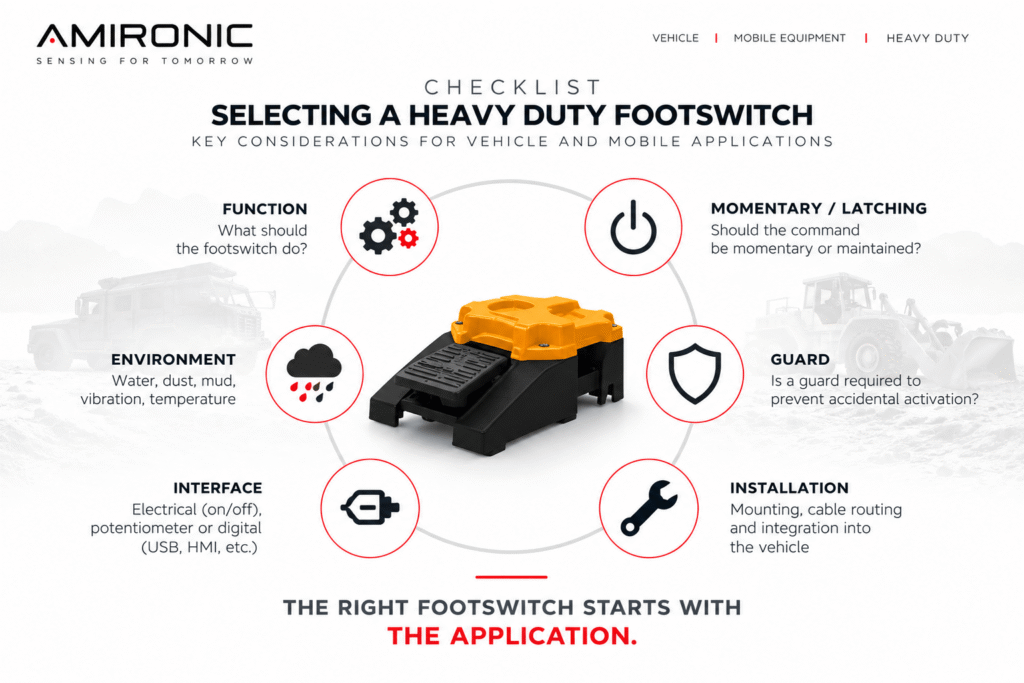
Checklist – How to Select a Heavy Duty Footswitch for Vehicles or Mobile Equipment

Before selecting a Footswitch, at least the following points should be defined:

  1. Function – What action does the operator need to perform?
  2. Control Type – Is ON/OFF or proportional control required?
  3. Momentary / Latching – Should the command disappear when the operator releases the pedal?
  4. Accidental Activation – What are the consequences of unintended operation?
  5. Guard – Is mechanical protection around the operating area required?
  6. Environment – Will the Footswitch be exposed to water, dust, mud, or oils?
  7. Mechanical Duty – What type of use and number of operating cycles are expected?
  8. Electrical Interface – What Signal or Interface does the system expect to receive?
  9. Cable & Connector – How will the Footswitch connect to the system?
  10. Installation – Where and how will the Footswitch be installed?
  11. Operator Ergonomics – Can it be operated comfortably and clearly distinguished from other controls?
  12. Safety Architecture – Does the function require an Interlock, Redundancy, or additional safety measures?

This checklist also explains why there is no single Footswitch that is “best” for every application.

A Heavy Duty Footswitch should fit the system, not simply have an impressive list of specifications.

The Right Foot Control Starts with Defining the Task

Foot operation can solve a real HMI challenge in vehicles and mobile equipment.

When the operator’s hands are already being used for driving, operating a joystick, controlling a tool, or managing other controls, a Footswitch provides an additional control channel and allows a defined function to be performed without moving the hands away from their primary tasks.

But this advantage is only achieved when the interface is designed correctly.

The role of the foot must first be defined: should the command be Momentary or Latching? Is a Guard required? What environmental conditions will the Footswitch face? And what electrical interface does the system need?

Only then does it make sense to compare different Footswitch families and determine which configuration best matches the requirements.

In Vehicle, Mobile Equipment, and Heavy Duty applications, the Footswitch may physically sit at the bottom of the system, but from an HMI perspective, it can play a significant role in how the driver or operator controls the machine.

Case Study – Foot Control for a Work Vehicle in a Dirty and Wet Environment

Consider a work vehicle or Mobile Equipment application in which the operator controls the vehicle using the steering wheel and a joystick, while also needing to activate an auxiliary function with their foot.

The system requirements include:

  • Foot operation to keep the operator’s hands on the primary controls
  • Repeated operation throughout the service life of the vehicle
  • Operation while wearing Safety Shoes
  • A floor area that may be exposed to water and dirt
  • The ability to secure the Footswitch to the vehicle floor
  • A Guard to help reduce accidental activation
  • Connection to the vehicle’s control system

In this scenario, the Herga 6256 Heavy Duty Footswitch is an example of a solution that can be considered.

The 6256 is manufactured from High Impact ABS, with an operating temperature range of -20°C to +80°C and a stated life expectancy of 1×10⁶ operations. The base includes provision for through holes for securing the unit to the floor, while the housing provides three M20×1.5 conduit entries for cable diameters of 6-13 mm.

Why Can a Guard Be Important in a Vehicle?

In this type of application, the operator is not using the Footswitch in a controlled laboratory environment. They may be wearing Safety Shoes, moving their feet during operation, and repeatedly entering and leaving the operator station.

The 6256 is available in both Unguarded and Guarded versions, and the manufacturer specifically states that the optional Guard is designed to accommodate Safety Shoes.

Therefore, if accidental activation of the auxiliary function has operational consequences, the Guarded version can be considered as part of the HMI design.

It is important to emphasize that a Guard does not replace the overall Safety Architecture when the function itself is Safety-Critical. It provides an additional mechanical measure that can help reduce the possibility of unintended activation.

What About Water?

This is where the datasheet illustrates an important point when selecting a Heavy Duty Footswitch.

Although Waterproof to IP67 is listed among the product features, the detailed specification defines the standard degree of protection as IPX2, with IP67 available as an option when using the appropriate Seal Kit or suitable components.

In other words, if the vehicle requires IP67 protection, simply specifying “6256” is not enough.

The actual ordered configuration must be verified to ensure that it includes the components required to achieve the specified level of protection.

This illustrates an important principle that applies when selecting components for Heavy Duty Vehicles:

Do not select by product family alone – verify the specific configuration.

One Pedal, Different Types of Input

Another advantage of the 6256 is the ability to adapt the Foot Control to the system’s control architecture.

According to the available ordering options, different Electrical configurations are available, including Slow Break & Make and Snap Break & Make. 5kΩ and 10kΩ Potentiometer configurations combined with Microswitches are also available, as well as a High Power configuration depending on the selected options.

This means that the same basic Foot Control concept can serve different system requirements.

If the system requires a simple Enable command, an appropriate switching configuration can be selected. If the system needs to receive a variable value according to pedal travel, a Potentiometer configuration can be considered.

Conclusion from the Case Study

This Case Study demonstrates why selecting a Heavy Duty Footswitch for a vehicle or Mobile Equipment should not begin with a part number.

It begins with the application:

Hands-Free → Function → Accidental Activation → Environment → Electrical Interface → Installation

Only after these requirements have been defined should the appropriate Footswitch configuration be selected.

In the case of the Herga 6256, its modular design allows several characteristics of the Foot Control to be adapted to the application rather than treating the pedal as a simple ON/OFF switch. The manufacturer also notes that the modular design allows multiple Footswitches to be combined and expanded with accessories.

Conclusion – The Footswitch as Part of HMI Design

A Footswitch may appear to be a simple component: a pedal, a mechanism, and an electrical contact. But in vehicles, mobile equipment, and Heavy Duty systems, selecting the right solution begins long before choosing a part number.

The first question is what the operator needs to do with their foot.

When the hands need to remain on the steering wheel, joystick, or other controls, Foot Control can provide an additional control channel for PTT, Enable, an Auxiliary Function, or another system function. In some applications, it may provide a simple ON/OFF command, while others may require proportional control.

Once the function has been defined, the operating method should be considered: Momentary or Latching, the need for a Guard, the risk of accidental activation, environmental conditions, required sealing, electrical connection, and installation within the vehicle.

Heavy Duty families such as the Herga 6251/6252 and 6256 demonstrate different approaches to Foot Control requirements. The 6256, for example, is available in Guarded and Unguarded configurations and offers several switching and control options, including Potentiometer configurations.

Ultimately, a Heavy Duty Footswitch should not be selected only according to the mechanical load it can withstand. It must also suit the operator, the function, the electrical interface, the working environment, and the vehicle’s control architecture.

The right Footswitch starts with the application.


Frequently Asked Questions – FAQ

Why Use a Footswitch in a Vehicle Instead of a Hand-Operated Switch?

The main advantage is the ability to perform an additional action with the foot when the operator’s hands are already being used for driving or operating a joystick, hand control, or other equipment.

Instead of moving a hand away from one of the primary controls to press a push button, a simple and clearly defined function can, where appropriate, be assigned to Foot Control.

This can be particularly useful for functions such as PTT, Enable, or an Auxiliary Function.

Is a Footswitch Suitable for PTT in a Vehicle?

Yes. PTT – Push To Talk is a natural example of a Footswitch application when the operator needs to use a communication system while keeping their hands on the primary controls.

A Momentary Footswitch can be considered for this type of application, so that the command remains active while the pedal is pressed and is released when the operator removes their foot.

The contact configuration and electrical interface should be matched to the specific communication system.

What Is the Difference Between a Momentary Footswitch and a Latching Footswitch?

With a Momentary Footswitch, the switch returns to its normal state when the operator releases the pedal.

With a Latching Footswitch, the switch state can remain active after the pedal is pressed, depending on the mechanism and configuration.

The choice depends on the system logic and whether the function should stop when the operator removes their foot from the pedal.

When Should a Guard Be Used?

A Guard can be relevant when there is a need to reduce the possibility of accidental Footswitch activation.

In a vehicle or mobile equipment application, the operator moves their feet, may wear work footwear, and repeatedly enters and exits the operator station. A Guard can create a more clearly defined operating area around the pedal.

The 6256 is available in Guarded and Unguarded configurations, and the manufacturer states that the optional Guard is also suitable for use with Safety Shoes.

However, a Guard is not a substitute for appropriate Safety design when the function is Safety-Critical.

Is a Heavy Duty Footswitch Necessarily Waterproof?

No.

The term Heavy Duty describes the general type of product and its intended use, but it does not in itself represent an IP rating.

The degree of protection of the specific model and configuration must be verified. For example, the Herga 6256 specification lists IPX2 as the standard degree of protection, with IP67 achievable using an appropriate Seal Kit or suitable components.

Therefore, where IP67 is required, the ordered configuration must be verified to ensure that it meets that requirement.

What Should Be Considered When a Footswitch Is Installed on a Vehicle Floor?

In addition to the electrical specifications, consider the environmental conditions, exposure to water and dust, mounting method, cable routing, operator footwear, distance from other controls, and the possibility of accidental activation.

It is useful to consider the complete connection chain:

Footswitch → Cable → Connector → Controller

rather than looking only at the pedal itself.

Can a Footswitch Provide Proportional Control Instead of Only ON/OFF?

Yes, depending on the product family and configuration.

For example, the 6256 options include 5kΩ and 10kΩ Potentiometer configurations combined with Snap Action Microswitches.

This allows Foot Control to be considered for systems that require a Variable Input rather than only an ON/OFF command.

What Is the Difference Between an Industrial Footswitch and a Heavy Duty Footswitch?

The category name alone should not be used as the basis for selection.

For a Heavy Duty application, the actual housing materials, service life, operating temperature, sealing, installation options, Guard, contact type, and suitability for the operating environment should all be evaluated.

For example, the 6256 is manufactured from High Impact ABS, has a specified operating temperature range of -20°C to +80°C, and a stated life expectancy of one million operations.

How Do You Select a Heavy Duty Footswitch for a Vehicle or Mobile Equipment?

Start with the application, not the product.

Define the required function, Control Type, operating method, risk of accidental activation, environmental conditions, electrical interface, and installation requirements.

Only then should different Footswitches be compared and the configuration that best matches the system requirements selected.


Glossary – Key Terms for Footswitch Selection

Footswitch – A switch or control device operated by the foot.

Foot Control – A broader term for a foot-operated control interface. Depending on the product and system, it may provide ON/OFF switching or variable control.

Heavy Duty Footswitch – A Footswitch intended for demanding industrial or mechanical applications. The specifications of the specific model should always be reviewed rather than relying on the term Heavy Duty alone.

Vehicle Footswitch – A Footswitch used as part of the driver or operator interface in a vehicle or mobile equipment.

Hands-Free Control – Operating a function without using the hands. In the context of a Footswitch, the foot provides an additional control channel.

PTT – Push To Talk – A command used to activate transmission in a communication system for as long as the control is operated.

Momentary – An operating mode in which the switch remains activated only while pressure is applied.

Latching – An operating mode in which the switch state remains after activation, depending on the mechanism and configuration.

Guard – A mechanical structure around the operating area designed, among other purposes, to reduce the possibility of accidental activation.

Proportional Control – A type of control in which the Output varies according to pedal position or travel rather than providing only an ON/OFF command.

Potentiometer – A variable-resistance component that can be used to generate a Signal corresponding to pedal position.

IP Rating – A classification according to IEC/EN 60529 that defines the degree of protection provided by an enclosure against the ingress of solid objects and water, according to the specified rating.

HMI – Human Machine Interface – The collection of interfaces through which an operator interacts with a machine or vehicle, including push buttons, joysticks, displays, and Foot Controls.

Auxiliary Function – A supporting or secondary system function that is not necessarily one of the primary vehicle or machine controls.

Safety-Critical Function – A function whose failure or unintended activation could affect system safety and therefore requires consideration as part of the overall Safety Architecture.

Tags: Herga

Related Articles

The Role of Vacuum Switches in Fume Extraction Systems

25/02/2025amironicLTD

UL 60601-1 Medical Switches – Safety, Reliability & Innovation with Herga

25/09/2025amironicLTD

Hands on the Keyboard, Foot on the Radio – Why Push-to-Talk Is Moving to the Floor in Control Rooms

10/08/2026amironicLTD

Recent Posts

  • Footswitches for Vehicles and Mobile Equipment – When Does Foot Control Make Sense?
  • Waterproof Switches for Military and Industrial Systems – CPI B2000 Series Overview and B2030-15 Case Study
  • When the Mission Goes High-Dynamic: What Happens to a Tactical IMU Under Extreme Motion?
  • Hands on the Patient, Foot on the System – Why Footswitches Are Still Essential in Medical Imaging
  • As AI Racks Demand More Power – What Happens to Circuit Breaker Protection?

Categories

  • Air Switch
  • Circuit Breakers
  • Elapsed Time Indicator
  • Feedthrough
  • Footswitches
  • Gears & Transmission
  • Hour Meters
  • Infra Red Switches
  • INFRARED LAMPS
  • Low Noise Inertial MEMS
  • Mechanics
  • MEMS Gyroscope
  • MEMS Inertial
  • Microelectronics
  • Motors
  • Position Sensors
  • Power Supply
  • Pressure Sensors
  • Pressure Switch
  • Switches
  • Temperature Sensors
  • Tungsten and Molybdenum
  • Uncategorized
  • Vacuum Switches

Quick Contact

Fill out the form and our representatives will return to you

    Name (required)

    Email (required)

    Phone

    Message

    This site is protected by reCAPTCHA and the Google
    Privacy Policy and
    Terms of Service apply.

    Amironic Ltd.

    3 Rabinovich Street, Petah Tikva 4928144 , Israel. Tel: +972-3-9047744 E-mail: office@amironic.co.il
    Email
    Facebook
    Twitter
    LinkedIn
    YouTube
    Press on the ISO Certificate below for download
    ISO 9001:2015 Certification
    • MEMS Inertial
    • Circuit Breakers
    • Footswitches
    • Mechanical & Transmisions
    • Sensors
    • Motors
    • Electronics
    • Hand Control
    • Power Solutions

    News

    • Footswitches for Vehicles and Mobile Equipment – When Does Foot Control Make Sense?
    • Waterproof Switches for Military and Industrial Systems – CPI B2000 Series Overview and B2030-15 Case Study
    • When the Mission Goes High-Dynamic: What Happens to a Tactical IMU Under Extreme Motion?
    • Hands on the Patient, Foot on the System – Why Footswitches Are Still Essential in Medical Imaging
    • As AI Racks Demand More Power – What Happens to Circuit Breaker Protection?
    About AmironicContactעברית
    © 2022 Amironic All rights reserved. All Trademarks are the property of their respective owners.
    • Increase Font
    • Decrease Font
    • Black & White
    • Inverse Colors
    • Highlight Links
    • Regular Font
    • Reset