flagעברית
flagEnglish
3 Rabinovich St., Petah-Tikva, Israel
+972 3 9047744
office@amironic.co.il
Facebook
Twitter
LinkedIn
YouTube
  • Products
    • MEMS Inertial
      • Gyros & Accels
      • IMU
      • Inertial Navigation
      • AHRS
    • Circuit Breakers
      • Airpax Circuit Breakers
      • Electronic Circuit Breakers
      • Aircraft Circuit Breakers
      • Thermal Circuit Breakers
      • Sealing Solutions & Guards
    • Footswitches
      • Pedals & Bellows
      • USB
      • Air Switches
      • Medical
      • Modular Bases System
      • Industrial
      • Foot Potentiometers
      • Wireless
    • Mechanical & Transmisions
      • Gears
      • Sealing Solutions
      • Gearboxes
      • Couplings
      • Shafts & Bearings
      • Fasteners
      • Mechanical & Springs
      • Linear Motion
      • Anti-Vibration
    • Sensors
      • Thermostats
      • Temperature
      • Position
      • Pressure
      • Speed
      • Level Sensor
      • Load Cells
      • Flex Sensors
      • Membrane Potentiometer
    • Motors
      • Geared DC
      • Brushless DC
      • Step Motors with Gearbox
      • Torque Motors & Brushless Servo
      • DC Motors
    • Electronics
      • Xenon & IR Lamps
      • Counters & Meters
      • Microelectronics Packaging
      • Waterproof Switches
      • Micro Switches
    • Hand Control
      • Operator Controls (JOYSTICK)
      • Electrical
      • Pneumatic (Medical)
      • USB Hand Control
      • Air Push Button
      • Pressure Switch
      • IR Switch
    • Power Solutions
      • Rugged & Military Power Supply
      • Input Power Protection
      • Sealed Military Power Adaptor
      • Triple Output Military Power Supply Series – up to 250 W
    • Materials
      • Molybdenum and Advanced Alloys (TZM, MOLA, HCT)
      • Tungsten (Wolfram) and Advanced Alloys – High-Performance Materials for Extreme Conditions
      • Materials for Gears
  • Shop
  • Companies
  • About Amironic
  • News
  • Contact
Product was added to your cart

Cart

waze

Why Position Feedback Matters More Than Ever in Counter-UAS Swarm Defense

MEMS Inertial, Position Sensors02/08/2026amironicLTD

Modern Counter-UAS systems are typically built around four core functions: detection, identification, tracking, and interception.

When facing a single UAV, a radar or electro-optical (EO/IR) system can focus on one target, continuously track its trajectory, and provide accurate targeting data to the interceptor.

A drone swarm changes the challenge completely.

Instead of tracking a single target, the system must simultaneously deal with multiple fast-moving UAVs approaching from different directions, flying at different altitudes, changing their trajectories, and in many cases coordinating their movements.

Much of today’s discussion focuses on artificial intelligence, computer vision, radar technology, and target classification algorithms.

These technologies are essential, but there is another critical layer between the algorithm’s decision and the system’s ability to engage the target – a layer that is often overlooked.

Artificial intelligence can decide where to look. The mechanical system still has to get there.

A tracking system does not exist only inside a computer.

Eventually, every digital command must become physical motion of a:

  • EO/IR turret
  • Stabilized camera
  • Radar antenna
  • High-energy laser
  • Missile launcher
  • Directional RF antenna
  • Or another tracking or interception subsystem

The controller may calculate the target position within milliseconds, but it must also know the exact position of every mechanical axis at all times.

Has the turret already reached the commanded angle?

Is it still moving?

Is there any difference between the commanded position and the actual position?

Have vibration, gearbox backlash, acceleration, or rapid direction changes caused the line of sight to drift away from the target?

Without fast and accurate answers to these questions, the system may believe it is pointing directly at the UAV while, in reality, its line of sight is already somewhere else.

This is exactly where Position Feedback becomes essential.
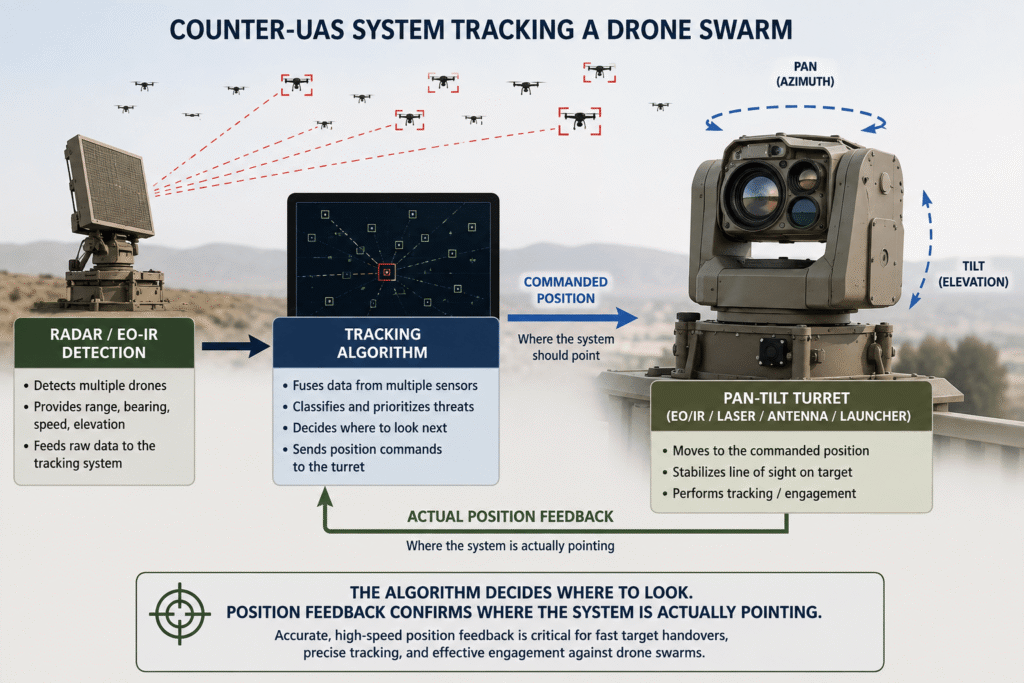
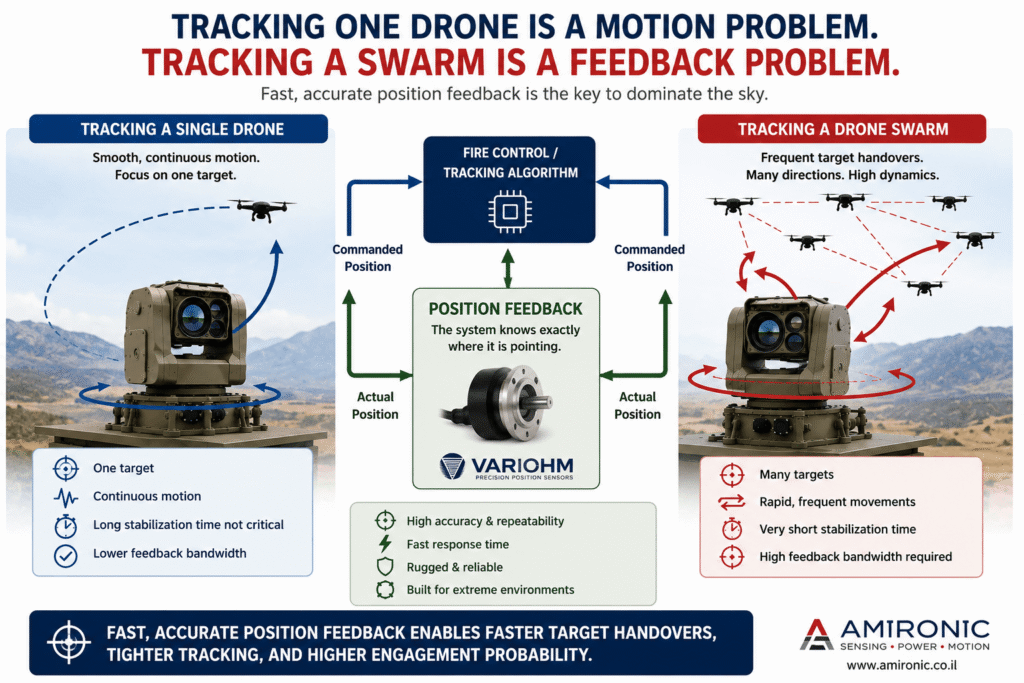
Figure 1 – The Algorithm Decides, Position Feedback Confirms Execution

In a Counter-UAS system, the tracking algorithm continuously determines which target should be engaged and where the system should point next. However, only fast and accurate Position Feedback can confirm that the turret, camera, radar antenna, or laser system has actually reached the commanded position. Without continuous feedback from the mechanical axes, a gap can develop between where the system believes it is pointing and where it is actually pointing.

Tracking a Single UAV Is a Motion Problem. Tracking a Swarm Is a Feedback Problem.

Once the system knows where every target is located, the real engineering challenge begins.

When tracking a single UAV, the EO/IR turret or stabilized camera typically performs relatively smooth, continuous motion. The controller’s objective is simply to maintain a stable line of sight on a single moving target.

A drone swarm changes that dynamic completely.

Instead of following one target, the system must rapidly switch between multiple UAVs, each flying at different speeds, altitudes, and directions.

Within just a few seconds, the tracking system may need to:

  • Track one target.
  • Rapidly slew to another.
  • Correct for overshoot after a fast direction change.
  • Re-stabilize the line of sight.
  • Immediately transition to the next target.

In this environment, it is no longer enough for the motor to simply execute the commanded movement.

The controller must continuously verify the exact position of every mechanical axis to ensure that the line of sight is actually pointing where the tracking algorithm expects it to be.

The faster the system transitions between targets, the more critical fast, accurate, and repeatable Position Feedback becomes.

Accuracy Is Only Part of the Story

When evaluating a rotary position sensor, it is easy to focus on a single specification: accuracy.

For modern Counter-UAS systems, however, several other performance parameters are equally important – and in many cases even more critical.

  • Repeatability – Can the sensor consistently return to exactly the same position?
  • Resolution – Can it detect extremely small angular changes?
  • Response Time – Is the position feedback fast enough for real-time control?
  • Environmental Robustness – Can it maintain its performance under vibration, shock, dust, moisture, and extreme temperatures?
  • Long-Term Stability – Will it maintain consistent performance after years of continuous operation?

A Counter-UAS system may perform hundreds of rapid target transitions during a single mission.

High-quality Position Feedback enables the controller to reduce settling time, minimize overshoot, and transition between targets faster while maintaining precise line-of-sight stabilization.

Figure 2 – Drone Swarms Place New Demands on Position Feedback

When tracking a single UAV, the motion of the EO/IR turret or stabilized camera is typically continuous and focused on a single target. In contrast, countering a drone swarm requires the system to rapidly transition between multiple targets, perform aggressive acceleration and deceleration, and stabilize after every movement. As the rate of target transitions increases, fast, accurate, and repeatable Position Feedback becomes increasingly critical, enabling the controller to continuously verify the true position of every mechanical axis and maintain precise line-of-sight tracking.

In Counter-UAS swarm defense, the speed of target transitions is limited not only by the motor, but also by the quality of the Position Feedback.

How Do You Select the Right Rotary Position Sensor for a Counter-UAS System?

Not every rotary position sensor is suitable for a Counter-UAS platform.

Unlike conventional industrial applications, where mechanical axes typically operate at predictable speeds and duty cycles, Counter-UAS systems must withstand rapid direction changes, aggressive acceleration and deceleration, and continuous high-speed transitions between multiple targets.

At the same time, they must maintain reliable performance in harsh operating environments, including:

  • Continuous vibration
  • Mechanical shock
  • Dust and moisture
  • Extreme temperatures
  • Years of continuous operation

For this reason, system engineers evaluate far more than sensor accuracy alone.

A rotary position sensor intended for Counter-UAS applications should be assessed based on several key performance characteristics:

  • Repeatability – Can the sensor consistently return to exactly the same position?
  • Resolution – Can it detect extremely small angular changes?
  • Response Time – Is the feedback fast enough for real-time closed-loop control?
  • Reliability – Will it continue operating after millions of duty cycles?
  • Environmental Robustness – Can it maintain stable performance under vibration, shock, and harsh environmental conditions?

A high-quality Position Feedback sensor does far more than measure shaft angle.

It provides the controller with the real-time information required to reduce settling time, minimize overshoot, and enable faster, more precise transitions between targets.

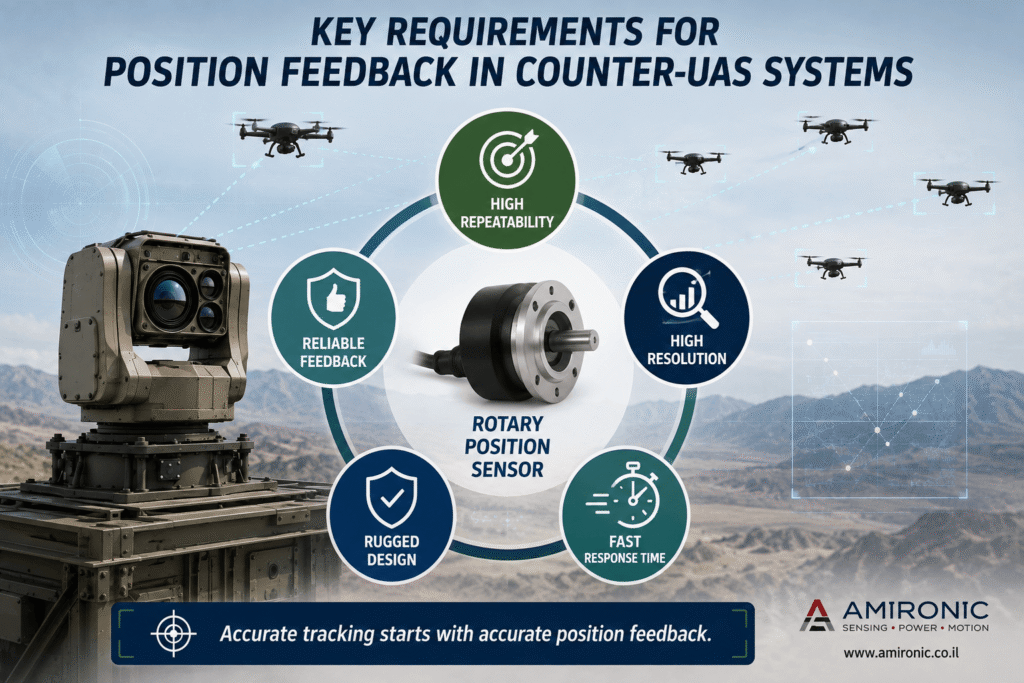
Figure 3 – Key Performance Requirements for Rotary Position Sensors in Counter-UAS Systems

A Rotary Position Sensor used in a Counter-UAS system must do far more than simply measure shaft position.

It must provide fast, accurate, and repeatable Position Feedback, even under continuous vibration, mechanical shock, extreme temperatures, and rapid transitions between multiple targets.

Performance characteristics such as high repeatability, high resolution, fast response time, long-term reliability, and environmental robustness enable the controller to reduce settling time, minimize overshoot, and maintain precise line-of-sight tracking during complex drone swarm engagements.

How Variohm Rotary Position Sensors Address These Challenges

Variohm’s Rotary Position Sensors are designed for applications where accuracy, reliability, and long-term durability are fundamental system requirements rather than optional features.

The portfolio includes a wide range of non-contact rotary position sensors, allowing system designers to select the most suitable solution for each application, from industrial automation and robotics to advanced aerospace and defense platforms.

In Counter-UAS systems, a rotary position sensor does much more than measure shaft angle.

It becomes an integral part of the closed-loop control system, continuously providing the controller with accurate feedback on the true position of the EO/IR turret, radar antenna, directional RF antenna, or other tracking subsystem.

This continuous Position Feedback enables the controller to:

  • Verify that the commanded position has been reached.
  • Detect deviations caused by vibration, mechanical backlash, or changing loads.
  • Apply real-time position corrections.
  • Reduce settling time after rapid direction changes.
  • Transition quickly and accurately between multiple targets.

For Counter-UAS systems engaged against drone swarms, even small improvements in settling time or positioning accuracy can translate into faster target handovers and improved overall tracking performance.

As the number of targets increases, the quality of the Position Feedback becomes increasingly critical to the performance of the entire tracking system.

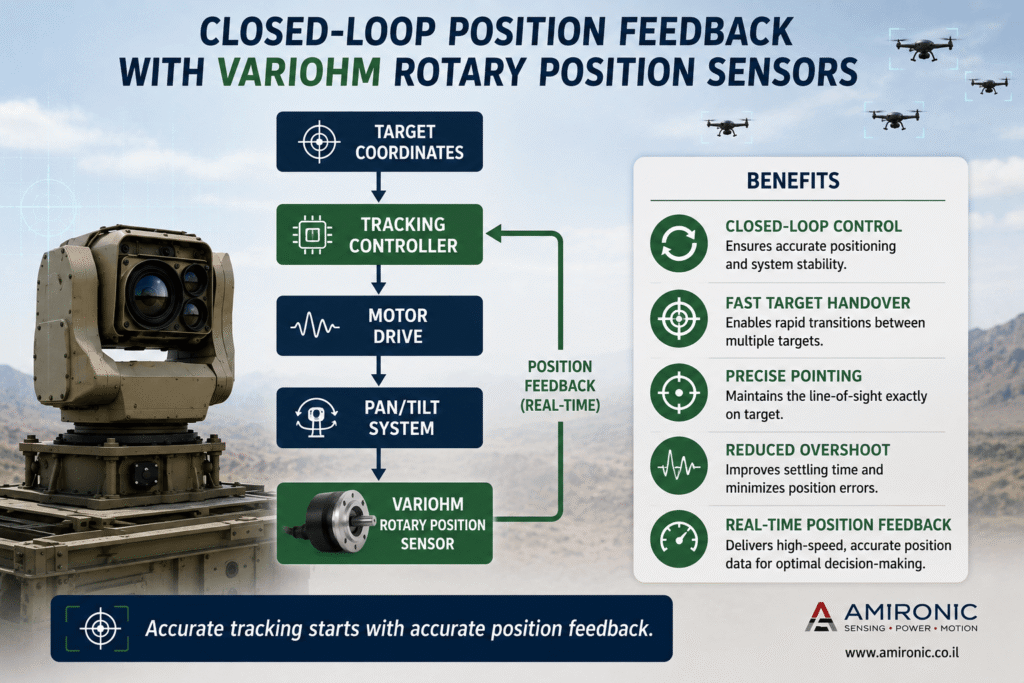
Figure 4 – Rotary Position Sensor as Part of a Closed-Loop Control System

A Variohm Rotary Position Sensor continuously provides the controller with real-time feedback on the actual position of the EO/IR turret or Pan/Tilt mechanism. This enables the control system to verify that the commanded position has been reached, apply real-time position corrections, reduce settling time, and minimize overshoot. In Counter-UAS applications, where rapid transitions between multiple targets are essential, accurate Position Feedback is a key enabler of stable, repeatable, and reliable tracking performance.

Position Feedback Is Only Part of the System

In a modern Counter-UAS platform, Position Feedback is one of the most critical sources of information – but it is not the only one.

Many systems also rely on continuous monitoring of additional parameters, including:

  • Temperature Sensors – for monitoring motors, actuators, power electronics, and high-energy laser systems.
  • Pressure Sensors – for hydraulic, pneumatic, and cooling systems.
  • Linear Position Sensors – for measuring the movement of linear actuators and deployment mechanisms.
  • Load Cells and Force Sensors – for monitoring structural loads and stabilization mechanisms.

By combining Position Feedback with environmental and condition-monitoring sensors, system engineers gain a far more complete understanding of the platform’s operating condition, improving both reliability and long-term performance.

But One Critical Piece of Information Is Still Missing

Even after the controller knows:

  • Where every mechanical axis is located.
  • The temperature of critical subsystems.
  • The pressure within hydraulic or pneumatic circuits.
  • The operating condition of the actuation system.

One fundamental question still remains.

How is the platform itself moving?

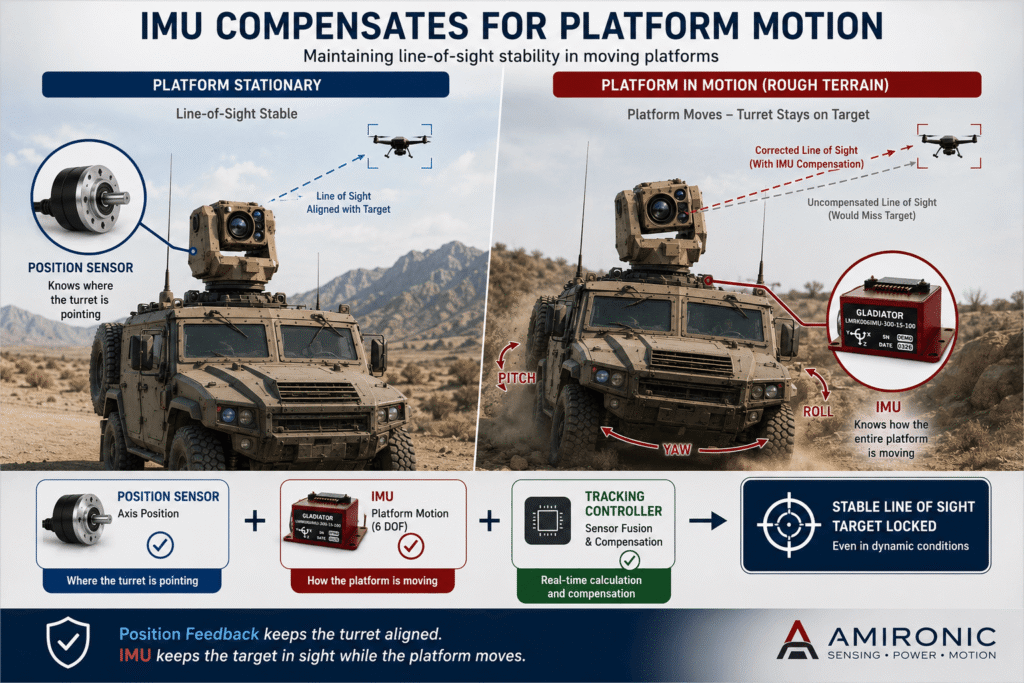
A Rotary Position Sensor measures the position of a mechanical axis.

It does not measure how the vehicle, naval platform, mast, or other host platform is moving through space.

Consider an armored vehicle traveling over rough terrain.

Even if the EO/IR turret remains at exactly the same commanded angle, the platform itself may:

  • Pitch.
  • Roll.
  • Yaw.
  • Accelerate.
  • Decelerate.
  • Experience continuous vibration.

In this situation, the Position Feedback from the turret is still perfectly correct.

The problem is that the line of sight is no longer where the tracking system expects it to be.

To maintain accurate tracking, the controller must know not only where the turret is pointing, but also how the entire platform is moving in real time.

This is where a Tactical MEMS Inertial Measurement Unit (IMU) becomes an essential part of the solution.

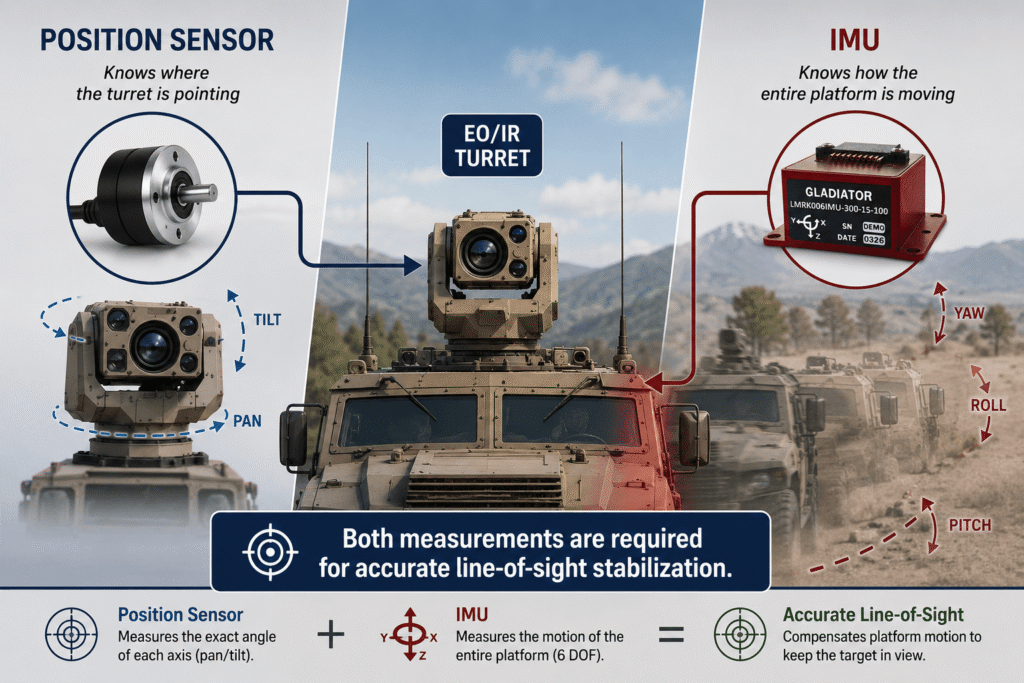
Figure 5 – Rotary Position Sensors and IMUs Provide Different but Complementary Information

A Rotary Position Sensor measures the precise position of the Pan/Tilt axes, enabling the controller to know exactly where the EO/IR turret is pointing. In contrast, a Tactical MEMS IMU measures the motion of the entire platform, including angular rates, acceleration, and attitude changes. By combining these two independent sources of information, the control system can distinguish between turret movement and platform motion, maintain a stable line of sight, and deliver accurate target tracking even under highly dynamic operating conditions.

How Does a Tactical MEMS IMU Complement the Tracking System?

A Tactical MEMS Inertial Measurement Unit (IMU) continuously measures the motion of the host platform using precision gyroscopes and accelerometers.

Unlike a Rotary Position Sensor, which measures the position of the mechanical axes, an IMU measures how the vehicle or platform itself is moving through space.

This information becomes especially important whenever the Counter-UAS platform is in motion.

Consider an armored vehicle traveling over rough terrain.

Continuous vibration, rapid acceleration, braking, and sudden changes in direction all affect the line of sight of the EO/IR tracking system.

Even if the turret remains at exactly the same commanded angle, movement of the host platform can still cause the system to lose accurate target alignment.

This is where the IMU becomes essential.

By continuously measuring angular rates and linear acceleration, the IMU enables the control system to estimate platform motion in real time and immediately compensate for it, keeping the line of sight locked onto the target.

In advanced Counter-UAS systems, Rotary Position Sensors and Tactical MEMS IMUs are not competing technologies.

They solve different engineering problems and work together as complementary sources of information:

  • Rotary Position Sensor – Where is each mechanical axis pointing?
  • Tactical MEMS IMU – How is the host platform moving?

Only by combining both measurements can the control system maintain stable line-of-sight tracking while the platform is moving over rough terrain, maneuvering, or operating in highly dynamic environments.

Figure 6 – Combining Rotary Position Feedback and IMU Data Enables Stable Line-of-Sight Tracking While the Platform Is Moving

A Rotary Position Sensor continuously measures the precise position of the Pan/Tilt axes, while a Tactical MEMS IMU measures the motion of the host platform, including angular rates and linear acceleration. By combining these two complementary sources of information, the control system can compensate for vehicle motion in real time, maintain a stable line of sight, and continue tracking the target even while operating over rough terrain or in highly dynamic environments.

Conclusion

When discussing modern Counter-UAS systems, most attention is focused on radar, artificial intelligence, tracking algorithms, and interception technologies.

In reality, however, a system’s ability to defeat a drone swarm depends just as much on the quality of the data delivered to the control system.

Rotary Position Sensors provide precise information about the position of every mechanical axis.

Temperature, pressure, and force sensors continuously monitor the health and operating condition of critical subsystems.

Tactical MEMS IMUs measure the motion of the host platform, enabling the controller to compensate for vibration, acceleration, and attitude changes in real time.

Only when all of these sources of information work together can the control system maintain a stable line of sight, transition rapidly between multiple targets, and sustain accurate tracking under highly dynamic operating conditions.

As drone threats become faster, smarter, and increasingly autonomous, the demands placed on sensing and control systems continue to grow.

The future of Counter-UAS will not be determined by better algorithms alone. It will also depend on how accurately the physical world is measured.

Ultimately, the difference between a system that merely detects a drone swarm and one that can successfully defeat it is not defined by software alone.

It is defined by the speed, accuracy, and reliability of the sensors that turn digital decisions into precise physical action.

Case Study – Rapid Target Transitions in Counter-UAS Swarm Defense

Consider an EO/IR tracking system installed on an armored vehicle tasked with engaging multiple UAVs during a Counter-UAS mission.

The system must rapidly transition between two targets separated by 20°.

Assume the Pan/Tilt drive is capable of rotating at 120°/s.

The theoretical slew time is therefore:

20° ÷ 120°/s = 0.167 seconds (167 ms)

However, reaching the commanded angle is only part of the process.

Before the system can begin tracking the next target, it must also:

  • Verify that the turret has reached the commanded position.
  • Correct any overshoot.
  • Re-stabilize the line of sight.
  • Compensate for vehicle motion using the IMU.

In practice, the operational transition time is always longer than the mechanical slew time alone.

When a Counter-UAS system performs dozens of target transitions within only a few seconds, even small improvements in settling time or Position Feedback accuracy can significantly increase overall tracking performance.

A Practical Sensor Architecture

One possible implementation combines a Variohm Euro-MXPS Rotary Position Sensor with a Gladiator LandMark™ 006 Tactical MEMS IMU.

Variohm Euro-MXPS Rotary Position Sensor

  • Non-contact Hall-effect technology
  • Programmable measurement range from 30° to 360°
  • Sampling rate up to 5 kHz
  • System propagation delay of only 600 µs
  • IP68 environmental protection
  • More than 50 million operating cycles
  • Optional redundant outputs for mission-critical applications

Gladiator LandMark™ 006 Tactical MEMS IMU

  • Data rate up to 10 kHz
  • 600 Hz bandwidth
  • Digital message latency below 20 µs
  • 0.8°/hour bias stability
  • Operating temperature from -50°C to +85°C
  • Qualified for 1000 g shock and 8 gRMS vibration

How the System Works

When the tracking algorithm commands the system to engage a new target:

  1. The motion controller commands the Pan/Tilt drive.
  2. The Euro-MXPS Rotary Position Sensor continuously reports the true position of the mechanical axes.
  3. At the same time, the LandMark™ 006 IMU measures platform motion, including angular rates and linear acceleration.
  4. The controller combines both data streams to compensate for vehicle motion and correct positioning errors in real time.
  5. The result is faster target transitions, shorter settling times, and more stable line-of-sight tracking, even while the host platform is moving.

The engineering value is clear.

The Rotary Position Sensor confirms where the turret is pointing.

The Tactical MEMS IMU measures how the host platform is moving.

Only by combining these complementary measurements can a Counter-UAS system maintain accurate tracking performance against fast-moving drone swarms.

Frequently Asked Questions (FAQ)

Can a Rotary Position Sensor replace an IMU?

No. These devices measure different but complementary parameters. A Rotary Position Sensor measures the precise position of the Pan/Tilt axes, while a Tactical MEMS IMU measures the motion of the host platform, including angular rates and linear acceleration. Modern Counter-UAS systems typically require both to maintain accurate line-of-sight tracking.


Why is Repeatability just as important as Accuracy?

Accuracy describes how close a measurement is to the true value, while Repeatability describes how consistently the sensor returns to the same position under identical conditions. In systems performing hundreds of rapid target transitions, high repeatability helps reduce settling time and improves overall tracking performance.


Why are Hall-effect Rotary Position Sensors well suited for Counter-UAS systems?

Hall-effect sensors operate without mechanical contact, eliminating wear associated with conventional contact-based technologies. This provides long operating life, high reliability, and excellent resistance to vibration, shock, dust, and moisture – all essential characteristics for demanding defense applications.


Do all EO/IR tracking systems use both Position Feedback and an IMU?

Many advanced stabilized EO/IR systems do. Position Feedback provides precise information about the position of the mechanical axes, while the IMU measures platform motion. Together they allow the controller to compensate for vehicle movement and maintain a stable line of sight.


How does vehicle motion affect target tracking?

Even when the turret remains at the commanded angle, pitch, roll, yaw, vibration, and acceleration of the host platform can shift the line of sight away from the target. This is why modern Counter-UAS systems combine Rotary Position Sensors with Tactical MEMS IMUs.


Why is fast sensor response important in Counter-UAS applications?

Drone swarm defense requires rapid transitions between multiple targets. The faster Position Feedback and IMU data become available, the faster the controller can stabilize the system, reduce settling time, and acquire the next target.


Are Rotary Position Sensors used only in EO/IR systems?

No. They are also widely used in radar antennas, directional RF systems, stabilized weapon stations (RWS), missile launchers, communication antennas, and other motion-control systems requiring accurate angular position measurement.


How do Rotary Position Sensors and IMUs improve overall system performance?

Sensors are much more than measurement devices. They are critical elements of the closed-loop control system. Selecting the appropriate Rotary Position Sensor and Tactical MEMS IMU directly affects settling time, tracking accuracy, line-of-sight stability, long-term reliability, and the ability to engage fast-moving drone swarms.


Glossary

Position Feedback

Real-time information provided by a position sensor that allows the control system to determine the exact position of a mechanical axis. Position Feedback is fundamental to closed-loop motion control.


Rotary Position Sensor

A sensor that measures the angular position of a rotating shaft. In Counter-UAS applications, Rotary Position Sensors are commonly used in EO/IR turrets, Pan/Tilt mechanisms, radar antennas, and stabilized tracking systems.


Hall-effect Sensor

A non-contact sensor that measures magnetic field changes to determine position. Hall-effect technology provides long service life, high reliability, and excellent resistance to vibration and shock.


Tactical MEMS IMU (Inertial Measurement Unit)

An inertial sensor combining precision gyroscopes and accelerometers to measure the motion of the host platform. IMUs enable real-time compensation for platform movement, improving line-of-sight stabilization and tracking accuracy.


Closed-Loop Control

A control method in which the controller continuously compares the commanded position with the measured position and automatically applies corrections to minimize positioning error.


Line of Sight (LOS)

The direct viewing axis between the tracking system and the target. Maintaining a stable LOS is essential for accurate tracking, targeting, and engagement.


Repeatability

The ability of a sensor to return to the same position repeatedly under identical operating conditions. High repeatability is critical for consistent tracking performance.


Resolution

The smallest angular change that a sensor can reliably detect. Higher resolution enables finer motion control and more accurate pointing.


Overshoot

A condition in which a motion system moves beyond its commanded position before settling. Excessive overshoot increases settling time and can reduce tracking accuracy.


Settling Time

The time required for a motion system to reach and stabilize at its commanded position after movement. Reducing settling time allows faster target acquisition and engagement.


Pan/Tilt System

A two-axis motion mechanism providing horizontal (Pan) and vertical (Tilt) positioning for EO/IR cameras, radar antennas, communication systems, and stabilized weapon platforms.


Counter-UAS

A defense system designed to detect, identify, track, and defeat unmanned aerial systems (UAS) using an integrated combination of sensors, control systems, and countermeasure technologies.

Tags: Gladiator_Technologies, Variohm

Related Articles

How to Choose a Pressure Sensor for Harsh Field Conditions – and What Is Almost Always Missed

21/01/2026amironicLTD

VARIOHM Position Sensors – Engineering Position as a System, Not Just a Signal

26/02/2026amironicLTD

LandMark005 IMU – Precision That Stabilizes the Mission

04/11/2025amironicLTD

Recent Posts

  • Why Position Feedback Matters More Than Ever in Counter-UAS Swarm Defense
  • Why Military Power Distribution Is Becoming the New Battlefield
  • High-Energy Laser Interception – The Engineering Behind Stable Line of Sight, Power Delivery, and Thermal Management
  • Why Do Counter-UAS Systems Lose Track of a Drone Right After Detecting It?
  • Why Programming a Rotary Position Sensor to 360° Is Sometimes the First Design Mistake

Categories

  • Air Switch
  • Circuit Breakers
  • Elapsed Time Indicator
  • Feedthrough
  • Footswitches
  • Gears & Transmission
  • Hour Meters
  • Infra Red Switches
  • INFRARED LAMPS
  • Low Noise Inertial MEMS
  • Mechanics
  • MEMS Gyroscope
  • MEMS Inertial
  • Microelectronics
  • Motors
  • Position Sensors
  • Power Supply
  • Pressure Sensors
  • Pressure Switch
  • Temperature Sensors
  • Tungsten and Molybdenum
  • Uncategorized
  • Vacuum Switches

Quick Contact

Fill out the form and our representatives will return to you

    Name (required)

    Email (required)

    Phone

    Message

    This site is protected by reCAPTCHA and the Google
    Privacy Policy and
    Terms of Service apply.

    Amironic Ltd.

    3 Rabinovich Street, Petah Tikva 4928144 , Israel. Tel: +972-3-9047744 E-mail: office@amironic.co.il
    Email
    Facebook
    Twitter
    LinkedIn
    YouTube
    Press on the ISO Certificate below for download
    ISO 9001:2015 Certification
    • MEMS Inertial
    • Circuit Breakers
    • Footswitches
    • Mechanical & Transmisions
    • Sensors
    • Motors
    • Electronics
    • Hand Control
    • Power Solutions

    News

    • Why Position Feedback Matters More Than Ever in Counter-UAS Swarm Defense
    • Why Military Power Distribution Is Becoming the New Battlefield
    • High-Energy Laser Interception – The Engineering Behind Stable Line of Sight, Power Delivery, and Thermal Management
    • Why Do Counter-UAS Systems Lose Track of a Drone Right After Detecting It?
    • Why Programming a Rotary Position Sensor to 360° Is Sometimes the First Design Mistake
    About AmironicContactעברית
    © 2022 Amironic All rights reserved. All Trademarks are the property of their respective owners.
    • Increase Font
    • Decrease Font
    • Black & White
    • Inverse Colors
    • Highlight Links
    • Regular Font
    • Reset