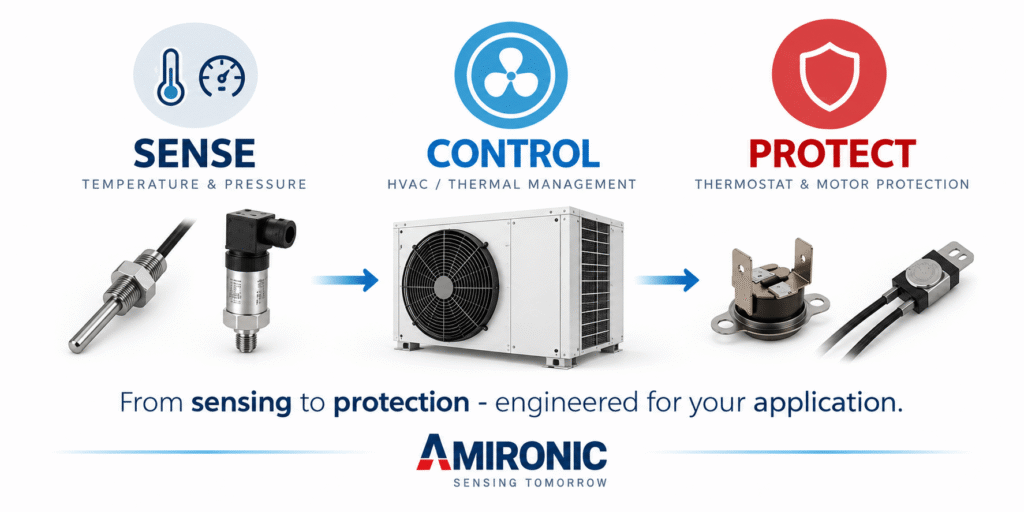
Modern HVAC/R systems rely on multiple layers of sensing, control, and protection. Air temperature is only part of the picture: the operating conditions of the refrigeration circuit must also be monitored, motors and blowers need protection against overheating, and in certain locations an independent layer of thermal protection may be required that does not rely on software or the main controller.
Therefore, when designing an air-conditioning or refrigeration system, the question is not simply which temperature sensor to choose, but what function is required at each point in the system:
- Is continuous temperature measurement required for a controller or PLC?
- Is a switching or shutdown action at a defined temperature required?
- Does the fan or blower motor need protection against overheating and overload?
- Is continuous pressure measurement required as part of the control system?
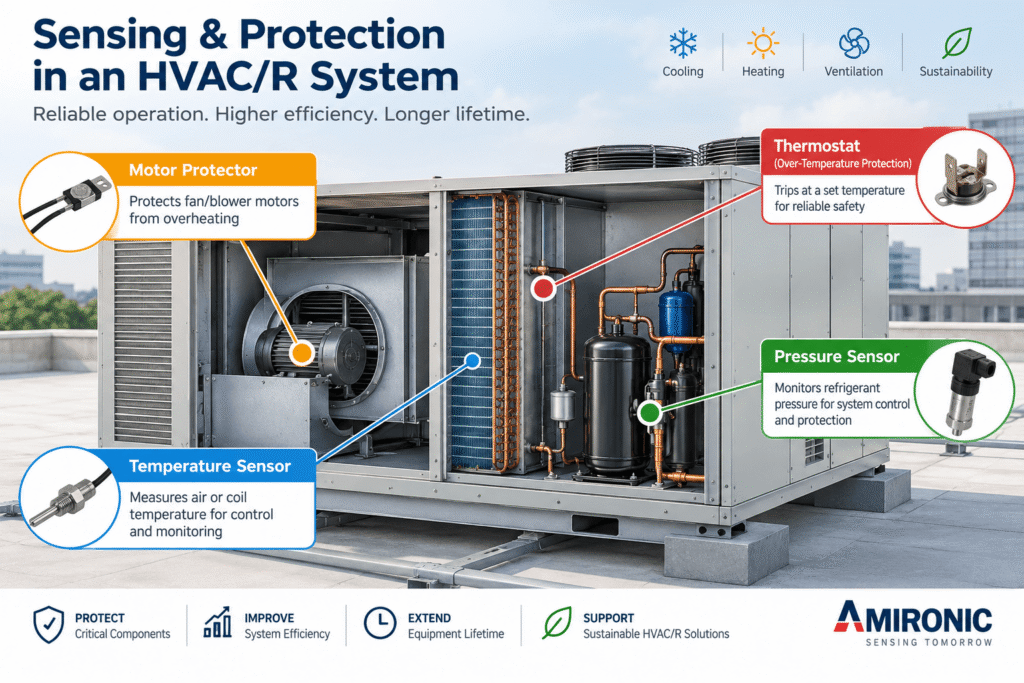
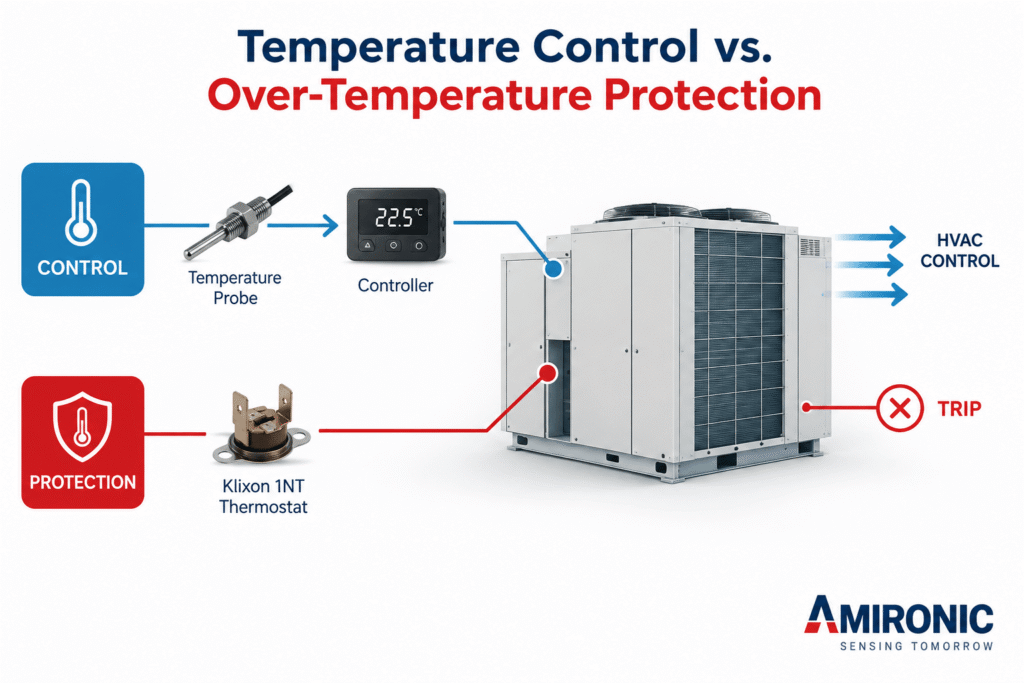
The distinction between these functions is important. A Temperature Sensor, Thermostat, and Thermal Motor Protector may all respond to temperature, but they do not perform the same function.
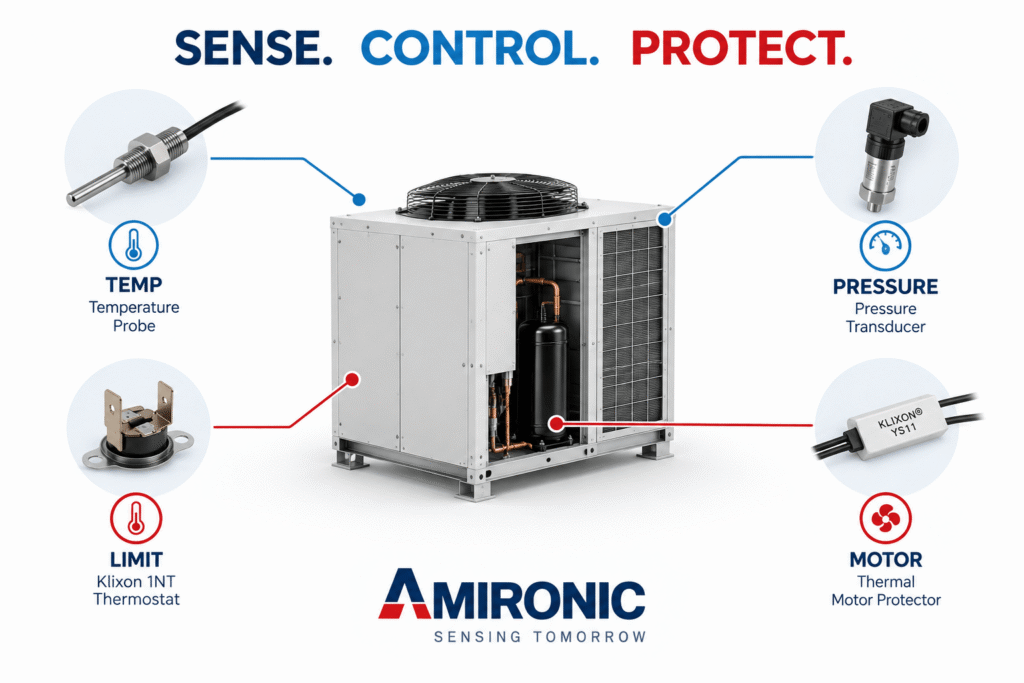
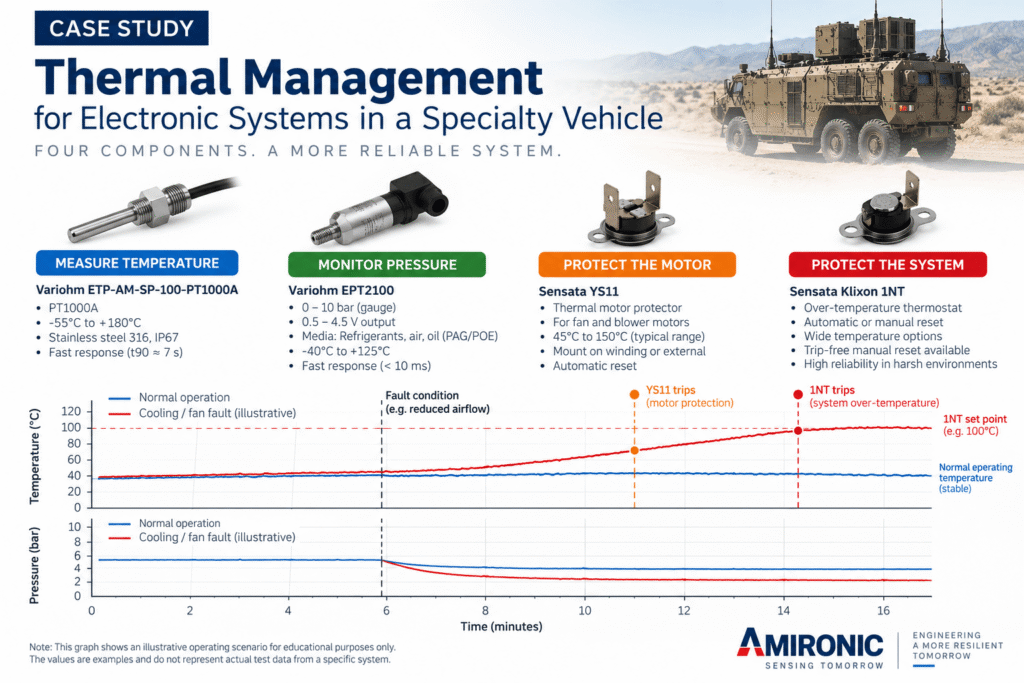
For example, the Klixon 1NT family is designed, among other applications, for HVAC equipment and can be used as a Regulating Thermostat or as an Over-Temperature Safety Switch. It is based on a factory-calibrated bimetal disc and is available in Automatic Reset, Manual Reset, Trip-Free Manual Reset, and One-Shot configurations.
By contrast, when the control system needs to know the actual temperature, rather than simply react when a threshold is reached, a Temperature Sensor such as an NTC, PT100, or PT1000 is required. Different mechanical configurations are available for surface mounting, threaded installation, insertion into a pipe, or measurement at other points in the system. For example, our range of temperature sensors includes Screw-In versions based on NTC or PT100/PT1000 elements, with temperature ranges suitable for a variety of industrial applications.
Motor protection is another separate function. A device such as the Klixon YS11 is designed as a Thermal Motor Protector / Thermal Cut-Out and can be installed on the motor winding or externally, depending on the motor design. The manufacturer specifically identifies fan motors among its applications, with an operating temperature range of 45°C to 150°C.
Alongside these functions, a Pressure Transducer allows the control system to receive continuous pressure measurements instead of relying only on a binary contact opening or closing event. For OEM applications, pressure sensors are available in a variety of ranges, including solutions for low-pressure measurement and ranges extending to tens of bar.
In other words, a single HVAC/R system may incorporate several components operating in parallel, with each addressing a different layer of the system:
Temperature Sensor → Measurement and Control
Thermostat → Switching or Over-Temperature Protection
Motor Protector → Local Motor Protection
Pressure Sensor → Pressure Monitoring and System Control