flagעברית
flagEnglish
3 Rabinovich St., Petah-Tikva, Israel
+972 3 9047744
office@amironic.co.il
Facebook
Twitter
LinkedIn
YouTube
  • Products
    • MEMS Inertial
      • Gyros & Accels
      • IMU
      • Inertial Navigation
      • AHRS
    • Circuit Breakers
      • Airpax Circuit Breakers
      • Electronic Circuit Breakers
      • Aircraft Circuit Breakers
      • Thermal Circuit Breakers
      • Sealing Solutions & Guards
    • Footswitches
      • Pedals & Bellows
      • USB
      • Air Switches
      • Medical
      • Modular Bases System
      • Industrial
      • Foot Potentiometers
      • Wireless
    • Mechanical & Transmisions
      • Gears
      • Sealing Solutions
      • Gearboxes
      • Couplings
      • Shafts & Bearings
      • Fasteners
      • Mechanical & Springs
      • Linear Motion
      • Anti-Vibration
    • Sensors
      • Thermostats
      • Temperature
      • Position
      • Pressure
      • Speed
      • Level Sensor
      • Load Cells
      • Flex Sensors
      • Membrane Potentiometer
    • Motors
      • Geared DC
      • Brushless DC
      • Step Motors with Gearbox
      • Torque Motors & Brushless Servo
      • DC Motors
    • Electronics
      • Xenon & IR Lamps
      • Counters & Meters
      • Microelectronics Packaging
      • Waterproof Switches
      • Micro Switches
    • Hand Control
      • Operator Controls (JOYSTICK)
      • Electrical
      • Pneumatic (Medical)
      • USB Hand Control
      • Air Push Button
      • Pressure Switch
      • IR Switch
    • Power Solutions
      • Rugged & Military Power Supply
      • Input Power Protection
      • Sealed Military Power Adaptor
      • Triple Output Military Power Supply Series – up to 250 W
    • Materials
      • Molybdenum and Advanced Alloys (TZM, MOLA, HCT)
      • Tungsten (Wolfram) and Advanced Alloys – High-Performance Materials for Extreme Conditions
      • Materials for Gears
  • Shop
  • Companies
  • About Amironic
  • News
  • Contact
Product was added to your cart

Cart

waze

Filter Monitoring in Fume Extraction Systems – Detecting Filter Clogging with Pressure & Vacuum Switches

Pressure Switch, Vacuum Switches23/09/2026amironicLTD

Extraction, filtration, and fume extraction systems are used across a wide range of industrial applications in Israel – from soldering stations and electronics manufacturing to laser and CNC machines, filtration equipment, laboratory systems, and OEM machinery.

In these systems, it is relatively easy to determine whether the blower is running. The more important question is:

Is the system still delivering the airflow it was designed to provide?

A filter that is gradually becoming clogged does not necessarily cause the system to stop operating immediately. The blower may continue to run, the system may sound normal, and everything may appear to be working – while in reality, resistance to airflow is increasing and extraction performance is gradually decreasing.

One relatively simple way to detect this change is by using a Pressure Switch or Vacuum Switch to monitor pressure conditions at a defined point in the system and provide an electrical signal when a predetermined threshold is reached.

Why Is a Clogged Filter a Pressure Problem, Not Just a Maintenance Issue?

When air passes through a clean filter, the filter creates a certain resistance to airflow. Over time, dust, particles, fumes, and other process contaminants accumulate on the filter.

As the filter becomes clogged, its resistance to airflow changes.

Depending on the system design and the location of the measurement point, this can appear as a change in Pressure, Vacuum, or Differential Pressure.

There is therefore no universal rule stating that “a clogged filter causes pressure to increase” or, alternatively, that it “causes vacuum to decrease.” The meaning of a pressure change depends on the system architecture and where the measurement is taken.

In a properly characterized system, this change can be used as an indication of filter condition.

Rather than waiting for extraction performance to deteriorate significantly, a switching point can be defined at which a Pressure or Vacuum Switch changes contact state and sends a signal to a controller, warning indicator, or control system.

Why Is This Particularly Relevant to OEM Systems in Israel?

Israel has a significant number of companies developing and manufacturing low- to medium-volume systems, including medical and laboratory equipment, automation machinery, electronic systems, production equipment, and specialized OEM machines.

In many of these applications, there is no need for a complex system that continuously measures pressure.

The requirement can be much simpler:

When the filter condition moves outside the defined operating range – give me a signal.

In such an application, a mechanical or electromechanical Pressure/Vacuum Switch can provide a practical solution. There is not necessarily a need for a Pressure Transducer, analog signal, A/D conversion, and software to interpret the measurement.

The Switch performs a simple function: when pressure reaches the selected Setpoint, the electrical contact changes state.

Herga offers several product families intended for these types of applications, including Pressure, Vacuum, and Differential Pressure Switching, with options for Factory Set or Adjustable Setpoints.

For example, the HPS-500-G series is designed for high-sensitivity Pressure, Vacuum, and Differential Pressure Switching, with operating ranges starting as low as 0.25-1.25 mbar, followed by higher ranges depending on the version.

The HPS-600-V series, designed for Vacuum Switching, includes ranges such as 5-20 mbar, 20-37 mbar, 37-189 mbar, and 189-964 mbar, with either fixed or adjustable actuation settings available.
How Do You Choose the Right Measurement Point?

Selecting a Pressure or Vacuum Switch does not start with a part number. Before choosing the component, you first need to understand exactly what you want to detect in the system.

In a typical Fume Extraction system, pressure conditions vary at different points: at the extraction point, upstream of the filter, downstream of the filter, and near the blower. The meaning of a pressure reading therefore depends on where it is measured.

If the objective is to detect a reduction in extraction performance, it may be possible to monitor the Vacuum level at a selected point and identify when it moves outside the normal operating range.

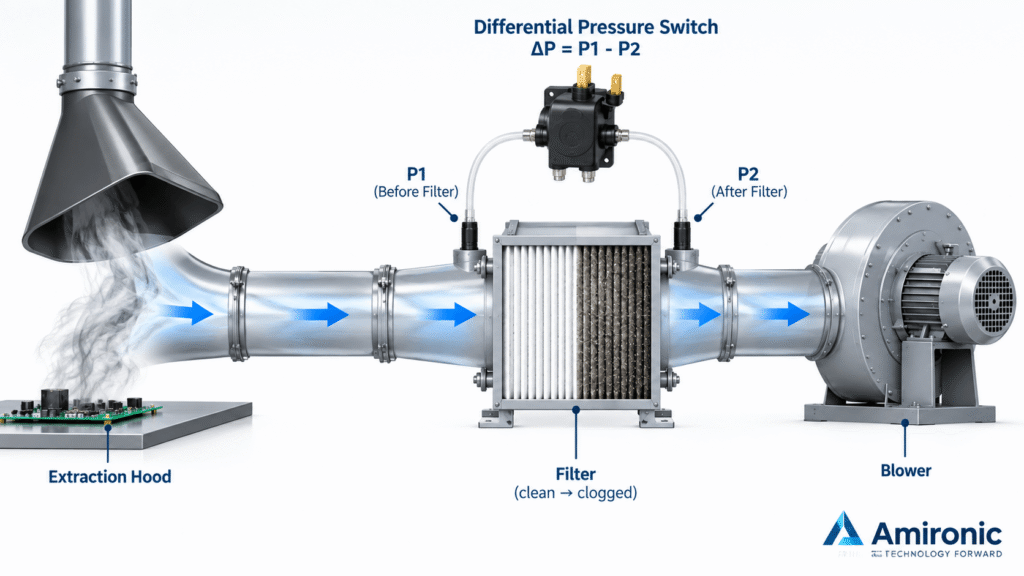
If the objective is to monitor the condition of the filter more directly, the Differential Pressure across the filter can be measured. As particles accumulate in the filter, its resistance to airflow changes, and the pressure differential changes accordingly.

For this reason, when designing a new system, it is good practice to first measure the actual pressure conditions with a clean Filter and again with a Filter representing the desired maintenance point. Only then should the operating range and Switch Setpoint be selected.

Pressure Switch, Vacuum Switch, or Differential Pressure Switch?

The three terms describe similar, but not identical, applications.

A Pressure Switch is suitable when the objective is to detect pressure relative to the switch reference pressure.

A Vacuum Switch is used when the operating point is below atmospheric pressure.

A Differential Pressure Switch responds to the difference between two pressure points. In Filter Monitoring applications, this can provide a direct way to monitor changes in filter resistance.

There is no need to select a more complex solution than the application requires. If the system only needs a binary indication, such as FILTER OK / FILTER SERVICE, a Switch may be sufficient. If continuous measurement, pressure display, data logging, or advanced maintenance algorithms are required, a Pressure Transducer may be more appropriate.

Case Study – Filter Monitoring in a Fume Extraction System for an Israeli OEM Machine

Consider a typical Israeli machine manufacturer.

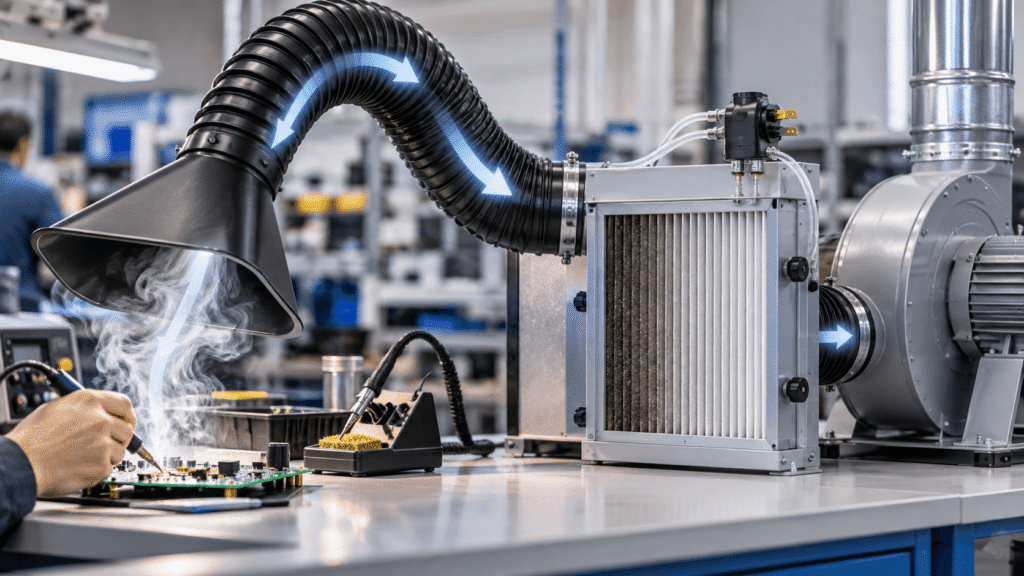
The machine includes a process that generates fumes or particles, such as soldering, thermal processing, marking, or cutting. A local Hood extracts the contaminated air, which passes through a Filter and then through a Blower.

The machine designer’s requirement is simple:

There is no need to know that the pressure is exactly 8.7 mbar. What matters is knowing when the extraction system moves outside its defined operating condition.

In this case, a Pressure/Vacuum Switch can be set to an appropriate actuation point. When the pressure condition reaches the Setpoint, the electrical contact changes state and the controller can trigger:

  • Filter Service / Replace Filter indication
  • Warning light or Buzzer
  • HMI message
  • An Interlock for a process that should not continue under inadequate extraction conditions
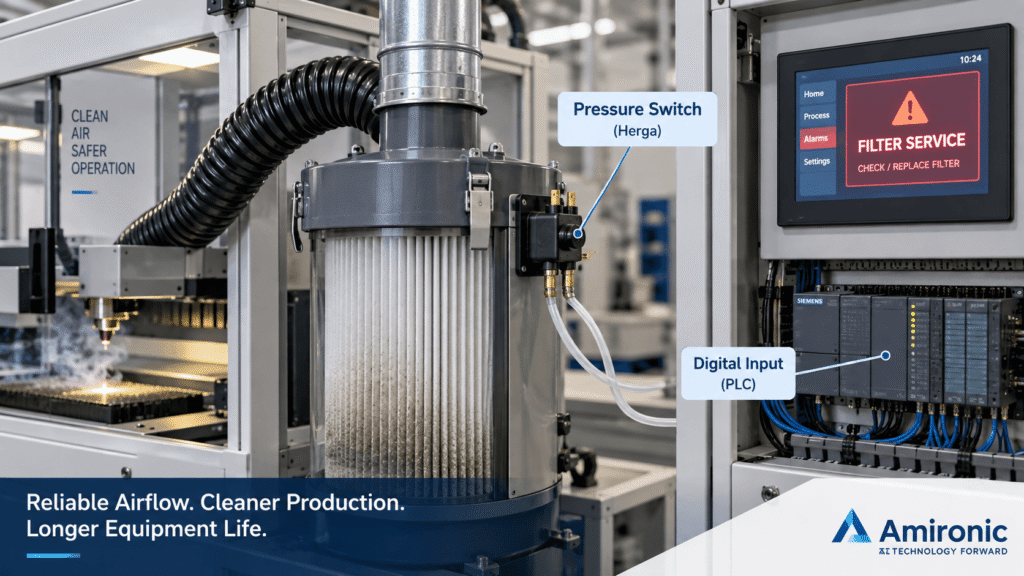
  • Digital Input to a PLC or machine controller

The advantage is that the Threshold decision is made at the component level, without necessarily requiring an analog input or software-based interpretation of the pressure value.

What If the Pressure Levels Are Very Low?

This is particularly important in Airflow and Filtration systems.

Not every Pressure Switch is designed to operate at very small pressure differentials. In a system where a change of only a few mbar is significant, the selected component must be designed for this level of sensitivity.

For example, the Herga HPS-500-G family includes very low operating ranges:

0.25-1.25 mbar
1.25-5 mbar
5-25 mbar

with additional versions covering higher ranges up to 1370 mbar.

The series is designed for Pressure, Vacuum, and Differential Pressure Switching, offers Factory Set or Adjustable Actuation Setpoints, and is suitable for integration into compact OEM systems.

For Vacuum-based applications, the HPS-600-V family offers ranges including 5-20 mbar, 20-37 mbar, 37-189 mbar, and 189-964 mbar. Different configurations are available, including fixed or adjustable actuation settings.

For the designer, the important point is that a Pressure Switch should not be selected simply because it is described as a “Vacuum Switch.” The actual operating pressure range of the extraction system is one of the first parameters that should be defined.

What Should Be Defined Before Selecting a Pressure or Vacuum Switch?

Once you have defined what needs to be detected and where the measurement will be taken, you can move on to selecting the component itself.

The first parameter is, of course, the pressure range and Actuation Point, but it is not the only one. When designing an OEM system, it is also important to consider actuation accuracy, Hysteresis, contact configuration, electrical load, operating temperature, pneumatic connection, and the materials exposed to the media.

Fixed Setpoint or Adjustable Setpoint?

In a system manufactured in volume, it may be possible to define a fixed actuation point in advance. During the development stage, however, or when different Filters, tubing lengths, or Blowers may be used, the ability to adjust the Setpoint can be extremely useful.

For example, the HPS-600-V family provides Vacuum Switching with either a Factory Set or Adjustable Actuation Setpoint. Its compact design also makes it suitable for OEM applications.

It is important to remember that the Setpoint should not simply be selected arbitrarily from a catalogue. Ideally, it should be based on measurements taken from the actual system:

New Filter → Normal Operation → Loaded Filter → Desired Maintenance Point

Only after this operating window is understood can the appropriate Switch and pressure range be selected.

What About the Electrical Signal?

Here too, it is important to distinguish between Sensing and Switching.

If the Switch is connected to a digital input on a PLC or Controller, the electrical current may be very low. In such cases, the contact material and appropriate electrical rating become important considerations.

For example, the HPS-600-V is available with Gold Contacts intended for reliable operation in low-voltage and low-current applications.

The 6721 series can also be supplied with Gold Contact options for very low-power circuits.

On the other hand, there is little reason to select a High Current device when all that is required is a Dry Contact for a controller. Conversely, if the Switch is intended to switch a load directly, its Electrical Rating must be verified rather than selecting the component based on pressure specifications alone.

Another Option: Herga 6721/6722 Vacuum Switch

For systems requiring a more conventional Vacuum Switch, the Herga 6721/6722 family provides several Vacuum ranges:

7.5-20 mbar
17.5-37 mbar
32-80 mbar
70-200 mbar
185-670 mbar

depending on the version.

The series is designed for OEM manufacturers requiring high reliability, while the 6722 version provides Double Pole Switching.

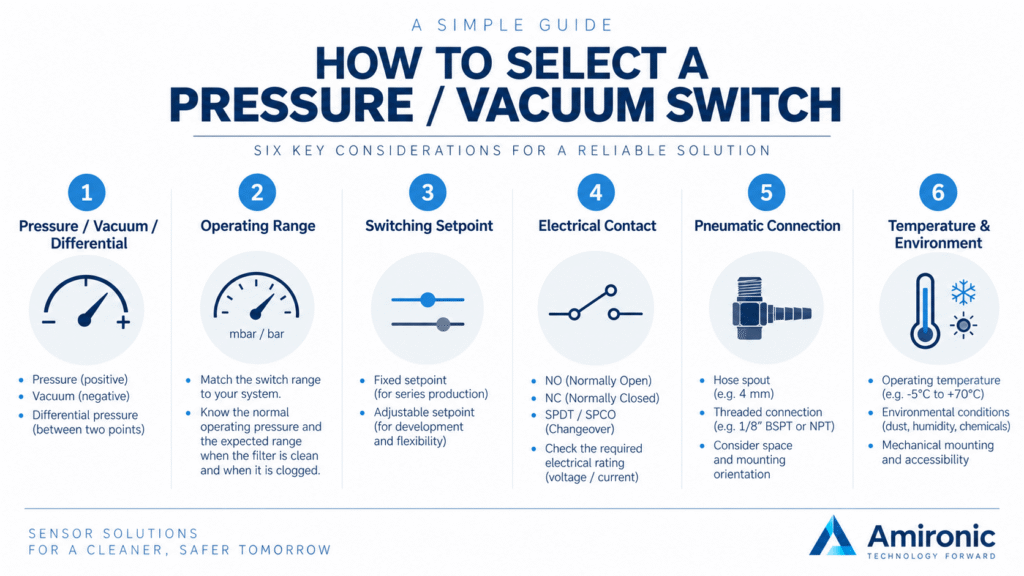
Connection options include Back or Side Entry with a 4 mm spout, as well as 1/8″ BSPT or NPT connections. The specified operating temperature range is -5°C to +70°C.

These details may seem minor during component selection, but they can become very important in machine design: Is there enough space for the tubing? From which direction does it approach the Switch? Is a threaded connection required? Can the component be replaced in the field without dismantling a significant part of the machine?

Not Every System Needs a Sensor

It is easy to assume that every parameter in a modern machine should be measured by a Sensor and transmitted to a controller.

But if the actual requirement is simply:

“When the pressure reaches a certain value – give me a contact.”

a Pressure/Vacuum Switch may be the simpler solution.

There is no complex Signal Conditioning, no need to read an analog value, and no need to write software that decides whether 8.2 mbar is acceptable while 10.6 mbar means the Filter should be replaced.

The decision is made by the Switch’s actuation point.

On the other hand, if the objective is to monitor the rate of filter loading over time, implement Predictive Maintenance, display a pressure value on an HMI, or store Historical Data, a Pressure Transducer becomes much more relevant.

In other words, the question is not “Switch or Sensor – which is better?” but rather what information does the control system actually need?

Case Study – How Should the Engineering Requirement Be Defined?

Consider an Israeli manufacturer developing a compact Extraction system for a machine.

Instead of sending a supplier a general request such as:

“We need a vacuum switch for filter monitoring.”

it is much more useful to define at least:

  • Whether the measurement is Pressure, Vacuum, or Differential Pressure
  • Pressure under normal operating conditions with a new Filter
  • Pressure at the point where a Filter warning should be triggered
  • Whether a Fixed or Adjustable Setpoint is required
  • Required contact configuration – NO, NC, SPST, or SPDT/SPCO
  • Voltage and current to be switched
  • Operating temperature
  • Pneumatic connection type and size
  • Any size or mounting-orientation limitations

With this information, the requirement moves from “we need a Vacuum Switch” to an engineering specification that can be used to select the appropriate component.

This is particularly important in OEM projects: do not select the Switch first and only then determine the system Setpoint. Characterize the system first, then select the Switch accordingly.

Applications Relevant to Israeli Industry

Although the principle is the same, Filter Monitoring is not limited to large Fume Extraction systems. In Israel, similar requirements can be found across a wide range of systems and machines where extraction performance or airflow affects the process.

Typical applications include:

  • Soldering stations and electronics manufacturing – extraction of fumes and particles from the work area.
  • Laser and marking machines – removal of fumes and particles generated during cutting, engraving, or marking.
  • CNC machines and machining processes – Extraction and filtration systems selected according to the material and process.
  • Medical and laboratory equipment – systems where monitoring extraction, Vacuum, or Filter condition is part of the machine’s operation.
  • Industrial cabinets and machinery – monitoring air filters where clogging may affect cooling or airflow.
  • Dust Extraction systems – for example, processes involving wood, powders, or other particle-generating materials.
  • Special-purpose OEM systems – where the manufacturer requires a simple and reliable indication that pressure or vacuum conditions have moved outside the defined operating range.

The requirements can be very different in each of these applications. There is therefore no single “Vacuum Switch for filter monitoring” that is suitable for every system.

Time-Based Maintenance or Filter Condition-Based Maintenance?

One of the interesting reasons for integrating a Pressure/Vacuum Switch is the possibility of moving beyond maintenance based solely on operating time toward Condition-Based Maintenance.

Suppose the maintenance instructions specify Filter replacement every 500 operating hours.

In practice, two identical Filters can be in very different conditions after 500 hours. One machine may operate in a relatively clean environment, while another may be used in a process that generates a high concentration of particles.

Replacement based solely on operating hours can therefore lead to two undesirable situations: replacing a Filter that still has useful service life remaining, or continuing to operate with a Filter that is already affecting system performance.

Monitoring pressure conditions does not necessarily replace the maintenance schedule defined by the machine manufacturer, but it can add an indication based on the actual condition of the system.

That is the principle of Condition-Based Maintenance in this application: instead of asking only how long the Filter has been installed, we also ask whether actual system conditions indicate that maintenance is required.

What About the Herga 6731/6732?

When a Low Pressure Switch with broader electrical switching capability is required, the Herga 6731/6732 family can also be considered.

The series is designed primarily for OEM manufacturers requiring high reliability. The 6732 version provides Double Pole Switching, and several Microswitch options are available.

The family includes three main pressure ranges, depending on the version:

6731-03: 4-18 mbar
6731-06: 12.5-62 mbar
6731-10: 50-1137 mbar

Connections are available with a 4 mm spout or 1/8″ BSPT/NPT threaded connections, and the specified operating temperature range is -5°C to +70°C.

Gold Contact options are also available for very low-power circuits.

Not every one of these specifications will be relevant to every application, but they demonstrate why a requirement such as “I need a Pressure Switch for a few mbar” is not sufficient when selecting a component for series production.

Questions to Ask During the Design Stage

Do I Want to Know That the Blower Is Running, or That Extraction Is Effective?

These are two different requirements.

It is possible to know that the Blower motor is powered while still not knowing whether the Filter is clogged, a hose has become disconnected, or the actual airflow is sufficient.

The first step should therefore be to define the Failure Mode that needs to be detected, rather than simply deciding which component should be monitored.

Where Should the Pressure Be Measured?

The measurement point should be selected according to the system architecture. A Pressure Switch installed upstream of the Filter does not necessarily provide the same information as a Switch installed downstream.

When the objective is to monitor the resistance of the Filter itself, a Differential Pressure measurement across the Filter can be an appropriate solution.

What Should Happen When the Setpoint Is Reached?

The answer is not always simply “Alarm.”

In one system, the requirement may only be to illuminate a FILTER SERVICE indicator. In another, a message may be displayed on the HMI. In a machine where adequate airflow is essential to the process, the signal may also form part of an Interlock.

The required control logic and safety level should, of course, be determined as part of the overall system design rather than relying on a Pressure Switch alone.

Should the Setpoint Be Adjustable?

During the Prototype stage, an Adjustable Setpoint can allow the engineer to experiment and determine the appropriate operating point.

Once the system has been characterized and moves into series production, a Factory Setpoint may instead be preferable in order to achieve consistency between units and reduce the possibility of incorrect adjustment in the field.

An Important Point – A Pressure Switch Is Not an Airflow Sensor

This distinction is important.

A Pressure/Vacuum Switch does not directly measure airflow. It responds to pressure or differential pressure.

In a properly designed and characterized system, changes in pressure can be used as an indication of airflow conditions, filter clogging, or other system conditions. However, the relationship between Pressure and Airflow depends on the Blower, Filter, ducting, openings, and other characteristics of the system.

Therefore, when the engineering requirement is to measure Airflow accurately, an appropriate airflow measurement solution should be considered.

On the other hand, when the requirement is a defined Switching Point – for example, detecting when a Filter reaches the level of loading defined for maintenance – a Pressure/Vacuum Switch can provide a simple and effective solution.

Which Herga Pressure/Vacuum Switch Is Suitable?

There is no single answer based on the application name alone.

The choice between the HPS-500-G, HPS-600-V, 6721/6722, 6731/6732, or another solution should be based on the actual operating conditions of the system.

The most important information for starting the selection process is:

Pressure / Vacuum / Differential Pressure + Operating Range + Required Setpoint + Electrical Contact + Connection + Temperature

In many cases, a photo of the system, a basic pneumatic diagram, and pressure measurements under normal operating conditions and with a loaded Filter can significantly narrow down the available options.

Proper Design Starts with the System, Not the Catalogue

A Pressure Switch or Vacuum Switch may be a relatively small component within an extraction system, but its selection should be based on the behavior of the system as a whole.

Before defining a part number, it is important to understand how the system behaves with a new Filter, how pressure conditions change during operation, and at what point an alert should be provided to the operator or controller.

In many cases, the best way to establish this is simply to measure the system.

The system can first be operated with a new Filter and the Pressure or Vacuum measured at the intended monitoring point. The same measurement can then be taken with a Filter representing the desired maintenance condition. The difference between these operating conditions provides a much better basis for defining the Setpoint than selecting a theoretical value from a catalogue.

Possible variations between machines should also be considered. Tubing length and diameter, Filter type, Blower performance, the number of extraction points, and even tubing installation can influence pressure conditions.

Once the system has been characterized, a suitable Pressure/Vacuum Switch range and actuation point can be selected for consistent use across a production OEM system.

Not Just Filter Clogging

Although this article focuses on clogged Filters, the same principle can be used to detect other system conditions.

For example, an abnormal change in Vacuum may indicate a tubing problem, a disconnected Hose, a blockage, a change in extraction conditions, or another issue affecting the resistance of the system.

However, a Pressure Switch does not know why the pressure has changed.

It only knows that the pressure condition has reached its actuation point.

If the same pressure change can be caused by several different faults, this should be taken into account in the control logic. In some systems, a general message such as CHECK EXTRACTION SYSTEM may therefore be more appropriate than a specific REPLACE FILTER warning.

This distinction is particularly important when a Pressure/Vacuum Switch is used as part of a diagnostic system rather than simply as an indication for periodic maintenance.

Summary – A Simple Component That Can Provide Valuable System Information

A Fume Extraction system should not be evaluated only by whether the Blower is running. What ultimately matters is whether the system continues to operate within the conditions for which it was designed.

As a Filter becomes clogged, its resistance to airflow changes, which can affect the system’s Pressure, Vacuum, or Differential Pressure conditions. Monitoring this change can provide an indication that maintenance is required before extraction performance deteriorates significantly.

Where continuous measurement, Trending, or Predictive Maintenance is required, a suitable Pressure Transducer or Sensor can be used. But when the requirement is simpler – detect when the system crosses a defined Threshold and provide a Signal – a Pressure or Vacuum Switch can offer a simple and effective solution.

The Herga Technology Pressure & Vacuum Switch families include solutions for different pressure ranges, including Low Pressure, Vacuum, and Differential Pressure applications, with various Setpoint, electrical contact, and mechanical connection options.

In a properly designed OEM application, selection should not begin with the question, “Which Pressure Switch is available in the catalogue?” Instead, it should begin with three questions:

What do we want to detect, where are we measuring it, and what should happen when the system reaches the actuation point?

Once these three questions are clearly defined, the component can be selected to suit the system – rather than designing the system around the component.


Frequently Asked Questions – FAQ

What Is the Difference Between a Pressure Switch and a Vacuum Switch?

Both devices perform a Switching action when a defined pressure point is reached. A Pressure Switch is generally used to detect pressure relative to its reference pressure, while a Vacuum Switch is intended for operating conditions below atmospheric pressure. Some product families can also be used for Pressure, Vacuum, or Differential Pressure applications.

Can a Vacuum Switch Detect a Clogged Filter?

Yes, when properly integrated into the system. Particle accumulation changes the resistance of the Filter and may therefore cause a change in Vacuum or Pressure at the measurement point.

The system should first be characterized to determine which pressure change corresponds to the desired maintenance condition.

What Is Differential Pressure and Why Is It Useful for Filter Monitoring?

Differential Pressure is the difference in pressure between two points.

When pressure is measured upstream and downstream of a Filter, the differential can provide an indication of the resistance created by the Filter. As the Filter condition changes, the Pressure Drop across it may also change.

Does a Pressure Switch Measure Airflow?

No. A Pressure Switch responds to pressure and does not directly measure airflow.

In a characterized system, pressure can be used as an indication of airflow conditions or Filter condition. If actual Airflow measurement is required, an appropriate airflow measurement technology should be selected.

What Is the Difference Between a Pressure Switch and a Pressure Sensor or Transducer?

A Switch typically provides a change in electrical contact state when a defined Setpoint is reached.

A Sensor or Transducer provides a continuous measurement signal, allowing the controller to determine the actual pressure at any given time.

If the requirement is simply OK / NOT OK, a Switch may be sufficient. If numerical values, Trending, Data Logging, or Predictive Maintenance are required, continuous pressure measurement will generally be more appropriate.

What Is an Adjustable Setpoint?

An Adjustable Setpoint allows the actuation point of the Pressure/Vacuum Switch to be adjusted.

This can be particularly useful during system development, when operating conditions are still being characterized, or when the same design is used in several different configurations.

When Should a Factory Setpoint Be Used?

Once the operating point is known and the system moves into series production, a Factory Setpoint can provide a predefined actuation point and reduce the need for adjustment on each individual unit.

How Should the Correct Filter Setpoint Be Determined?

The best starting point is measurement of the actual system.

Measure the pressure conditions with a new Filter under normal operating conditions, and then measure them again when the Filter reaches the condition at which maintenance should be performed.

These measurements can then be used to define the appropriate actuation point and Switch range.

Can a Pressure Switch Be Connected Directly to a PLC?

In many cases, yes. A Pressure Switch can be connected to a Digital Input, provided that the contact configuration and Electrical Rating are compatible with the PLC input.

For very low-current circuits, the Contact Material may also be important, and Gold Contacts may be appropriate.

What Do NO and NC Mean?

NO – Normally Open means that the contact is open in its normal state and changes state when the actuation condition is reached.

NC – Normally Closed means that the contact is closed in its normal state and opens when the actuation condition is reached.

The appropriate configuration should be selected according to the control logic and system requirements.

Can a Pressure Switch Be Used as Part of an Interlock?

The signal from a Pressure Switch can be incorporated into the system’s control logic, including an Interlock where appropriate.

However, the safety requirements of the complete system must be considered. A standard Pressure Switch should not automatically be treated as a Safety Device, and a single component should not be assumed to provide the required safety level.

What Pressure/Vacuum Switch Range Is Suitable for a Fume Extraction System?

There is no single range suitable for all Fume Extraction systems. In some systems, a change of only a few mbar may be significant, while others operate at considerably higher pressure levels.

For example, the Herga HPS-500-G family includes ranges starting at 0.25-1.25 mbar and extending into the hundreds of mbar and above, depending on the version.

Selection should therefore be based on actual system measurements and operating conditions rather than the application name alone.

What Information Should Be Provided When Requesting a Pressure/Vacuum Switch?

It is useful to specify whether the application requires Pressure, Vacuum, or Differential Pressure measurement, together with the operating range, required Setpoint, electrical contact configuration, voltage and current, connection type, operating temperature, and any relevant mechanical limitations.

For Filter Monitoring applications, pressure measurements with a clean Filter and at the desired maintenance point can be particularly useful.


Technical Terms

Pressure Switch
A device that changes electrical contact state when pressure reaches a defined actuation point.

Vacuum Switch
A Switch designed to operate under pressure conditions below atmospheric pressure.

Differential Pressure
The difference in pressure between two measurement points. In Filter Monitoring applications, this is commonly measured across the Filter.

Pressure Drop
The reduction in pressure that occurs as air passes through a component that creates resistance to flow, such as a Filter.

Setpoint / Actuation Point
The pressure value at which the Switch changes the state of its electrical contact.

Adjustable Setpoint
An actuation point that can be adjusted to suit the operating conditions of the system.

Factory Set
An actuation point preset during manufacturing according to the product specification.

Hysteresis
The difference between the point at which the Switch actuates and the point at which it returns to its previous state. Hysteresis helps prevent rapid repeated Switching when pressure is close to the Setpoint.

NO – Normally Open
A contact that is open in its normal state.

NC – Normally Closed
A contact that is closed in its normal state.

SPST – Single Pole Single Throw
A basic contact configuration used to open or close a single electrical circuit.

SPDT / SPCO – Single Pole Double Throw / Changeover
A changeover contact that switches between two electrical paths.

Gold Contacts
Gold-plated electrical contacts particularly suited to low-voltage and low-current applications, subject to the component specification.

Fume Extraction
A system designed to remove fumes, vapors, and particles from a process or working area.

Dust Extraction
A system designed to remove dust and particles generated by an industrial process.

Filter Clogging
The accumulation of particles within a Filter, increasing its resistance to airflow and changing the operating conditions of the system.

Filter Monitoring
Monitoring Filter condition using a suitable parameter, such as Pressure or Differential Pressure, to identify when maintenance may be required.

Condition-Based Maintenance
Maintenance performed according to the actual condition of the system or component rather than solely according to a fixed time interval.

Pressure Transducer
A device that converts pressure into a continuous electrical signal, such as an analog output, for measurement and control.

PLC – Programmable Logic Controller
An industrial controller that can receive the state of a Pressure Switch as a Digital Input and use it within the machine’s control logic.

HMI – Human Machine Interface
The machine’s operator interface. For example, an HMI can display a FILTER SERVICE warning when the Pressure Switch changes state.

OEM – Original Equipment Manufacturer
In the context of this article, a manufacturer that integrates the Pressure/Vacuum Switch into a machine or system that it designs and produces.

Tags: Herga

Related Articles

Advanced Solutions for Medical Imaging Control

19/03/2025amironicLTD

The 6773 Double Diaphragm Pressure Switch from HergaPrecision, Safety, and Reliability in Coffee Machines

27/02/2025amironicLTD

Footswitches for Vehicles and Mobile Equipment – When Does Foot Control Make Sense?

16/09/2026amironicLTD

Recent Posts

  • Filter Monitoring in Fume Extraction Systems – Detecting Filter Clogging with Pressure & Vacuum Switches
  • Pressure in HVAC/R Systems – More Than Protection, It’s a Control Variable
  • Heavy Duty Foot Controls for Specialty Vehicles – An Engineer’s Guide to Foot Control Interface Design
  • Switches and Controls for Special Purpose Vehicles – Heavy Duty Controls for Harsh Environments
  • Footswitches for Vehicles and Mobile Equipment – When Does Foot Control Make Sense?

Categories

  • Air Switch
  • Circuit Breakers
  • Elapsed Time Indicator
  • Feedthrough
  • Footswitches
  • Gears & Transmission
  • Hour Meters
  • Infra Red Switches
  • INFRARED LAMPS
  • Low Noise Inertial MEMS
  • Mechanics
  • MEMS Gyroscope
  • MEMS Inertial
  • Microelectronics
  • Motors
  • Position Sensors
  • Power Supply
  • Pressure Sensors
  • Pressure Switch
  • Switches
  • Temperature Sensors
  • Tungsten and Molybdenum
  • Uncategorized
  • Vacuum Switches

Quick Contact

Fill out the form and our representatives will return to you

    Name (required)

    Email (required)

    Phone

    Message

    This site is protected by reCAPTCHA and the Google
    Privacy Policy and
    Terms of Service apply.

    Amironic Ltd.

    3 Rabinovich Street, Petah Tikva 4928144 , Israel. Tel: +972-3-9047744 E-mail: office@amironic.co.il
    Email
    Facebook
    Twitter
    LinkedIn
    YouTube
    Press on the ISO Certificate below for download
    ISO 9001:2015 Certification
    • MEMS Inertial
    • Circuit Breakers
    • Footswitches
    • Mechanical & Transmisions
    • Sensors
    • Motors
    • Electronics
    • Hand Control
    • Power Solutions

    News

    • Filter Monitoring in Fume Extraction Systems – Detecting Filter Clogging with Pressure & Vacuum Switches
    • Pressure in HVAC/R Systems – More Than Protection, It’s a Control Variable
    • Heavy Duty Foot Controls for Specialty Vehicles – An Engineer’s Guide to Foot Control Interface Design
    • Switches and Controls for Special Purpose Vehicles – Heavy Duty Controls for Harsh Environments
    • Footswitches for Vehicles and Mobile Equipment – When Does Foot Control Make Sense?
    About AmironicContactעברית
    © 2022 Amironic All rights reserved. All Trademarks are the property of their respective owners.
    • Increase Font
    • Decrease Font
    • Black & White
    • Inverse Colors
    • Highlight Links
    • Regular Font
    • Reset