flagעברית
flagEnglish
3 Rabinovich St., Petah-Tikva, Israel
+972 3 9047744
office@amironic.co.il
Facebook
Twitter
LinkedIn
YouTube
  • Products
    • MEMS Inertial
      • Gyros & Accels
      • IMU
      • Inertial Navigation
      • AHRS
    • Circuit Breakers
      • Airpax Circuit Breakers
      • Electronic Circuit Breakers
      • Aircraft Circuit Breakers
      • Thermal Circuit Breakers
      • Sealing Solutions & Guards
    • Footswitches
      • Pedals & Bellows
      • USB
      • Air Switches
      • Medical
      • Modular Bases System
      • Industrial
      • Foot Potentiometers
      • Wireless
    • Mechanical & Transmisions
      • Gears
      • Sealing Solutions
      • Gearboxes
      • Couplings
      • Shafts & Bearings
      • Fasteners
      • Mechanical & Springs
      • Linear Motion
      • Anti-Vibration
    • Sensors
      • Thermostats
      • Temperature
      • Position
      • Pressure
      • Speed
      • Level Sensor
      • Load Cells
      • Flex Sensors
      • Membrane Potentiometer
    • Motors
      • Geared DC
      • Brushless DC
      • Step Motors with Gearbox
      • Torque Motors & Brushless Servo
      • DC Motors
    • Electronics
      • Xenon & IR Lamps
      • Counters & Meters
      • Microelectronics Packaging
      • Waterproof Switches
      • Micro Switches
    • Hand Control
      • Operator Controls (JOYSTICK)
      • Electrical
      • Pneumatic (Medical)
      • USB Hand Control
      • Air Push Button
      • Pressure Switch
      • IR Switch
    • Power Solutions
      • Rugged & Military Power Supply
      • Input Power Protection
      • Sealed Military Power Adaptor
      • Triple Output Military Power Supply Series – up to 250 W
    • Materials
      • Molybdenum and Advanced Alloys (TZM, MOLA, HCT)
      • Tungsten (Wolfram) and Advanced Alloys – High-Performance Materials for Extreme Conditions
      • Materials for Gears
  • Shop
  • Companies
  • About Amironic
  • News
  • Contact
Product was added to your cart

Cart

waze

Pressure in HVAC/R Systems – More Than Protection, It’s a Control Variable

Pressure Switch, Temperature Sensors22/09/2026amironicLTD

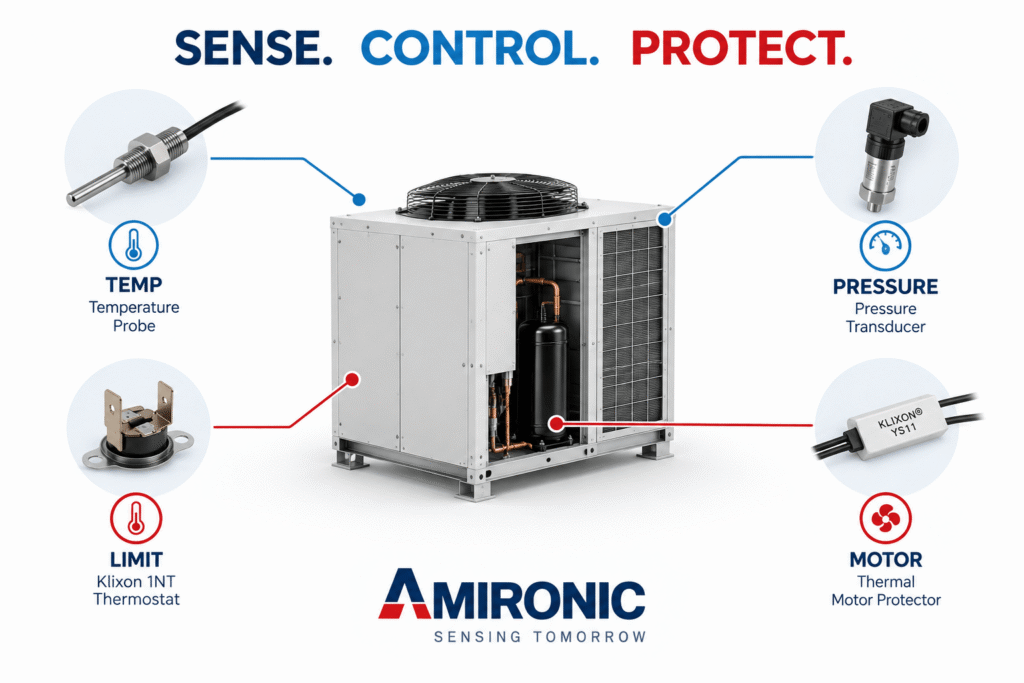
Modern HVAC/R systems rely on multiple layers of sensing, control, and protection. Air temperature is only part of the picture: the operating conditions of the refrigeration circuit must also be monitored, motors and blowers need protection against overheating, and in certain locations an independent layer of thermal protection may be required that does not rely on software or the main controller.

Therefore, when designing an air-conditioning or refrigeration system, the question is not simply which temperature sensor to choose, but what function is required at each point in the system:

  • Is continuous temperature measurement required for a controller or PLC?
  • Is a switching or shutdown action at a defined temperature required?
  • Does the fan or blower motor need protection against overheating and overload?
  • Is continuous pressure measurement required as part of the control system?

The distinction between these functions is important. A Temperature Sensor, Thermostat, and Thermal Motor Protector may all respond to temperature, but they do not perform the same function.

For example, the Klixon 1NT family is designed, among other applications, for HVAC equipment and can be used as a Regulating Thermostat or as an Over-Temperature Safety Switch. It is based on a factory-calibrated bimetal disc and is available in Automatic Reset, Manual Reset, Trip-Free Manual Reset, and One-Shot configurations.

By contrast, when the control system needs to know the actual temperature, rather than simply react when a threshold is reached, a Temperature Sensor such as an NTC, PT100, or PT1000 is required. Different mechanical configurations are available for surface mounting, threaded installation, insertion into a pipe, or measurement at other points in the system. For example, our range of temperature sensors includes Screw-In versions based on NTC or PT100/PT1000 elements, with temperature ranges suitable for a variety of industrial applications.

Motor protection is another separate function. A device such as the Klixon YS11 is designed as a Thermal Motor Protector / Thermal Cut-Out and can be installed on the motor winding or externally, depending on the motor design. The manufacturer specifically identifies fan motors among its applications, with an operating temperature range of 45°C to 150°C.

Alongside these functions, a Pressure Transducer allows the control system to receive continuous pressure measurements instead of relying only on a binary contact opening or closing event. For OEM applications, pressure sensors are available in a variety of ranges, including solutions for low-pressure measurement and ranges extending to tens of bar.

In other words, a single HVAC/R system may incorporate several components operating in parallel, with each addressing a different layer of the system:

Temperature Sensor → Measurement and Control
Thermostat → Switching or Over-Temperature Protection
Motor Protector → Local Motor Protection
Pressure Sensor → Pressure Monitoring and System Control
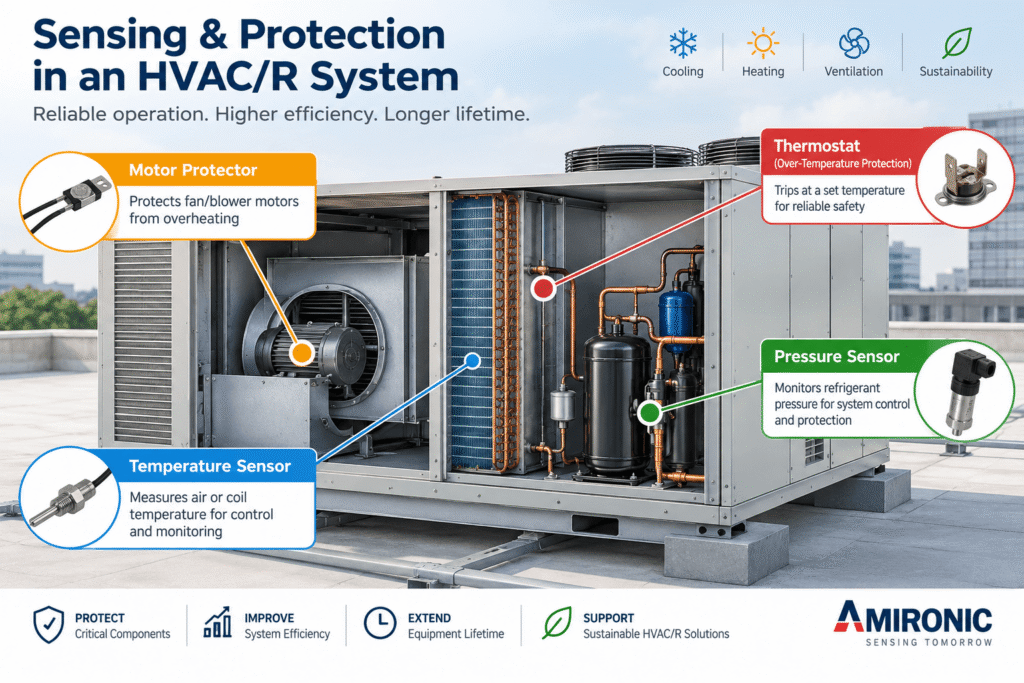
Four Different Layers – Not Four Ways of Doing the Same Thing

The diagram illustrates an important point in HVAC/R system design: sensing and protection components are not necessarily alternatives to one another. In many cases, they complement each other.

A temperature sensor can inform the controller that the temperature is rising. In response, the controller may change the fan speed, start or stop the compressor, generate an alarm, or execute other control logic. However, if independent Over-Temperature Protection is required, a mechanical thermostat can be added to provide a switching action at a predefined temperature.

Similarly, continuous pressure measurement allows the controller to monitor how the system behaves over time, while a Thermal Motor Protector can be positioned where it can respond directly to motor overheating.

This means that good system design should start with the required function rather than the product:

What do we need to measure, what do we need to control, and what must remain protected even in the event of a fault?

Thermostat or Temperature Sensor – What Do You Really Need?

This is one of the key distinctions in an HVAC/R system.

When continuous temperature measurement is required, an NTC, PT100, or PT1000 sensor can provide the temperature value to the controller. The controller then decides what to do with that information.

This approach is suitable, for example, for measuring inlet or outlet air temperature, pipe temperature, coil temperature, heat exchanger temperature, or any other point where the measured temperature is used as part of the control algorithm.

In such applications, the sensor construction can be matched to the actual measurement point. Amironic’s temperature sensor range includes NTC, PT100, and PT1000 sensors in Screw-In, Tubular Probe, and Ring Terminal configurations, as well as IP67 versions and different temperature ranges.

But when the requirement is simpler – for example:

“When the temperature reaches a certain value, open the circuit.”

Continuous measurement is not necessarily required.

This is where the Klixon 1NT Fixed Temperature Thermostat comes in.

The 1NT is based on a bimetal disc that is factory-calibrated to a defined operating temperature. Sensata specifies the series for HVAC applications, among others, both for Regulation and as an Over-Temperature Safety Switch. Depending on the configuration, Automatic Reset, Manual Reset, Trip-Free Manual Reset, or One-Shot operation is available, as well as Normally Open or Normally Closed switching logic in the appropriate versions.

This is more than simply choosing between two types of components. It also makes it possible to create two separate layers of control and protection.

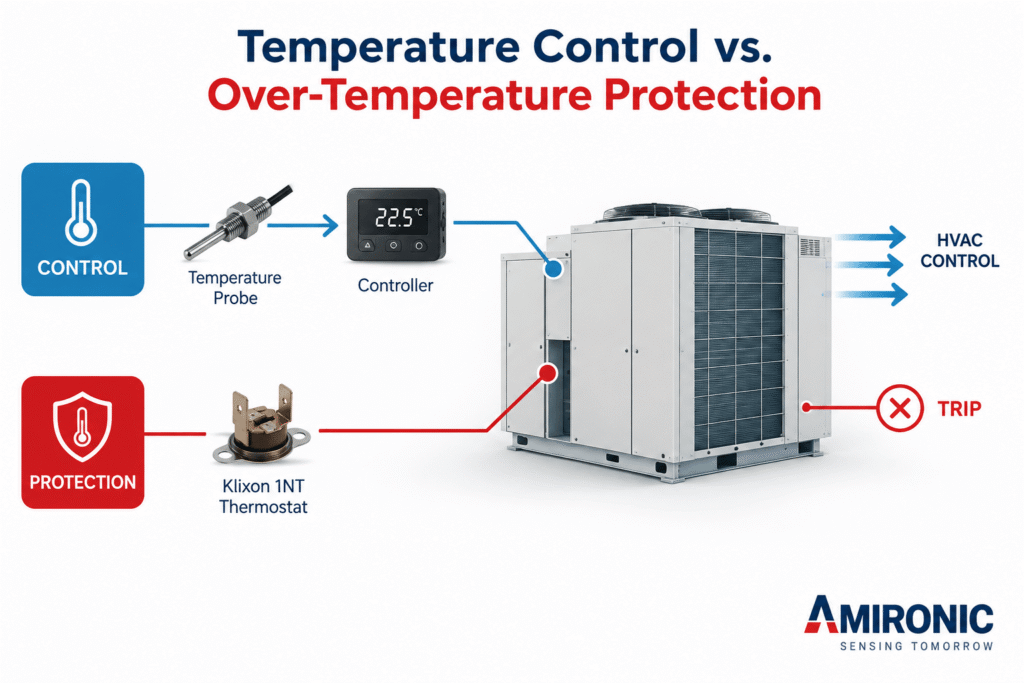
For example, a Temperature Probe can be connected to the main controller and used for normal system control, while a 1NT thermostat can serve as an independent High Temperature Limit. In this configuration, even if there is a problem with the sensor, controller, or software logic, an additional layer of protection remains that does not rely on the same measurement and control chain.

Useful design rule: If the system needs to know what the temperature is, a Temperature Sensor is required. If it needs to perform an action when a defined temperature is reached, a Thermostat may be the simpler and more direct solution. In systems that require both control and a separate layer of protection, both can be used.

Design Example – Control vs. Over-Temperature Protection

Consider a commercial HVAC unit in which the controller must maintain the normal operating temperature, while the manufacturer also wants independent protection against abnormal overheating.

For normal system control, a Temperature Probe can be installed at the appropriate point in the system. The sensor provides continuous temperature measurement to the controller, which operates the system according to the measured value.

At the same time, a Klixon 1NT can be installed at a point where a temperature rise beyond a defined limit may indicate an abnormal condition, with its operating temperature selected according to the system design requirements.

Under normal operating conditions, the thermostat does not participate in continuous temperature control. It is there to perform a different function: to respond when its predefined temperature threshold is reached.

This creates a simple architecture:

Temperature Probe → Controller → Normal HVAC Control

In parallel:

Klixon 1NT → Over-Temperature Protection

The advantage is that the over-temperature protection does not have to rely on the same sensing and control chain used for normal system operation.

HVAC/R Is More Than Building Air Conditioning

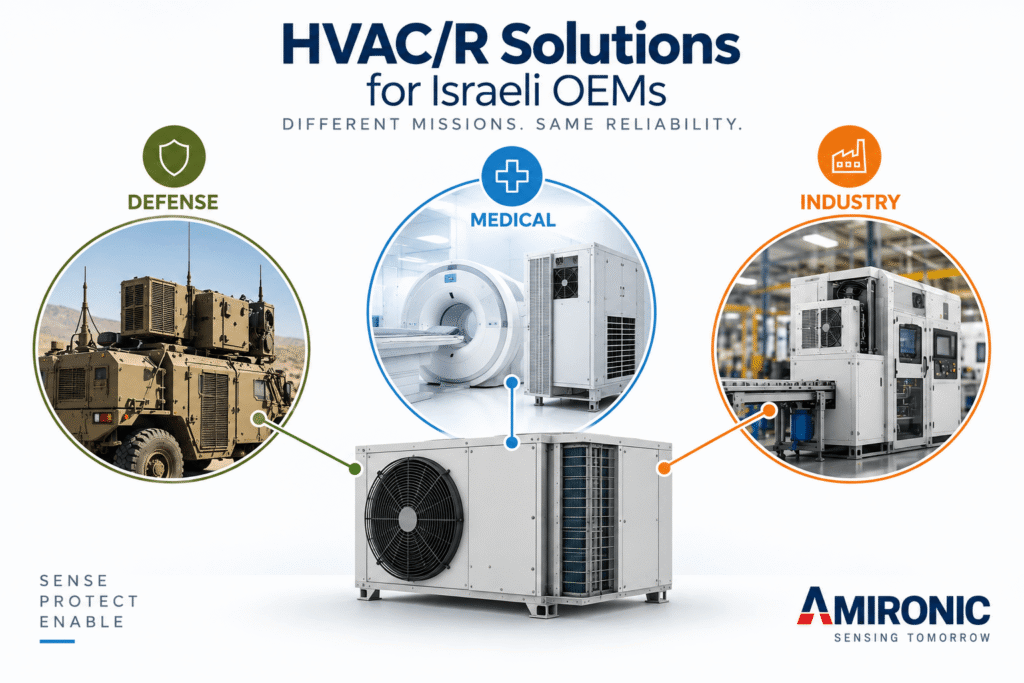
When people think of HVAC, the first thing that often comes to mind is the air-conditioning system in an office, factory, or commercial building. In practice, for equipment manufacturers and OEMs in Israel, temperature control, cooling, and ventilation are found in a much broader range of systems.

In the defense industry, Thermal Management and cooling systems can be found in ground platforms, electronic cabinets and enclosures, communication systems, radar systems, mobile equipment, and mission systems. In the medical industry, temperature control is required in medical and laboratory equipment, as well as in systems incorporating electronics, motors, or cooling units. Similar requirements can be found throughout Israeli industry in machinery, laser systems, production equipment, control cabinets, and specialized OEM systems.

Therefore, even when the system is not called an “air conditioner,” the engineering challenge may be very similar:

Measure temperature and pressure, control the cooling process, and protect critical components in the event of an abnormal condition.

Adapting the Solution to Israeli Applications

In a standard HVAC system, the objective may simply be to maintain a comfortable temperature within a space. In an industrial or defense application, however, exceeding the permitted temperature range may affect sensitive electronics, power supplies, computers, motors, or other equipment within the system.

In a medical application, the priorities may be different: accurate temperature measurement, long-term stability, adapting the sensor construction to the equipment, and sometimes integrating the sensor as an integral part of an OEM assembly. Israel’s Life Sciences industry includes more than 1,800 active companies as of 2025, with Medical Devices and Digital Health representing its largest sectors.

In industrial equipment, the requirement may instead focus on durability, simple installation, a wide temperature range, or independent protection that does not rely on the PLC.

There is therefore no single “HVAC sensor” that fits every system. The selection process begins by asking what exactly needs to be done at the measurement or protection point.

When Measurement Is Required – Temperature Probe

In an OEM system, the sensor can be matched to the mechanical design of the equipment: a Screw-In Probe for measurement at a defined point, a Tubular Probe for measurement within an area or duct, or a Ring Terminal when the sensor needs to be mounted directly onto a surface.

The ability to choose between NTC, PT100, and PT1000, together with different mechanical configurations and temperature ranges, makes it possible to adapt the sensor to the system rather than designing the system around a single off-the-shelf sensor.

When Independent Protection Is Required – Klixon 1NT

In a system where exceeding a defined temperature requires a clear action, a Thermostat can provide a simple and direct layer of protection.

The Klixon 1NT offers a wide ambient temperature range of -40°C to 240°C, multiple mounting options, and different Reset configurations. The operating point of the bimetal disc is factory-set, so this is not a Temperature Sensor that requires the controller to interpret a measurement. Instead, it is a device that performs a switching action at the temperature specified for the application.

This approach is particularly relevant in industrial, medical, and defense systems where the design calls for a separation between Control and Protection.

Fan and Blower Motor Protection

Fans and blowers are often critical components within a cooling system. If airflow stops because of a motor failure, the problem may not be limited to the motor itself – the temperature inside the system can begin to rise and affect other components.

Protection can therefore be implemented as close as possible to the source of the problem.

The Klixon YS11 is a compact Thermal Motor Protector that can be installed on the motor winding or externally, depending on the motor design. It is Self-Resetting and operates over a temperature range of 45°C to 150°C.

For other requirements, the Klixon 7AM family is also available, combining sensitivity to both temperature and current. It is offered with different operating temperatures and is intended, among other applications, for motor protection and thermal protection.

This is an important consideration for OEM designers: it is not always appropriate to wait for the system’s general temperature sensor to detect the consequences of a fault. Where appropriate, protection can be applied directly to the motor itself.

Pressure in HVAC/R Systems – More Than Protection, It Provides Information for Control

After temperature and motor protection, the next key variable in a refrigeration system is pressure.

In an HVAC/R system, pressure at different points in the circuit provides important information about the system’s operating conditions. Unlike a Pressure Switch, which typically provides a binary switching action when a defined threshold is reached, a Pressure Transducer provides the controller with continuous pressure measurement.

This distinction is particularly important in OEM systems. When the controller receives a continuous pressure value, the information can be used not only for an Alarm or Shutdown, but also as part of the control logic, performance monitoring, Diagnostics, and detection of abnormal operating conditions.

Pressure Sensor as Part of the Control System

Consider, for example, a refrigeration system equipped with both a Temperature Sensor and a Pressure Sensor.

The temperature sensor tells the controller the temperature at the selected measurement point. At the same time, the pressure sensor provides information about the pressure conditions within the circuit.

Combining these measurements allows the equipment manufacturer to develop control logic based on the actual operating condition of the system, rather than relying only on ON/OFF commands.

For OEM manufacturers, we offer several Pressure Transducers that can be matched to the required pressure range and system configuration. For example, the EPT2100 and EPT2200 are designed for OEM applications and are available in ranges from 0…0.25 bar up to 40 bar. The EPT2100 features a Stainless Steel housing, while the EPT2200 provides a Cost-Effective solution with a brass housing.

For lower-pressure applications, the EPT8100, for example, is available in ranges starting from 0…0.06 bar up to 10 bar, with a 316L Stainless Steel pressure cell.

Final selection should not be based on the pressure range alone. The media type, media temperature, mechanical pressure connection, output signal, electrical connection, and compatibility with the refrigerant used in the system must also be considered.

This is particularly important in HVAC/R applications: a Pressure Sensor with the correct pressure range is not automatically compatible with every Refrigerant.

Architecture Example – Combining Sensing and Protection in a Thermal Management System

Consider a dedicated cooling system for an electronics enclosure or OEM system. Such an application could be found in defense equipment, communication systems, industrial machinery, or medical equipment.

Rather than selecting a single component and expecting it to address every system requirement, the design can be divided into several separate functions.

A Temperature Probe provides continuous temperature measurement to the controller and forms part of the system’s control logic.

A Pressure Transducer provides continuous pressure measurement within the refrigeration circuit, allowing the controller to monitor the system’s operating conditions.

Alongside these sensors, additional protection layers can be added to perform different functions. A Klixon 1NT can provide Over-Temperature Protection at a point where a switching action is required at a defined temperature, while a Thermal Motor Protector such as the YS11 or 7AM can protect the fan or blower motor directly, according to the motor and application requirements.

Each component therefore answers a different question:

Temperature Probe – What is the temperature now?
Pressure Transducer – What is the pressure now?
Thermostat – Has the temperature reached the threshold that requires action?
Motor Protector – Has the motor itself reached a condition that requires protection?

These are not four different ways of performing the same task. Instead, this is an architecture that separates Monitoring, Control, and Protection, with each layer selected according to the function it needs to perform.

Later in this article, we will apply this principle in a detailed Case Study of a Thermal Management system for a specialty vehicle, using a specific Temperature Probe and Pressure Transducer, YS11 motor protection, and an additional Over-Temperature Protection layer based on the Klixon 1NT.

How Do You Select the Right Component for an HVAC/R System?

Once the four functions – temperature measurement, pressure measurement, over-temperature protection, and motor protection – have been separated, component selection can be approached in a more structured way.

A common mistake is to start with a part number. In OEM design, it is better to start with the system itself: What needs to be measured, what needs to be protected, what potential fault condition could occur, and what should the system do when it happens?

1. What Is Required from the Temperature – Measurement or Switching?

If the controller needs to receive a continuous temperature value, the usual choice will be a Temperature Probe. Once the sensing technology – such as NTC, PT100, or PT1000 – has been selected, the mechanical construction, temperature range, mounting method, cable, and electrical connection must also be defined.

In one system, for example, a Screw-In Sensor mounted directly into the assembly may be required. In another, a Tubular Probe may be more appropriate, while a Ring Terminal configuration can be used when surface temperature needs to be measured.

The available range of temperature sensors makes it possible to match both the mechanical construction and the sensing element to the application, rather than relying on a single general-purpose sensor.

If, on the other hand, a switching action at a defined temperature is required, a Thermostat should be considered. In the Klixon 1NT series, for example, the bimetal disc is factory-calibrated to the required operating temperature, with different configurations available including Automatic Reset, Manual Reset, Trip-Free Manual Reset, and One-Shot.

2. Is Automatic Reset or Manual Reset Required?

This is a particularly important design decision in protection applications.

With Automatic Reset, the thermostat can return to its normal state after the temperature falls, according to the component’s Differential. This may be suitable for applications where restarting the system after it has cooled down is the desired behavior.

In an application where overheating indicates a fault that requires inspection, Manual Reset may be more appropriate. In this case, the system does not return to operation simply because the temperature has fallen – a mechanical Reset action is required.

The 1NT family supports both approaches, allowing the protection logic to be selected as part of the system design rather than considering only the Trip temperature.

3. For Motor Protection – Do Not Select by Temperature Alone

For a Fan or Blower motor, the situation is more complex.

A Thermal Motor Protector is not necessarily just a “small thermostat.” The current flowing through the device also matters, as does the relationship between ambient temperature, motor temperature, and Trip time.

In the YS11 datasheet, for example, Sensata emphasizes that the Rating should be selected according to the motor and with reference to the device’s performance curves. Trip time depends on the operating temperature, while parameters such as Must Hold Current and Short-Time Trip are also part of the selection process.

The same principle applies to the 7AM, which is sensitive to both temperature and current.

For a Motor Protection application, the motor specifications and operating conditions should therefore be evaluated rather than selecting a Protector based only on a statement such as, “I want it to open at 120°C.”

4. What Needs to Be Defined for a Pressure Transducer?

Here too, Range is only the starting point.

When selecting a Pressure Sensor for an HVAC/R system, the required pressure range, measurement type, temperature conditions, mechanical and electrical connections, output signal, and, of course, material compatibility with the media must all be defined.

In refrigeration systems in particular, compatibility with the specific refrigerant must be verified rather than assumed simply because the sensor’s pressure range is suitable.

For OEM applications, various options are available, ranging from Low Pressure sensors to Transducers for significantly higher pressure ranges, allowing the sensor to be selected around the system requirements rather than the other way around.

In Israel, HVAC Is Often Part of the Product

This may be one of the most important points for an Israeli manufacturer.

In an OEM project, the objective is usually not simply to “buy an air-conditioning system.” The cooling or Thermal Management system is a Subsystem within a larger product.

This could be an electronics enclosure for a defense system, medical equipment, a test system, production machinery, communication equipment, or a specialized industrial system.

In such applications, the sensing and protection components must also integrate into the product in terms of dimensions, mounting location, operating ranges, wiring, connectors, and system logic.

For this reason, sensor and protection component selection should ideally be considered during the design stage, rather than only after the mechanical and electrical design has already been finalized.

From Initial Design to Component Selection

Amironic provides sensing and protection solutions for HVAC/R and Thermal Management systems, with the ability to combine Temperature Sensors, Pressure Transducers, Klixon Thermostats, and Thermal Motor Protectors according to the application requirements.

For OEM projects, the measurement or protection point, temperature and pressure ranges, environmental conditions, mechanical configuration, and electrical requirements can be evaluated together to identify a suitable configuration for the system.

The objective is not to add as many sensors as possible.

The objective is to understand what needs to be measured, what needs to be controlled, and what must be protected.

CASE STUDY – Thermal Management for an Electronic System in a Specialty Vehicle

Electronic systems installed in specialty vehicles may include mission computers, power supplies, communication equipment, and other electronics that generate heat during operation. When this equipment is installed inside an enclosed housing or operates under harsh environmental conditions, the Thermal Management system becomes an important part of the overall system design.

Consider a design example of a cooling system incorporating four different layers of sensing and protection.

Note: This is an Application Example intended to illustrate design principles. The temperature and pressure values used in the scenario and graph are illustrative and are not results from testing or from a customer system.

Temperature Measurement – ETP-AM-SP-100-PT1000A

An ETP-AM-SP-100-PT1000A Temperature Probe is installed at a point that represents the thermal condition of the system and is connected to the controller.

The sensor is based on a PT1000A element, features a 316 Stainless Steel construction, and is rated IP67. Its specified operating temperature range is -55°C to +180°C, and the manufacturer specifically identifies demanding Temperature Monitoring applications in vehicles, as well as medical equipment, test machinery, industrial instrumentation, and Process Control systems.

Its role in this application is Measurement: it does not determine whether the system is in a fault condition, but instead provides the controller with continuous temperature information.

Pressure Measurement – EPT2100

An EPT2100 Pressure Transducer is integrated into the refrigeration circuit.

For this example, the EPT2100-H-01000-B-5-A configuration shown in the datasheet can be used: 0-10 bar gauge pressure measurement with a 0.5-4.5V analog output.

The datasheet for this configuration lists Refrigerants, Mineral Oil, PAG, and POE among the applicable media, together with a media temperature range of -40°C to +125°C and a response time of less than 10 ms. Final media compatibility must still be verified for the specific refrigerant and sensor configuration used in the system.

The sensor’s role is Monitoring & Diagnostics: changes in pressure can provide the controller with additional information about the condition of the refrigeration circuit and allow the system logic to respond accordingly.

Local Blower Motor Protection – YS11

Measuring the system temperature does not replace protection of the motor itself.

For this reason, a YS11 Thermal Motor Protector is incorporated into the blower motor. The YS11 is designed for motor protection, including motors used in Fans, and can be installed on the Winding or externally to the motor. The specified operating temperature range for Motor Protection is 45°C to 150°C.

In the event of an abnormal load, blower blockage, or motor overheating, the YS11 provides Local Motor Protection rather than relying solely on the system’s general temperature sensor to detect the effects of the fault at a later stage.

Additional Protection Layer – Klixon 1NT

Finally, a Klixon 1NT can be added at a critical thermal point as an independent Over-Temperature Limit.

Unlike a Temperature Probe, which provides a measured value to the controller, the 1NT is a factory-calibrated bimetal device that performs a switching action when its defined operating temperature is reached. The series is available in configurations including Automatic Reset, Manual Reset, Trip-Free Manual Reset, and One-Shot.

This provides an additional layer of protection that does not rely solely on the controller’s sensing and software.

What Happens When a Fault Begins?

Assume that under normal operating conditions, the system is thermally stable.

At some point, a fault develops in the cooling system or airflow.

The EPT2100 continues to provide the controller with pressure information from the refrigeration circuit, while the ETP-AM-SP-100-PT1000A indicates the gradual rise in temperature.

If the fault causes abnormal heating of the blower motor, the YS11 provides the local motor protection layer.

If the temperature at the protected point continues to rise despite this and reaches the defined threshold, the 1NT provides an additional layer of Over-Temperature Protection.

Each of the four components effectively sees a different aspect of the same event:

ETP-AM-SP-100-PT1000A → Measure Temperature
EPT2100 → Monitor Pressure
YS11 → Protect the Motor
Klixon 1NT → Protect the System

This is the key principle in Thermal Management system design: do not rely on a single component to do everything. Instead, separate Measurement, Diagnostics, and Protection.

Summary – Sensing and Protection Are Part of the Same System

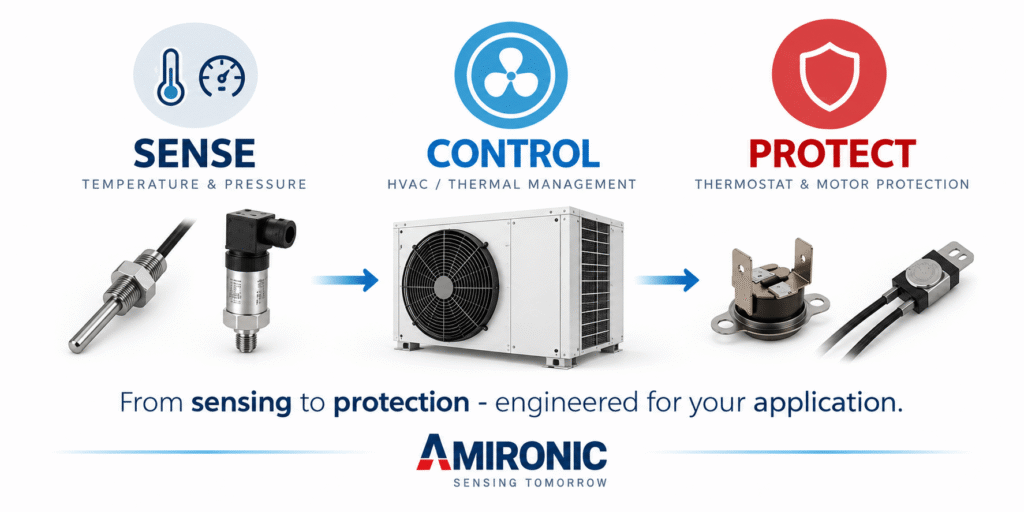
Proper design of an HVAC/R or Thermal Management system involves more than simply selecting a temperature or pressure sensor. In OEM systems, and particularly in industrial equipment, medical equipment, vehicle systems, and defense applications, the system should be considered as a combination of Measurement, Control, and Protection.

A Temperature Probe allows the controller to determine the actual temperature. A Pressure Transducer provides continuous information about pressure conditions within the circuit. A Thermostat can provide an independent switching action in the event of an over-temperature condition, while a Thermal Motor Protector directly protects the fan or blower motor.

The Case Study presented in this article illustrates this principle: the same fault can be detected differently by several components. One sensor measures the change, another provides information about the condition of the refrigeration circuit, while the protection devices are designed to act when conditions exceed the defined limits.

Therefore, the right question at the beginning of a project is not simply “Which Sensor is suitable?”, but:

What do we want to measure, what do we want to control, and what do we need to protect?

Amironic provides a range of Temperature Sensing, Pressure Sensing, and Thermal Protection solutions and can assist in selecting components according to the electrical, mechanical, and environmental requirements of the OEM application.


Key Terms in HVAC/R and Thermal Management Systems

HVAC/R – Heating, Ventilation, Air Conditioning and Refrigeration. The term covers heating, ventilation, air-conditioning, and refrigeration systems.

Thermal Management – Management of the thermal conditions of a system or piece of equipment. In electronic systems, the objective may be to keep components within the required temperature range and remove heat generated during operation.

Temperature Probe – A sensor designed for continuous temperature measurement. The signal is typically transmitted to a controller, PLC, or measurement system.

PT100 / PT1000 – RTD temperature sensors based on the change in the electrical resistance of platinum as a function of temperature. The number refers to the nominal resistance at 0°C – 100Ω and 1000Ω, respectively.

NTC – A Thermistor whose resistance decreases as temperature increases. It is widely used in a variety of Temperature Sensing applications.

Thermostat – A device that performs a switching action when a defined temperature is reached. Unlike a Temperature Sensor, its purpose is not necessarily to provide the controller with a continuous temperature value.

Over-Temperature Protection – A protection layer designed to take action when the temperature exceeds a threshold defined by the system design.

Thermal Motor Protector – A device designed to provide thermal protection for a motor. In the case of the YS11, the manufacturer specifies its use as a Thermal Motor Protector, including for motors used in fans, with installation possible on the Winding or externally to the motor.

Pressure Transducer – A sensor that converts pressure into an electrical signal that can be read by a controller or control system.

Gauge Pressure – Pressure measured relative to atmospheric pressure.

Absolute Pressure – Pressure measured relative to an absolute vacuum.

Ratiometric Output – An output signal whose value depends on the supply voltage. For example, the EPT2100 configuration used in the Case Study provides a 0.5-4.5V output with a 5VDC supply.

IP Rating – A rating that describes the degree of protection provided by an enclosure against the ingress of solid objects and water. For example, the ETP-AM-SP-100-PT is rated IP67.

Automatic Reset – After the temperature falls, the device can automatically return to its normal state according to its design characteristics.

Manual Reset – After a Trip, a manual Reset action is required before the system can be returned to operation.


Frequently Asked Questions – FAQ

What Is the Difference Between a Temperature Sensor and a Thermostat?

A Temperature Sensor is generally designed to provide the controller with continuous temperature measurement. A Thermostat performs a switching action when a defined temperature is reached. The two devices can therefore be used within the same system to perform different functions.

Do I Need a Thermostat If I Already Have a Temperature Sensor?

Not in every system. However, where a separate layer of Over-Temperature Protection is required, a Thermostat can provide an action that does not rely solely on the temperature sensor and controller software. The Klixon 1NT series is designed, among other applications, for use as a Regulating Thermostat or Over-Temperature Safety Switch.

What Is the Difference Between a Pressure Transducer and a Pressure Switch?

A Pressure Transducer provides the controller with a continuous pressure value. A Pressure Switch is generally designed to change electrical state when the pressure reaches a defined threshold. The choice depends on whether continuous measurement and control or a switching action at a defined pressure point is required.

Is the EPT2100 Suitable for Pressure Measurement in HVAC/R Systems?

The datasheet for the EPT2100 configuration presented in the Case Study lists Refrigerants, Mineral Oil, PAG, and POE among the applicable media. However, compatibility of the specific configuration with the refrigerant, temperature, and operating conditions of the system must be verified. The manufacturer specifically states that responsibility for verifying media compatibility and suitability for the application lies with the purchaser/designer.

Why Use a PT1000 in an HVAC/R System?

A PT1000 provides continuous temperature measurement using an RTD element. In the example presented in this article, the ETP-AM-SP-100-PT1000A features a compact 316 Stainless Steel construction, IP67 protection, and a wide operating temperature range. The manufacturer identifies applications including Vehicles, Medical Equipment, Test Machinery, Industrial Instrumentation, and Process Control.

What Is the Role of the YS11 in the System?

The YS11 is not used to measure the system temperature. Its function is Thermal Motor Protection. In an HVAC/R application, it can be used to protect a Fan or Blower motor according to the motor specifications and thermal design.

Can the YS11 Be Selected Based Only on Trip Temperature?

No. When selecting a Motor Protector, the motor characteristics, current, and operating conditions must also be considered. YS11 specifications include parameters such as Must Hold Current and Short-Time Trip, so the device should be matched to the motor rather than selected solely according to temperature.

Automatic Reset or Manual Reset – Which Is Better?

There is no single answer for every system. Automatic Reset may be appropriate when restarting after the system has cooled is the desired behavior. Manual Reset may be more appropriate when reaching the protection temperature should require inspection or intervention before operation resumes. The 1NT series includes Automatic Reset, Manual Reset, and Trip-Free Manual Reset options.

What Parameters Should Be Defined Before Selecting a Pressure Sensor?

At a minimum, define the pressure range, Gauge or Absolute measurement, media type, media temperature, output signal, supply voltage, mechanical pressure connection, and electrical connection. The EPT2100, for example, is available with several pressure ranges, electrical outputs, and pressure connections.

Are the Same Solutions Suitable for Medical and Industrial Equipment?

The basic architecture of Measurement, Control, and Protection is relevant to a wide range of applications, but component selection must be based on the requirements of the specific system. For example, the manufacturer identifies applications for the ETP-AM-SP-100-PT including vehicles, medical equipment, test machinery, industrial instrumentation, and process control.

Can Amironic Help Select Components for an HVAC/R System?

Yes. For component selection, it is helpful to provide the temperature and pressure ranges, media type, motor specifications, mechanical and electrical connection requirements, and environmental conditions. Based on these requirements, suitable Temperature Probe, Pressure Transducer, Thermostat, and Thermal Motor Protector options can be evaluated for the system architecture.

Tags: Amironic

Related Articles

Why Most Engineers Use Bevel Gears for Only 10% of What They Can Actually Do

11/06/2026amironicLTD

Power Integrity in Military Vehicle Platforms: Why Systems Fail Even When Power Supplies Meet the Standard

18/02/2026amironicLTD

Bridging Control and Navigation: How Advanced MEMS IMUs Are Redefining System Performance

15/02/2026amironicLTD

Recent Posts

  • Pressure in HVAC/R Systems – More Than Protection, It’s a Control Variable
  • Heavy Duty Foot Controls for Specialty Vehicles – An Engineer’s Guide to Foot Control Interface Design
  • Switches and Controls for Special Purpose Vehicles – Heavy Duty Controls for Harsh Environments
  • Footswitches for Vehicles and Mobile Equipment – When Does Foot Control Make Sense?
  • Waterproof Switches for Military and Industrial Systems – CPI B2000 Series Overview and B2030-15 Case Study

Categories

  • Air Switch
  • Circuit Breakers
  • Elapsed Time Indicator
  • Feedthrough
  • Footswitches
  • Gears & Transmission
  • Hour Meters
  • Infra Red Switches
  • INFRARED LAMPS
  • Low Noise Inertial MEMS
  • Mechanics
  • MEMS Gyroscope
  • MEMS Inertial
  • Microelectronics
  • Motors
  • Position Sensors
  • Power Supply
  • Pressure Sensors
  • Pressure Switch
  • Switches
  • Temperature Sensors
  • Tungsten and Molybdenum
  • Uncategorized
  • Vacuum Switches

Quick Contact

Fill out the form and our representatives will return to you

    Name (required)

    Email (required)

    Phone

    Message

    This site is protected by reCAPTCHA and the Google
    Privacy Policy and
    Terms of Service apply.

    Amironic Ltd.

    3 Rabinovich Street, Petah Tikva 4928144 , Israel. Tel: +972-3-9047744 E-mail: office@amironic.co.il
    Email
    Facebook
    Twitter
    LinkedIn
    YouTube
    Press on the ISO Certificate below for download
    ISO 9001:2015 Certification
    • MEMS Inertial
    • Circuit Breakers
    • Footswitches
    • Mechanical & Transmisions
    • Sensors
    • Motors
    • Electronics
    • Hand Control
    • Power Solutions

    News

    • Pressure in HVAC/R Systems – More Than Protection, It’s a Control Variable
    • Heavy Duty Foot Controls for Specialty Vehicles – An Engineer’s Guide to Foot Control Interface Design
    • Switches and Controls for Special Purpose Vehicles – Heavy Duty Controls for Harsh Environments
    • Footswitches for Vehicles and Mobile Equipment – When Does Foot Control Make Sense?
    • Waterproof Switches for Military and Industrial Systems – CPI B2000 Series Overview and B2030-15 Case Study
    About AmironicContactעברית
    © 2022 Amironic All rights reserved. All Trademarks are the property of their respective owners.
    • Increase Font
    • Decrease Font
    • Black & White
    • Inverse Colors
    • Highlight Links
    • Regular Font
    • Reset