flagעברית
flagEnglish
3 Rabinovich St., Petah-Tikva, Israel
+972 3 9047744
office@amironic.co.il
Facebook
Twitter
LinkedIn
YouTube
  • Products
    • MEMS Inertial
      • Gyros & Accels
      • IMU
      • Inertial Navigation
      • AHRS
    • Circuit Breakers
      • Airpax Circuit Breakers
      • Electronic Circuit Breakers
      • Aircraft Circuit Breakers
      • Thermal Circuit Breakers
      • Sealing Solutions & Guards
    • Footswitches
      • Pedals & Bellows
      • USB
      • Air Switches
      • Medical
      • Modular Bases System
      • Industrial
      • Foot Potentiometers
      • Wireless
    • Mechanical & Transmissions
      • Gears
      • Sealing Solutions
      • Gearboxes
      • Couplings
      • Shafts & Bearings
      • Fasteners
      • Mechanical & Springs
      • Linear Motion
      • Anti-Vibration
    • Sensors
      • Thermostats
      • Temperature
      • Position
      • Pressure
      • Speed
      • Level Sensor
      • Load Cells
      • Flex Sensors
      • Membrane Potentiometer
    • Motors
      • Geared DC
      • Brushless DC
      • Step Motors with Gearbox
      • Torque Motors & Brushless Servo
      • DC Motors
    • Electronics
      • Xenon & IR Lamps
      • Counters & Meters
      • Microelectronics Packaging
      • Waterproof Switches
      • Micro Switches
    • Hand Control
      • Operator Controls (JOYSTICK)
      • Electrical
      • Pneumatic (Medical)
      • USB Hand Control
      • Air Push Button
      • Pressure Switch
      • IR Switch
    • Power Solutions
      • Rugged & Military Power Supply
      • Input Power Protection
      • Sealed Military Power Adaptor
      • Triple Output Military Power Supply Series – up to 250 W
    • Materials
      • Molybdenum and Advanced Alloys (TZM, MOLA, HCT)
      • Tungsten (Wolfram) and Advanced Alloys – High-Performance Materials for Extreme Conditions
      • Materials for Gears
  • Shop
  • Companies
  • About Amironic
  • News
  • Contact
Product was added to your cart

Cart

waze

Overtemperature Protection Up to 450°C – Advanced Thermal Solutions for Industrial Ovens and Equipment

Temperature Sensors29/10/2026amironicLTD

High-Temperature Thermal Protection – Limitor TB97/TB98

In industrial heating systems, ovens, welding machines, and equipment operating at elevated temperatures, accurate temperature control is essential for reliable operation. But what happens when the control system fails, a heating element continues operating, or the temperature exceeds the permitted operating range?

Under such conditions, overheating can damage components, compromise equipment performance, cause costly production downtime, and create serious safety hazards.

One effective approach to reducing these risks is the integration of a dedicated thermal protector, which responds directly to temperature changes and can interrupt an electrical circuit when a predetermined threshold is reached.

The Limitor TB97/TB98 series, based on proven Bimetal Snap-Disc technology, is specifically designed for demanding high-temperature applications, offering switching temperatures of up to 450°C, depending on the selected configuration.

These thermal switches combine heat-resistant ceramic housings, mechanical switching mechanisms, multiple connection options, and automatic reset functionality after cooling.

Amironic offers Limitor TB97/TB98 thermal protection solutions, helping engineers and OEM manufacturers select suitable switching temperatures, contact configurations, electrical connections, and mounting options for their specific applications.

1. Why Is Independent Thermal Protection Essential in Industrial Heating Systems?

Industrial heating systems typically combine heating elements, temperature sensors, temperature controllers, and electrical switching components.

During normal operation, a temperature controller monitors the process temperature using a sensor, such as a thermocouple or RTD (Resistance Temperature Detector), and regulates the heating process according to the desired setpoint.

However, even well-designed temperature control systems are not immune to failures.

Potential causes of overheating include:

  • Failure of a temperature sensor or its electrical connections.
  • Malfunction of the temperature controller or control circuitry.
  • Relay or contactor contacts becoming stuck in the closed position.
  • Failure of cooling or ventilation systems.
  • Unexpected changes in thermal load conditions.
  • Localized heat accumulation that is not detected at the controller’s measurement point.

In these situations, the heating system may continue operating even when temperatures exceed the intended operating limits.

Temperature Control vs. Overtemperature Protection

It is important to distinguish between two different engineering functions:

Temperature Control

A system designed to maintain the desired operating temperature through continuous measurement and regulation of the heating process.

Overtemperature Protection

A protective function designed to respond when a predefined temperature threshold is reached, allowing the system to interrupt or modify its operation to reduce the risk of damage.

In applications requiring an additional layer of protection, an independent thermal switch can be integrated without relying on the primary temperature controller’s sensor or measurement circuitry.

However, the overall system architecture, applicable safety standards, and fault-handling requirements must be carefully evaluated. An automatically resetting thermal switch is not necessarily a substitute for a safety device requiring permanent disconnection or manual reset.

2. The Engineering Challenge: Thermal Protection at Switching Temperatures Up to 450°C

Selecting a suitable thermal protection device becomes increasingly challenging when industrial processes involve temperatures reaching several hundred degrees Celsius.

At elevated temperatures, the switching mechanism is not the only component that must withstand demanding conditions. The housing materials, electrical contacts, terminals, wiring, and mounting arrangement also influence the suitability of the device for a particular application.

Key Engineering Challenges

High-Temperature Material Resistance

Thermal protection devices installed in high-temperature environments require materials capable of withstanding the specified operating conditions.

The Limitor TB97/TB98 series features a heat-resistant ceramic housing, designed for demanding thermal applications.

Switching Temperature Accuracy

In industrial heating systems, deviations from the specified switching temperature can affect equipment operation and the effectiveness of the protective function.

The TB97/TB98 series offers a standard switching temperature tolerance of ±5%, including configurations with switching temperatures exceeding 400°C.

Temperature Compatibility of Electrical Connections

Not every electrical connection configuration supports the maximum switching temperature of the product.

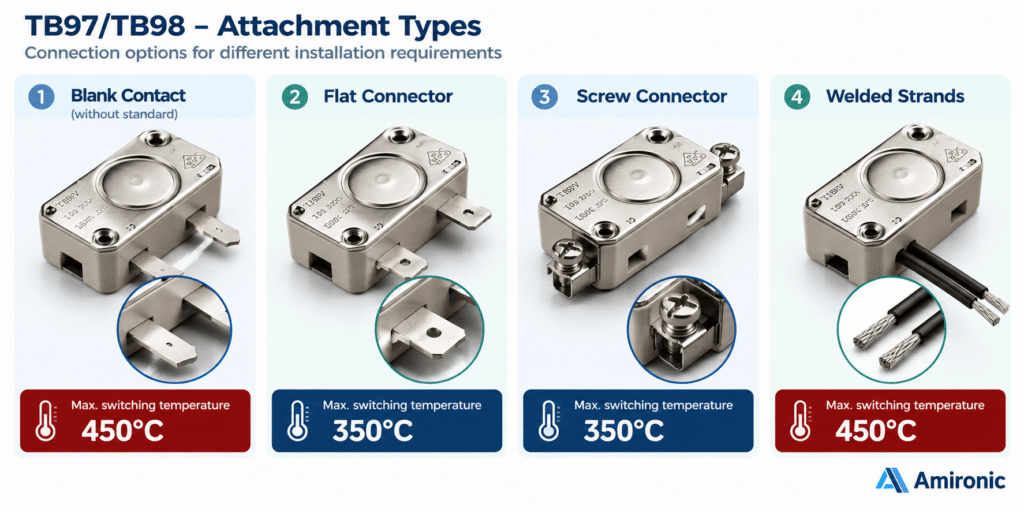
Within the TB97/TB98 series, certain connection options are available for switching temperatures up to 450°C, while Flat Connector and Screw Connector configurations are limited to 350°C.

Electrical Switching Capacity

A thermal switch must also be compatible with the operating voltage, load current, and electrical characteristics of the circuit.

For example, the TB97/TB98 series includes electrical ratings of 10A at 230VAC or 6A at 400VAC, depending on the specific version.

Thermal Response Characteristics

The thermal response of a protective switch depends on its construction, mounting location, and the transfer of heat from the surrounding system to the sensing mechanism.

The TB97/TB98 series is designed to provide efficient heat transfer and fast thermal response, supporting reliable switching under demanding temperature conditions.

An Important Distinction: Switching Temperature vs. Ambient Temperature

Although the TB97/TB98 series offers switching temperatures of up to 450°C, this should not be confused with the maximum permitted ambient temperature.

According to the manufacturer’s datasheet, the maximum ambient temperature is specified as 400°C.

These are two different parameters, and both must be considered when selecting a suitable device and determining its installation conditions.

The combination of these requirements highlights why high-temperature applications demand carefully selected thermal protection components rather than relying solely on the maximum advertised switching temperature.
3. How Does Bimetal Snap-Disc Technology Work?

One of the established technologies used in thermal protection devices is Bimetal Snap-Disc technology, which relies on a bimetallic disc that rapidly changes its shape when a predetermined temperature is reached.

Unlike electronic temperature sensors, which typically require measurement and signal-processing circuitry, a Bimetal Snap-Disc mechanism enables direct mechanical switching in response to temperature changes.

This technology is particularly suitable for applications requiring simple, independent, and reliable temperature-sensitive switching without relying on an electronic control circuit.

Operating Principle of a Bimetallic Thermal Switch

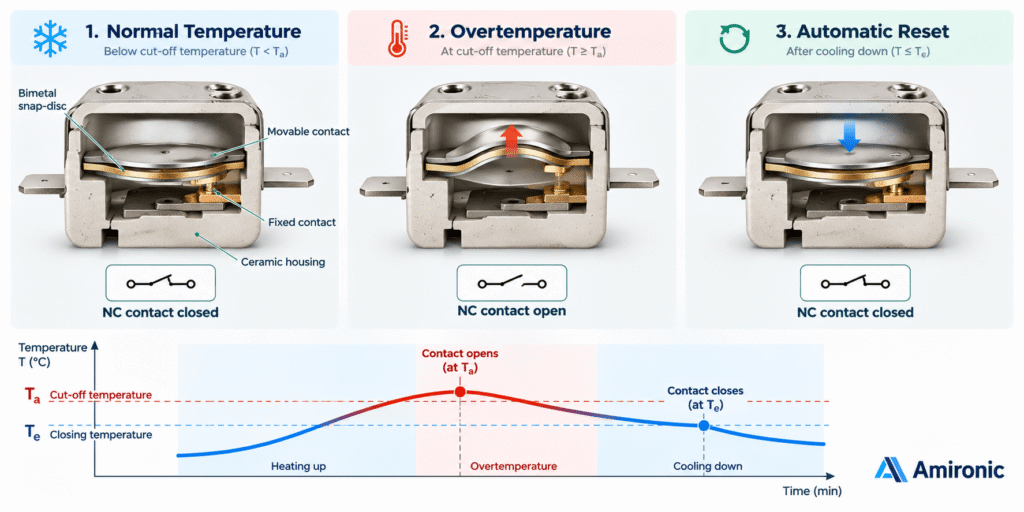
The switching mechanism operates through four main stages:

Stage 1 – Normal Operating Temperature

When the temperature is below the switching threshold, the bimetallic disc remains in its initial position, and the electrical contacts maintain their normal state.

Stage 2 – Temperature Increase

As the device heats up, the two metals forming the disc expand at different rates. This difference in thermal expansion creates mechanical stresses that influence the disc’s shape.

Stage 3 – Reaching the Switching Temperature

When the predetermined switching temperature is reached, the disc rapidly changes its shape through a snap-action movement.

This movement activates the contact mechanism, opening or closing the electrical circuit depending on the thermal switch configuration.

Stage 4 – Cooling and Automatic Reset

Once the temperature decreases to the specified reset temperature, the bimetallic disc returns to its original position, allowing the electrical contacts to return to their initial state.

This functionality is known as Automatic Reset.

What Are the Advantages of a Snap-Disc Mechanism?

A Snap-Disc mechanism provides a rapid transition between switching states rather than relying on gradual contact movement.

Key advantages include:

  • Mechanical temperature sensing without requiring an external power supply.
  • Direct electrical switching at a predetermined temperature.
  • Relatively simple construction without electronic signal-processing circuitry.
  • Repeatable operation through automatic reset.
  • Suitability for industrial applications requiring localized thermal protection.

In the Limitor TB97/TB98 series, this technology is integrated into a ceramic housing designed for demanding high-temperature applications.

4. Limitor TB97/TB98 – Thermal Switches with Switching Temperatures Up to 450°C

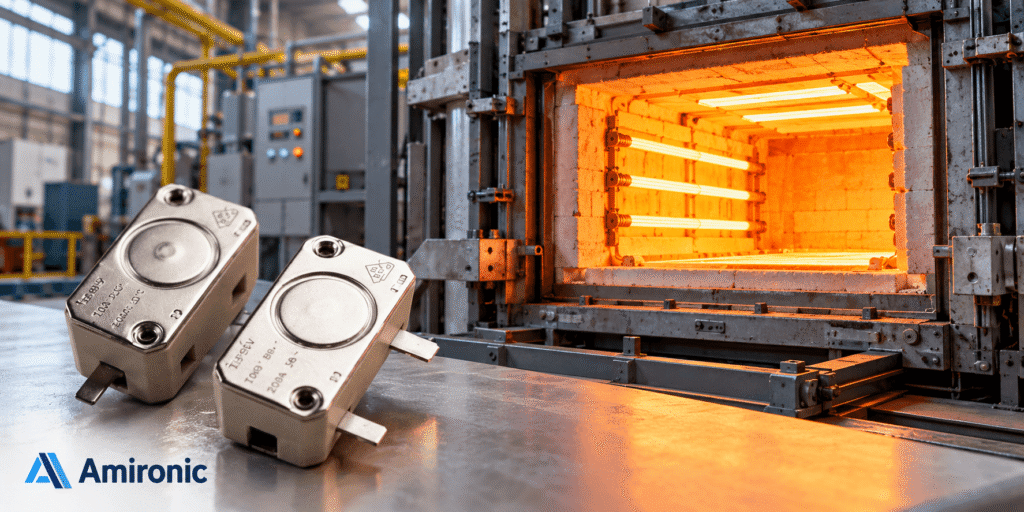
The Limitor TB97/TB98 series is designed for applications requiring thermal switching at elevated temperatures, including industrial ovens, heating elements, welding equipment, and electrical heating systems.

These thermal switches utilize Bimetal Snap-Disc technology and feature ceramic housings, multiple electrical connection and mounting options, and switching temperatures ranging from 180°C to 450°C, depending on the selected model and configuration.

Key Technical Specifications

Parameter Specification
Manufacturer Limitor
Product Series TB97 / TB98
Technology Bimetal Snap-Disc
Switching Temperature Range 180°C to 450°C, depending on configuration
Standard Switching Temperature Tolerance ±5%
Contact Configurations Normally Closed / Normally Open
Reset Function Automatic Reset
Housing Material Ceramic
Example Electrical Ratings 10A at 230VAC / 6A at 400VAC
Electrical Rating for Applicable 120VAC Versions 13A at 120VAC
Contact Resistance ≤50mΩ
Dielectric Strength Up to 3,000V, depending on version
Switching Cycles 10,000, according to manufacturer specifications
Approximate Body Dimensions 27.5 × 15.5 × 12.5mm
Maximum Ambient Temperature 400°C, according to the datasheet
Standards and Approvals IEC/EN 60730-1, IEC/EN 60730-2-9, VDE, and UL, subject to applicable approval conditions

Important Engineering Note: The maximum switching temperature of 450°C does not apply to every electrical connection configuration. Furthermore, the manufacturer’s UL approval covers switching temperatures from 180°C to 350°C only.

The maximum switching temperature must also be distinguished from the maximum ambient temperature of 400°C specified in the datasheet. Engineers should verify all applicable temperature limits, electrical ratings, and approval conditions for the specific part number.

Heat-Resistant Ceramic Construction

One of the key features of the TB97/TB98 series is its heat-resistant ceramic housing.

This construction enables the thermal switching mechanism to be integrated into high-temperature applications where conventional polymer-housed devices may not be suitable.

The device is also designed to facilitate effective heat transfer to the temperature-sensitive mechanism, enabling a responsive reaction to temperature changes at the installation location.

Compact Design for System Integration

Despite its high switching temperatures, the TB97/TB98 features a relatively compact body, with approximate dimensions of 27.5 × 15.5 × 12.5mm.

The series is available with different electrical connection and mounting configurations, including flat terminals, screw connections, and welded leads, depending on the selected version.

This flexibility allows design engineers and Original Equipment Manufacturers (OEMs) to select a configuration that meets the mechanical and electrical requirements of their equipment.

5. TB97 vs. TB98 – Understanding Normally Closed and Normally Open Contacts

When selecting a thermal switch, one of the most important considerations is the electrical contact state before the switching temperature is reached.

The Limitor TB97/TB98 series offers two primary contact configurations.

TB97 – Normally Closed (NC)

In the TB97 configuration, the electrical contacts are closed under normal conditions, when the temperature is below the switching threshold.

As the temperature rises and reaches the predetermined switching point, the contacts open, interrupting the electrical circuit.

Once the device cools to its specified reset temperature, the contacts automatically close again.

This configuration is suitable for applications requiring the interruption of a heating circuit when a defined temperature threshold is reached, provided the switch is appropriately integrated and electrically rated.

TB98 – Normally Open (NO)

In the TB98 configuration, the electrical contacts remain open under normal conditions, when the temperature is below the switching threshold.

When the temperature reaches the predetermined switching point, the contacts close.

After cooling to the specified reset temperature, the contacts automatically open again.

This configuration can be used to activate an alarm circuit, provide an input signal to a controller, or perform another switching function when a defined temperature is reached, subject to the electrical ratings of the device.

Comparison Table – TB97 vs. TB98

Feature TB97 TB98
Normal Contact State Normally Closed (NC) Normally Open (NO)
At Switching Temperature Contacts Open Contacts Close
After Cooling to Reset Temperature Contacts Close Again Contacts Open Again
Typical Application Heating Circuit Interruption Alarm or Control Circuit Activation
Sensing Mechanism Bimetal Snap-Disc Bimetal Snap-Disc
Reset Function Automatic Automatic

The choice between TB97 and TB98 depends on the intended function of the thermal switch and the required electrical response when the temperature reaches the switching threshold.

In overtemperature protection applications, engineers must also evaluate system behavior after cooling, particularly when automatic contact reset could allow a heating element or other equipment to restart without operator intervention.

6. Switching Temperature and Thermal Hysteresis – Two Critical Parameters in Thermal Protection

When selecting a thermal switch for an industrial heating system, knowing the maximum switching temperature is not enough. Engineers must also understand the temperature at which the electrical contacts change state and the temperature at which they return to their original position.

Two key parameters define this behavior: Switching Temperature and Thermal Hysteresis.

Switching Temperature – When Does the Thermal Switch Activate?

The switching temperature is the temperature at which the thermal switch mechanism changes the state of its electrical contacts.

For example, a TB97 thermal switch with a nominal switching temperature of 300°C is designed to open its contacts when the sensing mechanism reaches its actual switching threshold.

However, the switching temperature tolerance must also be considered.

The Limitor TB97/TB98 series has a standard switching temperature tolerance of ±5%.

Therefore, a thermal switch with a nominal switching temperature of 300°C may operate within the following range:

285°C to 315°C

This has an important engineering implication: if a component may be damaged at 310°C, selecting a thermal switch with a nominal switching temperature of 300°C does not guarantee that the circuit will be interrupted before that temperature is reached.

Engineers must also consider the mounting location, thermal response time, and temperature differences between the switch and the area requiring protection.

Thermal Hysteresis – What Is It and Why Does It Matter?

Thermal hysteresis is the difference between the switching temperature during heating and the reset temperature during cooling.

In the TB97/TB98 series, the thermal switch does not necessarily return to its original contact state immediately after the temperature drops slightly below the switching threshold.

Consider the following illustrative example of a TB97 thermal switch:

  • Contact opening temperature: 300°C
  • Contact reclosing temperature: 200°C
  • Thermal hysteresis: 100°C

As the temperature rises to 300°C, the electrical contacts open.

If the temperature subsequently decreases to 250°C, the contacts remain open.

Only when the temperature reaches 200°C do the contacts close again.

Important: This example illustrates the operating principle and does not represent the guaranteed specifications of a particular part number. Actual switching and reset temperatures depend on the selected configuration and manufacturer specifications.

Why Is Thermal Hysteresis Important?

Thermal hysteresis helps prevent rapid and repeated switching when the temperature fluctuates around the switching threshold.

Without a suitable temperature differential, even small temperature variations could cause frequent opening and closing of the electrical contacts.

According to Limitor’s technical specifications, the TB97/TB98 series offers a temperature differential of 50K to 200K, depending on the switching temperature and selected configuration.

The manufacturer also specifies a differential tolerance of ±20K, subject to the applicable configuration. Special differential characteristics may be available upon request.

Since a temperature difference of 1K is equivalent to a temperature difference of 1°C, this range can also be expressed as a differential of 50°C to 200°C.

Selecting an appropriate thermal hysteresis can improve system operating stability and reduce unnecessary switching cycles.

7. How to Select a High-Temperature Thermal Switch

Selecting a suitable High-Temperature Thermal Switch requires careful evaluation of thermal, electrical, and mechanical parameters.

7.1 Required Switching Temperature

The first step is to determine the temperature at which the thermal switch must change its contact state.

This value should be selected based on the normal operating temperature, the maximum permissible temperature, component limitations, and the thermal response characteristics of the system.

7.2 Switching Temperature Tolerance

Engineers should evaluate the entire possible switching temperature range rather than relying solely on the nominal value.

The TB97/TB98 series features a standard switching temperature tolerance of ±5%, which must be considered when designing the thermal protection function.

7.3 Normally Closed vs. Normally Open

The TB97 is a Normally Closed (NC) thermal switch, with contacts that open when the switching temperature is reached.

The TB98 is a Normally Open (NO) thermal switch, with contacts that close when the switching temperature is reached.

The selected contact configuration must match the electrical logic and intended protective function of the system.

7.4 Electrical Voltage and Current Ratings

The thermal switch must be suitable for the operating voltage and load current of the electrical circuit.

The TB97/TB98 series includes electrical ratings such as:

  • 10A at 230VAC
  • 6A at 400VAC
  • 13A at 120VAC, for applicable versions

These ratings depend on the specific configuration. Engineers should also verify compatibility with the load characteristics and actual switching conditions.

7.5 Electrical Connection Types

The Limitor TB97/TB98 series is available with several electrical connection configurations.

Connection Type Maximum Available Switching Temperature
Blank Contact Up to 450°C
Flat Connector Up to 350°C
Screw Connector Up to 350°C
Welded Strands Up to 450°C

The choice of electrical connection is not merely a mechanical consideration. It also determines the maximum switching temperature available for the selected configuration.

The temperature resistance of external wiring, connectors, insulation materials, and related accessories must be evaluated separately.

7.6 Mounting Position and Heat Transfer

The mounting location directly affects the thermal switch’s ability to detect overheating in the area requiring protection.

Installing the switch at a location that does not accurately represent the critical temperature may result in delayed switching relative to the development of an overheating condition.

Therefore, engineers should evaluate thermal contact, mounting arrangements, environmental conditions, and temperature gradients within the equipment.

7.7 Standards and Certifications

When integrating a thermal switch into equipment intended for international markets, applicable regulatory and certification requirements must be considered.

The Limitor TB97/TB98 technical documentation references IEC/EN 60730 standards, VDE certification, and UL File E96862.

It is important to note that the UL approval covers switching temperatures from 180°C to 350°C, even though the series includes configurations with switching temperatures up to 450°C.

The applicability of each certification must be verified for the specific model and configuration.

8. Industrial Applications of Limitor TB97/TB98 Thermal Switches

High-temperature thermal switches are used in a wide range of industrial systems where a defined electrical response to excessive temperature is required.

Industrial Ovens and Furnaces

Industrial ovens and furnaces often operate at elevated temperatures for extended periods.

A malfunctioning temperature controller, sensor, or switching component may result in uncontrolled temperature increases.

An independent thermal switch can form part of the protection system by interrupting an appropriately designed electrical circuit when the specified switching temperature is reached.

Soldering and Welding Equipment

Soldering and welding equipment may incorporate heating elements and components operating at high temperatures.

Integrating a suitable thermal switch can help detect localized overheating and initiate a circuit interruption or other control action.

Industrial Heating Elements

Electrical heating elements are widely used in manufacturing, processing, and industrial heating applications.

In these systems, a thermal switch can provide an additional protective function, particularly when a response is required after the temperature exceeds a predetermined threshold.

Commercial Heating Equipment

Additional applications may include hot plates, ironing equipment, grills, and electrical heating appliances.

For each application, the switching temperature, electrical ratings, connection configuration, and mounting arrangement must be matched to the actual operating conditions and applicable safety requirements.

9. Key Advantages of the Limitor TB97/TB98 Series for Engineers and OEM Manufacturers

The Limitor TB97/TB98 series combines several features that make it suitable for integration into industrial heating and thermal protection systems.

High Switching Temperatures

Switching temperature options up to 450°C, depending on configuration, support applications requiring thermal protection at elevated temperatures.

Independent Mechanical Operation

The Bimetal Snap-Disc mechanism does not require an external power supply for temperature sensing or mechanical contact actuation.

Heat-Resistant Ceramic Housing

The ceramic construction is designed for demanding thermal conditions and supports integration into a variety of high-temperature equipment.

Multiple Connection and Mounting Options

Different electrical connection and mounting configurations allow engineers to select a solution compatible with the mechanical and electrical requirements of their equipment.

Flexibility for OEM Integration

A range of switching temperatures, contact configurations, and connection options enables OEM manufacturers to select suitable versions for their specific system designs.

Automatic Reset Functionality

After cooling to the specified reset temperature, the electrical contacts automatically return to their original state without requiring manual intervention.

However, in applications where automatic restarting after an overheating event must be prevented, additional protective or control measures should be incorporated according to the system’s safety requirements.

10. Standards and Certifications – What Should Engineers Verify Before Integrating a Thermal Switch?

When integrating a thermal switch into industrial equipment, engineers must consider not only the switching temperature and electrical ratings but also the component’s compliance with the applicable standards and certification requirements of the final system.

The Limitor TB97/TB98 series is covered by various international standards and approvals, subject to the manufacturer’s specifications and the selected configuration.

IEC/EN 60730 Standards

The IEC/EN 60730 series covers automatic electrical controls, including temperature-sensitive control devices.

The TB97/TB98 technical documentation references IEC/EN 60730-1 and IEC/EN 60730-2-9, together with VDE Certificate No. 131955.

These standards address various functional and safety requirements for automatic electrical control devices.

UL Approval – Important Temperature Limitations

According to the manufacturer’s documentation, the TB97/TB98 series is associated with UL File E96862.

However, an important limitation must be considered:

The switching temperature range covered by the UL approval is limited to 180°C to 350°C.

Although the series includes configurations with switching temperatures up to 450°C, this does not mean that every temperature rating or product configuration is covered by the UL approval.

When UL certification is required, engineers should verify its applicability to the specific part number and intended operating conditions.

RoHS and REACH Compliance

According to the manufacturer’s declarations, the TB97/TB98 series complies with the applicable RoHS and REACH requirements.

For projects requiring formal compliance documentation, the availability of current manufacturer declarations should be verified according to the customer’s requirements.

Compliance of the Complete System

It is important to remember that component-level certification or compliance does not automatically certify the equipment into which the component is integrated.

The equipment manufacturer must evaluate applicable safety requirements, system behavior under fault conditions, electrical ratings, environmental conditions, and the integration of the thermal switch into the electrical circuit.

Particular attention should be given to automatically resetting thermal switches, as the system may restart after cooling. Engineers must determine whether such behavior is permitted under the applicable safety requirements.


11. Frequently Asked Questions (FAQ)

What Is a High-Temperature Thermal Switch?

A high-temperature thermal switch is an electrical component that changes the state of its contacts when a predetermined temperature is reached.

Depending on the circuit design, it can be used to interrupt a heating circuit, activate an alarm, or initiate another electrical switching function.

The Limitor TB97/TB98 series offers switching temperatures ranging from 180°C to 450°C, depending on the selected configuration.

Is There a Thermal Switch Available for Switching Temperatures Up to 450°C?

Yes. The Limitor TB97/TB98 series includes configurations with switching temperatures up to 450°C.

However, not all electrical connection types support this maximum switching temperature.

According to the manufacturer, Blank Contact and Welded Strands configurations are available up to 450°C, while Flat Connector and Screw Connector configurations are limited to 350°C.

What Is the Difference Between TB97 and TB98?

The main difference is the normal state of the electrical contacts.

TB97 is a Normally Closed (NC) thermal switch. Its contacts open when the switching temperature is reached.

TB98 is a Normally Open (NO) thermal switch. Its contacts close when the switching temperature is reached.

Both versions automatically return to their original contact states after cooling to the specified reset temperature.

Does a Bimetal Thermal Switch Require an External Power Supply?

No. The Bimetal Snap-Disc sensing and switching mechanism operates mechanically in response to temperature changes.

Therefore, no external power supply is required to activate the temperature-sensing mechanism itself.

However, the electrical contacts must be appropriately rated for the voltage, current, and load characteristics of the circuit.

What Does Automatic Reset Mean in a Thermal Switch?

Automatic Reset means that the electrical contacts return to their original state after the temperature decreases to the specified reset temperature.

For example, in a TB97 thermal switch, the contacts open when the switching temperature is reached and automatically close again after sufficient cooling.

Because automatic reset may allow equipment to restart, this feature is not necessarily suitable for every safety-critical application.

What Is Thermal Hysteresis?

Thermal hysteresis is the temperature difference between the switching point during heating and the reset point during cooling.

For example, if a thermal switch opens at 300°C and closes again at 200°C, its thermal hysteresis is 100°C.

This temperature differential helps prevent rapid, repeated switching when the temperature fluctuates around the switching threshold.

What Is the Switching Temperature Tolerance of Limitor TB97/TB98?

According to the manufacturer, the standard switching temperature tolerance is ±5%.

For example, a thermal switch with a nominal switching temperature of 300°C may operate between 285°C and 315°C.

This tolerance must be considered when selecting the device and evaluating the thermal protection requirements of the system.

Can TB97/TB98 Thermal Switches Be Used in Industrial Ovens?

Yes. Industrial ovens are among the applications identified by Limitor for the TB97/TB98 series.

These thermal switches can be integrated into an overtemperature protection system, provided that the switching temperature, electrical ratings, mounting location, and applicable safety requirements are properly evaluated.

Can a Thermal Switch Replace a Temperature Controller?

Generally, no.

A temperature controller is designed to regulate temperature during normal operation, while a thermal protection switch is intended to respond when a predetermined temperature threshold is reached.

In many applications, the two devices can work together, with the temperature controller managing normal operation and the thermal switch providing an additional protective function.

Are All TB97/TB98 Thermal Switches UL Approved Up to 450°C?

No.

According to the manufacturer’s documentation, the switching temperature range covered by the UL approval is limited to 180°C to 350°C.

Therefore, the approval status must be verified for the specific product configuration and part number.

Can TB97/TB98 Thermal Switches Be Ordered with Customized Switching Temperatures and Connections?

The TB97/TB98 series offers various switching temperatures, contact configurations, electrical connection options, and mounting arrangements.

According to Limitor, special configurations may also be considered upon request.

To identify a suitable solution, engineers should provide the required switching temperature, contact type, electrical ratings, mounting requirements, and other relevant application details.


12. Technical Glossary – High-Temperature Thermal Protection

Thermal Switch

An electrical component that changes the state of its contacts when a predetermined temperature is reached. Thermal switches are used in temperature control and thermal protection applications.

Thermal Protector

A device designed to help protect equipment against excessive temperatures by initiating an electrical switching or circuit interruption function.

Overtemperature Protection

A protective function intended to detect when a temperature exceeds a defined threshold and initiate an appropriate response to reduce the risk of equipment damage or hazardous conditions.

Bimetal Snap-Disc

A temperature-sensitive mechanical mechanism consisting of two bonded metals with different thermal expansion coefficients. Temperature changes cause the disc to rapidly change its shape and actuate electrical contacts.

Switching Temperature

The temperature at which a thermal switch changes the state of its electrical contacts.

Cut-off Temperature

The temperature at which a thermal switch designed for circuit interruption opens its contacts. In the TB97 configuration, this corresponds to the contact-opening temperature during heating.

Reset Temperature

The temperature at which the thermal switch returns to its original contact state during cooling.

Thermal Hysteresis

The difference between the switching temperature during heating and the reset temperature during cooling.

Normally Closed (NC)

A contact configuration in which the electrical circuit remains closed below the switching temperature and opens when the specified threshold is reached.

Normally Open (NO)

A contact configuration in which the electrical circuit remains open below the switching temperature and closes when the specified threshold is reached.

Automatic Reset

A function that allows a thermal switch to return to its original contact state after cooling, without requiring manual intervention.

Ceramic Housing

An enclosure made from ceramic material, suitable for applications requiring heat resistance and electrical insulation within the device’s specified operating limits.

Contact Rating

The specified voltage and current that the electrical contacts can handle under the operating conditions defined by the manufacturer.

Dielectric Strength

A measure of the ability of an insulating material or electrical device to withstand a specified test voltage under defined test conditions.

OEM – Original Equipment Manufacturer

A company that designs and manufactures equipment incorporating components and subsystems into its finished products.


13. Conclusion – Advanced Thermal Protection for Industrial Heating Systems

In high-temperature heating systems, overtemperature protection is an important engineering consideration for equipment safety, reliability, and long-term operation.

Selecting the appropriate thermal switch requires careful evaluation of switching temperature, tolerance, thermal hysteresis, electrical ratings, installation conditions, and applicable certification requirements.

The Limitor TB97/TB98 series provides thermal switching solutions with switching temperatures up to 450°C, combining Bimetal Snap-Disc technology, heat-resistant ceramic housings, and multiple electrical connection and mounting options.

Its independent mechanical operation, compact construction, and range of available configurations make the series a practical option for design engineers, system integrators, and Original Equipment Manufacturers (OEMs).

Looking for a High-Temperature Thermal Protection Solution?

Amironic supplies Limitor thermal protection and temperature control solutions, including the TB97/TB98 series, for industrial applications and advanced heating equipment.

Our team can assist in selecting a suitable configuration based on your specific requirements, including:

  • Required switching temperature.
  • Contact configuration – Normally Closed or Normally Open.
  • Operating voltage and current.
  • Electrical connection type and mounting arrangement.
  • Applicable standards and certification requirements.
  • Order quantities and special OEM project requirements.

Contact Amironic for technical information, application assistance, and a quotation.

Amironic – Advanced Components for Industrial Applications

Tags: Variohm

Related Articles

Choosing the Right Temperature Probe Mounting

27/05/2026amironicLTD

Why a Linear Position Sensor Shouldn’t Be Selected by Stroke Alone

14/07/2026amironicLTD

Hall Effect Rotary Sensor – Non-Contacting Design

25/08/2021amironicLTD

Recent Posts

  • Open-Loop vs. Closed-Loop Accelerometers – Which Technology Is Right for Your Application?
  • Overtemperature Protection Up to 450°C – Advanced Thermal Solutions for Industrial Ovens and Equipment
  • SX2 vs. SX3 – The Future of Inertial Sensor Technology
  • Allan Deviation in MEMS Sensors: Understanding Noise and Drift in Gyroscopes and Accelerometers
  • SFR6-32X3/8-2615 Sealing Screw by APM Hexseal – Preventing Liquid Ingress in Electronic Enclosures

Categories

  • Air Switch
  • Circuit Breakers
  • Elapsed Time Indicator
  • Feedthrough
  • Footswitches
  • Gears & Transmission
  • Hour Meters
  • Infra Red Switches
  • INFRARED LAMPS
  • Low Noise Inertial MEMS
  • Mechanics
  • MEMS Gyroscope
  • MEMS Inertial
  • Microelectronics
  • Motors
  • Position Sensors
  • Power Supply
  • Pressure Sensors
  • Pressure Switch
  • Sealing
  • Switches
  • Temperature Sensors
  • Tungsten and Molybdenum
  • Uncategorized
  • Vacuum Switches

Quick Contact

Fill out the form and our representatives will return to you

    Name (required)

    Email (required)

    Phone

    Message

    This site is protected by reCAPTCHA and the Google
    Privacy Policy and
    Terms of Service apply.

    Amironic Ltd.

    3 Rabinovich Street, Petah Tikva 4928144 , Israel. Tel: +972-3-9047744 E-mail: office@amironic.co.il
    Email
    Facebook
    Twitter
    LinkedIn
    YouTube
    Press on the ISO Certificate below for download
    ISO 9001:2015 Certification
    • MEMS Inertial
    • Circuit Breakers
    • Footswitches
    • Mechanical & Transmissions
    • Sensors
    • Motors
    • Electronics
    • Hand Control
    • Power Solutions

    News

    • Open-Loop vs. Closed-Loop Accelerometers – Which Technology Is Right for Your Application?
    • Overtemperature Protection Up to 450°C – Advanced Thermal Solutions for Industrial Ovens and Equipment
    • SX2 vs. SX3 – The Future of Inertial Sensor Technology
    • Allan Deviation in MEMS Sensors: Understanding Noise and Drift in Gyroscopes and Accelerometers
    • SFR6-32X3/8-2615 Sealing Screw by APM Hexseal – Preventing Liquid Ingress in Electronic Enclosures
    About AmironicContactעברית
    © 2022 Amironic All rights reserved. All Trademarks are the property of their respective owners.
    • Increase Font
    • Decrease Font
    • Black & White
    • Inverse Colors
    • Highlight Links
    • Regular Font
    • Reset