The Next Generation of MEMS Sensors: Lower Noise, Higher Stability, and Improved Tactical Precision
In a world where military and civilian systems must operate at high speeds, under vibration, temperature fluctuations, and extreme environmental conditions, the quality of inertial measurements has become one of the most critical factors affecting overall system performance.
In electro-optical and infrared (EO/IR) stabilization systems, tracking systems, unmanned aerial vehicles (UAVs), and navigation systems operating in GPS-denied or GPS-degraded environments, even small measurement errors can affect stabilization accuracy, tracking performance, and the reliability of motion estimation.
Gladiator Technologies, a US-based company represented in Israel by Amironic Ltd., develops and manufactures gyroscopes, accelerometers, and Inertial Measurement Units (IMUs) based on advanced Silicon MEMS technology.
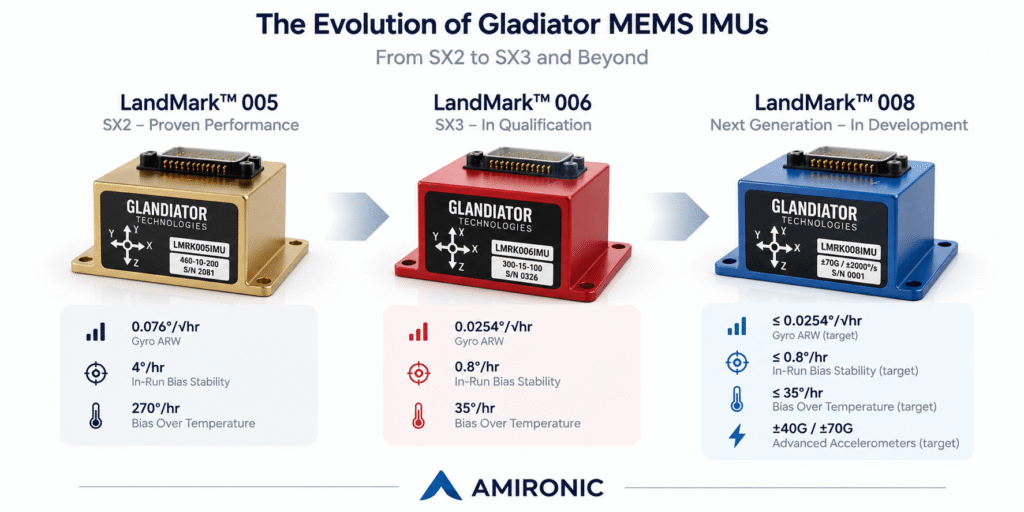
Following the success of the SX2 generation, including the G300D gyroscope and LandMark 005 IMU, the company is advancing its SX3 generation with the G400D gyroscope and LandMark 006 IMU, both undergoing qualification, alongside the development of the LandMark 008 IMU for next-generation high-dynamic applications.
The transition between generations goes beyond incremental improvements in resolution or sampling rates. It focuses on three key characteristics: reducing measurement noise, improving bias stability, and maintaining fast sensor response.
1. What Has Really Changed from SX2 to SX3?
The SX2 generation already offered a combination of low noise, compact dimensions, calibration over a wide temperature range, and high-speed signal processing through VELOX technology.
The SX3 generation is designed to improve the quality of the inertial measurements themselves, enabling control systems to receive cleaner, more stable data while maintaining high bandwidth and low latency.
Three key performance parameters illustrate this technological advancement:
Angle Random Walk – ARW
Angle Random Walk (ARW) describes the contribution of random gyroscope noise to accumulated angular error.
The lower the ARW value, the smaller the random error generated when integrating angular rate measurements to calculate changes in angle.
From an operational perspective, lower ARW enables more accurate estimation of small angular movements, particularly in precision stabilization systems and inertial navigation applications.
In-Run Bias Stability
In-Run Bias Stability describes the stability of the sensor’s measurement bias during operation.
Even when a system is stationary, a gyroscope may indicate a small non-zero angular rate. This offset is known as bias.
When the bias changes during operation, it can produce accumulated angular errors. Improved bias stability helps reduce the impact of these errors, particularly when continuous corrections from external sensors are unavailable.
Bias Over Temperature
Bias Over Temperature describes how the sensor’s bias changes across its operating temperature range, following the applicable calibration.
This parameter is particularly important in systems exposed to changing environmental conditions, such as unmanned aerial vehicles, outdoor surveillance platforms, and military systems operating across significant temperature variations.
A sensor with high thermal stability allows the system to maintain more consistent measurement performance as ambient temperatures change.
These three parameters complement one another. A sensor with low noise but unstable bias may deliver excellent short-term measurements while accumulating significant errors over longer operating periods.
2. Technology Comparison: SX2 vs. SX3
One way to demonstrate this technological advancement is by comparing the SX2-based LandMark 005 IMU with the SX3-based LandMark 006 IMU.
Both units integrate three gyroscope axes and three accelerometer axes and are designed for precision inertial measurements in systems with strict size, weight, and power constraints.
The comparison below refers to the C performance grade of the LandMark 006, based on preliminary specifications published by Gladiator Technologies.
| Parameter | SX2 – LMRK005 | SX3 – LMRK006 |
|---|---|---|
| Gyro ARW | 0.076°/√hr | 0.0254°/√hr |
| In-Run Bias Stability | 4°/hr | 0.8°/hr |
| Gyro Bias Over Temperature | 270°/hr | 35°/hr |
| Gyro Range | ±490°/s | ±300°/s |
| Accelerometer Range | ±15g | ±15g |
| Accel Bias Stability | 0.020mg | 0.020mg |
| Maximum Output Rate | 10kHz | 10kHz |
| Maximum Bandwidth | 600Hz | 600Hz |
The data demonstrates significant improvements in gyroscope performance:
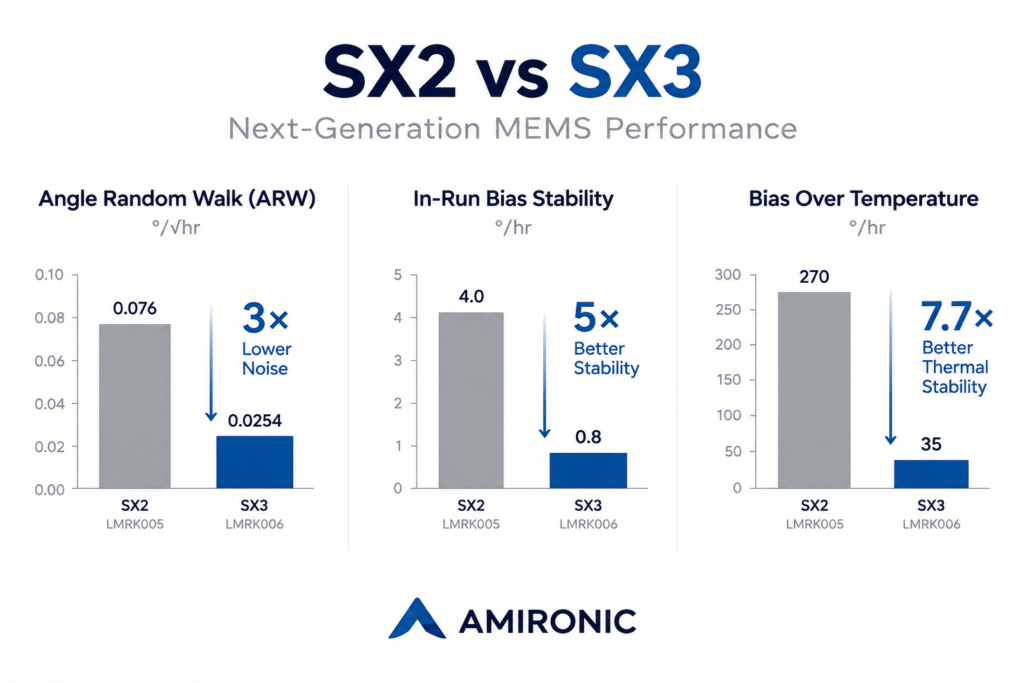
Approximately 67% reduction in random noise: ARW decreases from 0.076 to 0.0254 degrees per square root hour, representing nearly a threefold improvement.
Fivefold improvement in bias stability: In-Run Bias Stability improves from 4°/hr to 0.8°/hr.
Approximately 87% reduction in bias variation over temperature: From 270°/hr to 35°/hr.
From an engineering perspective, these improvements can reduce the contribution of sensor errors to overall system performance, particularly in applications requiring accurate motion estimation over extended periods.
However, the improvements are not uniform across all parameters. Accelerometer bias stability remains at 0.020mg, while the nominal angular rate measurement range of the LandMark 006 is lower than that of the LandMark 005.
Therefore, sensor selection should not be based solely on technology generation, but also on motion dynamics, environmental conditions, bandwidth requirements, and the overall control system architecture.
LandMark 006 specifications are preliminary and may change upon completion of the qualification process.