flagעברית
flagEnglish
3 Rabinovich St., Petah-Tikva, Israel
+972 3 9047744
office@amironic.co.il
Facebook
Twitter
LinkedIn
YouTube
  • Products
    • MEMS Inertial
      • MEMS Gyroscopes
      • Inertial Measurement Units
      • MEMS Accelerometers
      • Inertial Navigation
      • AHRS
    • Circuit Breakers
      • Airpax Circuit Breakers
      • Electronic Circuit Breakers
      • Aircraft Circuit Breakers
      • Thermal Circuit Breakers
      • Sealing Solutions & Guards
    • Footswitches
      • Pedals & Bellows
      • USB
      • Air Switches
      • Medical
      • Modular Bases System
      • Industrial
      • Foot Potentiometers
      • Wireless
    • Mechanical & Transmissions
      • Gears
      • Sealing Solutions
      • Gearboxes
      • Couplings
      • Shafts & Bearings
      • Fasteners
      • Mechanical & Springs
      • Linear Motion
      • Anti-Vibration
    • Sensors
      • Thermostats
      • Temperature
      • Position
      • Pressure
      • Speed
      • Level Sensor
      • Load Cells
      • Flex Sensors
      • Membrane Potentiometer
    • Motors
      • Geared DC
      • Brushless DC
      • Step Motors with Gearbox
      • Torque Motors & Brushless Servo
      • DC Motors
    • Electronics
      • Xenon & IR Lamps
      • Counters & Meters
      • Microelectronics Packaging
      • Waterproof Switches
      • Micro Switches
    • Hand Control
      • Operator Controls (JOYSTICK)
      • Electrical
      • Pneumatic (Medical)
      • USB Hand Control
      • Air Push Button
      • Pressure Switch
      • IR Switch
    • Power Solutions
      • Rugged & Military Power Supply
      • Input Power Protection
      • Sealed Military Power Adaptor
      • Triple Output Military Power Supply Series – up to 250 W
    • Materials
      • Molybdenum and Advanced Alloys (TZM, MOLA, HCT)
      • Tungsten (Wolfram) and Advanced Alloys – High-Performance Materials for Extreme Conditions
      • Materials for Gears
  • Shop
  • Companies
  • About Amironic
  • News
  • Contact
Product was added to your cart

Cart

waze

Inclinometers and Tilt Sensors – Precision Angle Measurement for Mobile Machinery and Heavy-Duty Equipment

Position Sensors11/11/2026amironicLTD

In modern mechanical systems, angle and tilt measurement involves much more than simply displaying a value in degrees. In many applications, it is a critical parameter affecting machine stability, operational safety, motion accuracy, and control performance.

In construction and heavy machinery, cranes, aerial work platforms, agricultural equipment, and industrial automation systems, continuous measurement of the inclination angle relative to gravity or a defined reference plane is often required.

Angle and tilt sensors, commonly known as Inclinometers or Tilt Sensors, measure changes in inclination and transmit this information to a control system for monitoring, warning functions, position correction, or motion limitation.

Variohm Eurosensor, together with Positek sensing solutions, offers a comprehensive range of industrial inclinometers, including compact models, sensors designed for harsh environments, submersible versions, and sensors certified for use in potentially explosive atmospheres.

In this article, we will explore the operating principles of inclinometers, the differences between single-axis and dual-axis measurement, the challenges of measuring inclination on mobile machinery, and the key engineering considerations when selecting the right sensor.

1. What Is an Inclinometer and How Does It Measure Angle?

An Inclinometer is a sensor designed to measure the angle of inclination relative to gravity or another reference system, depending on the sensing technology.

Unlike a Rotary Position Sensor, which typically measures the angular position of a mechanical shaft relative to another component, a static inclinometer measures its orientation relative to the direction of gravity.

This distinction is particularly important when designing control systems for mobile machinery.

For example, in a crane, an inclinometer can be used to measure the boom angle relative to the horizontal plane, while a rotary position sensor can measure the relative angle between two mechanical components connected by a joint.

1.1 Common Inclinometer Sensing Technologies

Several technologies are used to measure inclination, each offering specific advantages and limitations.

MEMS-Based Inclinometers Using Accelerometers

These sensors measure acceleration components along their sensing axes. Under static conditions, or when dynamic accelerations are negligible, the gravitational acceleration components can be used to calculate the inclination angle.

Their advantages include compact dimensions, low power consumption, and the ability to measure inclination along multiple axes.

However, when a machine accelerates, brakes, or experiences vibration, an accelerometer cannot immediately distinguish between acceleration caused by gravity and acceleration resulting from machine movement.

Inclinometers Based on Dedicated Position-Sensing Technologies

Industrial inclinometers may also use other sensing technologies, including mechanical mechanisms, capacitive sensing, or specialized inductive technologies.

For example, Positek’s TIPS (Tilt Inductive Position Sensor) technology is specifically designed for industrial tilt measurement applications requiring rugged and durable sensors.

It is important not to assume that all inclinometers operate using the same sensing principle. The operating technology of each specific model should be evaluated to ensure suitability for the intended measurement conditions.

Important engineering consideration: Tilt measurement accuracy under static conditions does not necessarily represent measurement accuracy when the machine is in motion.
2. Single-Axis vs. Dual-Axis Inclination Measurement

One of the first considerations when selecting an inclinometer is the number of measurement axes required.

Although inclinometers are designed to measure angles, not all sensors measure the same directions of movement, and not every application requires multi-axis measurement.

Proper selection begins with understanding the mechanical movement of the system and identifying the angles that must be measured for control, monitoring, or protection.

2.1 Single-Axis Inclinometer

A single-axis inclinometer is designed to measure inclination in one defined plane.

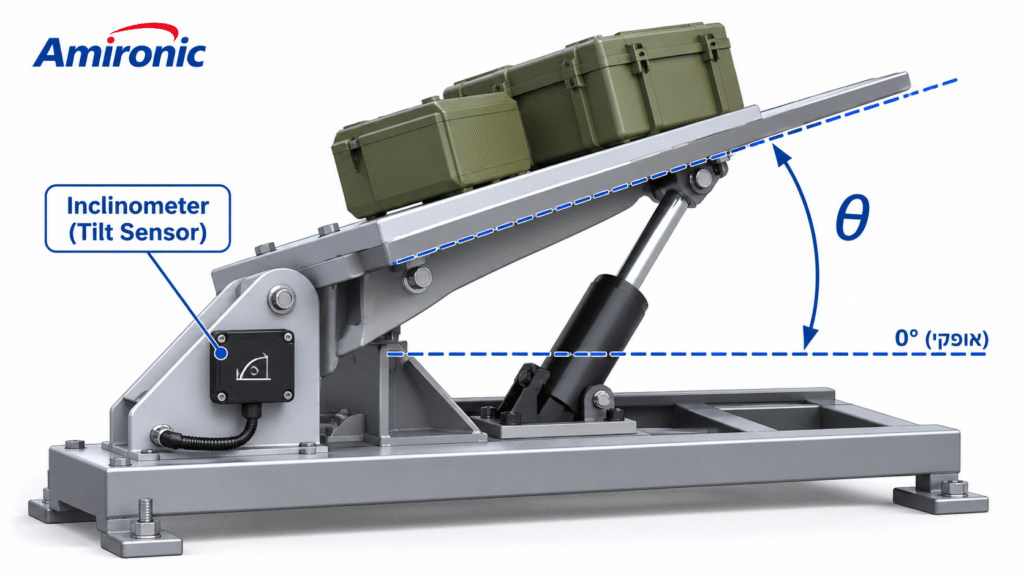
For example, when a mechanical boom moves up and down around a fixed pivot, a single-axis inclinometer can be used to measure the boom angle relative to gravity.

Typical applications include:

  • Measuring the boom angle of a crane or lifting platform.
  • Monitoring the inclination of a conveyor or adjustable surface.
  • Controlling the angle of a hydraulic lifting mechanism.
  • Measuring inclination in agricultural machinery.
  • Monitoring the angular position of industrial equipment.

The main advantage of single-axis measurement is the ability to focus on the required parameter without processing data from additional axes.

However, it is important to evaluate the influence of out-of-plane tilts, particularly when the sensor is installed on mobile machinery that does not always operate on level ground.

2.2 Dual-Axis Inclinometer

A dual-axis inclinometer measures inclination components in two directions.

In a mobile system, for example, dual-axis measurement can be used to monitor both the forward/backward inclination and the side-to-side inclination of the chassis.

These two inclination components are commonly referred to as:

  • Pitch – Forward and backward inclination.
  • Roll – Side-to-side inclination.

This type of measurement is particularly useful in systems where machine stability is affected by inclination in both directions.

For example, in an automatic leveling system for a work platform, the controller may use both inclination components to determine how the leveling mechanisms should be operated.

It is important to distinguish between dual-axis inclination measurement and full three-dimensional orientation measurement. A gravity-referenced inclinometer cannot independently measure rotation around the vertical axis (Yaw).

2.3 How to Select the Number of Measurement Axes

The number of measurement axes should be selected according to the system requirements rather than simply based on sensor availability.

When measuring a mechanical boom moving in a single plane, a single-axis inclinometer may be sufficient.

However, when monitoring the stability of a platform or machine in two directions, a dual-axis inclinometer may be more suitable.

Additional considerations include mounting orientation, measurement range, the influence of other movements, and how the control system interprets the measurement data.

Important engineering consideration: A sensor with more measurement axes is not necessarily more accurate. Measurement accuracy depends on the sensing technology, calibration, operating conditions, and specifications of the selected model.

3. Angle and Tilt Measurement in Construction Equipment and Mobile Machinery

Construction and heavy machinery often operate under particularly demanding conditions, including variable loads, uneven terrain, engine vibration, mechanical shocks, dirt, moisture, and temperature fluctuations.

In these systems, inclination measurement may be used to monitor machine position, control movement, and provide information to protection and safety systems.

3.1 Cranes and Lifting Systems

In cranes and lifting systems, boom angle measurement and machine position monitoring are particularly important.

The boom angle affects the geometry of the lifting system and, when combined with additional parameters such as boom length, load, and outrigger configuration, may be used to calculate operating radius and lifting moments.

An inclinometer mounted on the boom can provide the control system with information about its angle relative to gravity.

However, angle measurement alone is insufficient to determine crane stability or permissible lifting capacity. Safety systems require additional information and must be designed according to the applicable standards and regulations.

3.2 Aerial Work Platforms and Lifting Platforms

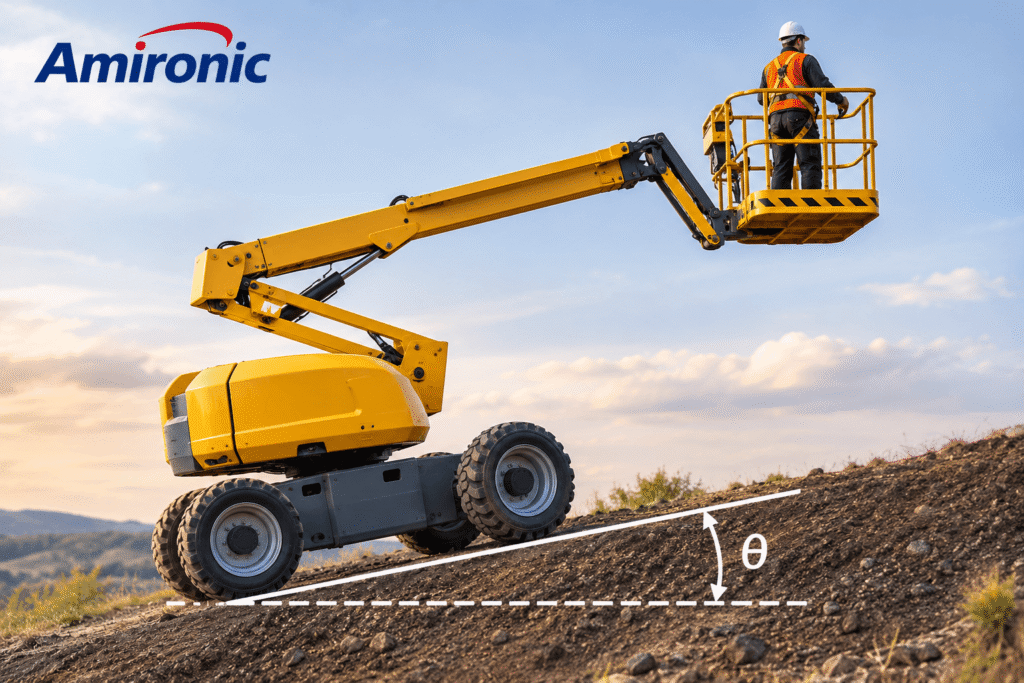
Aerial work platforms often need to operate on surfaces that are not perfectly level.

Inclinometers can help detect chassis or platform inclination and transmit this information to the control system.

Depending on the machine design, this information may be used to generate operator warnings, restrict certain movements, or activate an automatic leveling system.

In these applications, it is important to distinguish between static inclination measurement and measurement during movement, as acceleration and vibration may affect certain sensing technologies.

3.3 Agricultural Machinery and Off-Road Equipment

Tractors, agricultural sprayers, harvesting machines, and advanced agricultural equipment frequently operate on sloped terrain and under changing environmental conditions.

Inclination measurement can be used to monitor machine tilt, control the position of attachments, and support leveling systems.

For example, in an agricultural sprayer, tilt measurement can be integrated into a control system designed to maintain the appropriate positioning of the spray booms relative to the ground.

However, an inclinometer alone does not measure distance from the ground. When precise height control is required, additional sensors must be integrated according to the system design.

3.4 Industrial Automation and Machinery

Inclinometers are not limited to mobile equipment.

In industrial automation systems, they can be used to measure surface inclination, monitor the position of adjustable structures, and control mechanical mechanisms.

Additional applications include leveling systems, test equipment, measurement instruments, and OEM systems requiring continuous information about mounting angle or mechanical movement.

In these applications, sensor selection depends not only on the measurement range but also on accuracy requirements, electrical interfaces, environmental conditions, and mounting options.

4. Challenges of Tilt Measurement in Mobile Machinery

Measuring inclination in a stationary system is significantly different from measuring inclination on a machine in motion.

In mobile applications, several factors must be considered, as they can affect measurement quality and the reliability of the information transmitted to the control system.

4.1 Vibration and Shock

Heavy machinery is exposed to vibrations generated by engines, hydraulic systems, ground contact, and the movement of mechanical components.

These vibrations may cause fluctuations in the measurement signal and, depending on the sensing technology, may also affect the calculated inclination angle.

In some systems, digital filtering or mechanical damping can be used to reduce the influence of vibration.

However, excessive filtering may increase the response time of the measurement system.

Therefore, an appropriate balance must be achieved between signal stability and the required response speed.

4.2 Acceleration During Movement

In accelerometer-based inclinometers, acceleration generated during driving, braking, or changes in direction may affect the calculated inclination angle.

For example, when a vehicle accelerates on a level surface, a MEMS-based sensor may detect an additional acceleration component and temporarily interpret it as a change in inclination.

In applications requiring accurate measurements during dynamic movement, it may be necessary to integrate a gyroscope, an Inertial Measurement Unit (IMU), or a sensor fusion algorithm.

4.3 Harsh Environmental Conditions

An inclinometer installed on construction or heavy machinery may be exposed to water, dust, mud, oils, and significant temperature variations.

Therefore, in addition to measurement accuracy, engineers should evaluate mechanical durability, ingress protection rating, connector type, and electromagnetic compatibility (EMC).

For example, the Positek inclinometer range includes models with IP67 protection, as well as specialized submersible models rated IP68.

The required ingress protection rating should be selected according to actual operating conditions, rather than assuming that a higher IP rating is automatically suitable for every application.

4.4 Installation and Calibration

Even a highly accurate inclinometer may provide incorrect readings if it is installed in the wrong orientation or if its zero reference is not properly defined.

The measurement axis must be aligned with the intended direction of movement, the sensor must be securely mounted to a stable structure, and the control system must account for the installation angle.

In some applications, calibration after installation is required to compensate for mechanical misalignment and differences between the sensor mounting plane and the reference plane.

5. Variohm Eurosensor and Positek Inclinometers – Angle Measurement Solutions for Harsh Environments

Having explored the principles of inclination measurement and the challenges associated with using tilt sensors in mobile machinery, we can now examine the industrial sensing solutions available on the market.

Variohm Eurosensor offers a comprehensive range of inclinometers designed for industrial applications, construction equipment, automation systems, and OEM machinery.

The product range includes single-axis and dual-axis sensors, models with analog and digital outputs, compact inclinometers, and rugged sensors designed to operate in demanding environmental conditions.

These solutions include Positek inclinometers, which utilize non-contact inductive sensing technology, as well as heavy-duty sensors and specialized angle measurement devices.

Selecting the appropriate sensor family depends on the required measurement range, accuracy, operating conditions, electrical interface, and installation requirements.

5.1 Positek P603 – Industrial Large-Angle Tilt Sensor

The Positek P603 Large Angle Tilt Sensor is designed for angle measurement in industrial applications and OEM systems.

The sensor utilizes Positek’s TIPS (Tilt Inductive Position Sensor) technology, which enables inclination measurement using a non-contact inductive sensing principle.

This technology is designed to provide reliable position measurement while minimizing the need for mechanical contact between sensing components.

One of the key features of the P603 family is the ability to order sensors calibrated to specific angular measurement ranges according to application requirements, typically between 15° and 160°.

The sensor features a rugged industrial construction with an IP67 ingress protection rating.

Potential applications include measuring the angle of mechanical booms, lifting mechanisms, adjustable platforms, and systems requiring continuous angular position feedback.

It is important to note that the P603 is designed for inclination measurement rather than continuous shaft rotation measurement. Therefore, the calibrated measurement range and mounting orientation must be compatible with the mechanical movement of the system.

5.2 Positek S623 – Submersible Tilt Sensor for High-Pressure Environments

Applications involving exposure to water, high humidity, or particularly demanding environmental conditions may require a sensor with enhanced ingress protection.

The Positek S623 Submersible Large Angle Tilt Sensor is designed for applications requiring angle measurement in wet or submerged environments.

The sensor offers IP68 ingress protection and is specified by the manufacturer to withstand pressures of up to 350 bar, subject to the conditions defined in the product specifications.

These characteristics may make it suitable for underwater systems, marine equipment, and mechanical mechanisms operating in environments with significant water exposure.

However, resistance to water pressure does not necessarily indicate compatibility with all liquids or corrosive environments. In marine or chemical applications, housing materials, sealing components, and environmental compatibility must also be evaluated.

5.3 Positek X603 and X623 – Inclinometers for Hazardous Areas

Certain industrial applications require equipment certified for operation in environments where potentially explosive atmospheres may occur.

Such applications may include gas installations, chemical processing facilities, process equipment, and systems installed in hazardous environments.

The Positek inclinometer range includes models with specific certifications for use in potentially explosive atmospheres.

Examples include:

  • Positek X603 – An IP67-rated inclinometer with intrinsic safety certification for gas applications, classified as Ex II 1G.
  • Positek X623 – A submersible version offering IP68 protection and pressure resistance of up to 350 bar, with intrinsic safety classification for gas applications.

Selecting an inclinometer for a hazardous area must be based on the complete certification documentation, hazardous area classification, gas group, temperature requirements, and installation conditions.

The model designation or a general reference to ATEX or IECEx certification alone is not sufficient to confirm suitability for a specific application.

5.4 Heavy-Duty Inclinometers – IT9101 and IT9420 Series

In addition to Positek sensors, the Variohm inclinometer range includes the IT9101 and IT9420, both presented as heavy-duty inclinometers.

These sensors are intended for applications requiring rugged industrial construction and resistance to demanding operating conditions.

They may be suitable for mechanical equipment, industrial machinery, and systems exposed to vibration, dirt, or changing environmental conditions.

Depending on the specific model and configuration, available characteristics include:

  • Measurement ranges from 45° to 270°.
  • IP68 / NEMA 6 ingress protection.
  • Optional magnetic damping.
  • Voltage divider or two-wire 4–20 mA output configurations.

When selecting a heavy-duty inclinometer, engineers should evaluate not only its mechanical construction but also its measurement range, accuracy characteristics, response time, vibration resistance, and output signal.

It is important to emphasize that the term Heavy Duty does not represent a single standardized engineering classification. Suitability for a particular application must be confirmed using the specifications of the selected model.

5.5 Compact and PCB-Mounted Inclinometers

Not every application requires a large metal housing or an exceptionally high ingress protection rating.

In compact electronic systems, measurement instruments, and industrial products with limited installation space, compact inclinometers or PCB-Mounted Inclinometers may provide a suitable alternative.

These solutions can be particularly relevant to OEM systems in which the sensor is integrated into a larger electronic assembly.

In such applications, engineers should consider the sensor’s location on the PCB, measurement axis orientation, vibration transmitted through the structure, and environmental conditions inside the enclosure.

5.6 Comparison of Inclinometer Families

Sensor Family Key Features Potential Applications
Positek P603 Industrial angle measurement, IP67 Mechanical booms and mechanisms
Positek S623 IP68 protection, up to 350 bar Underwater systems
Positek X603 Certification for hazardous gas atmospheres Process industries
Positek X623 Hazardous gas area certification and submersible protection Hazardous and wet environments
IT9101 / IT9420 Heavy-duty construction Industrial machinery and equipment
Compact / PCB Inclinometers Compact dimensions OEM systems and electronics

This comparison provides a general overview of the sensor families and does not replace a detailed review of the relevant datasheets and certification documents.

The key to selecting the right inclinometer is matching the sensing technology and model characteristics to actual operating conditions, rather than making a decision based solely on the angular measurement range.

6. How to Select the Right Inclinometer for Your Application

Selecting an inclinometer for an industrial system involves much more than comparing angular measurement ranges or housing protection ratings.

In mechanical systems, particularly mobile equipment and defense applications, engineers must evaluate the complete set of technical requirements to ensure that the measurement system provides reliable information under the expected operating conditions.

6.1 Measurement Range

The first step is to define the angular range that the system must measure.

For example, a mechanical mechanism may operate between 0° and 90°, while another system may require measurement around a zero reference, such as −30° to +30°.

It is important to distinguish between the sensor’s calibrated measurement range and the mechanical movement range of the system.

Certain Positek models can be ordered with measurement ranges calibrated according to specific application requirements.

Matching the measurement range to the application may help optimize the use of the output signal and improve the effective resolution of the control system, depending on the sensor characteristics and data acquisition equipment.

6.2 Accuracy, Repeatability, and Resolution

Three important parameters influence the quality of angle measurement:

  • Accuracy: How closely the measured angle corresponds to the true angle.
  • Repeatability: The sensor’s ability to produce consistent readings when returning to the same angle under identical conditions.
  • Resolution: The smallest angular change that can be distinguished by the measurement system.

It is important to understand that a sensor with high resolution does not necessarily provide high accuracy.

For example, a system may display angular changes of 0.01° while still exhibiting larger measurement errors due to nonlinearity, temperature variations, or calibration inaccuracies.

Therefore, when comparing inclinometers, engineers should examine how the manufacturer defines accuracy specifications and whether these values apply across the full measurement range, under laboratory conditions, or within specified operating conditions.

6.3 Response Time and Vibration Filtering

Mobile systems often require rapid measurement of changes in inclination.

However, a sensor with a fast response may also transmit fluctuations caused by mechanical vibration to the control system.

In certain applications, signal filtering can be used to reduce noise and unwanted fluctuations.

The selection should be based on the system’s dynamics. A slow leveling system may benefit from a stable, filtered signal, while a high-speed motion control system may require a shorter response time.

Engineers should evaluate the bandwidth, response time, and available filtering options of the selected model, where specified in the datasheet.

6.4 Output Signal and Electrical Interface

Industrial inclinometers are available with various output interfaces, depending on the product family and specific model.

Available options on the market include analog voltage outputs, current outputs, and digital communication interfaces.

The appropriate interface depends on the control system connected to the sensor.

For example, an industrial PLC system may benefit from an analog signal compatible with its input modules, while an embedded control system may be better suited to a digital interface.

Additional considerations include supply voltage, power consumption, electrical connection type, cable length, and electromagnetic compatibility requirements.

Not all output interfaces are available for every model, so the available configurations must be verified against the manufacturer’s specifications.

6.5 Environmental Conditions and Ingress Protection

A sensor installed inside a control cabinet is not exposed to the same conditions as a sensor mounted on the external boom of a machine.

Outdoor applications require consideration of water exposure, dust, extreme temperatures, vibration, and mechanical shock.

Sensors with IP67 protection may be suitable for applications requiring dust protection and resistance to temporary water immersion, under the conditions defined by the relevant standard.

When prolonged submersion or operation under high water pressure is required, specialized models with IP68 protection and clearly defined immersion conditions should be evaluated.

It is important to remember that an IP rating does not necessarily indicate resistance to oils, fuels, solvents, or corrosion.

7. Common Mistakes When Selecting Inclinometers and Tilt Sensors

Even when an inclinometer has suitable technical specifications, mistakes in defining system requirements, installation, or signal processing can negatively affect measurement performance.

The following are some common mistakes that should be avoided during the design stage.

7.1 Selecting an Inclinometer Based Only on Measurement Range

One of the most common mistakes is selecting an inclinometer simply because its angular measurement range covers the required mechanical movement.

For example, a sensor capable of measuring angles between 0° and 90° is not necessarily suitable for every mechanism operating within that range.

Engineers must also consider accuracy, repeatability, response time, environmental conditions, and mounting requirements.

In systems requiring precise measurement of small angular changes, it is particularly important to evaluate measurement error relative to the selected range.

7.2 Ignoring the Effects of Acceleration and Vibration

An inclinometer that provides stable measurements under stationary conditions may behave differently when installed on moving machinery.

In accelerometer-based inclinometers, dynamic acceleration can influence the calculated inclination angle.

Even with other sensing technologies, mechanical vibration may affect measurement signal quality.

Therefore, when selecting an inclinometer for mobile equipment, its performance should be evaluated under actual operating conditions rather than relying exclusively on static laboratory testing.

7.3 Confusing Inclination Measurement with Rotary Position Measurement

An inclinometer and a rotary position sensor may both measure angles, but they do not necessarily measure the same physical quantity.

An inclinometer typically measures inclination relative to gravity, while a rotary position sensor measures the relative angular position of a shaft or mechanical mechanism.

For example, when a mechanical boom is mounted on a vehicle operating on sloped terrain, the boom angle relative to the vehicle chassis may differ from its angle relative to the horizontal plane.

If the control system requires the relative angle between the boom and the chassis, a rotary position sensor may be more suitable, or a combination of measurements may be required.

7.4 Selecting an IP Rating Without Evaluating Operating Conditions

IP67 and IP68 ratings provide important information about protection against dust and water ingress, but they do not describe every possible environmental condition.

An IP68-rated inclinometer is not necessarily suitable for prolonged exposure to fuels, hydraulic oils, chemicals, or seawater.

In demanding applications, engineers should also evaluate housing materials, sealing components, chemical compatibility, and the immersion conditions specified by the manufacturer.

7.5 Overlooking Temperature Variations

Temperature changes can affect sensor output and measurement accuracy.

In outdoor installations, sensor temperature may vary significantly between day and night and across different seasons.

The operating temperature range and the effect of temperature on measurement accuracy should be evaluated according to the specifications of the selected model.

7.6 Using an Industrial Sensor Without Verifying Safety Requirements

In lifting systems, construction machinery, and applications where angle measurement affects operator safety, it is important to distinguish between a general-purpose industrial sensor and a component approved for use in a safety-related function.

Even a highly accurate and rugged inclinometer is not necessarily suitable for independent use in a safety protection system.

When inclination measurement is used to limit movement, prevent overturning, or activate a protective mechanism, the safety requirements of the entire system must be evaluated, including fault detection, redundancy, and compliance with applicable standards.

8. Engineering Example – Angle Measurement in an Adjustable Antenna System

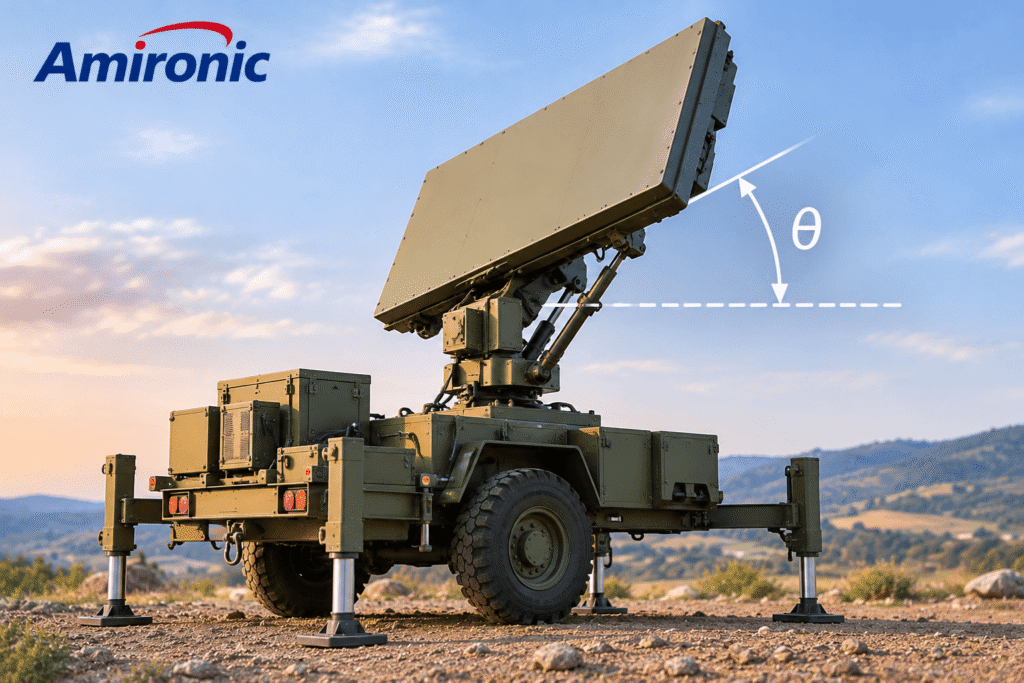
Consider an antenna system mounted on a mechanical mechanism that allows adjustment of its elevation angle.

Such systems may be found in communication equipment, test installations, industrial systems, and defense applications.

These systems often require continuous measurement of the antenna angle relative to the horizontal plane for position indication, motion control, or verification of the mechanical position.

8.1 Defining the Measurement Requirements

Assume that the antenna moves through an elevation range of 0° to 75° relative to the horizontal plane and that the control system requires continuous elevation angle feedback.

The requirements may include:

  • Angle measurement throughout the entire movement range.
  • Suitable repeatability for position control.
  • Compatibility with outdoor installation.
  • Resistance to vibration and temperature variations.
  • An output signal compatible with the control system.

At this stage, the sensor should not be selected based on its angular measurement range alone.

The maximum permissible measurement error and the operating conditions under which that accuracy must be maintained should also be defined.

8.2 Sensor Positioning and Installation

When the antenna angle must be measured relative to gravity, an inclinometer can be considered for installation on the structure that moves together with the antenna.

In this configuration, the sensor measures the inclination of the structure on which it is mounted.

However, if the system requires measurement of the relative angle between the antenna and its mechanical base, it is important to determine whether inclination measurement alone is sufficient.

For example, when the antenna base is installed on a mobile platform that is not level, the angle relative to the horizontal plane is not necessarily identical to the mechanical angle relative to the base.

In such cases, additional measurement of the base inclination or the use of a rotary position sensor at the mechanical joint may be considered.

8.3 Selecting a Suitable Inclinometer

An industrial inclinometer from the Positek P603 family may be considered when inclination measurement is required over a defined angular range and under industrial environmental conditions.

The calibrated measurement range, accuracy characteristics, sensor response, and installation requirements must be verified against the system specifications.

Applications with special environmental requirements may also benefit from evaluating other sensor families within the Variohm product range.

The final selection should be based on the sensor datasheet and suitability testing within the actual system.

8.4 Integrating the Sensor into the Control System

The sensor output is transmitted to the controller, which converts the signal into an angular value according to the output characteristics and calibration data.

The control system can use this value to display the antenna angle to the operator, compare the measured angle with a target position, or control the drive mechanism.

In applications requiring high accuracy, system-level calibration after installation is recommended to account for mechanical misalignment and errors associated with sensor positioning.

Engineering conclusion: Selecting an inclinometer does not begin with a part number. It begins with accurately defining the angle to be measured, the reference system, and the operating conditions.

9. Frequently Asked Questions – Inclinometer FAQ

9.1 What Is the Difference Between an Inclinometer and a Tilt Sensor?

In most industrial applications, both terms describe sensors designed to measure inclination angles.

The term Inclinometer is commonly used for devices measuring angles relative to gravity, while Tilt Sensor may also refer to simpler devices that detect when a predefined inclination threshold has been exceeded.

It is important to determine whether the sensor provides continuous angular measurement or only a signal indicating that a specific tilt threshold has been reached.

9.2 Can an Inclinometer Measure 360 Degrees?

This depends on the sensing technology and how the measurement is defined.

Many inclinometers are designed for limited angular measurement ranges. For example, the Positek P603 family is available with calibrated measurement ranges between 15° and 160°.

However, the Variohm product range also includes PCB-Mounted Inclinometers that are presented by the manufacturer as capable of measuring angles up to 360°.

It is important to distinguish between inclination measurement and continuous shaft rotation measurement.

When relative rotary position measurement is required, a Rotary Position Sensor or Encoder may be more suitable.

9.3 Can an Inclinometer Be Used on a Moving Vehicle or Machine?

Yes, but the sensor must be evaluated for the expected operating conditions.

In accelerometer-based inclinometers, acceleration and braking may affect the calculated inclination angle.

In highly dynamic applications, an alternative sensing technology or the integration of additional sensors may be necessary.

9.4 What Is the Difference Between an Inclinometer and an IMU?

An inclinometer is primarily designed to measure inclination angles.

An IMU (Inertial Measurement Unit) typically combines accelerometers and gyroscopes, and sometimes additional sensors, to provide information about motion, angular rates, and linear accelerations.

A system using an IMU with suitable algorithms can estimate orientation under dynamic conditions.

However, an IMU does not necessarily provide accurate absolute orientation without additional processing, calibration, or appropriate reference sources.

9.5 Is an IP67 Inclinometer Suitable for Outdoor Installation?

In many cases, yes, but suitability depends on the operating conditions.

IP67 indicates protection against dust ingress and resistance to temporary water immersion under the conditions defined by the applicable standard.

When prolonged submersion, high-pressure washing, or chemical exposure is expected, additional requirements must be evaluated and an appropriate sensor selected.

9.6 Are Positek Inclinometers Suitable for Construction and Heavy Machinery?

The Positek and Variohm inclinometer ranges include solutions designed for industrial applications and machinery operating under demanding environmental conditions.

Suitability for construction and heavy machinery depends on the specific model, installation conditions, accuracy requirements, and vibration and shock characteristics.

Each application must be evaluated individually. Not every sensor within a product family is necessarily suitable for every machine.

9.7 Can Inclinometers Be Used in Defense Applications?

Yes. Industrial inclinometers may be considered for defense applications such as lifting mechanisms, antenna positioning systems, test equipment, and mechanical platforms.

However, suitability for a defense application does not automatically indicate compliance with military standards.

Project requirements and manufacturer specifications must be reviewed, including environmental resistance, EMC, vibration, shock, and operating temperature limits.

9.8 Can an Inclinometer Replace a Rotary Position Sensor?

In certain applications, both technologies can provide useful angular information, but they are not interchangeable in every situation.

An inclinometer typically measures inclination relative to gravity, while a rotary position sensor measures the relative angular position of a mechanical mechanism.

The appropriate choice depends on the required reference system and mechanical configuration.

9.9 Are Inclinometers Available for Hazardous Areas?

Yes. The Positek product range includes inclinometers certified for use in potentially explosive atmospheres, including models from the X603 and X623 families.

Sensor selection must be based on the hazardous area classification, complete certification documentation, and installation requirements.

9.10 Can an Inclinometer Be Ordered with a Custom Measurement Range?

Certain Positek sensor families can be ordered with calibrated angular measurement ranges selected according to application requirements.

For example, the P603 family is available with selected measurement ranges depending on the intended application.

Available calibration ranges, output characteristics, and ordering requirements should be confirmed with the manufacturer.

10. Inclinometer Glossary – Key Engineering Terms

Term Definition
Inclinometer A sensor designed to measure inclination relative to a reference system, typically gravity.
Tilt Sensor A sensor that provides inclination measurement or tilt-state detection, depending on the technology.
Single Axis Inclination measurement in one defined plane.
Dual Axis Measurement of inclination components in two directions.
Pitch Forward and backward inclination.
Roll Side-to-side inclination.
Yaw Rotation around the vertical axis.
Measurement Range The angular range over which the sensor is designed to operate.
Accuracy The degree of agreement between the measured value and the true value.
Repeatability The ability to produce consistent readings under identical measurement conditions.
Resolution The smallest change that can be distinguished by the measurement system.
Linearity The degree to which the sensor response follows an ideal linear relationship.
Zero Offset The deviation of the sensor output from its intended value at the zero reference position.
Temperature Drift Changes in measurement characteristics resulting from temperature variations.
Response Time The time required for the sensor to respond to a change in angle, according to the specified measurement definition.
Bandwidth The frequency range over which the measurement system responds to changes in the measured signal.
MEMS Micro-Electro-Mechanical Systems technology, used in devices such as accelerometers.
IMU Inertial Measurement Unit, typically combining accelerometers and gyroscopes.
Sensor Fusion Combining information from multiple sensors to improve the estimation of system conditions.
IP67 / IP68 Ingress protection ratings defining protection against dust and water under specified conditions.
EMC Electromagnetic Compatibility of electronic equipment.
ATEX / IECEx Certification frameworks for equipment intended for use in potentially explosive atmospheres.
Heavy Duty A commercial description of equipment designed for demanding operating conditions; not a single standardized engineering classification.
OEM Original Equipment Manufacturer, a company integrating components into its own products or systems.
Elevation Angle The angle of elevation relative to a reference plane, such as in an antenna positioning system.

11. Conclusion – Selecting the Right Inclinometer for Industrial Applications

Inclinometers play an important role in mechanical and industrial systems requiring continuous and reliable inclination measurement.

In construction machinery, lifting systems, agricultural equipment, antenna positioning systems, and a wide range of OEM applications, angle measurement can support machine monitoring, motion control, leveling, and communication with control systems.

However, selecting the right inclinometer requires careful consideration of several factors, including measurement range, number of measurement axes, accuracy and repeatability, environmental conditions, vibration and acceleration effects, output signal, and installation requirements.

The Variohm Eurosensor and Positek inclinometer ranges include industrial measurement solutions, high-ingress-protection models, sensors for hazardous areas, heavy-duty inclinometers, and compact solutions for integration into electronic systems.

The differences between these sensor families allow engineers to evaluate solutions according to their specific application requirements. Nevertheless, the final selection must always be based on the specifications of the individual model and its suitability for the intended system.

Amironic Ltd. supplies Variohm Eurosensor and Positek sensing and position measurement solutions in Israel, supporting industrial customers and development engineers in selecting components according to their application requirements.

For technical assistance, inclinometer selection, or a quotation, please contact the Amironic team.

Tags: Variohm

Related Articles

Does Your Thermal Protector Really Solve the Problem? Or Just Give the System Another Chance to Fail?

09/07/2026amironicLTD

Advanced Sensing Solutions for Military and Autonomous Vehicles

12/03/2025amironicLTD

Hall Effect Rotary Sensor – Non-Contacting Design

25/08/2021amironicLTD

Recent Posts

  • Inclinometers and Tilt Sensors – Precision Angle Measurement for Mobile Machinery and Heavy-Duty Equipment
  • Footswitches in Medical Imaging Systems and Surgical Robotics – Hands-Free Operation, Ergonomics, and Precision Control
  • How to Choose a High-Precision IMU for GPS-Denied Navigation: An Engineering Guide Featuring Gladiator Technologies
  • Vacuum Switches for Filter Monitoring – Clog Detection, Differential Pressure and Predictive Maintenance
  • Hook Terminal vs. Screw Terminal – Understanding Terminal Connections in AIRPAX Hydraulic Magnetic Circuit Breakers

Categories

  • Air Switch
  • Circuit Breakers
  • Elapsed Time Indicator
  • Feedthrough
  • Footswitches
  • Gears & Transmission
  • Hour Meters
  • Infra Red Switches
  • INFRARED LAMPS
  • Low Noise Inertial MEMS
  • Mechanics
  • MEMS Gyroscope
  • MEMS Inertial
  • Microelectronics
  • Motors
  • Position Sensors
  • Power Supply
  • Pressure Sensors
  • Pressure Switch
  • Sealing
  • Switches
  • Temperature Sensors
  • Tungsten and Molybdenum
  • Uncategorized
  • Vacuum Switches

Quick Contact

Fill out the form and our representatives will return to you

    Name (required)

    Email (required)

    Phone

    Message

    This site is protected by reCAPTCHA and the Google
    Privacy Policy and
    Terms of Service apply.

    Amironic Ltd.

    3 Rabinovich Street, Petah Tikva 4928144 , Israel. Tel: +972-3-9047744 E-mail: office@amironic.co.il
    Email
    Facebook
    Twitter
    LinkedIn
    YouTube
    Press on the ISO Certificate below for download
    ISO 9001:2015 Certification
    • MEMS Inertial
    • Circuit Breakers
    • Footswitches
    • Mechanical & Transmissions
    • Sensors
    • Motors
    • Electronics
    • Hand Control
    • Power Solutions

    News

    • Inclinometers and Tilt Sensors – Precision Angle Measurement for Mobile Machinery and Heavy-Duty Equipment
    • Footswitches in Medical Imaging Systems and Surgical Robotics – Hands-Free Operation, Ergonomics, and Precision Control
    • How to Choose a High-Precision IMU for GPS-Denied Navigation: An Engineering Guide Featuring Gladiator Technologies
    • Vacuum Switches for Filter Monitoring – Clog Detection, Differential Pressure and Predictive Maintenance
    • Hook Terminal vs. Screw Terminal – Understanding Terminal Connections in AIRPAX Hydraulic Magnetic Circuit Breakers
    About AmironicContactעברית
    © 2022 Amironic All rights reserved. All Trademarks are the property of their respective owners.
    • Increase Font
    • Decrease Font
    • Black & White
    • Inverse Colors
    • Highlight Links
    • Regular Font
    • Reset