flagעברית
flagEnglish
3 Rabinovich St., Petah-Tikva, Israel
+972 3 9047744
office@amironic.co.il
Facebook
Twitter
LinkedIn
YouTube
  • Products
    • MEMS Inertial
      • Gyros & Accels
      • IMU
      • Inertial Navigation
      • AHRS
    • Circuit Breakers
      • Airpax Circuit Breakers
      • Electronic Circuit Breakers
      • Aircraft Circuit Breakers
      • Thermal Circuit Breakers
      • Sealing Solutions & Guards
    • Footswitches
      • Pedals & Bellows
      • USB
      • Air Switches
      • Medical
      • Modular Bases System
      • Industrial
      • Foot Potentiometers
      • Wireless
    • Mechanical & Transmisions
      • Gears
      • Sealing Solutions
      • Gearboxes
      • Couplings
      • Shafts & Bearings
      • Fasteners
      • Mechanical & Springs
      • Linear Motion
      • Anti-Vibration
    • Sensors
      • Thermostats
      • Temperature
      • Position
      • Pressure
      • Speed
      • Level Sensor
      • Load Cells
      • Flex Sensors
      • Membrane Potentiometer
    • Motors
      • Geared DC
      • Brushless DC
      • Step Motors with Gearbox
      • Torque Motors & Brushless Servo
      • AC Motors
      • DC Motors
    • Electronics
      • Xenon & IR Lamps
      • Counters & Meters
      • Microelectronics Packaging
      • Waterproof Switches
      • Micro Switches
    • Hand Control
      • Operator Controls (JOYSTICK)
      • Electrical
      • Pneumatic (Medical)
      • USB Hand Control
      • Air Push Button
      • Pressure Switch
      • IR Switch
    • Power Solutions
      • Rugged & Military Power Supply
      • Input Power Protection
      • Sealed Military Power Adaptor
      • Triple Output Military Power Supply Series – up to 250 W
    • Materials
      • Molybdenum and Advanced Alloys (TZM, MOLA, HCT)
      • Tungsten (Wolfram) and Advanced Alloys – High-Performance Materials for Extreme Conditions
      • Materials for Gears
  • Shop
  • Companies
  • About Amironic
  • News
  • Contact
Product was added to your cart

Cart

waze

Does Your Thermal Protector Really Solve the Problem? Or Just Give the System Another Chance to Fail?

Temperature Sensors09/07/2026amironicLTD

When engineers design a system that includes a motor, heating element, or other electrical load, thermal protection is almost always part of the design.

In most cases, this protection comes in the form of a thermostat, thermal protector, or thermal fuse.

The basic assumption is straightforward.

If the temperature gets too high, disconnect the circuit.

Sounds reasonable.

But here’s a question that is rarely asked.

What happens after the system cools down?

For most thermal protection devices, the answer is simple.

The protector automatically resets.

Power is restored to the motor.

The system attempts to operate again.

But what if the original cause of the overheating hasn’t gone away?

In many applications, the automatic restart – not the overheating itself – can become the greatest source of damage.

🧩 Further Reading – Measurement as a System

This article is part of an engineering series exploring how reliable measurement depends on proper system design rather than on a single sensor component.

Before diving deeper into industrial temperature sensing, you may also find the following articles in the series useful:

  • VARIOHM Group – When Measurement Is a System, Not a Component
  • How to Select Sensors for Harsh Environments: An Engineering Guide for Reliable Measurement in the Real World
  • VARIOHM Position Sensors – Engineering Position as a System, Not Just a Signal
  • Industrial Pressure Sensors – When Pressure Measurement Becomes a System Engineering Challenge
  • Industrial Temperature Sensors – When Temperature Measurement Becomes a System Engineering Challenge
  • Choosing the Right Linear Position Sensor: Why Stroke Length Is Only the Beginning
  • Contactless Rotary Position Sensors – Why More and More Systems Are Moving to Non-Contact Sensing
  • Choosing the Right Temperature Probe Mounting
  • How Differential Pressure (ΔP) Can Reveal Problems Long Before a System Shuts Down
  • Your Temperature Sensor Says 80°C. The Real Hot Spot Could Already Be at 130°C
  • Measuring Pressure Without Temperature Is Only Half the Picture

Overheating Is Usually Not the Real Problem

When a thermal protector trips, it’s easy to assume that temperature was the problem.

In reality, overheating is often just a symptom.

The root cause may be something entirely different, such as:

  • Locked rotor
  • Dry-running pump
  • Blocked cooling fan
  • Blender jammed by a foreign object
  • Coffee grinder with seized blades
  • Prolonged overload
  • Partial motor short circuit

In each of these cases, the rise in temperature is merely the result of an underlying fault.

Even after the system has cooled down, the original problem still exists.


The Real Problem Begins After the System Cools Down

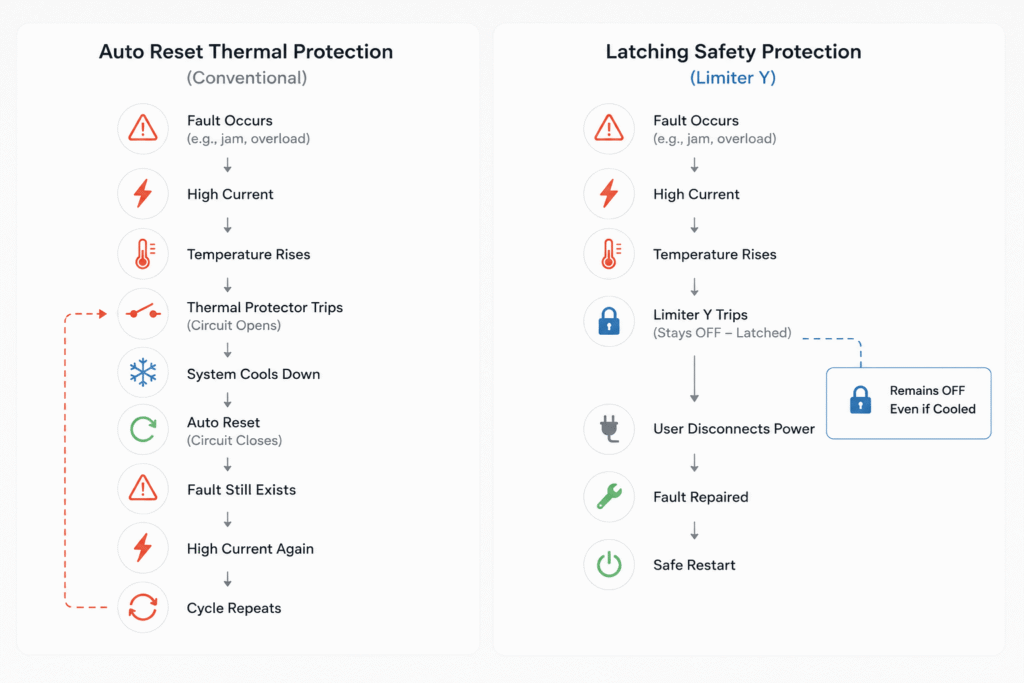
Now imagine the motor has cooled.

The thermal protector automatically resets.

Power is restored.

The system starts operating again.

But the rotor is still locked.

The motor immediately draws excessive current.

The temperature rises once more.

The protector trips again.

A short time later, it resets.

And the cycle repeats.

The system has entered an endless loop of:

  • Overheating
  • Trip
  • Cooling
  • Automatic restart

As long as the original fault remains unresolved, nothing has actually changed.

In fact, every cycle adds more thermal, mechanical, and electrical stress to the system.

Over time, this repeated stress can lead to cumulative damage to the motor, power electronics, connectors, insulation, and even the surrounding plastic housing.

Mechanical Fault
│
▼
High Current
│
▼
Temperature Rises
│
▼
Thermal Protector Trips
│
▼
System Cools Down
│
▼
Auto Reset
│
▼
Fault Still Exists
│
▼
High Current Again
│
▼
Failure Cycle Repeats

This Is Where the Real Problem Begins

If we take a step back and think about everyday applications, we’ll find that this scenario is far more common than most engineers realize.

Consider the following examples:

  • A pump running dry.
  • A cooling fan blocked by dust or debris.
  • A blender jammed by excessive load.
  • A coffee grinder with seized blades.
  • A small motor in a household appliance with a locked rotor.

In every one of these situations, the thermal protector does exactly what it was designed to do.

It detects excessive temperature.

It disconnects the circuit.

But it has no idea why the temperature increased in the first place.

Once the temperature drops, it simply reconnects the circuit.

From the protector’s perspective, everything is back to normal.

From the system’s perspective, nothing has changed.


Sometimes the Automatic Restart Is More Dangerous Than the Overheating

If the original fault still exists, every restart immediately pushes the motor back into the same failure condition.

High current.

Mechanical stress.

Rising temperature.

Trip.

Cooling.

And the cycle begins again.

Beyond the repeated stress on the motor itself, these thermal cycles can also lead to:

  • Accelerated insulation aging
  • Repeated heating of connectors and wiring
  • Damage to power electronics
  • Mechanical wear of moving components
  • Significantly reduced product lifetime
  • Increased warranty claims and service costs

In severe cases, repeated restart attempts may even create a genuine safety hazard.


The real engineering question is therefore not:

“At what temperature should the thermal protector trip?”

Instead, it should be:

“What happens after it trips?”

That is an entirely different design question.

And it fundamentally changes the way engineers should think about system protection.

In many applications, interrupting the circuit is only part of the solution.

It is equally important to ensure that the system does not automatically restart while the original fault still exists.

This is where the design philosophy shifts from Thermal Protection to Safety Protection.


A Different Approach: Limitor Y

Instead of simply interrupting the circuit until the device cools down, Limitor Y is designed to remain in the open state after a fault by means of an electrical latching mechanism.

As long as mains voltage is present, the contacts remain open.

Only after the power has been completely removed can the device be reset and returned to service.

In addition to over-temperature protection, Limitor Y also responds to abnormal current conditions, with current sensitivity tailored to the specific application.

The engineering benefit is straightforward.

The system is not given another opportunity to fail.

It remains safely shut down until the root cause has been identified and corrected.

That is the fundamental difference between a device that simply reacts to temperature and one that is designed to prevent an uncontrolled restart of the original fault.

More Than Just a Thermal Protector

At first glance, it is easy to assume that Limiter Y is simply another thermal protection device.

A closer look reveals something very different.

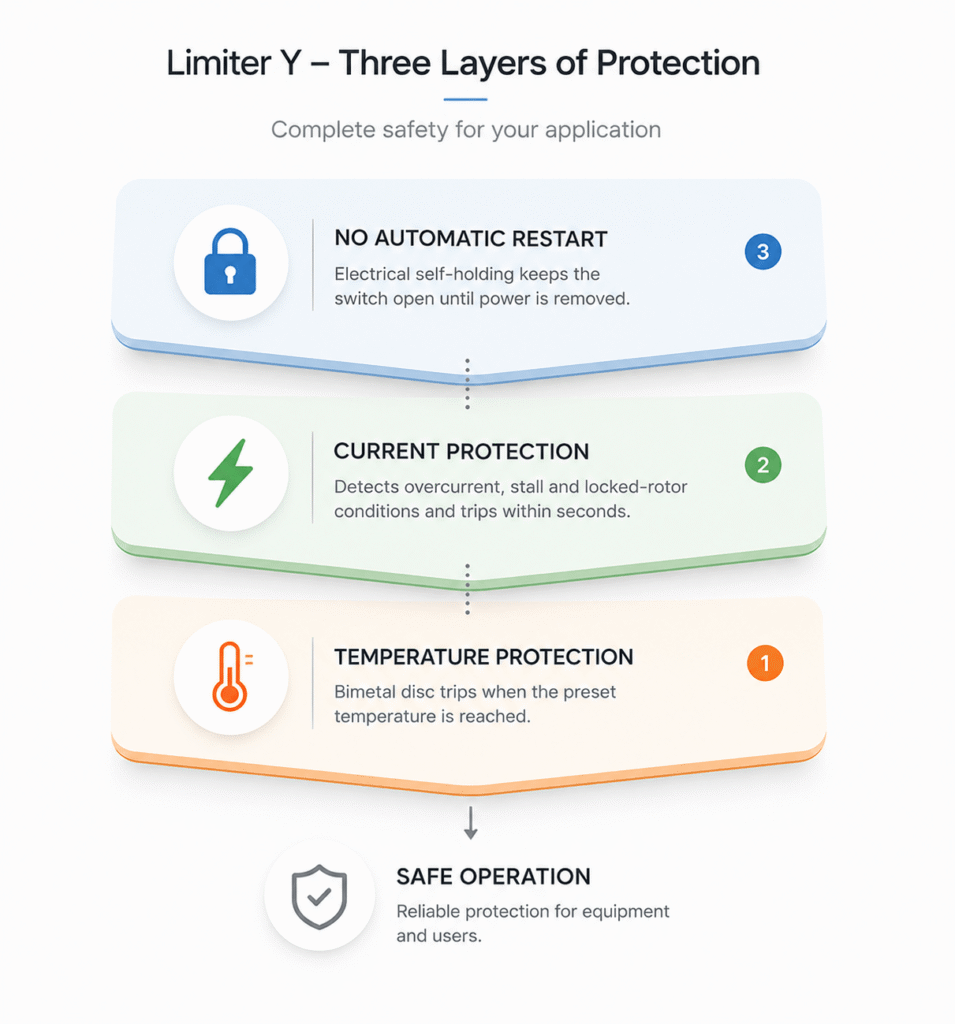
Rather than relying solely on a preset trip temperature, Limiter Y combines three complementary layers of protection into a single device.

1. Overtemperature Protection

Like a conventional thermal protector, Limiter Y uses a bimetal disc to interrupt the circuit once the specified operating temperature has been reached.

However, the trip temperature can be selected to match the application’s specific thermal requirements, providing greater flexibility across a wide range of operating conditions.


2. Overcurrent Protection

This is where Limiter Y begins to stand apart.

Instead of waiting for the motor to heat up over several seconds, it also detects abnormal electrical conditions, including:

  • Locked Rotor
  • Stall
  • Overload
  • Short Circuit

An internal Tripping Resistor (TR) rapidly heats the bimetal element whenever excessive current is detected, allowing the device to trip within seconds – often before the motor itself has reached a damaging temperature.

In other words, Limiter Y does more than monitor temperature.

It also responds to the electrical behavior of the system.


3. Automatic Restart Prevention

This is the feature that transforms Limiter Y from a thermal protector into a genuine safety device.

Once the circuit has been interrupted, an internal Holding Resistor (HR) keeps the contacts open as long as supply voltage is present.

Even after the device has cooled down, the circuit remains open.

The system cannot restart automatically.

Only after the power source has been disconnected can the device be reset and returned to service.

This ensures that someone must first investigate the cause of the fault before the equipment is allowed to operate again.


What Makes the Selection Process Different?

One of the most interesting aspects of Limitor’s engineering approach is that the process does not begin with a part number.

Most manufacturers present a catalog.

Choose the trip temperature.

Choose the current rating.

Place the order.

Limitor approaches the problem differently.

The first question is not “Which part number do you need?”

It is:

“Tell us about your application.”

  • Is it a motor?
  • A pump?
  • A cooling fan?
  • What is the continuous operating current?
  • What is the locked-rotor current?
  • How long can the motor safely withstand a stall condition?
  • What is the ambient operating temperature?
  • What is the supply voltage?

Only after these questions have been answered can the appropriate trip resistor, holding resistor, trip temperature, and protection characteristics be defined.

The Application Guide also recommends validating the selected device under real operating conditions rather than relying solely on catalog specifications.

Not Every Application Needs Limiter Y

It is important to emphasize that Limiter Y is not intended to replace every thermal protector.

In many applications, a conventional auto-reset thermal protector is the right solution.

For example:

  • General temperature control
  • Overtemperature protection where automatic restart presents no risk
  • Applications where repeated operating cycles are part of normal operation

In these situations, adding additional protection would simply increase complexity without providing meaningful benefit.

However, some applications require engineers to ask a different question.

Not:

“How hot will the system get?”

But rather:

“What happens if the equipment starts running again on its own?”

That is an entirely different engineering challenge.


When Should You Consider a Latching Protection Device?

The greater the consequences of a fault, the more important it becomes to prevent an automatic restart.

Typical examples include:

Coffee Machines

If the water pump has seized or a heating element has experienced an abnormal condition, the original fault may still exist long after the system has cooled down.

Blenders and Food Processors

Jammed blades rarely free themselves after a few minutes.

An automatic restart simply forces the motor back into the same overload condition.

Dryers and Washing Machines

If airflow has been restricted by a blocked fan or clogged air path, automatically re-energizing the heating element may immediately recreate the same fault condition.

Small Electric Motors

  • Locked Rotor
  • Stall
  • Bearing Failure
  • Pump Jam

These are mechanical faults that manifest themselves as excessive electrical current.


The Device Doesn’t Know What It’s Protecting

This is perhaps the most elegant aspect of the design.

Limiter Y does not know whether it has been installed in a blender.

A pump.

A coffee machine.

Or a ventilation fan.

It simply responds to physics.

Current.

Temperature.

And the electrical state of the circuit.

That is precisely why it can be adapted to such a wide variety of applications.

By selecting the appropriate trip temperature, current sensitivity, supply voltage, and mounting configuration, the same protection concept can be optimized for completely different systems.

It is not a matter of selecting a part number.

It is a matter of designing system behavior.


The Question Every Engineer Should Ask

Ultimately, the question is not:

“Which thermal protector should I choose?”

It is:

  • Is overheating the actual problem, or merely a symptom?
  • Will the original fault still exist after the system cools down?
  • Can the equipment safely restart on its own?
  • Or is the automatic restart itself the greatest risk?

Once these questions are answered, selecting a protection device becomes far more than a purchasing decision.

It becomes a system design decision.


Conclusion

Thermal protectors have been successfully protecting electrical equipment for decades.

In countless applications, they remain the ideal solution.

However, as safety requirements continue to evolve, simply disconnecting a circuit during an overtemperature event is not always enough.

In some systems, preventing an uncontrolled restart is just as important as detecting the fault itself.

That is the design philosophy behind Limiter Y.

It is not simply a device that reacts to temperature.

It is a protection device designed to interrupt the failure cycle before it leads to equipment damage, costly downtime, or a safety hazard.


Frequently Asked Questions (FAQ)

Does Limiter Y replace a conventional thermal protector?

No. It is intended for applications where preventing an automatic restart after a fault is just as important as interrupting an overtemperature condition.


Does Limiter Y respond only to temperature?

No. It combines overtemperature protection with current-sensitive tripping, allowing it to respond to abnormal electrical conditions as well as excessive heat.


What types of applications is it designed for?

Typical applications include coffee machines, blenders, food processors, washing machines, dryers, ventilation systems, pumps, and other equipment where an uncontrolled automatic restart could create additional damage or safety risks.


Can Limiter Y be customized for different applications?

Yes. Parameters such as trip temperature, current sensitivity, supply voltage, housing style, and mounting options can all be selected to match the specific application.

Decision Tree – Should You Consider a Latching Protection Device?

Step 1

Does the system automatically restart after it has cooled down?

No → A conventional thermal protector may be sufficient.

Yes → Proceed to Step 2.


Step 2

Could the original fault still exist after the system has cooled down?

Examples include:

  • Locked Rotor
  • Dry-Running Pump
  • Blocked Cooling Fan
  • Jammed Blade

No → A conventional thermal protector may be sufficient.

Yes → Proceed to Step 3.


Step 3

Could an automatic restart cause equipment damage, system downtime, or a safety hazard?

No → Evaluate the application’s overall risk and protection requirements.

Yes → Consider a Latching Safety Protection solution.


Conclusion

If you answered “Yes” to all three questions, a protection device that prevents automatic restart after a fault may be a better choice than a conventional auto-reset thermal protector.


Quick Design Guide – Is an Auto-Reset Thermal Protector Enough?

There is no single protection strategy that fits every application.

In many systems, an auto-reset thermal protector provides reliable and effective overtemperature protection.

However, in some applications, the automatic restart itself can become part of the problem.

When designing a new system, ask yourself the following questions.

✔ Could the original fault still exist after the system has cooled down?

Examples include:

  • Locked Rotor
  • Dry-Running Pump
  • Jammed Blade
  • Blocked Cooling Fan

✔ Could the motor draw excessive current during a fault condition?

If the fault can result in a Locked Rotor or Stall Current, a protection device that responds to current as well as temperature may be more appropriate.


✔ Could an automatic restart cause additional damage?

In some applications, repeatedly restarting the motor before the fault has been corrected can shorten equipment life, increase repair costs, and even create a safety hazard.


✔ Are safety requirements or warranty costs particularly important?

The greater the consequences of a failure, the greater the need to prevent uncontrolled automatic restarts.


✔ Should the user inspect the equipment before it is allowed to operate again?

If the answer is Yes, a latching protection device may be a better choice than an auto-reset thermal protector.


Simply put,

If the original fault can still exist after the system has cooled down, the real engineering question is not “When should the circuit trip?” but rather “When should the system be allowed to restart?”


Common Mistakes When Selecting Thermal Protection

Even experienced engineers sometimes make assumptions that can lead to unreliable system protection.

Here are five common mistakes.

1. “If there’s a thermal protector, the system is protected.”

Not necessarily.

A thermal protector responds to overheating, but it does not eliminate the underlying cause of the fault.


2. “Once the system has cooled down, it’s safe to restart.”

Not always.

If the original fault still exists, the system may immediately return to the same failure condition.


3. “All thermal protectors work the same way.”

They do not.

Auto-reset, manual-reset, and latching protection devices behave very differently.

Choosing the right operating principle is just as important as selecting the correct trip temperature.


4. “Trip temperature is the only parameter that matters.”

Trip temperature is only one part of the equation.

Current behavior, response time, supply voltage, and restart characteristics are often just as important.


5. “Thermal protection fixes mechanical problems.”

It doesn’t.

A thermal protector cannot repair a locked rotor, a blocked pump, or a stalled fan.

It simply reacts to the consequences of those faults.


Key Terms

Auto Reset

A thermal protection device that automatically returns to its closed state once its temperature falls below the reset threshold.


Electrical Latching

A mechanism that keeps the device in the open state even after it has cooled down, until the power supply is removed and the device is reset.


Locked Rotor

A condition in which power is applied to a motor but the rotor cannot rotate, resulting in excessive current draw.


Stall Current

The current drawn by a motor when it is unable to rotate or accelerate from standstill.


Thermal Cycling

Repeated cycles of overheating, tripping, cooling, and automatic restarting.


Overload

A condition in which a mechanical or electrical load exceeds the intended operating limits, potentially causing excessive heating.

Tags: Variohm

Related Articles

Choosing the Right Linear Position Sensor: Why Stroke Length Is Only the Beginning

21/04/2026amironicLTD

When Space is Tight – Euro‑MXPK Fits Right In

30/07/2025amironicLTD

Choosing the Right Temperature Probe Mounting

27/05/2026amironicLTD

Recent Posts

  • Does Your Thermal Protector Really Solve the Problem? Or Just Give the System Another Chance to Fail?
  • Momentary or Latching? How to Choose the Right Switch for Industrial, Medical, and OEM Applications
  • A 30mA Ground Fault Could Bring Down Thousands of GPUs – Designing Ground Fault Protection for Data Center CDUs
  • Pneumatic Foot Bellows vs. Electrical Footswitch – Do You Really Need to Run Electricity to the Foot Pedal?
  • The Gearbox Isn’t the Problem – It’s Simply the First to Pay for Design Mistakes

Categories

  • Air Switch
  • Circuit Breakers
  • Elapsed Time Indicator
  • Feedthrough
  • Footswitches
  • Gears & Transmission
  • Hour Meters
  • Infra Red Switches
  • INFRARED LAMPS
  • Low Noise Inertial MEMS
  • Mechanics
  • MEMS Gyroscope
  • MEMS Inertial
  • Microelectronics
  • Motors
  • Position Sensors
  • Power Supply
  • Pressure Sensors
  • Pressure Switch
  • Temperature Sensors
  • Tungsten and Molybdenum
  • Uncategorized
  • Vacuum Switches

Quick Contact

Fill out the form and our representatives will return to you

    Name (required)

    Email (required)

    Phone

    Message

    This site is protected by reCAPTCHA and the Google
    Privacy Policy and
    Terms of Service apply.

    Amironic Ltd.

    3 Rabinovich Street, Petah Tikva 4928144 , Israel. Tel: +972-3-9047744 E-mail: office@amironic.co.il
    Email
    Facebook
    Twitter
    LinkedIn
    YouTube
    Press on the ISO Certificate below for download
    ISO 9001:2015 Certification
    • MEMS Inertial
    • Circuit Breakers
    • Footswitches
    • Mechanical & Transmisions
    • Sensors
    • Motors
    • Electronics
    • Hand Control
    • Power Solutions

    News

    • Does Your Thermal Protector Really Solve the Problem? Or Just Give the System Another Chance to Fail?
    • Momentary or Latching? How to Choose the Right Switch for Industrial, Medical, and OEM Applications
    • A 30mA Ground Fault Could Bring Down Thousands of GPUs – Designing Ground Fault Protection for Data Center CDUs
    • Pneumatic Foot Bellows vs. Electrical Footswitch – Do You Really Need to Run Electricity to the Foot Pedal?
    • The Gearbox Isn’t the Problem – It’s Simply the First to Pay for Design Mistakes
    About AmironicContactעברית
    © 2022 Amironic All rights reserved. All Trademarks are the property of their respective owners.
    • Increase Font
    • Decrease Font
    • Black & White
    • Inverse Colors
    • Highlight Links
    • Regular Font
    • Reset