


- MIL-PRF-39019 Circuit Breakers: Selection, Trip Curves, and Aerospace Power Protection
- Why M39019 Is Not Just a Standard – It’s an Identity
- Understanding Trip Curves in Hydraulic-Magnetic Circuit Breakers
- Power Protection in Military Ground Platforms: Electrical Stability Under Vibration, Shock, and 28V Vehicle Systems
- The Airpax AP Series: The Engineering Logic Behind a Hydraulic-Magnetic Circuit Breaker That Became a Military Standard
- Hydraulic-Magnetic vs Thermal Circuit Breakers
- Airpax IULN and IUGN Circuit Breakers: Sealed Hydraulic-Magnetic Protection for Rugged Electronic Systems
- How Engineers Choose Between Airpax AP, IUL, IUG, and Commercial Circuit Breakers
- SNAPAK Circuit Protectors: When Circuit Protection Becomes a User Interface
- DIN Rail Circuit Breakers – Why Industrial Systems Demand More Than a Standard MCB
- Why MIL-PRF-39019 Circuit Breakers Still Appear in New Defense Programs
- Why a 10A Circuit Breaker Is Not Always Suitable for a 10A Load
- Keeping Data Centers Running: The Role of Circuit Protection
- Circuit Breaker or Control Device? Why Military Circuit Breakers Do More Than Protect
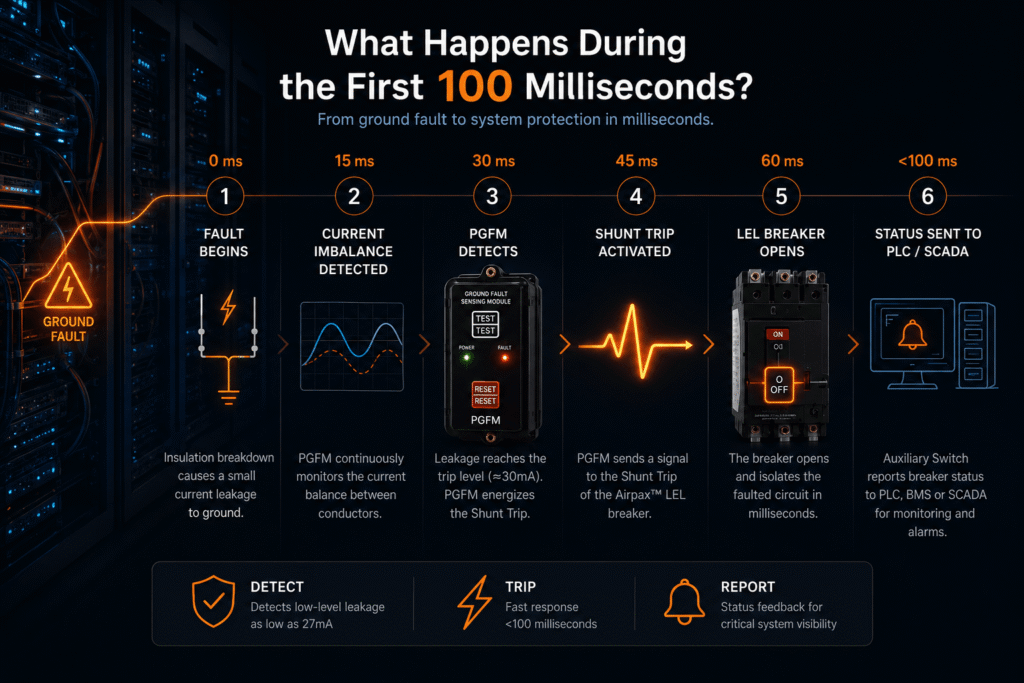
When an Entire Data Center Depends on 30mA
Imagine a newly built AI data center.
Hundreds of servers.
Thousands of GPUs.
Cooling Distribution Units (CDUs) delivering continuous liquid cooling.
Pumps, heat exchangers, piping, controllers, and monitoring systems all operate around the clock to maintain stable operating temperatures.
Then a fault occurs.
Not a short circuit.
Not a fire.
Not a power outage.
Just 30mA leaking from the electrical circuit.
In one system, it may simply be the first indication of insulation degradation.
In another, it could be the beginning of an outage affecting thousands of GPUs.
That is why more and more engineers are no longer asking only how to protect an electrical circuit.
They are asking how to maintain system availability even when an electrical fault occurs.
AI Has Changed More Than Cooling – It Has Changed Electrical Protection
A decade ago, most data centers relied on air cooling, and a single rack typically consumed only a few kilowatts.
Today, a single rack may draw tens of kilowatts – and in some AI deployments, well over 100kW.
As power density has increased, cooling technologies have evolved just as dramatically.
Direct-to-Chip Cooling.
Rear Door Heat Exchangers.
Cooling Distribution Units (CDUs).
Yet while most engineering effort is focused on pumps, heat exchangers, coolant flow, and thermal management, one critical subsystem often receives far less attention than it deserves:
The electrical protection system powering the CDU.
Ironically, that system may determine whether the data center continues operating when an electrical fault occurs.
The Cost of Failure Is No Longer the Cost of the Component
Years ago, a cooling system failure might have affected only a handful of servers.
Today, a single CDU may support dozens of high-density AI racks.
As a result, a single electrical fault can trigger a chain reaction:
- Rising processor temperatures
- Thermal throttling
- Interrupted AI workloads
- Reduced service availability
- Costly recovery time
The real cost is no longer the circuit breaker.
Or the pump.
The real cost is downtime.
The Mistake Many Engineers Still Make
One of the most common misconceptions in power system design is surprisingly simple:
“We already have a high-quality circuit breaker. We’re protected.”
Not necessarily.
Hydraulic-magnetic circuit breakers are specifically designed to protect against:
- Overload
- Short circuit
Ground faults are different.
Imagine a 50A circuit breaker protecting a CDU.
If only 30mA leaks through the equipment frame, piping, moisture, or another unintended path, the breaker still sees normal operating current.
From the breaker’s perspective, nothing abnormal has happened.
The breaker hasn’t failed.
It is doing exactly what it was designed to do.
And that is precisely why an additional layer of protection is required.
What Is a Ground Fault?
Under normal operating conditions, every ampere flowing to the load must return through the intended conductors.
When even a small portion of that current takes an unintended path – through earth, the equipment chassis, moisture, or another conductive surface – an imbalance develops between the outgoing and returning current.
That condition is known as a Ground Fault.
The leakage current may be very small.
Yet even a small leakage current can indicate insulation degradation, moisture ingress, or an electrical fault in its early stages – long before a short circuit develops.
Because the leakage current is so small, a conventional circuit breaker is generally not intended to detect it.
If You’re Designing a CDU, This Is the Question You Should Be Asking
Most CDU engineers spend countless hours selecting:
- Pumps
- Heat exchangers
- Coolant flow rates
- Operating pressure
- Coolant type
But are you giving the same level of attention to one critical question?
How will a leakage current be detected before it becomes an outage?
In systems operating 24 hours a day, 365 days a year, even a minor electrical fault that goes undetected can become an expensive interruption.
The Solution – A Protection System, Not Just a Circuit Breaker
This is where the Sensata LineGard™ PGFM system comes into play.
The PGFM is not a circuit breaker.
Nor is it simply another GFCI device.
It is a dedicated Ground Fault sensing module that continuously monitors the current balance of the conductors supplying the CDU.
When it detects a leakage current at its nominal trip level of approximately 27mA (30mA maximum), it energizes the Shunt Trip coil of an Airpax™ LEL circuit breaker, rapidly disconnecting the circuit while simultaneously providing clear fault indication that distinguishes a Ground Fault from a conventional short circuit.
In other words, protection is no longer based on a single device.
It is based on an integrated protection architecture.
Why Doesn’t Sensata Support PGFM with Every Circuit Breaker?
At first glance, this might seem like a limitation.
In reality, it is one of the system’s greatest engineering strengths.
System reliability is not determined by how many components you install.
It is determined by how well those components work together.
Just as you wouldn’t combine an ABS controller from one manufacturer with another manufacturer’s braking system, Ground Fault protection should not be assembled from unrelated components.
The PGFM was specifically engineered to work with Airpax™ LEL circuit breakers equipped with:
- Shunt Trip
- Auxiliary Switch
- UL 489 certification
The result is a coordinated protection system in which fault detection, breaker tripping, indication, and communication with the control system operate as one integrated solution.
Why Airpax™ LEL?
The Airpax™ LEL series was selected for more than just compatibility with the PGFM.
It was designed specifically for applications where reliability is a fundamental requirement.
Its hydraulic-magnetic technology delivers highly repeatable trip characteristics that remain substantially unaffected by ambient temperature, unlike conventional thermal circuit breakers.
In addition, the LEL family is available with Shunt Trip, Auxiliary Switch, multiple pole configurations, and UL 489 certification, making it ideally suited for integration into advanced monitoring and control systems.
More Than a Circuit Breaker – Part of the Data Center Reliability Architecture
When combined, the PGFM and Airpax LEL provide a protection system capable of:
- Detecting Ground Fault leakage
- Activating the Shunt Trip
- Rapidly disconnecting the affected circuit
- Distinguishing Ground Faults from short circuits
- Reporting breaker status through the Auxiliary Switch
- Integrating with PLC, BMS, and SCADA systems
At this point, the circuit breaker is no longer simply a protective device.
It becomes an active component of the data center’s monitoring and reliability architecture.
Conclusion
For decades, the primary purpose of a circuit breaker was to protect wiring and equipment.
In today’s AI-driven data centers, its role has expanded significantly.
It helps protect availability.
It helps maintain uptime.
And it helps safeguard critical infrastructure where even a leakage current of just a few tens of milliamps may signal the beginning of a costly outage.
That is why today’s infrastructure designers are no longer asking:
“Which circuit breaker should I choose?”
Instead, they are asking a much more important question:
“How will my protection system respond on the day the first electrical fault occurs?”
Case Study
How a 30mA Leakage Current Nearly Disrupted an AI Cluster – and How a Dedicated Ground Fault Protection System Solved the Problem
Background
A manufacturer of Cooling Distribution Units (CDUs) was developing a liquid cooling system for a next-generation AI and High-Performance Computing (HPC) data center.
Each CDU was responsible for cooling multiple high-density server racks, making continuous operation essential. Any interruption to the cooling system could rapidly increase processor temperatures, trigger thermal throttling, and reduce overall system availability.
The electrical architecture included:
- AC power input
- Cooling pumps
- Heat exchanger
- PLC
- Building Management System (BMS)
- Hydraulic-magnetic circuit breaker
The Challenge
During system integration testing, engineers encountered a scenario that had not been considered during the initial design phase.
Moisture ingress within one section of the cooling system created a small leakage current.
There was no short circuit.
There was no overload.
The operating current remained essentially unchanged.
The hydraulic-magnetic circuit breaker continued operating exactly as designed.
Yet the engineering team knew something was wrong.
Why Didn’t the Circuit Breaker Trip?
That was precisely the issue.
The circuit breaker had not failed.
Quite the opposite.
It was performing exactly as intended.
Its purpose was to protect against:
- Overload
- Short circuit
It was never designed to detect leakage currents of only a few tens of milliamps.
From the breaker’s perspective, there was simply no reason to trip.
The Solution
To address the problem, the engineering team added:
- A Sensata LineGard™ PGFM Ground Fault sensing module
- An Airpax™ LEL hydraulic-magnetic circuit breaker equipped with Shunt Trip and Auxiliary Switch
The PGFM continuously monitored the current balance of the conductors supplying the CDU.
When it detected a leakage current at its nominal trip threshold of approximately 27mA, it energized the Shunt Trip coil of the Airpax LEL breaker, rapidly disconnecting the circuit.
At the same time, the module provided a clear indication that the event was a Ground Fault, rather than a conventional short circuit.
Results
The upgraded protection architecture delivered several important benefits:
✔ Early detection of leakage currents
✔ Fast automatic circuit isolation
✔ Clear differentiation between Ground Faults and short circuits
✔ Breaker status reporting through the Auxiliary Switch
✔ Simple integration with the Building Management System (BMS)
✔ Improved troubleshooting and maintenance diagnostics
Engineering Insight
One of the project’s most important lessons was that a high-quality circuit breaker is not expected to detect every type of electrical fault.
Each component has a specific role within the protection architecture.
In this application:
- Airpax™ LEL provided overload and short-circuit protection.
- PGFM continuously monitored for Ground Fault leakage.
- Shunt Trip initiated rapid circuit isolation.
- Auxiliary Switch reported breaker status to the control system.
Working together, these components created a coordinated protection system rather than a collection of independent devices.
Why Airpax™ LEL?
During the design review, engineers evaluated whether the Ground Fault sensing module could be paired with other circuit breakers.
The answer was no.
The PGFM was specifically engineered to operate with Airpax™ LEL circuit breakers equipped with Shunt Trip, Auxiliary Switch, and UL 489 certification, ensuring that fault detection, breaker operation, indication, and system communication function as one coordinated protection solution.
Lessons Learned
The project highlighted several important principles for designing reliable AI infrastructure:
- Not every electrical fault is a short circuit.
- A small leakage current may be the earliest indication of insulation degradation.
- Ground Fault protection complements – rather than replaces – the circuit breaker.
- Using components specifically designed to operate together simplifies system integration and improves overall reliability.
- In modern AI data centers, system availability is just as important as electrical protection.
Frequently Asked Questions (FAQ)
Is a Ground Fault the Same as a Short Circuit?
No. A short circuit occurs when two conductors at different electrical potentials come into direct contact, creating a very high current. A Ground Fault, on the other hand, occurs when a portion of the current flows through an unintended path, such as earth, the equipment chassis, moisture, or another conductive surface. In many cases, the leakage current is too small for a conventional circuit breaker to detect.
Can a Standard Circuit Breaker Detect a Ground Fault?
Not necessarily. Hydraulic-magnetic and thermal circuit breakers are typically designed to protect against overloads and short circuits. Leakage currents of only a few tens of milliamps may not exceed the breaker’s rated operating current, making dedicated Ground Fault protection necessary.
Why Is a 30mA Leakage Current Considered Significant?
Even a relatively small leakage current can indicate insulation degradation, moisture ingress, or an emerging electrical fault. In some applications, it may also present a safety hazard to personnel or equipment, which is why dedicated Ground Fault protection systems are commonly used to detect leakage currents at these levels.
Does the PGFM Replace the Circuit Breaker?
No. The PGFM is not intended to replace the Airpax™ LEL circuit breaker. Instead, it complements it. The circuit breaker protects against overloads and short circuits, while the PGFM detects Ground Fault leakage and activates the Shunt Trip mechanism when necessary.
Why Is the PGFM Designed Specifically for Airpax™ LEL Circuit Breakers?
The PGFM was specifically engineered to operate with Airpax™ LEL circuit breakers equipped with Shunt Trip and Auxiliary Switch options. This coordinated design enables fault detection, breaker tripping, indication, and communication to function as a fully integrated protection system rather than as a collection of unrelated components.
What Is a Shunt Trip?
A Shunt Trip is an electrically operated mechanism that allows a circuit breaker to be opened remotely. In a PGFM system, the module energizes the Shunt Trip coil whenever a Ground Fault is detected.
What Is an Auxiliary Switch?
An Auxiliary Switch is a secondary contact that reports the status of the circuit breaker. It can provide feedback to PLCs, Building Management Systems (BMS), SCADA platforms, or other monitoring systems.
Is the PGFM Intended Only for Data Centers?
No. While it is particularly well suited for AI data centers and CDU applications, the PGFM can also be used in marine systems, industrial equipment, critical cooling applications, and other installations requiring reliable Ground Fault protection.
Can the System Be Integrated with BMS or SCADA?
Yes. The Auxiliary Switch allows breaker status to be communicated to Building Management Systems (BMS), SCADA platforms, PLCs, and other supervisory control systems.
What Is the Advantage of a Hydraulic-Magnetic Circuit Breaker in CDU Applications?
Hydraulic-magnetic circuit breakers provide highly repeatable trip characteristics that are substantially unaffected by ambient temperature. This makes them particularly suitable for applications requiring precise and reliable protection under varying environmental conditions.
Does Ground Fault Protection Improve Data Center Availability?
Yes. Early detection of leakage currents can help identify developing faults before they escalate into major failures. In critical infrastructure, maintaining system availability is just as important as protecting electrical equipment.
Does Every Leakage Current Indicate a Serious Failure?
Not always. Some leakage currents may be temporary or relatively harmless. However, they can also represent the earliest indication of insulation degradation or moisture ingress and should therefore be investigated.
What Is the Difference Between a GFCI and the PGFM?
GFCI is a general term describing Ground Fault protection devices. The Sensata LineGard™ PGFM is a dedicated Ground Fault sensing module specifically designed to operate with Airpax™ LEL circuit breakers, creating a coordinated protection system that includes fault detection, circuit interruption, and system indication.
Can the PGFM Be Used with Any Circuit Breaker?
No. The PGFM is designed to operate with compatible Airpax™ LEL circuit breakers equipped with Shunt Trip and Auxiliary Switch options to ensure proper coordination of the entire protection system.
When Should Ground Fault Protection Be Considered?
Ground Fault protection should be considered whenever an application involves valuable equipment, high availability requirements, critical cooling systems, moisture exposure, or a risk of leakage currents. Typical examples include AI data centers, CDU systems, medical equipment, marine applications, and industrial infrastructure.
Is Ground Fault Protection Still Needed If a Hydraulic-Magnetic Circuit Breaker Is Already Installed?
Yes. Hydraulic-magnetic circuit breakers and Ground Fault protection perform different functions. Circuit breakers protect against overloads and short circuits, while Ground Fault protection detects current imbalances that may not be large enough to operate the breaker. In many applications, the two systems complement each other.
Does Every CDU Require Ground Fault Protection?
Not necessarily. The decision depends on system architecture, applicable standards, environmental conditions, risk assessment, and customer requirements. As CDU systems become increasingly critical to AI infrastructure, many designers are incorporating Ground Fault protection as part of their overall electrical protection strategy.
Can the PGFM Be Added to an Existing System?
In many cases, yes. However, compatibility depends on the existing electrical architecture and the installed circuit breaker. Since the PGFM is designed for Airpax™ LEL circuit breakers equipped with Shunt Trip and Auxiliary Switch options, engineering compatibility should always be verified before retrofitting.
Can a Ground Fault Occur Without an Electrical Equipment Failure?
Yes. Leakage currents may result from moisture, condensation, conductive contamination, aging insulation, water ingress, or mechanical damage to cables. A Ground Fault does not necessarily indicate a short circuit, but it should always be investigated.
Does Liquid Cooling Increase the Importance of Ground Fault Protection?
In many applications, yes. Pumps, piping, heat exchangers, and liquid coolant create an environment where early detection of leakage currents and insulation faults becomes particularly important.
Can Ground Fault Protection Improve Overall System Reliability?
Yes. When properly integrated, Ground Fault protection can improve system reliability by identifying developing electrical faults before they result in equipment damage or costly downtime.
Can Operators Receive an Alarm Before Maintenance Is Required?
Depending on the system architecture, yes. By integrating the Auxiliary Switch with a PLC, BMS, or SCADA system, operators can receive breaker status information, alarms, and diagnostic data to support preventive maintenance and faster troubleshooting.
What Is the Advantage of Using Components Designed to Work Together?
When the sensing module, circuit breaker, Shunt Trip, and Auxiliary Switch are designed as a coordinated system, integration becomes simpler and the risk of compatibility issues is reduced. This can shorten development time while improving overall system reliability.
Is the Airpax™ LEL Series Suitable Only for Data Centers?
No. Airpax™ LEL circuit breakers are widely used in industrial equipment, OEM systems, communications infrastructure, marine applications, and other mission-critical installations requiring reliable hydraulic-magnetic protection together with features such as Shunt Trip and Auxiliary Switch.
How Should Engineers Select the Right Protection Solution for a CDU?
The selection process should consider several key factors, including:
- Operating voltage
- Continuous operating current
- Applicable standards and certifications
- Cooling system architecture
- Availability (uptime) requirements
- Integration with PLC, BMS, or SCADA systems
- The need for Ground Fault detection and remote status indication
For mission-critical applications, Ground Fault protection should be evaluated as an integral part of the CDU design rather than being added later as an afterthought.
When Should Ground Fault Protection Be Considered?
There is no single answer that applies to every electrical system.
In many applications, a high-quality hydraulic-magnetic circuit breaker provides the required protection against overloads and short circuits.
However, there are situations where adding Ground Fault Protection should be considered as part of the overall electrical protection strategy.
This is particularly true when one or more of the following conditions apply.
✔ Liquids or Moisture Are Present
Cooling Distribution Units (CDUs), liquid cooling systems, marine equipment, pumps, and industrial process systems may all be exposed to moisture, condensation, or coolant leaks.
In these environments, early detection of leakage current can become an important part of the system design.
✔ System Availability Is More Valuable Than the Protection Hardware
Ground Fault Protection should be considered whenever an unexpected shutdown could result in:
- Production line downtime
- Data center service interruptions
- Medical equipment outages
- AI workload disruption
- High recovery costs
In these applications, early fault detection may be just as important as overload protection.
✔ Regulatory Requirements or Safety Standards Apply
Certain industries, including marine applications and other regulated installations, may require or recommend Ground Fault Protection.
Always verify the applicable electrical codes, safety standards, and regulatory requirements for your specific application.
✔ The System Is Integrated with PLC, BMS, or SCADA
If the system already includes:
- Monitoring
- Alarm management
- Remote supervision
- Predictive maintenance
Ground Fault Protection can become part of the overall monitoring architecture rather than serving solely as a protective device.
✔ Early Detection of Developing Faults Is Important
In many applications, leakage current is one of the earliest indicators of insulation degradation.
Detecting these conditions early may allow maintenance personnel to resolve the issue before it develops into a more serious electrical failure.
When Ground Fault Protection May Not Be Necessary
Not every application requires dedicated Ground Fault Protection.
For example, it may provide limited additional benefit in relatively simple systems where:
- High availability is not a design requirement.
- Moisture exposure is minimal.
- No critical equipment is involved.
- No regulatory requirements apply.
- A conventional circuit breaker provides adequate protection.
Ultimately, the decision should be based on risk assessment, system architecture, and applicable standards rather than a universal rule.
Ground Fault Protection Design Checklist
| Design Question | If the Answer Is “Yes,” Consider Ground Fault Protection |
|---|---|
| Are liquids or moisture present? | ✔ |
| Is system availability critical? | ✔ |
| Does the application include a CDU or liquid cooling system? | ✔ |
| Is the system integrated with PLC, BMS, or SCADA? | ✔ |
| Is expensive equipment or AI computing involved? | ✔ |
| Are regulatory or safety standards applicable? | ✔ |