flagעברית
flagEnglish
3 Rabinovich St., Petah-Tikva, Israel
+972 3 9047744
office@amironic.co.il
Facebook
Twitter
LinkedIn
YouTube
  • Products
    • MEMS Inertial
      • Gyros & Accels
      • IMU
      • Inertial Navigation
      • AHRS
    • Circuit Breakers
      • Airpax Circuit Breakers
      • Electronic Circuit Breakers
      • Aircraft Circuit Breakers
      • Thermal Circuit Breakers
      • Sealing Solutions & Guards
    • Footswitches
      • Pedals & Bellows
      • USB
      • Air Switches
      • Medical
      • Modular Bases System
      • Industrial
      • Foot Potentiometers
      • Wireless
    • Mechanical & Transmisions
      • Gears
      • Sealing Solutions
      • Gearboxes
      • Couplings
      • Shafts & Bearings
      • Fasteners
      • Mechanical & Springs
      • Linear Motion
      • Anti-Vibration
    • Sensors
      • Thermostats
      • Temperature
      • Position
      • Pressure
      • Speed
      • Level Sensor
      • Load Cells
      • Flex Sensors
      • Membrane Potentiometer
    • Motors
      • Geared DC
      • Brushless DC
      • Step Motors with Gearbox
      • Torque Motors & Brushless Servo
      • AC Motors
      • DC Motors
    • Electronics
      • Xenon & IR Lamps
      • Counters & Meters
      • Microelectronics Packaging
      • Waterproof Switches
      • Micro Switches
    • Hand Control
      • Operator Controls (JOYSTICK)
      • Electrical
      • Pneumatic (Medical)
      • USB Hand Control
      • Air Push Button
      • Pressure Switch
      • IR Switch
    • Power Solutions
      • Rugged & Military Power Supply
      • Input Power Protection
      • Sealed Military Power Adaptor
      • Triple Output Military Power Supply Series – up to 250 W
    • Materials
      • Molybdenum and Advanced Alloys (TZM, MOLA, HCT)
      • Tungsten (Wolfram) and Advanced Alloys – High-Performance Materials for Extreme Conditions
      • Materials for Gears
  • Shop
  • Companies
  • About Amironic
  • News
  • Contact
Product was added to your cart

Cart

waze

Measuring Pressure Without Temperature Is Only Half the Picture

Pressure Sensors, Temperature Sensors30/06/2026amironicLTD

🧩 Further Reading – Measurement as a System

This article is part of an engineering series exploring how reliable measurement depends on proper system design rather than on a single sensor component.

Before diving deeper into industrial temperature sensing, you may also find the following articles in the series useful:

  • VARIOHM Group – When Measurement Is a System, Not a Component
  • How to Select Sensors for Harsh Environments: An Engineering Guide for Reliable Measurement in the Real World
  • VARIOHM Position Sensors – Engineering Position as a System, Not Just a Signal
  • Industrial Pressure Sensors – When Pressure Measurement Becomes a System Engineering Challenge
  • Industrial Temperature Sensors – When Temperature Measurement Becomes a System Engineering Challenge
  • Choosing the Right Linear Position Sensor: Why Stroke Length Is Only the Beginning
  • Contactless Rotary Position Sensors – Why More and More Systems Are Moving to Non-Contact Sensing
  • Choosing the Right Temperature Probe Mounting
  • How Differential Pressure (ΔP) Can Reveal Problems Long Before a System Shuts Down
  • Your Temperature Sensor Says 80°C. The Real Hot Spot Could Already Be at 130°C

Together, these articles highlight a key engineering principle:
Reliable measurement begins with system architecture – not just sensor selection.
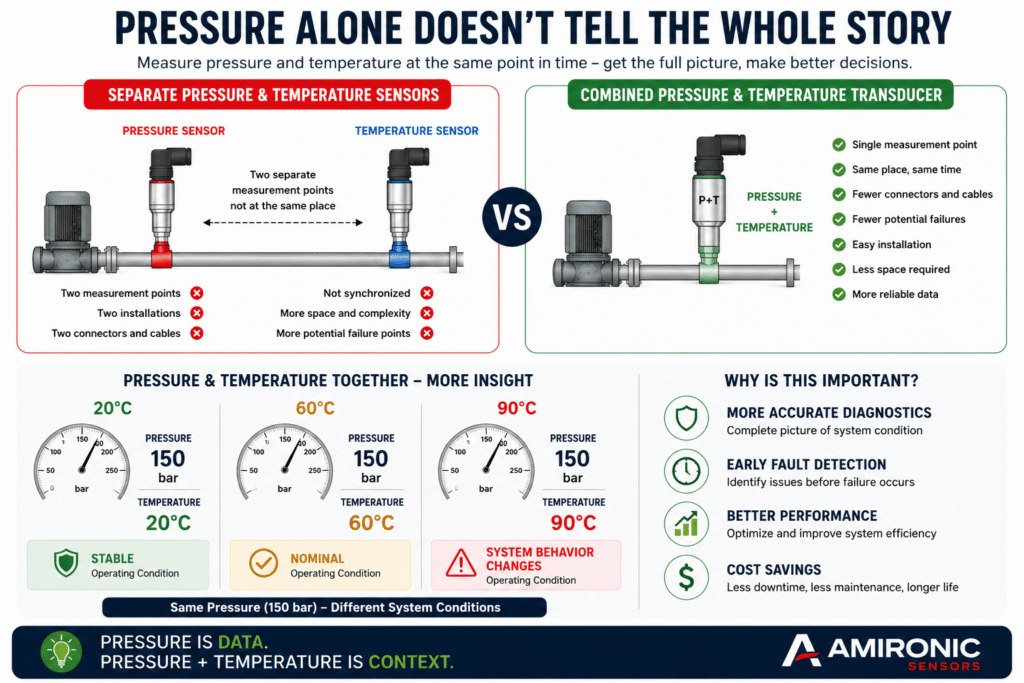
Comparison of pressure measurement using separate pressure and temperature sensors versus a combined pressure & temperature transducer. Measuring both parameters at the same location and at the same time provides a more complete understanding of system behavior while reducing installation complexity, wiring, and potential failure points.

In many industrial systems, measuring pressure seems like the obvious choice.

After all, pressure is one of the most important parameters in hydraulic, pneumatic, cooling, lubrication, fuel, and process control applications.

But what happens when the pressure looks perfect—yet the system is moving toward failure?

It happens far more often than most engineers realize.

In many cases, the problem is not the sensor, nor the accuracy of the measurement. The problem is that only part of the picture is being measured.

The missing parameter is temperature.


Pressure Rarely Changes Alone

In real-world systems, pressure and temperature are closely linked.

Almost every change in pressure is accompanied by a change in temperature—and vice versa.

As temperature changes, the properties of the fluid or gas change as well:

  • Oil viscosity changes.
  • Fluid density changes.
  • Gas volume changes.
  • Flow characteristics change.
  • Pump and compressor performance changes.

As a result, two identical pressure readings can represent two completely different operating conditions.

In other words, pressure is data. Pressure combined with temperature becomes meaningful information.


A Hydraulic System Example

Consider a hydraulic pump operating continuously throughout a work shift.

At the end of the shift, the system pressure is exactly the same as it was at startup.

At first glance, everything appears normal.

However, the hydraulic oil temperature has increased by 30°C.

The oil viscosity has decreased, system efficiency has changed, and the load on critical components has increased.

From the controller’s perspective, everything looks fine.

From the system’s perspective, operating conditions have changed – even though pressure has not.

If only pressure is monitored, this change in system behavior may go completely unnoticed.


The Same Principle Applies to Pneumatic Systems

An air compressor shows an increase in pressure.

Is it a fault?

Not necessarily.

The compressed air may simply have become hotter during the compression process, causing the pressure to rise naturally.

Without temperature data, engineers may begin troubleshooting a problem that doesn’t actually exist.


It’s Not Only What You Measure – It’s Where You Measure It

Many machines use:

  • One pressure sensor.
  • One temperature sensor.

At first glance, this seems like a straightforward solution.

In reality, each sensor measures a different physical location within the system.

Even a few centimeters of separation can introduce differences caused by flow patterns, turbulence, thermal gradients, or trapped air pockets.

As a result, the two sensors may not be describing the exact same operating condition.

When pressure and temperature are measured at the same location and at the same moment, the resulting data provides a far more accurate representation of the system.


Better Measurements – and a Simpler System

Using two separate sensors typically means:

  • Two process connections.
  • Two sealing points.
  • Two electrical connectors.
  • Two cables.
  • Two potential failure points.
  • More installation space.
  • Longer assembly time.
  • Additional spare parts to stock.

The issue is not simply the cost of an additional sensor.

Every extra connection introduces another seal, another connector, and another potential point of failure throughout the product’s lifetime.

In demanding industrial applications, reducing component count often improves both reliability and maintainability.


This Is Where Combined Pressure & Temperature Transducers Make Sense

Combined Pressure & Temperature Transducers integrate both measurements into a single device.

Beyond saving installation space, they measure pressure and temperature at exactly the same measurement point and at the same moment.

The result is:

  • A more complete understanding of system behavior.
  • Simplified installation.
  • Reduced wiring and connectors.
  • Fewer potential leak paths.
  • Lower maintenance requirements.
  • Easier integration into new machine designs.

It’s Not About Two Measurements—It’s About Their Relationship

In many applications, neither pressure nor temperature alone tells the full story.

The real value comes from understanding how the two parameters change together over time.

An increase in pressure accompanied by rising temperature may indicate one operating condition.

A pressure drop combined with increasing temperature may indicate something entirely different.

When both measurements originate from the same location and the same instant, engineers can more easily identify trends, diagnose faults, and improve overall system reliability.

Sensors measure parameters. Engineers need to understand processes.


Conclusion

In modern industrial systems, pressure measurement alone is often insufficient to fully understand what’s happening inside the process.

In many applications, measuring both pressure and temperature at the same location provides a far more complete picture of system behavior, simplifies system design, reduces component count, and enables more accurate diagnostics throughout the product lifecycle.

Ultimately, the question is not whether to measure pressure or temperature.

The real question is whether you want to measure a value—or truly understand your system.

Because in the real world, pressure rarely tells the whole story on its own.

Case Study 1 – Hydraulic Stabilization System for a Remote Weapon Station (RWS)

Application

Hydraulic stabilization system for a Remote Weapon Station (RWS), providing continuous stabilization and aiming correction while the vehicle is in motion.

Challenge

During environmental testing at +65°C, actuator response speed decreased by approximately 12% after two hours of continuous operation.

The control system continued to report a normal operating pressure of:

250 ±2 bar

As a result, no fault condition was detected.

Solution

The standalone pressure sensor was replaced with a VARIOHM EPTTE5100 Combined Pressure & Temperature Transducer, allowing both parameters to be measured simultaneously at the same measurement point.

Result

The sensor revealed that the hydraulic oil temperature had increased from 58°C to 93°C.

Although system pressure remained virtually unchanged, the reduction in oil viscosity affected servo response and stabilization performance.

Without the temperature measurement, the issue would likely have been misdiagnosed as a faulty hydraulic pump or servo valve.

Sensor Used

VARIOHM EPTTE5100

  • Pressure Range: 0–400 bar
  • Temperature Range: -50°C to +200°C
  • Pressure Response Time: <1 ms
  • Pressure Accuracy: ≤0.5%
  • Shock Resistance: 1000 g
  • Vibration Resistance: 20 g
  • Protection Rating: IP67
  • Rugged Stainless Steel Construction

Case Study 2 – Liquid Cooling System for Mission Electronics

Application

Liquid cooling system for a mission computer installed inside an armored military vehicle.

Challenge

During operation at +55°C ambient temperature, the cooling system generated intermittent over-temperature warnings.

Coolant pressure remained stable at:

5.8 ±0.1 bar

The cooling pump was initially suspected as the source of the problem.

Solution

A VARIOHM EPTT5100 Combined Pressure & Temperature Sensor was installed to monitor both pressure and coolant temperature at the same flow location.

Result

Pressure remained essentially constant, while coolant temperature increased from 39°C to 77°C.

The additional temperature data enabled the control software to detect thermal trends before electronic performance began to degrade.

Sensor Used

VARIOHM EPTT5100

  • Pressure Range: Up to 1000 bar
  • Temperature Range: -50°C to +150°C
  • Pressure Response Time: <1 ms
  • Pressure Life: >10 Million Pressure Cycles
  • Shock Resistance: 1000 g
  • Vibration Resistance: 25 g
  • All Stainless Steel Construction

Case Study 3 – UAV Fuel Conditioning System

Application

Fuel Conditioning Unit for a tactical Unmanned Aerial Vehicle (UAV).

Challenge

The engineering team aimed to reduce:

  • System weight
  • Number of electrical connectors
  • Potential leak paths
  • Wiring complexity

while maintaining continuous pressure and fuel temperature monitoring.

Solution

A separate pressure transducer and PT1000 temperature sensor were replaced with a single VARIOHM EPTTE3100 Combined Pressure & Temperature Transducer.

Result

The integrated sensor provided:

  • One connector instead of two
  • One process connection instead of two
  • Approximately 40% reduction in assembly time
  • Improved reliability under shock and vibration

In addition, the exposed temperature sensing element delivered significantly faster thermal response than conventional embedded temperature sensors.

Sensor Used

VARIOHM EPTTE3100

  • Pressure Range: Up to 25 bar
  • Temperature Range: -50°C to +150°C
  • Pressure Accuracy: ±0.5%
  • Pressure Response Time: <1 ms
  • Temperature Response Time: <10 s
  • Shock Resistance: 1000 g
  • Vibration Resistance: 25 g
  • Protection Rating: IP67

Case Study 4 – Hydraulic Automatic Test Equipment (ATE)

Application

Automatic Test Equipment (ATE) for hydraulic assemblies prior to delivery.

Challenge

Acceptance tests occasionally produced inconsistent results for identical hydraulic assemblies.

Operating pressure remained fixed at:

160 bar

yet measurements varied between morning and afternoon test cycles.

Solution

A VARIOHM EPTTE1400 Combined Pressure & Temperature Sensor was installed to record both parameters simultaneously from the same measurement point during every test cycle.

Result

The investigation showed that approximately 25°C variation in fluid temperature throughout the day significantly affected hydraulic behavior.

By including temperature data in every test report, measurement repeatability improved considerably and false failures were virtually eliminated.

Sensor Used

VARIOHM EPTTE1400

  • Pressure Range: Up to 25 bar
  • Temperature Range: -50°C to +150°C
  • Pressure Response Time: <1 ms
  • Temperature Response Time: <15 s
  • Pressure Life: >10 Million Pressure Cycles
  • Shock Resistance: 1000 g
  • Vibration Resistance: 25 g
  • Protection Rating: IP67
  • Lightweight Stainless Steel Construction
Tags: Variohm

Related Articles

Euro XPK Puck Programmable Sensor – Precision Meets Flexibility

19/05/2025amironicLTD

Industrial Pressure Sensors – When Pressure Measurement Becomes a System Engineering Challenge

05/03/2026amironicLTD

VARIOHM Position Sensors – Engineering Position as a System, Not Just a Signal

26/02/2026amironicLTD

Recent Posts

  • Measuring Pressure Without Temperature Is Only Half the Picture
  • Why a Smaller IMU Can Save Months of Development
  • Hour Meter: Why Machines with Advanced PLCs Still Need One
  • Why Foot Switches Fail – And What Experienced OEM Designers Do Differently
  • Why the Number of Starts in a Worm Gear Matters More Than the Gear Ratio

Categories

  • Air Switch
  • Circuit Breakers
  • Elapsed Time Indicator
  • Feedthrough
  • Footswitches
  • Gears & Transmission
  • Hour Meters
  • Infra Red Switches
  • INFRARED LAMPS
  • Low Noise Inertial MEMS
  • Mechanics
  • MEMS Gyroscope
  • MEMS Inertial
  • Microelectronics
  • Motors
  • Position Sensors
  • Power Supply
  • Pressure Sensors
  • Pressure Switch
  • Temperature Sensors
  • Tungsten and Molybdenum
  • Uncategorized
  • Vacuum Switches

Quick Contact

Fill out the form and our representatives will return to you

    Name (required)

    Email (required)

    Phone

    Message

    This site is protected by reCAPTCHA and the Google
    Privacy Policy and
    Terms of Service apply.

    Amironic Ltd.

    3 Rabinovich Street, Petah Tikva 4928144 , Israel. Tel: +972-3-9047744 E-mail: office@amironic.co.il
    Email
    Facebook
    Twitter
    LinkedIn
    YouTube
    Press on the ISO Certificate below for download
    ISO 9001:2015 Certification
    • MEMS Inertial
    • Circuit Breakers
    • Footswitches
    • Mechanical & Transmisions
    • Sensors
    • Motors
    • Electronics
    • Hand Control
    • Power Solutions

    News

    • Measuring Pressure Without Temperature Is Only Half the Picture
    • Why a Smaller IMU Can Save Months of Development
    • Hour Meter: Why Machines with Advanced PLCs Still Need One
    • Why Foot Switches Fail – And What Experienced OEM Designers Do Differently
    • Why the Number of Starts in a Worm Gear Matters More Than the Gear Ratio
    About AmironicContactעברית
    © 2022 Amironic All rights reserved. All Trademarks are the property of their respective owners.
    • Increase Font
    • Decrease Font
    • Black & White
    • Inverse Colors
    • Highlight Links
    • Regular Font
    • Reset