flagעברית
flagEnglish
3 Rabinovich St., Petah-Tikva, Israel
+972 3 9047744
office@amironic.co.il
Facebook
Twitter
LinkedIn
YouTube
  • Products
    • MEMS Inertial
      • Gyros & Accels
      • IMU
      • Inertial Navigation
      • AHRS
    • Circuit Breakers
      • Airpax Circuit Breakers
      • Electronic Circuit Breakers
      • Aircraft Circuit Breakers
      • Thermal Circuit Breakers
      • Sealing Solutions & Guards
    • Footswitches
      • Pedals & Bellows
      • USB
      • Air Switches
      • Medical
      • Modular Bases System
      • Industrial
      • Foot Potentiometers
      • Wireless
    • Mechanical & Transmisions
      • Gears
      • Sealing Solutions
      • Gearboxes
      • Couplings
      • Shafts & Bearings
      • Fasteners
      • Mechanical & Springs
      • Linear Motion
      • Anti-Vibration
    • Sensors
      • Thermostats
      • Temperature
      • Position
      • Pressure
      • Speed
      • Level Sensor
      • Load Cells
      • Flex Sensors
      • Membrane Potentiometer
    • Motors
      • Geared DC
      • Brushless DC
      • Step Motors with Gearbox
      • Torque Motors & Brushless Servo
      • AC Motors
      • DC Motors
    • Electronics
      • Xenon & IR Lamps
      • Counters & Meters
      • Microelectronics Packaging
      • Waterproof Switches
      • Micro Switches
    • Hand Control
      • Operator Controls (JOYSTICK)
      • Electrical
      • Pneumatic (Medical)
      • USB Hand Control
      • Air Push Button
      • Pressure Switch
      • IR Switch
    • Power Solutions
      • Rugged & Military Power Supply
      • Input Power Protection
      • Sealed Military Power Adaptor
      • Triple Output Military Power Supply Series – up to 250 W
    • Materials
      • Molybdenum and Advanced Alloys (TZM, MOLA, HCT)
      • Tungsten (Wolfram) and Advanced Alloys – High-Performance Materials for Extreme Conditions
      • Materials for Gears
  • Shop
  • Companies
  • About
  • News
  • Contact
Product was added to your cart

Cart

waze

From 5kW to 100kW Racks – The Engineering Challenges Behind Modern AI Data Centers

Circuit Breakers, Power Supply, Pressure Sensors, Pressure Switch, Temperature Sensors27/05/2026amironicLTD

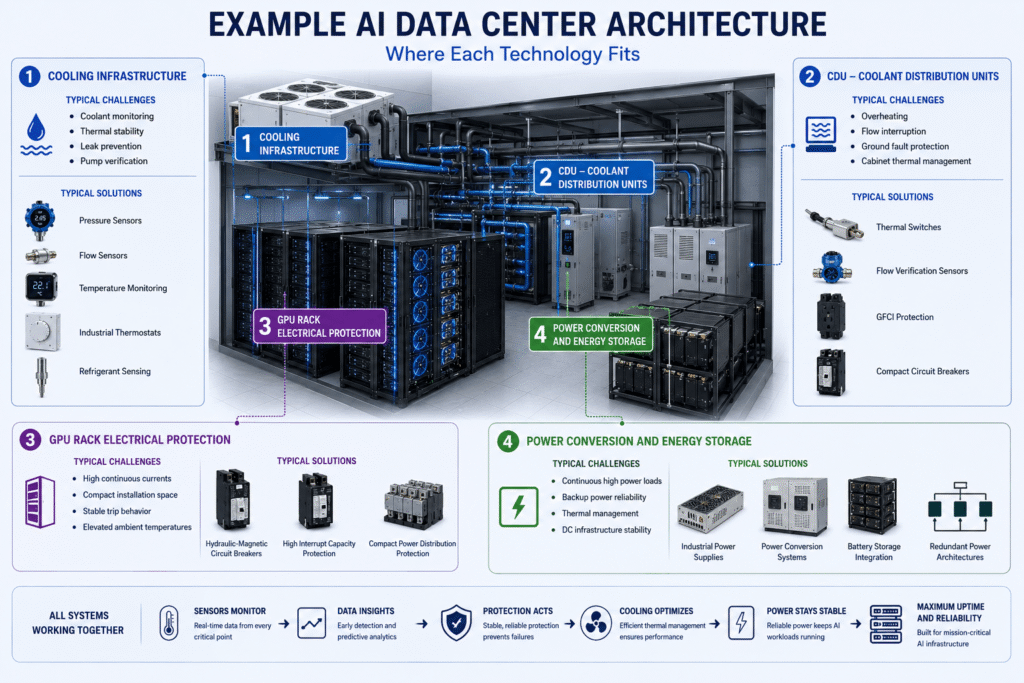
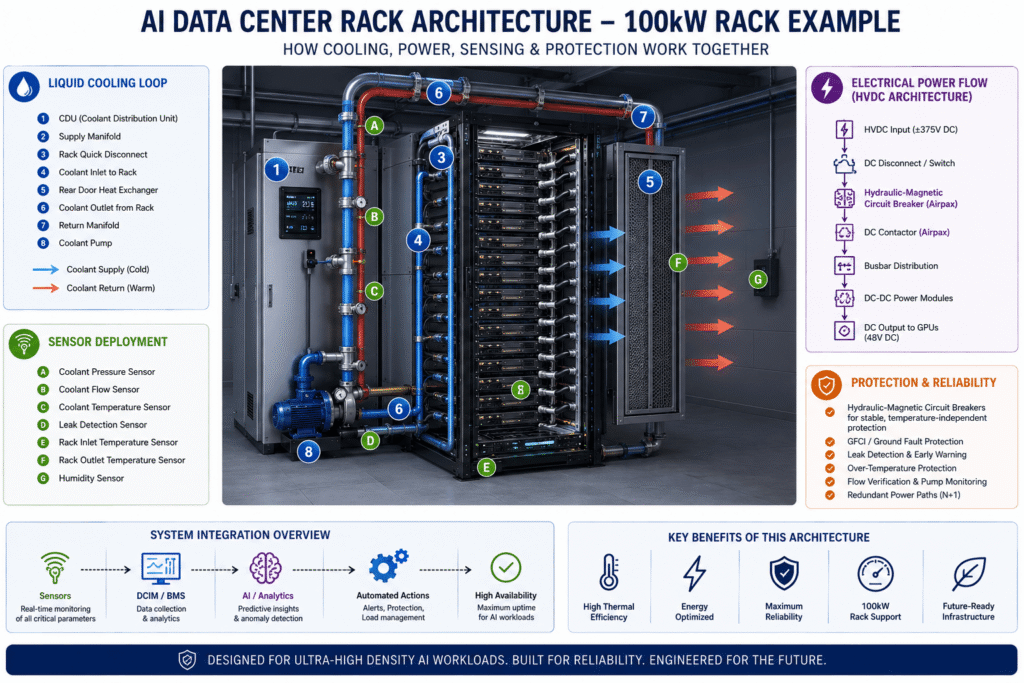
Example AI Data Center Architecture

Modern AI infrastructure is no longer just about processors and servers.

High-density AI facilities now require tightly integrated cooling, sensing, protection and power management systems working together as one coordinated infrastructure.

The diagram below illustrates how liquid cooling, industrial sensing, hydraulic-magnetic protection and HVDC power architectures interact inside a modern 100kW AI rack environment.
Artificial Intelligence is no longer just a software revolution.
It is rapidly becoming an infrastructure revolution.

As AI workloads continue to grow, modern data centers are being forced to handle unprecedented levels of power density, thermal load, electrical complexity and reliability requirements.

Traditional server rooms designed around conventional enterprise computing are no longer sufficient for high-density GPU clusters, AI training farms and large-scale inference systems.

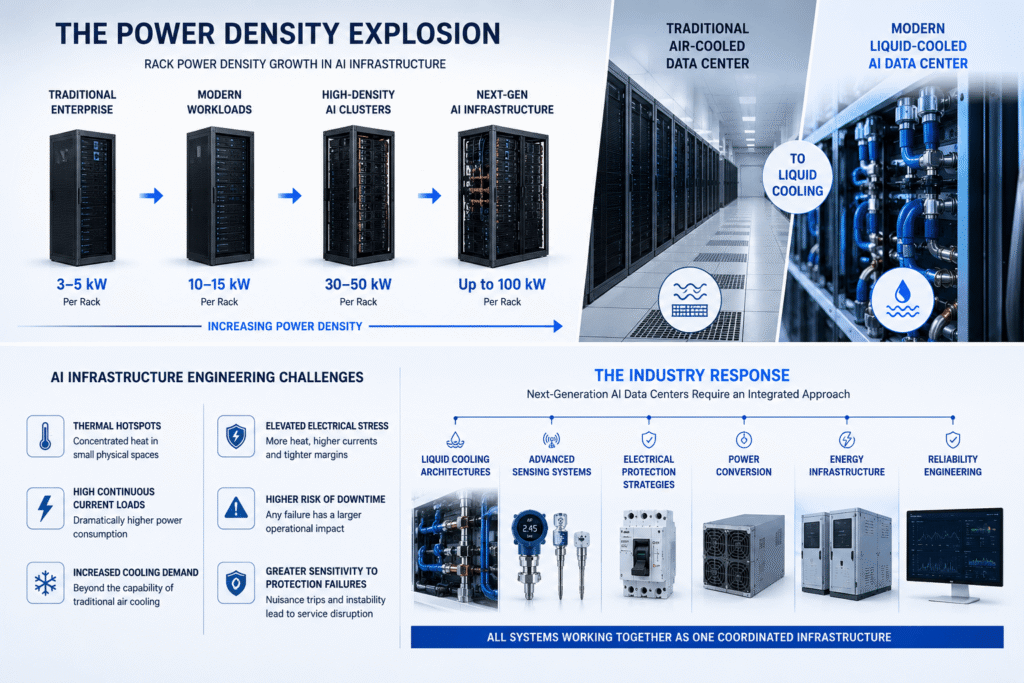
In many modern facilities, rack power densities that once averaged 3-5kW are now reaching 30kW, 50kW and even 100kW per rack.

This shift changes everything:

  • Cooling architectures
  • Electrical protection strategies
  • Power conversion
  • Sensor deployment
  • Redundancy planning
  • Thermal management
  • Energy infrastructure
  • Reliability engineering

As a result, AI data centers are becoming highly integrated electro-mechanical systems where cooling, sensing, protection and power management must operate together as one coordinated infrastructure.

This is where engineering decisions become critical.


The Power Density Explosion

For years, air-cooled data centers dominated the industry.

Conventional CPU-based systems generated manageable thermal loads that could be handled using traditional CRAC and CRAH cooling systems combined with raised-floor airflow designs.

AI infrastructure changes the equation entirely.

Modern GPU accelerators consume dramatically higher power levels and generate concentrated heat loads in extremely small physical spaces. Unlike conventional workloads, AI clusters often operate continuously at near maximum utilization for extended periods.

This creates several major engineering challenges:

  • Thermal hotspots
  • High continuous current loads
  • Increased cooling demand
  • Elevated electrical stress
  • Higher risk of downtime
  • Greater sensitivity to protection failures

The industry response is clear:
Data centers are rapidly transitioning toward liquid cooling architectures, advanced sensing systems and more sophisticated electrical protection strategies.

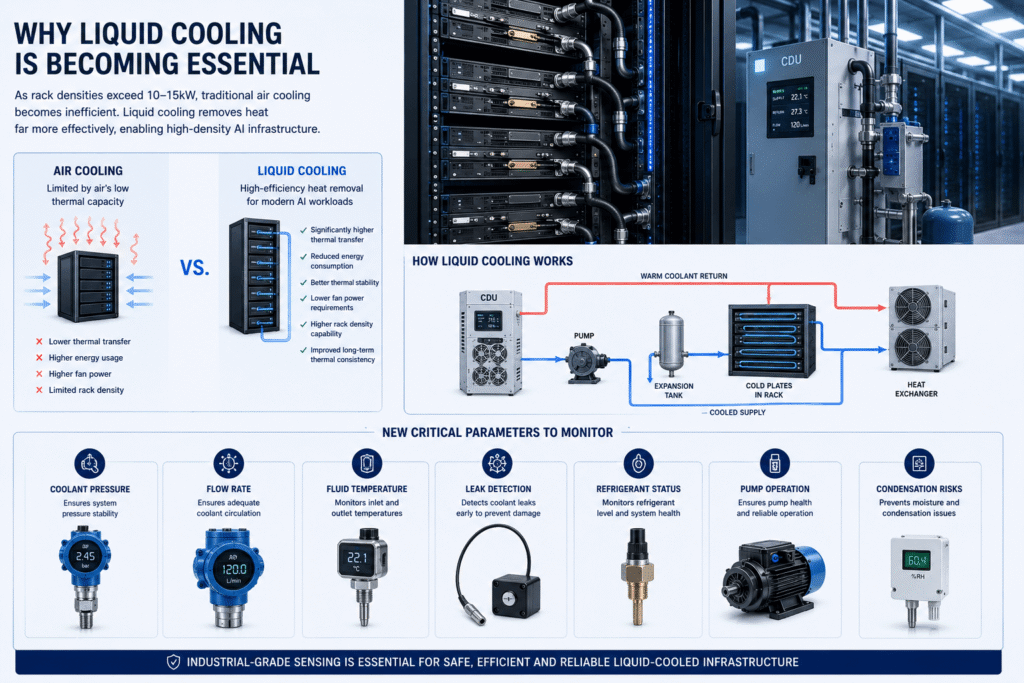
Why Liquid Cooling Is Becoming Essential

Once rack densities move beyond approximately 10-15kW, traditional air cooling systems begin to struggle.

Air simply becomes inefficient at removing concentrated heat from modern AI hardware.

This is why liquid cooling is rapidly becoming one of the most important technologies in next-generation AI infrastructure.

Liquid cooling systems circulate water or glycol-based coolant directly through cold plates, heat exchangers and coolant distribution units (CDUs), removing heat far more efficiently than air.

Compared with traditional air cooling, liquid cooling systems offer:

  • Significantly higher thermal transfer efficiency
  • Reduced energy consumption
  • Better thermal stability
  • Lower fan power requirements
  • Higher rack density capability
  • Improved long-term thermal consistency

However, these systems also introduce an entirely new layer of engineering complexity.

Now the data center must continuously monitor:

  • Coolant pressure
  • Flow rate
  • Fluid temperature
  • Leak conditions
  • Refrigerant status
  • Pump operation
  • Condensation risks

This is where industrial-grade sensing becomes essential.

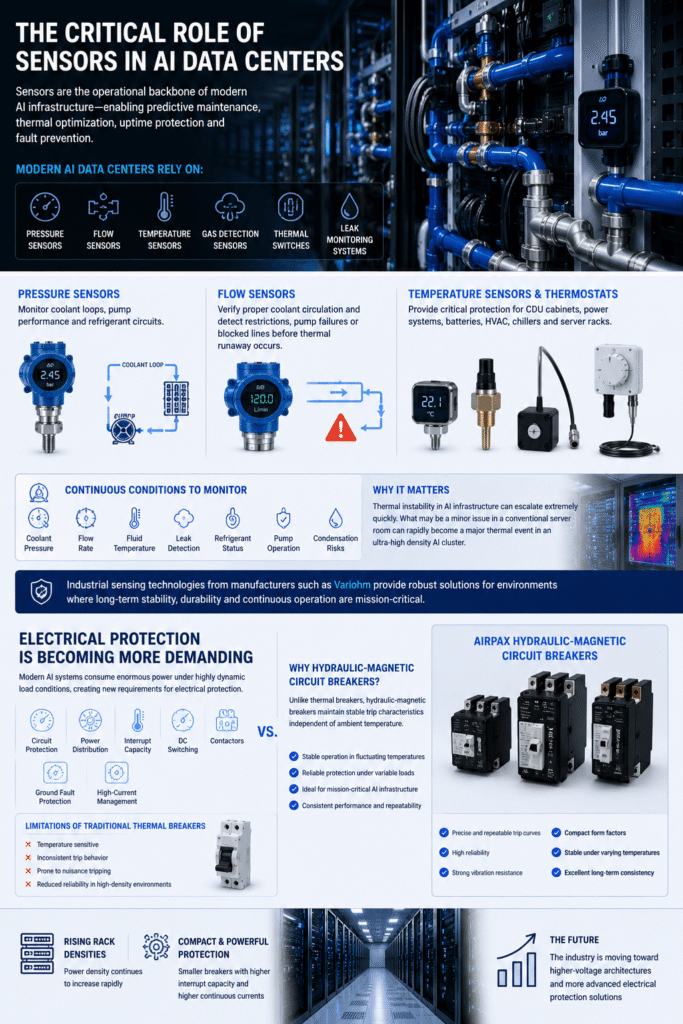
The Critical Role of Sensors in AI Data Centers

In high-density AI facilities, sensors are no longer auxiliary devices.

They are now part of the operational backbone of the infrastructure.

Reliable sensing enables predictive maintenance, thermal optimization, uptime protection and fault prevention.

Modern AI data centers increasingly rely on:

  • Pressure sensors
  • Flow sensors
  • Temperature sensors
  • Gas detection sensors
  • Thermal switches
  • Leak monitoring systems

Pressure sensors are commonly used to monitor coolant loops, pump performance and refrigerant circuits.

Flow sensors help verify proper coolant circulation and detect restrictions, pump failures or blocked lines before thermal runaway occurs.

Temperature sensors and thermostats provide critical protection for:

  • CDU cabinets
  • Power conversion systems
  • Battery systems
  • HVAC units
  • Chillers
  • Server rack environments

This is especially important because thermal instability in AI infrastructure can escalate extremely quickly.

A minor cooling issue in a conventional server room may create inconvenience.

In an AI cluster operating at ultra-high densities, the same issue can rapidly become a major thermal event.

Industrial sensing technologies from manufacturers such as Variohm provide robust solutions for these environments, particularly where long-term stability, environmental durability and continuous operation are required.


Electrical Protection Is Becoming More Demanding

As thermal demands rise, electrical infrastructure is also undergoing major changes.

Modern AI systems consume enormous amounts of power continuously, often under highly dynamic load conditions.

This creates new requirements for:

  • Circuit protection
  • Power distribution
  • Interrupt capacity
  • DC switching
  • Contactors
  • Ground fault protection
  • High-current management

Traditional thermal breakers may become problematic in these environments due to temperature sensitivity and inconsistent trip behavior under varying ambient conditions.

This is one reason why hydraulic-magnetic circuit breakers are gaining increased relevance in modern high-density infrastructure.

Unlike thermal protection devices, hydraulic-magnetic breakers maintain stable trip characteristics independent of ambient temperature.

This becomes extremely important in AI facilities where:

  • Internal cabinet temperatures fluctuate
  • Cooling loads vary continuously
  • Equipment operates near maximum utilization
  • Reliability is mission-critical

Airpax hydraulic-magnetic circuit breakers are particularly well suited for these demanding environments because they offer:

  • Precise and repeatable trip curves
  • Compact form factors
  • High reliability
  • Stable operation under varying temperatures
  • Strong vibration resistance
  • Excellent long-term consistency

As rack densities continue increasing, electrical protection systems must also become physically smaller while supporting higher interrupt capacities and higher continuous currents.

This trend is expected to accelerate further as the industry moves toward higher-voltage architectures.

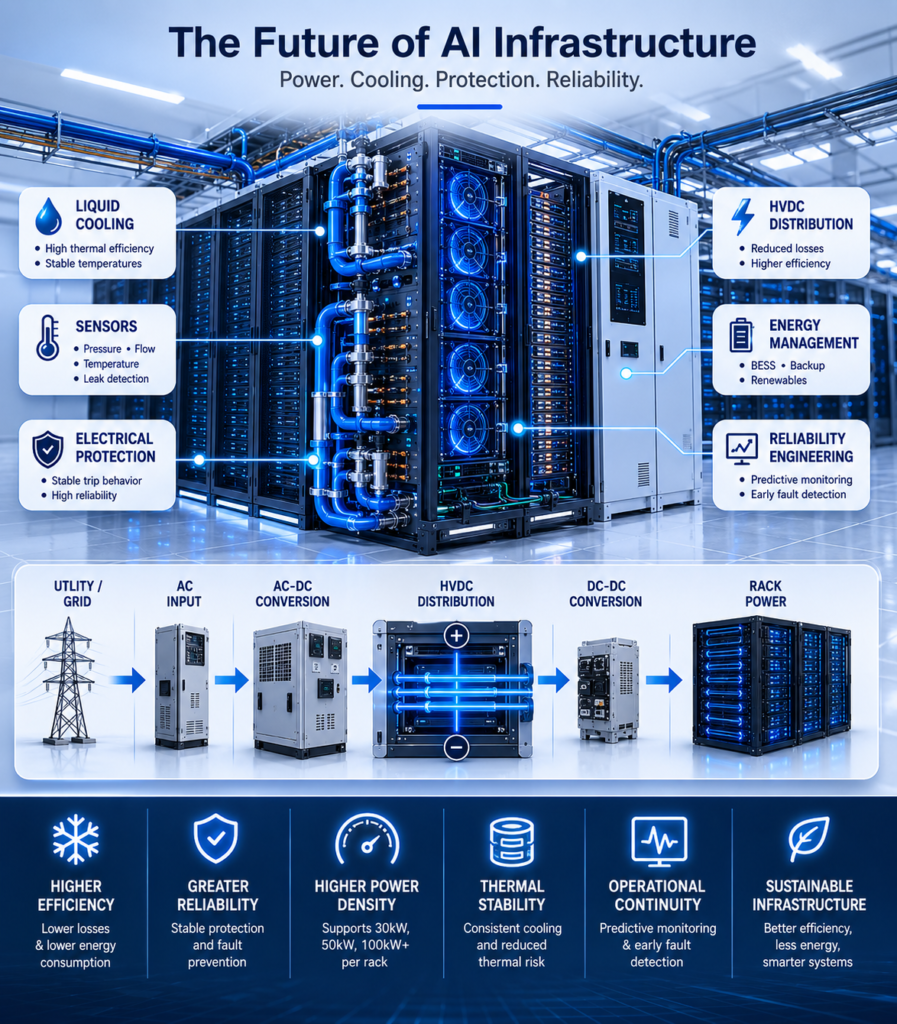
The Rise of HVDC in AI Infrastructure

One of the most important emerging trends in data center engineering is the move toward HVDC – High Voltage Direct Current architectures.

Traditional AC distribution systems suffer from conversion losses across multiple power stages.

In AI facilities operating at massive scale, even small efficiency improvements translate into enormous operational savings.

HVDC architectures can help:

  • Reduce conversion losses
  • Improve energy efficiency
  • Lower thermal generation
  • Simplify power distribution
  • Reduce copper requirements
  • Improve overall system efficiency

However, HVDC systems also introduce additional engineering challenges.

DC switching and protection are fundamentally different from AC systems.

Managing high continuous DC currents requires specialized:

  • Circuit protection
  • Contactors
  • Power conversion systems
  • Thermal management
  • Arc mitigation strategies

This is one reason why power electronics, intelligent protection systems and industrial-grade switching technologies are becoming increasingly important in modern AI facilities.


Power Infrastructure and Energy Management

The power demands of AI infrastructure are now so significant that many facilities are integrating:

  • Battery energy storage systems (BESS)
  • Backup generation
  • Peak-shaving systems
  • Renewable energy integration
  • Advanced power conditioning

Modern data centers are evolving into hybrid energy ecosystems.

This creates growing demand for:

  • Industrial power supplies
  • Power conversion systems
  • DC-DC conversion
  • AC-DC infrastructure
  • Redundant power architectures
  • Thermal-protected power systems

Advanced power solutions such as ruggedized industrial and high-reliability power systems are becoming increasingly relevant in these environments, particularly where uptime and operational continuity are critical.

This is where robust power architectures and industrial-grade power conversion solutions play an increasingly strategic role.


Reliability Is the Real Challenge

The real challenge in AI data centers is not simply generating computing power.

It is maintaining stable operation under extreme continuous load.

A modern AI cluster may contain infrastructure worth millions of dollars operating continuously at high thermal and electrical stress levels.

Downtime becomes extraordinarily expensive.

As a result, modern data center engineering increasingly focuses on:

  • Predictive monitoring
  • Thermal stability
  • Electrical reliability
  • Fault isolation
  • Redundancy
  • Early fault detection
  • Stable protection behavior
  • Sensor-driven infrastructure management

The future of AI infrastructure will not be determined solely by processors.

It will be determined by the reliability of the surrounding cooling, sensing, protection and power systems that keep those processors operational.

Example AI Data Center Architecture – Where Each Technology Fits

Cooling Infrastructure

Typical challenges:

  • Coolant monitoring
  • Thermal stability
  • Leak prevention
  • Pump verification

Typical solutions:

  • Pressure sensors
  • Flow sensors
  • Temperature monitoring
  • Industrial thermostats
  • Refrigerant sensing

CDU – Coolant Distribution Units

Typical challenges:

  • Overheating
  • Flow interruption
  • Ground fault protection
  • Cabinet thermal management

Typical solutions:

  • Thermal switches
  • Flow verification sensors
  • GFCI protection
  • Compact circuit breakers

GPU Rack Electrical Protection

Typical challenges:

  • High continuous currents
  • Compact installation space
  • Stable trip behavior
  • Elevated ambient temperatures

Typical solutions:

  • Hydraulic-magnetic circuit breakers
  • High interrupt capacity protection
  • Compact power distribution protection

Power Conversion and Energy Storage

Typical challenges:

  • Continuous high power loads
  • Backup power reliability
  • Thermal management
  • DC infrastructure stability

Typical solutions:

  • Industrial power supplies
  • Power conversion systems
  • Battery storage integration
  • Redundant power architectures

Conclusion

AI is reshaping the entire data center industry.

What was once considered a conventional server facility is rapidly evolving into a highly complex thermal, electrical and energy-management ecosystem.

As rack densities continue climbing and power demands increase, successful AI infrastructure will depend on far more than computing hardware alone.

The future belongs to integrated engineering approaches that combine:

  • Advanced sensing
  • Intelligent thermal management
  • Stable electrical protection
  • Reliable power conversion
  • High-efficiency cooling
  • Robust energy infrastructure

In this new generation of AI data centers, sensors, circuit protection devices, thermostats and power systems are no longer secondary components.

They are mission-critical infrastructure.

Frequently Asked Questions About AI Data Center Infrastructure
Why are hydraulic-magnetic circuit breakers important in AI infrastructure?
Key Engineering Challenges
Technologies Reshaping Modern AI Data Centers
Why Traditional Data Center Infrastructure Is No Longer Enough
The Critical Role of Sensors and Thermal Monitoring
Electrical Protection in High-Density AI Infrastructure
Power Infrastructure, HVDC and Energy Management
Typical Failure Points
Frequently Asked Questions About AI Data Center Infrastructure

What is considered a high-density AI rack?

Traditional server racks typically consumed 3-5kW, while modern AI racks may exceed 30kW, 50kW and even 100kW per rack depending on GPU density and workload.


Why are AI data centers moving to liquid cooling?

Liquid cooling removes heat far more efficiently than air cooling and enables significantly higher rack densities while reducing energy consumption and improving thermal stability.


Why are sensors critical in AI data centers?

Pressure, flow and temperature sensors help monitor coolant loops, refrigerant systems and thermal conditions to prevent overheating, downtime and infrastructure failures.


What are hydraulic-magnetic circuit breakers?

Hydraulic-magnetic breakers provide stable and repeatable protection independent of ambient temperature, making them highly suitable for mission-critical infrastructure and high-density electrical systems.


What is HVDC in data centers?

HVDC – High Voltage Direct Current – is an emerging power architecture designed to reduce conversion losses and improve efficiency in large-scale AI infrastructure.


Why is electrical protection becoming more challenging in AI infrastructure?

AI systems consume extremely high continuous currents and generate significant thermal loads, requiring more advanced protection systems with higher interrupt capacity and stable trip characteristics.


What is a CDU in liquid cooling systems?

A CDU – Coolant Distribution Unit – circulates and manages coolant flow between liquid-cooled server racks and facility cooling systems.


How do power supplies impact AI infrastructure reliability?

High-reliability power supplies and power conditioning systems help maintain uptime, protect sensitive equipment and stabilize operation during varying electrical conditions.

Why are hydraulic-magnetic circuit breakers important in AI infrastructure?

Modern AI data centers operate under extremely high and continuous electrical loads, often inside compact environments with elevated ambient temperatures and rapidly changing cooling conditions.

Traditional thermal circuit breakers may become problematic in these environments because their trip behavior can be affected by surrounding temperature conditions, potentially increasing the risk of nuisance trips and inconsistent protection performance.

Hydraulic-magnetic circuit breakers provide stable and repeatable trip characteristics independent of ambient temperature, making them highly suitable for mission-critical AI infrastructure.

This is especially important in high-density GPU environments where:

  • Rack power densities may exceed 30kW, 50kW or even 100kW
  • Continuous uptime is critical
  • Cooling conditions may fluctuate dynamically
  • Electrical loads remain consistently high

Hydraulic-magnetic protection technologies such as Airpax circuit breakers offer several important advantages for AI infrastructure, including:

  • Stable trip performance under varying temperatures
  • Precise and repeatable protection behavior
  • Reduced nuisance trip risk
  • Compact installation size
  • High reliability under continuous operation
  • Strong vibration and environmental resistance

As AI infrastructure continues moving toward higher power densities and more compact electrical architectures, stable protection systems are becoming increasingly important for maintaining operational continuity and preventing costly downtime.

Key Engineering Challenges

Modern AI data centers are no longer limited by computing power alone.
The real engineering challenge is maintaining stable operation under extreme thermal and electrical stress.

As rack densities continue rising from traditional 3-5kW levels toward 30kW, 50kW and even 100kW configurations, infrastructure designers must rethink nearly every aspect of data center architecture.

Key engineering challenges now include:

  • High thermal density
  • Continuous high-current operation
  • Cooling efficiency limitations
  • Electrical protection stability
  • Power conversion efficiency
  • Sensor reliability
  • Redundancy and uptime
  • Thermal runaway prevention
  • Energy management
  • HVDC transition strategies

Unlike traditional enterprise environments, AI infrastructure often operates near maximum utilization continuously, creating unprecedented stress on cooling systems, power distribution and protection architectures.

As a result, modern AI facilities increasingly resemble mission-critical industrial infrastructure rather than conventional server rooms.

Technologies Reshaping Modern AI Data Centers

The rapid growth of AI infrastructure is driving the adoption of entirely new cooling, sensing and power management technologies across modern data centers.

Traditional enterprise architectures are no longer sufficient for the thermal and electrical demands generated by high-density GPU systems.

As a result, next-generation AI facilities increasingly rely on advanced infrastructure technologies such as:

  • Liquid cooling systems
  • Coolant Distribution Units (CDU)
  • Hydraulic-magnetic circuit breakers
  • High interrupt-capacity protection devices
  • Pressure sensors
  • Flow sensors
  • Thermal switches and thermostats
  • Refrigerant monitoring systems
  • HVDC power architectures
  • Advanced power conversion systems
  • Battery Energy Storage Systems (BESS)
  • Intelligent power distribution
  • Industrial-grade power supplies
  • Predictive thermal monitoring systems

These technologies are no longer considered optional enhancements.

They are rapidly becoming mission-critical infrastructure components required to maintain uptime, thermal stability and electrical reliability under continuously increasing AI workloads.

This shift is also changing the role of sensing and protection technologies inside the data center.

Sensors are now directly involved in:

  • Cooling optimization
  • Fault detection
  • Predictive maintenance
  • Leak prevention
  • Thermal protection
  • Power management
  • Infrastructure health monitoring

At the same time, electrical protection systems must support:

  • Higher continuous currents
  • Higher interrupt capacities
  • Compact installation requirements
  • Stable operation under varying thermal conditions
  • Increased reliability expectations

The result is a major convergence between industrial engineering practices and modern AI infrastructure design.

Why Traditional Data Center Infrastructure Is No Longer Enough

For many years, conventional enterprise data centers operated successfully using relatively simple architectures:

  • Air cooling
  • Standard rack distribution
  • Conventional thermal breakers
  • Moderate power densities
  • Centralized UPS systems

That model is rapidly becoming obsolete in the AI era.

Modern AI clusters operate under fundamentally different conditions.

Unlike traditional enterprise workloads, AI accelerators and GPU systems often run continuously at extremely high utilization levels, generating massive thermal and electrical stress inside very compact physical spaces.

This creates a growing gap between traditional infrastructure capabilities and modern AI operational requirements.

Several major limitations are now becoming apparent in legacy data center designs:

Air Cooling Limitations

Traditional air cooling systems struggle to remove heat efficiently once rack densities exceed approximately 10-15kW.

At higher power levels:

  • Thermal hotspots increase
  • Airflow becomes inefficient
  • Fan power consumption rises dramatically
  • Cooling uniformity becomes difficult to maintain

This is one of the primary reasons why liquid cooling adoption is accelerating across AI facilities worldwide.


Conventional Thermal Protection Challenges

Standard thermal circuit breakers may become problematic in high-density environments because their trip characteristics are influenced by ambient temperature.

In AI infrastructure, where cabinet temperatures may fluctuate significantly, this can increase the risk of:

  • Nuisance trips
  • Inconsistent protection behavior
  • Reduced operational stability

As uptime requirements become more critical, infrastructure operators increasingly favor more stable protection technologies such as hydraulic-magnetic circuit breakers.


Power Distribution Complexity

Traditional power architectures were never designed for ultra-dense AI computing loads.

Modern AI facilities now face:

  • Massive continuous current demands
  • Higher rack voltages
  • Increased interrupt capacity requirements
  • Rapid transient load changes
  • Greater thermal stress on electrical infrastructure

This is driving increased adoption of:

  • Intelligent power distribution
  • HVDC architectures
  • Advanced power conversion
  • High-reliability power supplies
  • Industrial-grade protection systems

Reliability Expectations Have Changed

In conventional enterprise environments, temporary outages were disruptive.

In large-scale AI facilities, downtime can become extraordinarily expensive within minutes.

AI data centers now require infrastructure capable of supporting:

  • Continuous operation
  • Predictive monitoring
  • Fault isolation
  • Redundancy
  • Thermal stability
  • Power integrity
  • Fast fault response

As a result, modern AI infrastructure increasingly adopts engineering concepts traditionally associated with industrial and mission-critical systems rather than conventional office IT environments.

The Critical Role of Sensors and Thermal Monitoring

In modern AI data centers, sensors are no longer secondary support components.

They are becoming one of the most important layers of the entire infrastructure architecture.

As rack densities increase and liquid cooling adoption accelerates, modern facilities must continuously monitor thermal and fluid conditions in real time to maintain operational stability and prevent catastrophic failures.

Unlike traditional server rooms, AI infrastructure operates under:

  • Higher thermal stress
  • Higher power density
  • Continuous workload utilization
  • Tighter cooling tolerances
  • Faster thermal escalation risks

This makes sensing technologies essential for both protection and optimization.


Pressure Monitoring in Cooling Loops

Liquid cooling systems depend on stable coolant circulation.

Pressure sensors are commonly used to monitor:

  • Pump operation
  • Coolant loop integrity
  • Pressure stability
  • Refrigerant systems
  • Differential pressure conditions
  • Flow restrictions

A pressure anomaly may indicate:

  • Pump degradation
  • Leakage
  • Blocked cooling paths
  • Air ingress
  • Reduced thermal transfer efficiency

Detecting these conditions early is critical because thermal events inside high-density GPU environments can escalate extremely quickly.

Industrial-grade pressure sensors designed for continuous operation help ensure stable monitoring even under demanding environmental conditions.


Flow Sensors and Coolant Verification

Flow monitoring is equally important in liquid-cooled AI infrastructure.

Even if coolant pressure appears normal, insufficient flow can still create localized overheating and dangerous thermal hotspots.

Flow sensors are increasingly used to verify:

  • Coolant circulation
  • CDU performance
  • Pump effectiveness
  • Reservoir status
  • Cooling path continuity

This is especially important in large-scale AI clusters where multiple cooling zones may operate simultaneously under varying load conditions.

Continuous flow verification helps infrastructure operators detect abnormalities before temperatures reach critical levels.


Thermal Monitoring and Thermostatic Protection

Temperature monitoring remains one of the most fundamental layers of data center protection.

Modern AI facilities rely heavily on:

  • Thermal switches
  • Thermostats
  • Precision temperature sensors
  • Environmental monitoring systems

These technologies help protect:

  • CDU cabinets
  • Power conversion systems
  • Battery storage systems
  • Chillers
  • HVAC infrastructure
  • Server rack environments

Thermal protection becomes increasingly important as cooling systems operate closer to their performance limits.

In high-density AI infrastructure, even small temperature deviations may indicate:

  • Cooling degradation
  • Restricted airflow
  • Reduced coolant performance
  • Electrical overload
  • Heat exchanger inefficiency

Reliable thermal monitoring enables predictive maintenance strategies rather than reactive failure response.


Why Sensor Reliability Matters

Sensor stability and reliability are often underestimated in infrastructure design.

However, unstable sensing can create:

  • False alarms
  • Incorrect thermal decisions
  • Cooling inefficiencies
  • Unnecessary shutdowns
  • Reduced infrastructure confidence

Modern AI facilities increasingly require industrial-grade sensors capable of:

  • Long-term stability
  • Continuous operation
  • Fast response times
  • Environmental durability
  • Low drift characteristics
  • Reliable operation under vibration and thermal cycling

This is one reason why industrial sensing technologies are becoming more relevant inside next-generation AI infrastructure.

As cooling systems become more advanced and power densities continue increasing, the importance of stable, accurate and continuous sensing will only continue to grow.

Electrical Protection in High-Density AI Infrastructure

As AI data centers continue increasing in scale and power density, electrical protection is becoming one of the most critical engineering challenges in the entire infrastructure.

Modern GPU clusters consume enormous amounts of continuous power while operating under highly dynamic electrical conditions.

This creates growing stress on:

  • Power distribution systems
  • Protection devices
  • Contactors
  • Bus structures
  • Power conversion stages
  • Cooling-assisted electrical cabinets

Unlike conventional enterprise environments, AI infrastructure must support continuous operation under sustained heavy electrical loading with minimal tolerance for downtime.

As a result, protection systems must now provide:

  • Higher interrupt capacity
  • Greater thermal stability
  • Compact installation size
  • Improved reliability
  • Stable trip behavior
  • Predictable fault response

The Shift Toward Higher Power Density

Traditional server architectures operated at relatively modest electrical loads.

Modern AI systems are fundamentally different.

High-performance GPU accelerators may consume several kilowatts per server, while entire racks can exceed tens of kilowatts or even approach 100kW configurations.

This creates several major protection challenges:

  • Increased continuous current
  • Elevated cabinet temperatures
  • Higher inrush currents
  • More demanding transient conditions
  • Greater fault energy potential

As power density increases, even relatively small electrical faults may escalate rapidly if protection systems are not carefully engineered.


Why Stable Protection Matters

One of the most important challenges in AI infrastructure is avoiding unnecessary downtime caused by unstable or inconsistent protection behavior.

Conventional thermal breakers may become increasingly problematic in high-density environments because their operation can be affected by ambient temperature changes.

In AI facilities where:

  • Cabinet temperatures fluctuate
  • Cooling loads vary continuously
  • Electrical loads remain extremely high

this may increase the likelihood of nuisance trips or inconsistent protection characteristics.

In mission-critical infrastructure, nuisance trips are not simply inconvenient.

They may:

  • Interrupt AI workloads
  • Create cluster instability
  • Trigger unexpected shutdowns
  • Affect thermal management systems
  • Cause operational disruption across multiple systems

This is one reason why hydraulic-magnetic circuit protection technologies are gaining increased relevance in modern high-density electrical infrastructure.


Advantages of Hydraulic-Magnetic Protection

Hydraulic-magnetic circuit breakers provide trip characteristics that remain stable regardless of ambient temperature conditions.

This makes them particularly well suited for environments where:

  • Thermal conditions vary significantly
  • High reliability is required
  • Continuous operation is expected
  • Precise protection behavior is critical

Compared with conventional thermal protection devices, hydraulic-magnetic breakers can offer:

  • More repeatable trip curves
  • Stable operation across varying temperatures
  • Improved reliability
  • Better high-density integration
  • Compact form factors
  • Reduced nuisance trip risk

These characteristics are increasingly important as AI infrastructure moves toward:

  • Higher rack densities
  • More compact electrical distribution
  • Increased cabinet thermal loading
  • Higher system availability requirements

Ground Fault and High-Energy Protection

As liquid cooling adoption increases, electrical protection requirements also become more complex.

Cooling systems introduce additional infrastructure elements such as:

  • Coolant Distribution Units (CDUs)
  • Pumps
  • Heat exchangers
  • Fluid management systems
  • Condensation control systems

This creates growing demand for:

  • Ground fault protection
  • High interrupt-capacity protection
  • Coordinated fault isolation
  • Reliable branch protection

Ground fault interruption capability becomes particularly important in cooling-assisted electrical environments where fluid and electrical infrastructure operate in close proximity.


Electrical Infrastructure Is Becoming a Strategic Design Layer

In legacy data centers, electrical protection was often treated as a secondary infrastructure layer.

In AI facilities, this approach is no longer sufficient.

Today, electrical infrastructure directly impacts:

  • System uptime
  • Thermal stability
  • Operational continuity
  • Infrastructure scalability
  • Maintenance strategy
  • Energy efficiency

As AI systems continue increasing in scale and power consumption, electrical protection is evolving from a basic safety requirement into a core architectural element of next-generation data center engineering.

Power Infrastructure, HVDC and Energy Management

The rapid expansion of AI computing is not only reshaping cooling and protection systems.

It is also fundamentally changing the entire power architecture of modern data centers.

AI facilities now consume enormous amounts of continuous electrical power, often comparable to small industrial plants.

As GPU density increases and workloads operate continuously at near maximum utilization, infrastructure operators face growing pressure to improve:

  • Electrical efficiency
  • Thermal performance
  • Power stability
  • Energy management
  • Scalability
  • Operational reliability

This is driving a major transformation in how modern data centers generate, distribute and manage electrical power.


The Growing Energy Demand of AI Infrastructure

Traditional enterprise data centers were designed around moderate and relatively predictable workloads.

AI clusters behave very differently.

Modern AI accelerators generate:

  • Extremely high continuous loads
  • Rapid power fluctuations
  • Significant transient current demands
  • Elevated thermal stress

As AI deployments scale, facilities increasingly require:

  • Multi-megawatt infrastructure
  • Redundant power architectures
  • Large-scale backup systems
  • Advanced power conversion
  • Battery energy storage integration

Power availability is rapidly becoming one of the largest limiting factors in AI infrastructure expansion worldwide.


The Transition Toward HVDC Architectures

One of the most important emerging trends in AI infrastructure is the growing interest in HVDC – High Voltage Direct Current – power distribution architectures.

Traditional AC-based power systems require multiple conversion stages throughout the data center infrastructure.

Each conversion stage introduces:

  • Energy losses
  • Heat generation
  • Increased complexity
  • Additional cooling demand

In ultra-large AI facilities, even small efficiency improvements can create substantial operational savings.

HVDC architectures aim to reduce these inefficiencies by simplifying power distribution and minimizing conversion losses.

Potential advantages include:

  • Improved electrical efficiency
  • Reduced thermal generation
  • Lower copper losses
  • Simplified distribution paths
  • Better scalability for ultra-high-density computing

As AI infrastructure continues expanding, HVDC is expected to play an increasingly important role in next-generation data center design.


New Challenges in DC Power Distribution

While HVDC architectures offer major efficiency advantages, they also introduce entirely new engineering challenges.

DC electrical systems behave differently from conventional AC systems.

Managing high continuous DC currents requires specialized approaches for:

  • Circuit protection
  • Contactors
  • Arc suppression
  • Fault isolation
  • Thermal management
  • Switching technologies

Unlike AC systems, DC arcs are more difficult to extinguish, making reliable protection and switching technologies critically important.

As a result, next-generation AI infrastructure increasingly relies on advanced:

  • High-performance protection devices
  • Industrial-grade switching systems
  • Intelligent power distribution architectures
  • High-reliability power conversion systems

This is driving a growing convergence between industrial power engineering and AI infrastructure design.


Battery Energy Storage Systems and Backup Power

The enormous and continuously growing power demand of AI facilities is also accelerating adoption of:

  • Battery Energy Storage Systems (BESS)
  • On-site energy generation
  • Peak-shaving systems
  • Renewable energy integration
  • Smart energy management

Modern AI data centers increasingly operate as hybrid energy ecosystems rather than passive electrical consumers.

These systems help:

  • Stabilize grid demand
  • Improve power resilience
  • Reduce peak energy costs
  • Support backup operation
  • Improve energy efficiency

However, they also create additional infrastructure complexity.

Battery systems and large-scale power conversion equipment require:

  • Thermal monitoring
  • Current management
  • Protection coordination
  • Environmental sensing
  • High-reliability power distribution

This significantly increases the importance of integrated sensing, thermal protection and stable power management technologies.


The Growing Importance of Reliable Power Conversion

As electrical loads continue increasing, power conversion reliability becomes increasingly critical.

Modern AI facilities depend heavily on:

  • AC-DC conversion
  • DC-DC regulation
  • Redundant power architectures
  • Thermal-protected power systems
  • High-efficiency industrial power supplies

Any instability within the power conversion chain may affect:

  • GPU operation
  • Cooling infrastructure
  • Storage systems
  • Network equipment
  • Entire AI clusters

This is one reason why industrial-grade and ruggedized power solutions are becoming increasingly relevant in modern AI infrastructure.

High-reliability power systems originally developed for demanding industrial and mission-critical applications now offer important advantages in next-generation AI facilities where operational continuity is essential.


AI Infrastructure Is Becoming an Energy Engineering Challenge

The future of AI infrastructure will not depend solely on computing hardware performance.

It will increasingly depend on the ability to deliver massive amounts of stable electrical power efficiently, continuously and safely.

As AI clusters continue scaling globally, modern data centers are evolving into highly sophisticated energy management platforms combining:

  • Advanced cooling systems
  • Intelligent sensing
  • Stable electrical protection
  • HVDC architectures
  • Energy storage systems
  • High-reliability power conversion

This transformation is redefining the role of electrical engineering inside the modern data center industry.

Typical Failure Points

As AI infrastructure continues increasing in complexity and power density, the number of potential failure mechanisms inside modern data centers is also growing rapidly.

Unlike conventional enterprise environments, failures in high-density AI facilities may escalate extremely quickly due to the combination of:

  • High thermal loads
  • Continuous electrical stress
  • Dense hardware integration
  • Large-scale power consumption
  • Complex cooling architectures

Understanding these failure points is becoming essential for infrastructure reliability and long-term operational stability.


Coolant Flow Interruption

Liquid cooling systems depend entirely on stable and continuous coolant circulation.

A reduction in coolant flow may quickly create localized thermal hotspots inside GPU clusters and high-density compute racks.

Typical causes include:

  • Pump degradation
  • Blocked cooling paths
  • Flow restrictions
  • Air ingress
  • Valve malfunctions
  • Contaminated coolant systems

Because AI accelerators operate at extremely high thermal density, even short cooling interruptions may rapidly increase component temperatures.

This is one reason why continuous flow monitoring and pressure sensing are becoming critical infrastructure layers in modern AI facilities.


Thermal Runaway

Thermal runaway is one of the most serious risks in high-density AI infrastructure.

As cooling efficiency degrades, component temperatures rise rapidly, increasing electrical losses and generating even more heat.

Without proper thermal management, this may create a cascading failure condition involving:

  • GPU overheating
  • Power supply stress
  • Cooling inefficiency
  • Increased current consumption
  • System instability

Thermal runaway risks become significantly higher in:

  • Ultra-dense GPU clusters
  • Poorly balanced airflow systems
  • Inadequate liquid cooling architectures
  • Overloaded electrical cabinets

This is why modern AI infrastructure increasingly relies on:

  • Real-time thermal monitoring
  • Predictive sensing
  • Redundant cooling systems
  • Thermostatic protection
  • Automated fault detection

Nuisance Trips and Protection Instability

Electrical protection systems must operate reliably without unnecessary interruptions.

In high-density environments, unstable protection behavior may become a major operational problem.

Conventional thermal breakers operating in elevated ambient temperatures may experience:

  • Trip characteristic drift
  • Reduced stability
  • Increased nuisance trip risk

In AI facilities, nuisance trips may create:

  • Unexpected workload interruption
  • Cluster instability
  • Cooling disruption
  • Large-scale operational downtime

This is one reason why stable protection technologies such as hydraulic-magnetic circuit breakers are increasingly preferred in mission-critical infrastructure.


Sensor Drift and Monitoring Errors

Modern AI facilities depend heavily on sensing technologies for cooling management, fault detection and predictive maintenance.

However, unstable or drifting sensors may create inaccurate system behavior and false infrastructure decisions.

Potential risks include:

  • Incorrect thermal readings
  • False alarms
  • Missed fault conditions
  • Improper cooling response
  • Reduced infrastructure confidence

Long-term sensor stability becomes particularly important in systems operating continuously under varying thermal and environmental conditions.

Industrial-grade sensing technologies with low drift characteristics are increasingly important in high-reliability AI infrastructure.


Hotspot Formation in High-Density Racks

As rack power densities continue increasing, thermal uniformity becomes more difficult to maintain.

Even when overall cooling capacity appears sufficient, localized hotspots may still develop due to:

  • Uneven airflow
  • Inadequate coolant distribution
  • Obstructed airflow paths
  • Excessive cable density
  • Improper rack configuration

Hotspots may reduce:

  • GPU efficiency
  • Hardware lifespan
  • Thermal stability
  • Long-term reliability

This is driving increased adoption of:

  • Precision thermal sensing
  • Liquid cooling architectures
  • Intelligent airflow management
  • Real-time infrastructure monitoring

Condensation and Moisture Risks

As liquid cooling systems become more widespread, condensation management becomes increasingly important.

Temperature differences between cooled surfaces and ambient air may create moisture accumulation inside sensitive infrastructure areas.

Potential risks include:

  • Corrosion
  • Electrical leakage
  • Ground faults
  • Connector degradation
  • Reduced insulation performance

Modern AI facilities increasingly require coordinated monitoring of:

  • Coolant temperature
  • Ambient humidity
  • Thermal gradients
  • Leak detection systems

This creates growing demand for integrated thermal, environmental and protection monitoring solutions.


Power Instability and Transient Events

Large AI clusters generate significant electrical dynamics during workload transitions, startup conditions and power redistribution events.

Potential electrical risks include:

  • Inrush current events
  • Voltage instability
  • Switching transients
  • Power conversion stress
  • Harmonic distortion
  • DC switching challenges

As facilities move toward higher-density and HVDC architectures, stable power distribution and reliable protection systems become increasingly important for maintaining operational continuity.


Reliability Is Becoming the Core Engineering Priority

In traditional enterprise environments, many infrastructure failures were manageable inconveniences.

In modern AI facilities, even minor infrastructure instability may create major operational and financial consequences.

As AI infrastructure continues scaling globally, the industry is increasingly shifting toward:

  • Predictive monitoring
  • Redundant infrastructure
  • Stable protection architectures
  • Real-time sensing
  • Fault isolation strategies
  • Mission-critical reliability engineering

The future of AI infrastructure will depend not only on computing performance, but also on the ability to prevent, detect and manage failures before they impact operational continuity.

Tags: Airpax, Amironic, Variohm

Related Articles

Hydraulic-Magnetic vs Thermal Circuit Breakers: Hydraulic-Magnetic vs Thermal Circuit Breakers

08/03/2026amironicLTD

Gear Hardening Explained – Why Case Hardened Gears Dominate Heavy Duty Power Transmission

26/05/2026amironicLTD

Circuit Breaker Solutions for Industrial and Military Power Systems – What Really Matters

22/01/2026amironicLTD

Recent Posts

  • Choosing the Right Temperature Probe Mounting
  • From 5kW to 100kW Racks – The Engineering Challenges Behind Modern AI Data Centers
  • Gear Hardening Explained – Why Case Hardened Gears Dominate Heavy Duty Power Transmission
  • Anti-Vibration Engineering – Why Machines Fail Even When The Motor, Gearbox and Control System Are Correct
  • Contactless Rotary Position Sensors – Why More and More Systems Are Moving to Non-Contact Sensing

Categories

  • Air Switch
  • Circuit Breakers
  • Elapsed Time Indicator
  • Feedthrough
  • Footswitches
  • Gears & Transmission
  • Infra Red Switches
  • INFRARED LAMPS
  • Low Noise Inertial MEMS
  • Mechanics
  • MEMS Gyroscope
  • MEMS Inertial
  • Microelectronics
  • Motors
  • Position Sensors
  • Power Supply
  • Pressure Sensors
  • Pressure Switch
  • Temperature Sensors
  • Tungsten and Molybdenum
  • Uncategorized
  • Vacuum Switches

Quick Contact

Fill out the form and our representatives will return to you

    Name (required)

    Email (required)

    Phone

    Message

    This site is protected by reCAPTCHA and the Google
    Privacy Policy and
    Terms of Service apply.

    Amironic Ltd.

    3 Rabinovich Street, Petah Tikva 4928144 , Israel. Tel: +972-3-9047744 E-mail: office@amironic.co.il
    Email
    Facebook
    Twitter
    LinkedIn
    YouTube
    Press on the ISO Certificate below for download
    ISO 9001:2015 Certification
    • MEMS Inertial
    • Circuit Breakers
    • Footswitches
    • Mechanical & Transmisions
    • Sensors
    • Motors
    • Electronics
    • Hand Control
    • Power Solutions

    News

    • Choosing the Right Temperature Probe Mounting
    • From 5kW to 100kW Racks – The Engineering Challenges Behind Modern AI Data Centers
    • Gear Hardening Explained – Why Case Hardened Gears Dominate Heavy Duty Power Transmission
    • Anti-Vibration Engineering – Why Machines Fail Even When The Motor, Gearbox and Control System Are Correct
    • Contactless Rotary Position Sensors – Why More and More Systems Are Moving to Non-Contact Sensing
    AboutContactעברית
    © 2022 Amironic All rights reserved. All Trademarks are the property of their respective owners.
    • Increase Font
    • Decrease Font
    • Black & White
    • Inverse Colors
    • Highlight Links
    • Regular Font
    • Reset