flagעברית
flagEnglish
3 Rabinovich St., Petah-Tikva, Israel
+972 3 9047744
office@amironic.co.il
Facebook
Twitter
LinkedIn
YouTube
  • Products
    • MEMS Inertial
      • Gyros & Accels
      • IMU
      • Inertial Navigation
      • AHRS
    • Circuit Breakers
      • Airpax Circuit Breakers
      • Electronic Circuit Breakers
      • Aircraft Circuit Breakers
      • Thermal Circuit Breakers
      • Sealing Solutions & Guards
    • Footswitches
      • Pedals & Bellows
      • USB
      • Air Switches
      • Medical
      • Modular Bases System
      • Industrial
      • Foot Potentiometers
      • Wireless
    • Mechanical & Transmisions
      • Gears
      • Sealing Solutions
      • Gearboxes
      • Couplings
      • Shafts & Bearings
      • Fasteners
      • Mechanical & Springs
      • Linear Motion
      • Anti-Vibration
    • Sensors
      • Thermostats
      • Temperature
      • Position
      • Pressure
      • Speed
      • Level Sensor
      • Load Cells
      • Flex Sensors
      • Membrane Potentiometer
    • Motors
      • Geared DC
      • Brushless DC
      • Step Motors with Gearbox
      • Torque Motors & Brushless Servo
      • DC Motors
    • Electronics
      • Xenon & IR Lamps
      • Counters & Meters
      • Microelectronics Packaging
      • Waterproof Switches
      • Micro Switches
    • Hand Control
      • Operator Controls (JOYSTICK)
      • Electrical
      • Pneumatic (Medical)
      • USB Hand Control
      • Air Push Button
      • Pressure Switch
      • IR Switch
    • Power Solutions
      • Rugged & Military Power Supply
      • Input Power Protection
      • Sealed Military Power Adaptor
      • Triple Output Military Power Supply Series – up to 250 W
    • Materials
      • Molybdenum and Advanced Alloys (TZM, MOLA, HCT)
      • Tungsten (Wolfram) and Advanced Alloys – High-Performance Materials for Extreme Conditions
      • Materials for Gears
  • Shop
  • Companies
  • About Amironic
  • News
  • Contact
Product was added to your cart

Cart

waze

Why a Standard Pressure Sensor Isn’t Always Suitable for Hydrogen Systems

Pressure Sensors10/08/2026amironicLTD

Hydrogen is gradually becoming an increasingly important part of the energy, transportation, and industrial sectors. Hydrogen production systems, electrolyzers, storage systems, compressors, fuel cells, and refueling stations all include points where accurate pressure measurement is essential.

At first glance, this may seem like a standard measurement task: define the pressure range, select a pressure sensor with the appropriate output, and connect it to the controller.

However, in a system operating with Hydrogen – H₂, the question is not only:

“What pressure do I need to measure?”

It is also:

“Was the sensor itself designed for use with hydrogen?”

That is a significant distinction.

A pressure sensor that performs reliably with compressed air, water, or hydraulic oil is not necessarily the right choice for a hydrogen system. The materials in contact with the gas, the design of the sensing element, sealing, maximum pressure, and the sensor’s ability to withstand long-term operating conditions all need to be considered.

For engineers working with energy systems, hydrogen, fuel cells, transportation, mobile equipment, or test systems, this means that selecting a pressure sensor for hydrogen should begin with compatibility with the medium and the application – and only then move on to price, electrical connector, or output type.

What Makes Hydrogen Pressure Measurement Different?

Hydrogen presents several unique engineering challenges. One of them is its high permeability and its ability, under certain conditions, to affect materials and metals over time.

For this reason, a manufacturer designing a sensor for hydrogen applications must consider not only the sensor’s electronic performance, but also the mechanical design of the sensing element.

The Eurosensor EPT92H2, for example, uses a monolithic steel body with no welds and no internal oil-filled cavities. According to the manufacturer, its design is based on P2P technology using two full bridges, which also helps minimize the influence of external forces on the sensor signal – such as mechanical torque introduced during installation.

In practical terms, this means that the sensor is not simply a “standard pressure sensor with a hydrogen label.” Its sensing structure itself has been designed around requirements for durability, stability, and operation in demanding environments.

The manufacturer specifically lists compatibility with hydrogen, as well as gases, chemicals, hydraulic systems, and vacuum applications, and states resistance to embrittlement and permeation.

Hydrogen Embrittlement and Permeation – Why Do They Matter?

Hydrogen Embrittlement is a general term for phenomena in which the presence of hydrogen can, under certain conditions, affect the mechanical properties of specific metals.

Permeation describes the penetration or passage of hydrogen molecules through a material or structure.

These effects do not occur to the same extent in every system or at every pressure. However, when designing a system expected to withstand thousands or millions of pressure cycles, they cannot be treated as minor considerations.

This is one of the reasons why the construction of the sensing element matters.

In the EPT92H2, the wetted parts are made of 316L stainless steel, while the sensor housing is made of AISI 304 stainless steel. In addition, the sensing element is designed without internal seals and without welds in the measuring cell.

This leads to an important principle when selecting a pressure sensor for hydrogen:

Checking the pressure range is not enough. You also need to understand exactly what stands between the hydrogen and the sensing element.
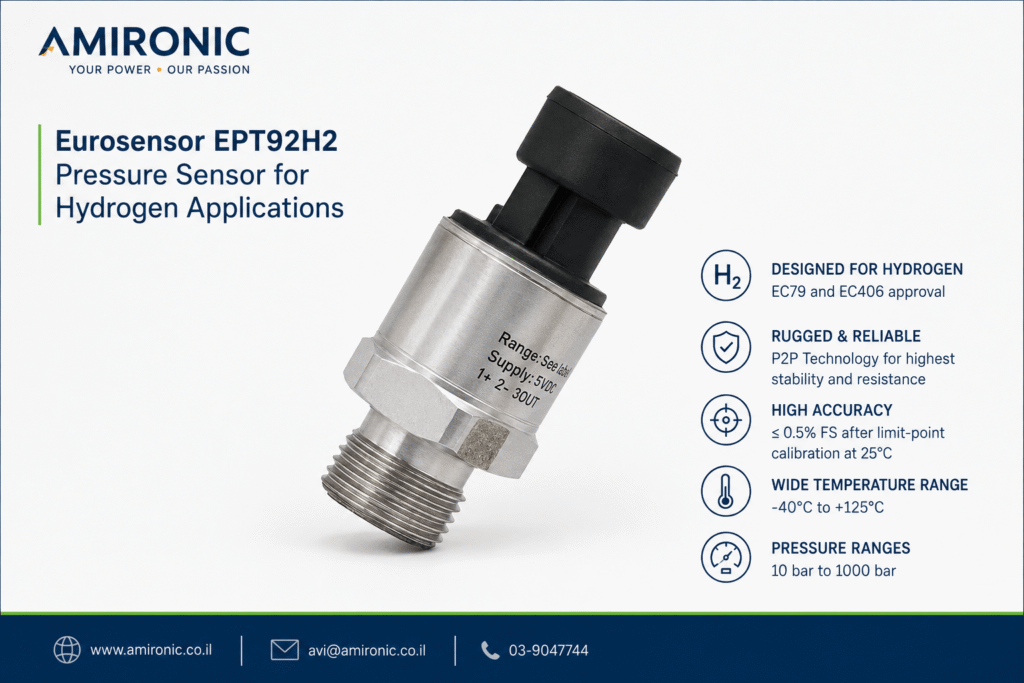
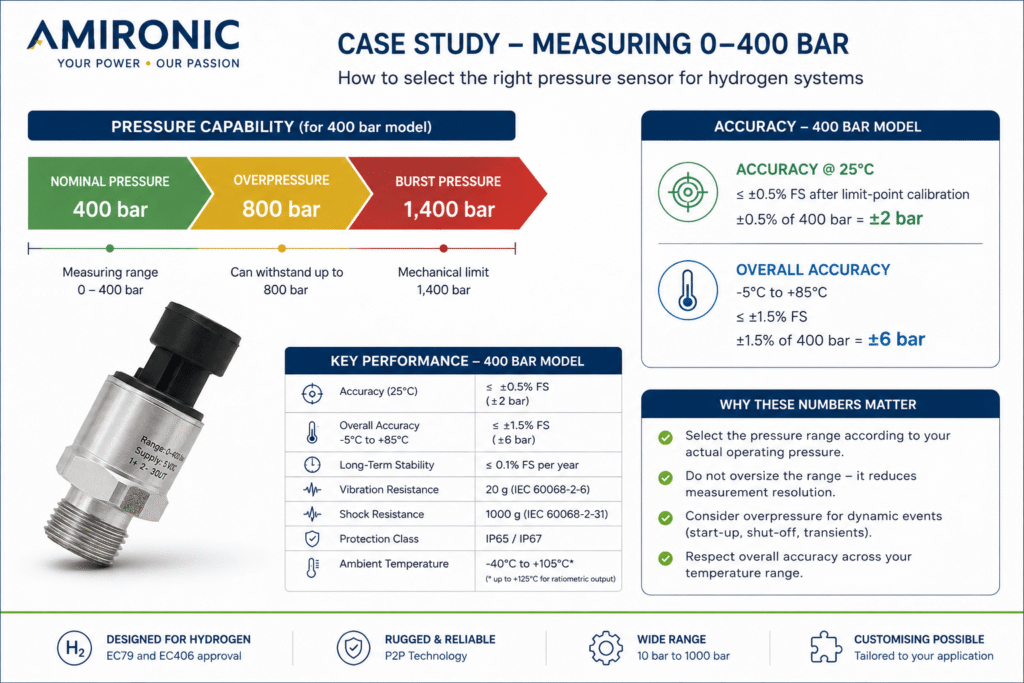
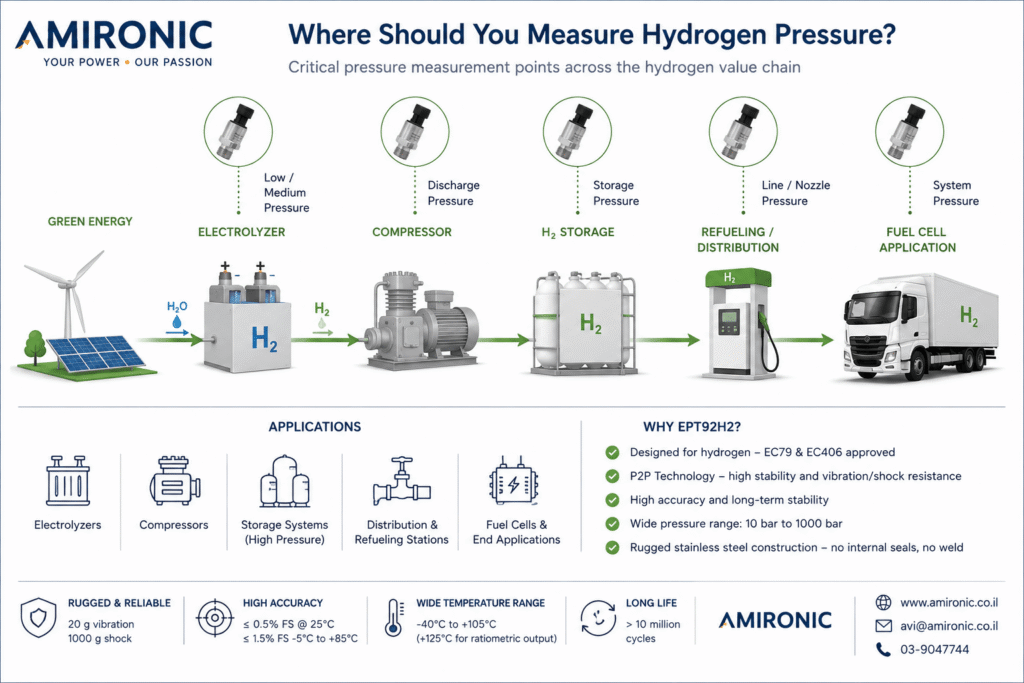
Figure 1 – Pressure measurement across the hydrogen process chain – from production using an electrolyzer, through compression and storage, to refueling and fuel cell applications. The EPT92H2 pressure sensor is specifically designed for hydrogen applications and approved according to EC79 and EC406.

How Much Pressure Do You Actually Need to Measure in a Hydrogen System?

There is no single “hydrogen operating pressure.” The required measurement range can vary significantly depending on where the sensor is installed within the system.

A sensor installed as part of a hydrogen production system may operate under completely different conditions from a sensor installed downstream of a compressor or in a high-pressure storage system. One potential design mistake is therefore to select a sensor based only on the system’s nominal operating pressure, without considering what may occur at the measurement point during startup, valve closure, changes in flow, or fault conditions.

The EPT92H2 series is available in nine nominal pressure ranges:

10, 25, 60, 100, 160, 250, 400, 700, and 1,000 bar.

This means that the same sensor family can be used at very different measurement points within a hydrogen system.

However, nominal pressure is only the first number that needs to be considered.

Nominal Pressure, Overpressure, and Burst Pressure Are Not the Same Thing

Suppose an engineer is designing a measurement point where the maximum expected operating pressure is 400 bar.

Selecting a 400 bar sensor may initially seem sufficient. However, the EPT92H2 datasheet specifies three different pressure values for this version:

Parameter Pressure
Nominal Pressure 400 bar
Overpressure 800 bar
Burst Pressure 1,400 bar

The distinction between these values is important.

Nominal Pressure is the measurement range for which the sensor is specified.

Overpressure is a higher pressure that the sensor is designed to withstand according to the manufacturer’s specification, but it does not turn a 400 bar sensor into an 800 bar measurement device.

Burst Pressure represents a different mechanical limit and must not be interpreted as an allowable operating pressure.

In other words:

Pressure Range tells us what we can measure. Overpressure and Burst Pressure tell us something entirely different about the sensor’s ability to withstand pressure.

This distinction is particularly important in high-pressure gas systems, where a component should not be selected simply because its burst pressure is higher than the intended operating pressure.

Case Study – Selecting a Sensor for a 400 bar Measurement Point

Consider a simple hydrogen system in which pressure needs to be measured over a range of 0–400 bar.

We select the 400 bar version of the EPT92H2.

According to the manufacturer’s specifications:

  • Nominal Pressure: 400 bar
  • Overpressure: 800 bar
  • Burst Pressure: 1,400 bar
  • Accuracy: up to ±0.5% FS after Limit-Point Calibration at 25°C
  • Long-Term Stability: up to 0.1% FS per year under reference conditions

We can now translate the accuracy specification into a number that is easier to understand.

At a Full Scale of 400 bar:

0.5% × 400 = 2 bar

This means that an accuracy specification of ±0.5% FS corresponds, in this case, to ±2 bar at 25°C, according to the accuracy conditions specified by the manufacturer.

By comparison, if we selected the 1,000 bar version simply because “more margin is better,” the same Full Scale percentage would translate into:

0.5% × 1,000 = 5 bar

This is a good example of why oversizing the measurement range is not necessarily an advantage.

The selected pressure range should provide the safety and design margins required by the system, while also maintaining measurement resolution and accuracy appropriate for the application.

What Happens When the Temperature Changes?

There is another important point to consider.

The ±0.5% FS specification does not apply across the entire temperature range. It is specified after Limit-Point Calibration at 25°C.

The manufacturer specifies an Overall Accuracy of 1.5% over the temperature range of -5°C to +85°C.

For the 400 bar version, for example:

1.5% × 400 = 6 bar

This becomes particularly relevant when considering real-world operating environments.

A sensor installed in a temperature-controlled laboratory does not experience the same conditions as one installed outdoors, on a vehicle, inside an equipment enclosure, or close to a compressor.

The EPT92H2 itself is designed for a wide range of environmental conditions, with a specified ambient temperature range from -40°C to +105°C, extending up to +125°C for the ratiometric output version.

Figure 2 – Case study for selecting a pressure sensor for a 0–400 bar hydrogen system: comparison of Nominal Pressure, Overpressure, and Burst Pressure, and the impact of measurement range and temperature on measurement accuracy.

Beyond Pressure: A Sensor in a Hydrogen System Must Also Withstand the Real World

So far, we have focused on pressure and measurement accuracy. But in a real-world system – particularly mobile equipment, compressors, refueling systems, or equipment installed in industrial environments – the sensor does not operate under laboratory conditions.

It may be exposed to vibration, mechanical shock, temperature variations, humidity, and millions of pressure cycles.

Therefore, once the appropriate pressure range has been selected, another question needs to be asked:

Can the sensor maintain its performance throughout the lifetime of the system?

20g Vibration and 1,000g Mechanical Shock

The EPT92H2 is specified to withstand 20g vibration according to IEC 60068-2-6 and 1,000g mechanical shock according to IEC 60068-2-31. The manufacturer also specifies a service life of more than 10 million cycles.

These specifications are particularly relevant when the sensor is installed close to a compressor, on mobile equipment, or in systems where vibration and mechanical shock are part of normal operating conditions.

This also helps explain why Eurosensor emphasizes the sensor’s P2P construction. According to the manufacturer, the two full bridges are connected in a way that largely compensates for the effects of external forces on the sensor signal – for example, mechanical torque introduced during installation.

4–20mA or 0.5–4.5V?

Even after selecting the appropriate pressure range, the sensor still needs to be matched to the control system.

The EPT92H2 is available with three main output options:

  • 4–20mA
  • 0.5–4.5V
  • 0.5–4.5V Ratiometric

The 4–20mA version operates from a 10–32V supply, the voltage-output version from 8–32V, and the ratiometric version is designed for a 5VDC ±10% supply. The specified response time is 1ms.

The choice between these outputs is not simply a matter of convenience.

In an industrial system where the sensor is located some distance from the controller, a 4–20mA output may be a natural choice. In a compact OEM system where the sensor is connected directly to an ECU or local controller, a voltage or ratiometric output may be more suitable.

It is therefore useful to define more than just:

Pressure: 0–400 bar

A more complete specification might look like this:

Medium: Hydrogen | Range: 0–400 bar | Output: 4–20mA | Supply: 24VDC | Electrical Interface: M12

At this point, the selection is based on the requirements of the complete system rather than on the pressure sensor alone.

Electrical and Process Connections – The System Shouldn’t Have to Be Redesigned Around the Sensor

One practical advantage of the EPT92H2 is the range of available mechanical and electrical configurations.

Electrical connection options include Packard Metripac, M12x1, AMP Superseal, Deutsch DT04-3P, and DT04-4P.

Process connection options include 7/16 UNF, 9/16 UNF, M16x1, and G1/2B, depending on the selected configuration.

This can be particularly important in an OEM project.

When the system already has an established wiring harness, tubing, manifold, or mechanical interface, it is often preferable to select a sensor configuration that matches the existing design rather than introducing unnecessary adapters and additional connections.

Figure 3 – Typical pressure measurement points across the hydrogen process chain – from production using an electrolyzer, through compression and storage, to refueling and fuel cell applications. The EPT92H2 offers pressure ranges from 10 to 1,000 bar and is designed for use with hydrogen.

What Do EC79 and EC406 Mean?

So far, we have focused on the engineering aspects: material compatibility with hydrogen, pressure, accuracy, temperature, vibration, and operating cycles.

However, when selecting a component for a hydrogen system, there is another important question:

Is the sensor simply capable of measuring hydrogen – or does it come with specific approvals for hydrogen applications?

In the case of the EPT92H2, Eurosensor specifically states EC79 and EC406 approval for use with hydrogen.

This can be an important consideration during component selection. When an engineer needs to document why a particular pressure sensor was selected for an H₂ system, there is a significant difference between relying on a general statement such as “Compatible with Hydrogen” and selecting a sensor family that the manufacturer offers with dedicated approvals for hydrogen use.

However, it is important to distinguish between component approval and approval of the complete system. The fact that a particular sensor is approved for use with hydrogen does not automatically mean that the system in which it is installed is approved. The system design, piping, valves, seals, sensor installation, and application-specific safety requirements must still be evaluated as a complete system.

Another Case Study: Is a 1,000 bar Sensor Always the Better Choice?

Suppose we are developing a system with a normal operating pressure of 250 bar, but someone on the engineering team suggests:

“Let’s use the 1,000 bar version. That will give us plenty of margin.”

From a pressure-withstand perspective, this may sound reasonable. From a measurement perspective, however, it is not necessarily the right choice.

The EPT92H2 is available with nominal ranges of 250, 400, 700, and 1,000 bar, allowing the measurement range to be matched to the application rather than automatically selecting the highest available range.

Consider only the ±0.5% FS accuracy specification at 25°C:

Pressure Range ±0.5% FS
250 bar ±1.25 bar
400 bar ±2 bar
700 bar ±3.5 bar
1,000 bar ±5 bar

The same 0.5% FS specification has a very different absolute meaning as the Full Scale range increases.

Therefore, if everything we need to measure is within approximately 0–250 bar, selecting a 1,000 bar sensor simply to gain “more safety margin” may significantly increase the absolute measurement error derived from the Full Scale specification.

The correct approach is not simply to choose the lowest or highest available range, but to evaluate the Maximum Operating Pressure, Transients, Overpressure Requirement, and required measurement accuracy together.

Why Is This Particularly Relevant to OEM Systems?

In many OEM projects, a hydrogen system is not necessarily a large standalone product. It may be a subsystem within an energy system, test platform, special-purpose vehicle, mobile system, or another type of equipment.

These applications often introduce additional constraints: limited space and weight, an existing wiring harness, predefined supply voltages, connectors already qualified for the project, and environmental conditions that may be far from ideal.

The EPT92H2 weighs approximately 50 grams, is available with IP65/IP67 protection depending on the electrical connection, and offers several electrical and process connection options.

Its dimensions vary slightly depending on the connector, but the overall design remains compact. Manufacturer drawings show options including M12, Deutsch, AMP Superseal, and Packard Metripac, allowing the configuration to be selected according to the existing system architecture.

Don’t Select a Part Number Before Defining These Five Parameters

Before requesting a quotation for a pressure sensor for a hydrogen system, it is useful to define at least the following:

  1. Pressure Range – What is the operating pressure, and what peak pressures may occur?
  2. Medium – Is the medium H₂, and under what operating conditions?
  3. Output Signal – 4–20mA, 0.5–4.5V, or ratiometric?
  4. Process Connection – What thread and mechanical connection are required?
  5. Electrical Connection – Which connector is compatible with the wiring harness and control system?

With the EPT92H2, these parameters directly affect the required configuration and part number. The datasheet, for example, shows a part-number structure based on the series, process connection, pressure range, pressure reference, output signal, and electrical connection.

So instead of starting with the question:

“How much does an EPT92H2 cost?”

it makes more sense to begin with the engineering question:

“Which EPT92H2 configuration is right for my measurement point?”

Conclusion – In Hydrogen Applications, a Pressure Sensor Is About More Than Pressure Range

Selecting a pressure sensor for a hydrogen system may begin with the measurement range, but it certainly does not end there.

Material compatibility with H₂, sensing-element construction, overpressure and burst pressure, temperature effects on accuracy, vibration and mechanical shock, electrical output, and application-specific approval requirements all need to be considered.

The Eurosensor EPT92H2 was developed specifically for applications of this type. It features a stainless-steel sensing element with no welds and no oil-filled cavities, uses P2P technology, and is offered with EC79 and EC406 approvals for use with hydrogen.

With pressure ranges from 10 to 1,000 bar, accuracy of up to ±0.5% FS at 25°C, resistance to 20g vibration and 1,000g mechanical shock, and a range of output and connection options, it can be configured for different measurement points in hydrogen production, compression, storage, and utilization systems.

For companies developing hydrogen systems, electrolyzers, storage systems, fuel cells, or other OEM equipment, the right question is not simply:

“Which sensor can measure the pressure?”

but rather:

“Which sensor was designed from the outset to operate with hydrogen under the conditions of our system?”

Amironic can assist in selecting the appropriate EPT92H2 configuration for your application – including pressure range, output signal, process connection, and electrical connection.

🧩 Further Reading – Measurement as a System

This article is part of an engineering series exploring how reliable measurement depends on proper system design rather than on a single sensor component.

Before diving deeper into industrial sensing, you may also find the following articles in the series useful:

  • VARIOHM Group – When Measurement Is a System, Not a Component
  • How to Select Sensors for Harsh Environments: An Engineering Guide for Reliable Measurement in the Real World
  • VARIOHM Position Sensors – Engineering Position as a System, Not Just a Signal
  • Industrial Pressure Sensors – When Pressure Measurement Becomes a System Engineering Challenge
  • Industrial Temperature Sensors – When Temperature Measurement Becomes a System Engineering Challenge
  • Choosing the Right Linear Position Sensor: Why Stroke Length Is Only the Beginning
  • Contactless Rotary Position Sensors – Why More and More Systems Are Moving to Non-Contact Sensing
  • Choosing the Right Temperature Probe Mounting
  • How Differential Pressure (ΔP) Can Reveal Problems Long Before a System Shuts Down
  • Your Temperature Sensor Says 80°C. The Real Hot Spot Could Already Be at 130°C
  • Measuring Pressure Without Temperature Is Only Half the Picture
  • Does Your Thermal Protector Really Solve the Problem? Or Just Give the System Another Chance to Fail?
  • Why a Linear Position Sensor Shouldn’t Be Selected by Stroke Alone
  • Your System Has Powered Up – But Does It Know Where It Is? Absolute Position Sensors vs. Homing
  • Your Pressure Sensor May Be Accurate. Your Measurement May Not Be – Why a ±0.5% Accuracy Specification Doesn’t Guarantee a ±0.5% Measurement
  • Why Programming a Rotary Position Sensor to 360° Is Sometimes the First Design Mistake
  • Why a Dual-Channel Rotary Position Sensor Is Not Just a Backup Sensor
  • Your PT100 Sensor Isn’t Reading the Wrong Temperature – Your Wiring Might Be
  • Why Every Battery Pack Needs a Temperature Sensor – Not Just Electric Vehicles

Frequently Asked Questions (FAQ)

Is every stainless steel pressure sensor suitable for measuring hydrogen?

No. The fact that a sensor is made of stainless steel is not sufficient to determine whether it is suitable for hydrogen. The materials in contact with the medium, the design of the sensing element, sealing, and resistance to phenomena such as Hydrogen Embrittlement and Permeation all need to be considered. In the EPT92H2, the wetted parts are made of 316L stainless steel, and the sensing element is designed without welds or oil-filled cavities.

What pressure ranges are available for the EPT92H2?

The EPT92H2 is available in nominal pressure ranges of 10, 25, 60, 100, 160, 250, 400, 700, and 1,000 bar. Each range also has its own specified Overpressure and Burst Pressure values.

What is the difference between Nominal Pressure, Overpressure, and Burst Pressure?

Nominal Pressure is the pressure range for which the sensor is specified for measurement. Overpressure is a higher pressure that the sensor can withstand according to the manufacturer’s specifications, while Burst Pressure refers to a higher mechanical limit. Neither Overpressure nor Burst Pressure should be interpreted as the sensor’s normal operating range.

For example, the 400 bar version of the EPT92H2 has an Overpressure rating of 800 bar and a Burst Pressure of 1,400 bar.

What is the accuracy of the EPT92H2?

The manufacturer specifies accuracy of up to ±0.5% FS at 25°C after Limit-Point Calibration, and an Overall Accuracy of 1.5% from -5°C to +85°C. The specified Long-Term Stability is up to 0.1% FS per year under reference conditions.

Which electrical outputs are available?

The EPT92H2 is available with 4–20mA, 0.5–4.5V, and 0.5–4.5V Ratiometric outputs. The specified response time is 1ms.

Is the EPT92H2 suitable for environments with vibration?

The manufacturer specifies vibration resistance of 20g according to IEC 60068-2-6 and mechanical shock resistance of 1,000g according to IEC 60068-2-31. The specified service life is more than 10 million cycles.

Is the EPT92H2 approved for use with hydrogen?

Yes. According to the manufacturer’s datasheet, the EPT92H2 has EC79 and EC406 approval for use with hydrogen. It is important to remember that approval of the sensor itself does not constitute approval of the complete system in which it is installed.

What types of hydrogen applications can it be used for?

Depending on the system requirements and selected configuration, pressure sensors of this type can be integrated at measurement points in hydrogen production, compression, storage, and other systems where H₂ pressure measurement is required. The manufacturer specifically identifies hydrogen as one of the media for which the EPT92H2 is designed.


Technical Glossary

Hydrogen (H₂)
The lightest chemical element. In energy systems, hydrogen can be produced, compressed, stored, and used either as a feedstock or as an energy carrier.

Pressure Sensor / Pressure Transmitter
A device that converts physical pressure into an electrical signal that can be transmitted to a PLC, ECU, Data Acquisition System, or other control system.

Hydrogen Embrittlement
A phenomenon in which exposure to hydrogen can, under certain conditions, adversely affect the mechanical properties of certain metals.

Permeation
The passage of molecules or atoms through a material. In hydrogen systems, this is an important consideration due to the very small size of the H₂ molecule.

Wetted Parts
All sensor components that come into direct contact with the measured gas or liquid. In the EPT92H2, the wetted parts are specified as Stainless Steel 1.4404 / 316L.

Nominal Pressure
The pressure range for which the sensor is specified for measurement.

Overpressure
Pressure above the nominal range that the sensor is designed to withstand according to the manufacturer’s specification. It is not a normal measurement range.

Burst Pressure
A specification relating to the mechanical pressure limit of the sensor. It should not be interpreted as an allowable operating pressure.

Full Scale (FS)
The full value of the measurement range. For a 0–400 bar sensor, for example, Full Scale is 400 bar. Therefore, 0.5% FS corresponds to 2 bar.

4–20mA
A widely used analog current signal in industrial control systems. The EPT92H2 is available with a 4–20mA output and a 10–32V supply voltage.

Ratiometric Output
A voltage output whose signal is proportional to the supply voltage. The EPT92H2 is available with a 0.5–4.5V ratiometric output using a 5VDC ±10% supply.

P2P Technology
The sensing technology used in the EPT92H2. According to the manufacturer, it uses two Full Bridges and is designed, among other things, to minimize the influence of external forces on the sensor signal.

EC79 / EC406
The approvals specified by the manufacturer for the EPT92H2 for use with hydrogen.

Tags: Variohm

Related Articles

Why Position Feedback Matters More Than Ever in Counter-UAS Swarm Defense

02/08/2026amironicLTD

Does Your Thermal Protector Really Solve the Problem? Or Just Give the System Another Chance to Fail?

09/07/2026amironicLTD

Why Programming a Rotary Position Sensor to 360° Is Sometimes the First Design Mistake

26/07/2026amironicLTD

Recent Posts

  • Why a Standard Pressure Sensor Isn’t Always Suitable for Hydrogen Systems
  • Hands on the Keyboard, Foot on the Radio – Why Push-to-Talk Is Moving to the Floor in Control Rooms
  • Why Every Battery Pack Needs a Temperature Sensor – Not Just Electric Vehicles
  • Why a Dirty Lens Is More Than Just an Optical Problem – It’s an Engineering Challenge in Endoscopy Systems
  • The Antenna Hasn’t Moved – So Why Did We Lose the Link? The Role of the IMU in Antenna Positioning Systems

Categories

  • Air Switch
  • Circuit Breakers
  • Elapsed Time Indicator
  • Feedthrough
  • Footswitches
  • Gears & Transmission
  • Hour Meters
  • Infra Red Switches
  • INFRARED LAMPS
  • Low Noise Inertial MEMS
  • Mechanics
  • MEMS Gyroscope
  • MEMS Inertial
  • Microelectronics
  • Motors
  • Position Sensors
  • Power Supply
  • Pressure Sensors
  • Pressure Switch
  • Temperature Sensors
  • Tungsten and Molybdenum
  • Uncategorized
  • Vacuum Switches

Quick Contact

Fill out the form and our representatives will return to you

    Name (required)

    Email (required)

    Phone

    Message

    This site is protected by reCAPTCHA and the Google
    Privacy Policy and
    Terms of Service apply.

    Amironic Ltd.

    3 Rabinovich Street, Petah Tikva 4928144 , Israel. Tel: +972-3-9047744 E-mail: office@amironic.co.il
    Email
    Facebook
    Twitter
    LinkedIn
    YouTube
    Press on the ISO Certificate below for download
    ISO 9001:2015 Certification
    • MEMS Inertial
    • Circuit Breakers
    • Footswitches
    • Mechanical & Transmisions
    • Sensors
    • Motors
    • Electronics
    • Hand Control
    • Power Solutions

    News

    • Why a Standard Pressure Sensor Isn’t Always Suitable for Hydrogen Systems
    • Hands on the Keyboard, Foot on the Radio – Why Push-to-Talk Is Moving to the Floor in Control Rooms
    • Why Every Battery Pack Needs a Temperature Sensor – Not Just Electric Vehicles
    • Why a Dirty Lens Is More Than Just an Optical Problem – It’s an Engineering Challenge in Endoscopy Systems
    • The Antenna Hasn’t Moved – So Why Did We Lose the Link? The Role of the IMU in Antenna Positioning Systems
    About AmironicContactעברית
    © 2022 Amironic All rights reserved. All Trademarks are the property of their respective owners.
    • Increase Font
    • Decrease Font
    • Black & White
    • Inverse Colors
    • Highlight Links
    • Regular Font
    • Reset