Selecting a power supply or DC-DC converter is not simply a matter of input voltage, output voltage, and power rating.
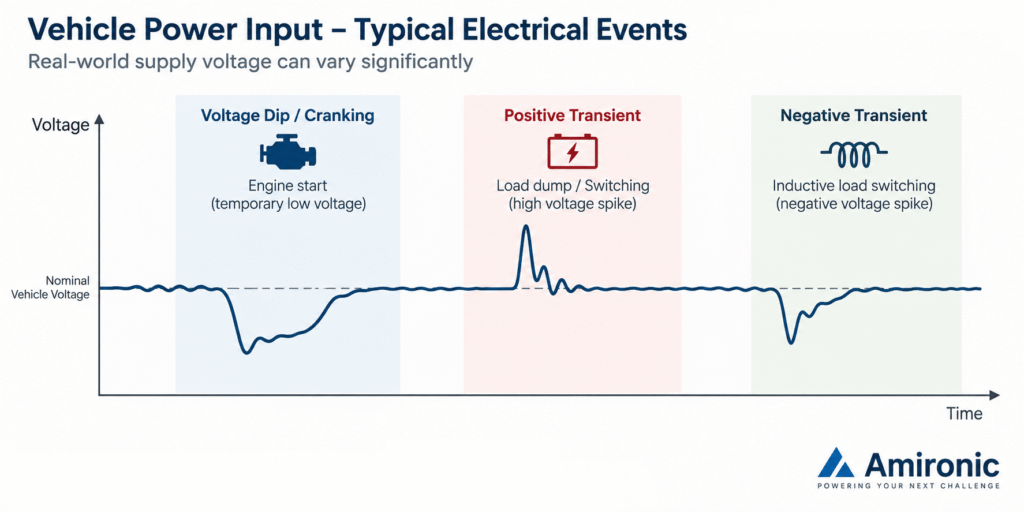
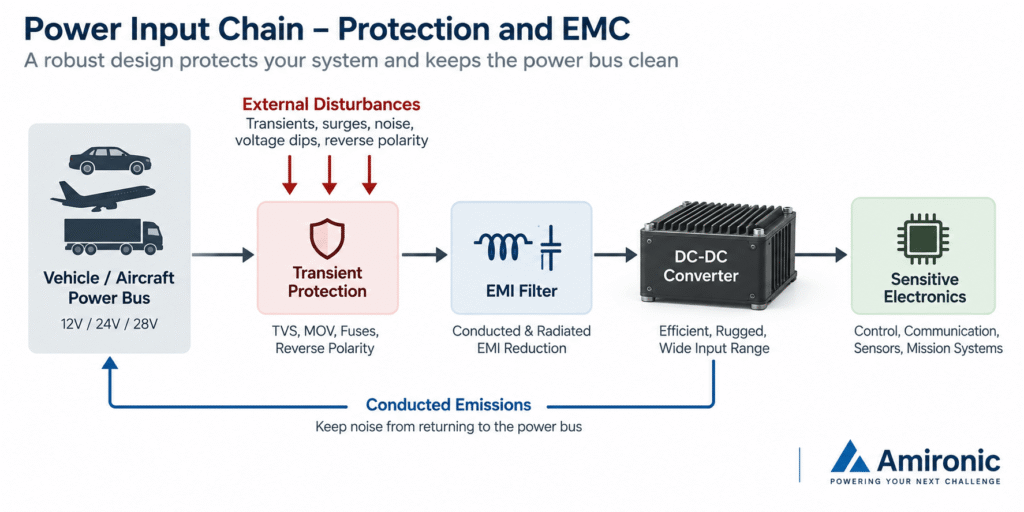
In military, aerospace, and automotive systems, the power source itself is part of the system’s operating environment. Power lines may be exposed to voltage spikes, voltage dips, conducted disturbances, electrical noise, and short-duration transients. At the same time, the equipment may be required to meet EMC, temperature, vibration, shock, and in some cases lightning and other harsh environmental requirements.
This is why different standards exist for different operating environments.
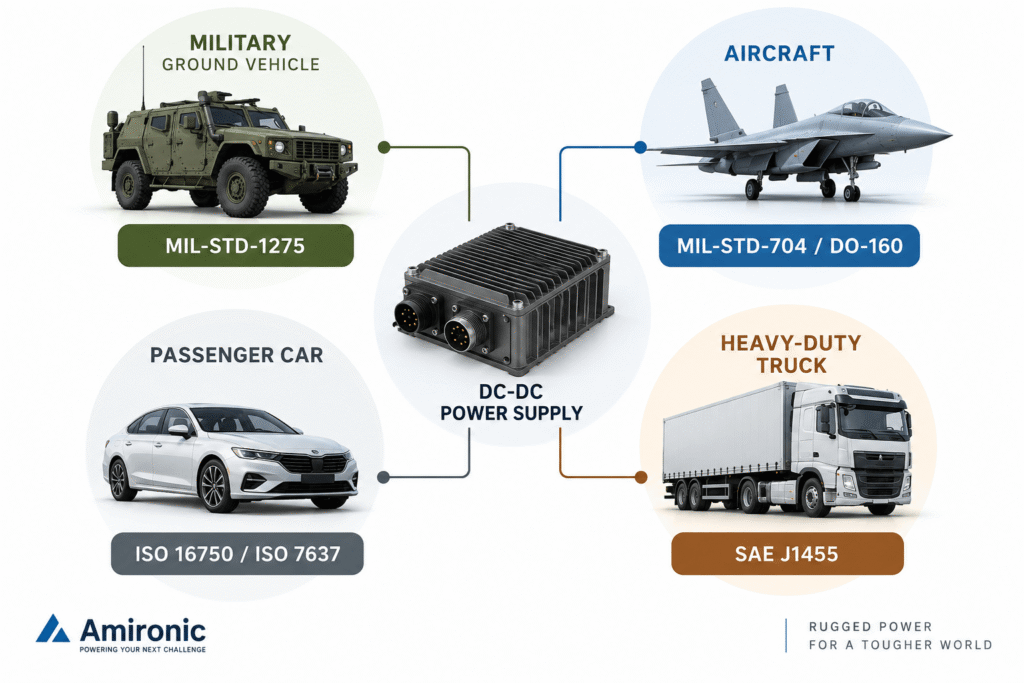
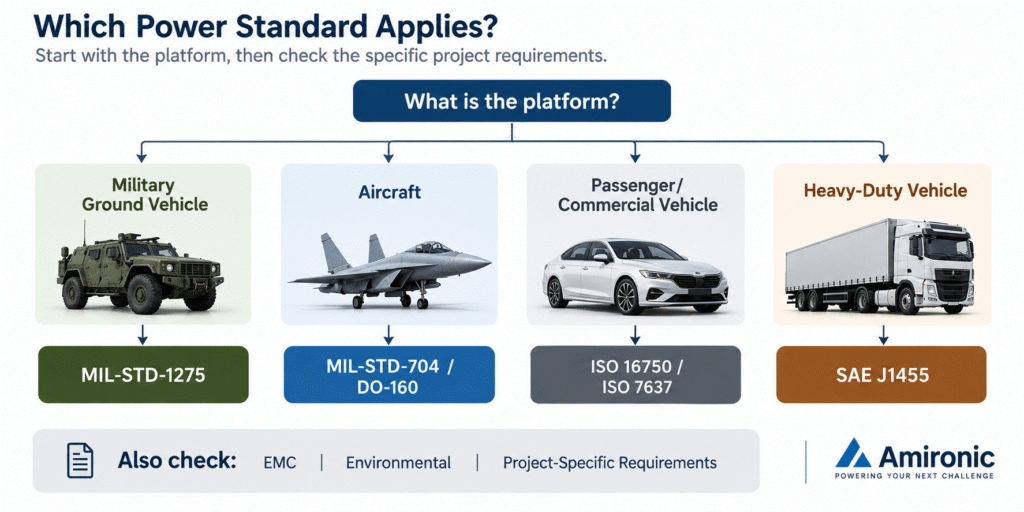
MIL-STD-1275 addresses the electrical environment of military vehicles, MIL-STD-704 defines aircraft electric power characteristics, MIL-STD-461 covers EMI/EMC requirements for military equipment, and MIL-STD-810 addresses environmental conditions and testing.
In civil and commercial aviation, RTCA DO-160 is widely used, while automotive applications may involve standards such as ISO 16750, ISO 7637, and requirements for Heavy-Duty applications such as SAE J1455.
The purpose of this guide is to make these requirements easier to understand: what each standard covers, where it applies, how the standards differ, and which requirements should be considered when selecting a power supply or DC-DC converter for a system.
Not Every Standard Tests the Same Thing
One common mistake is to treat a list of standards as a list of “certifications.”
In practice, different standards address completely different questions.
One standard may define what voltage conditions can appear at the power supply input, another may evaluate how much electromagnetic interference the equipment generates or can tolerate, while another may focus on whether the equipment can continue operating after exposure to vibration, shock, or temperature variations.
Therefore, equipment that complies with one standard does not automatically meet all of the system’s requirements.
The standards can be viewed as four main layers:
| Area | Examples of Standards | What Do They Cover? |
|---|---|---|
| Input Power Quality & Environment | MIL-STD-1275, MIL-STD-704, ISO 16750 | Variations, abnormal conditions, and disturbances in the input power |
| Transients | ISO 7637, MIL-STD-1275 | Fast voltage events on power lines |
| EMI / EMC | MIL-STD-461, DO-160, civilian EMC standards | Electromagnetic emissions and immunity/susceptibility |
| Environmental | MIL-STD-810, DO-160, SAE J1455 | Temperature, vibration, shock, and environmental conditions |
This distinction is particularly important when designing the Power Architecture. The question is not only “Which standard does the power supply comply with?”, but also “Which electrical and environmental phenomena does that standard actually cover?”
MIL-STD – The Key Standards for Military Systems
A military system may be subject to several standards simultaneously, even for the same power supply or DC-DC converter.
Four of the most important standards in this context are:
MIL-STD-1275 – Electrical power characteristics for military vehicles.
MIL-STD-704 – Aircraft electric power characteristics.
MIL-STD-461 – EMI and EMC requirements for equipment and subsystems.
MIL-STD-810 – Environmental conditions and testing, including temperature, vibration, and shock.
It is important to understand that these standards do not replace one another. A system may, for example, need to meet requirements related to input power characteristics, EMC, and environmental conditions at the same time.
We have published a separate in-depth guide for each of these standards, so here we will focus on the overall picture and how military requirements compare with aerospace and automotive applications.
Further reading: Military Power Supplies and DC-DC Converters – A Guide to MIL-STD Standards