flagעברית
flagEnglish
3 Rabinovich St., Petah-Tikva, Israel
+972 3 9047744
office@amironic.co.il
Facebook
Twitter
LinkedIn
YouTube
  • Products
    • MEMS Inertial
      • Gyros & Accels
      • IMU
      • Inertial Navigation
      • AHRS
    • Circuit Breakers
      • Airpax Circuit Breakers
      • Electronic Circuit Breakers
      • Aircraft Circuit Breakers
      • Thermal Circuit Breakers
      • Sealing Solutions & Guards
    • Footswitches
      • Pedals & Bellows
      • USB
      • Air Switches
      • Medical
      • Modular Bases System
      • Industrial
      • Foot Potentiometers
      • Wireless
    • Mechanical & Transmisions
      • Gears
      • Sealing Solutions
      • Gearboxes
      • Couplings
      • Shafts & Bearings
      • Fasteners
      • Mechanical & Springs
      • Linear Motion
      • Anti-Vibration
    • Sensors
      • Thermostats
      • Temperature
      • Position
      • Pressure
      • Speed
      • Level Sensor
      • Load Cells
      • Flex Sensors
      • Membrane Potentiometer
    • Motors
      • Geared DC
      • Brushless DC
      • Step Motors with Gearbox
      • Torque Motors & Brushless Servo
      • DC Motors
    • Electronics
      • Xenon & IR Lamps
      • Counters & Meters
      • Microelectronics Packaging
      • Waterproof Switches
      • Micro Switches
    • Hand Control
      • Operator Controls (JOYSTICK)
      • Electrical
      • Pneumatic (Medical)
      • USB Hand Control
      • Air Push Button
      • Pressure Switch
      • IR Switch
    • Power Solutions
      • Rugged & Military Power Supply
      • Input Power Protection
      • Sealed Military Power Adaptor
      • Triple Output Military Power Supply Series – up to 250 W
    • Materials
      • Molybdenum and Advanced Alloys (TZM, MOLA, HCT)
      • Tungsten (Wolfram) and Advanced Alloys – High-Performance Materials for Extreme Conditions
      • Materials for Gears
  • Shop
  • Companies
  • About Amironic
  • News
  • Contact
Product was added to your cart

Cart

waze

Military Power Supplies and DC-DC Converters – A Guide to MIL-STD Standards

Power Supply31/08/2026amironicLTD

📚 Our Guide Series to Military Power Supplies and MIL-STD Standards

This article is part of our guide series covering the design and selection of power supplies and DC-DC converters for military and aerospace systems.

⭐ Main Guide:

Military Power Supplies and DC-DC Converters – A Guide to MIL-STD Standards

📖 Additional Guides in the Series:

MIL-STD-1275 – Power Supplies and DC-DC Converters for Military Vehicles

MIL-STD-704 – Power Supplies for Military and Aerospace Systems

MIL-STD-461 for Military Power Supplies – EMI, EMC and CS101

MIL-STD-810 – Vibration, Shock and Environmental Conditions in Military Power Supplies

MIL-STD-1275 vs. MIL-STD-704 – What’s the Difference and How Do You Choose the Right Power Supply?

Military DC-DC Converters with Built-In EMI Filtering and Input Protection

Each guide focuses on a different aspect of the power system. Together, they provide a broader understanding of the electrical requirements, EMI/EMC requirements, environmental conditions, and integration considerations involved in selecting a power solution for military and aerospace applications.
Military Power Supplies and DC-DC Converters – A Guide to MIL-STD Standards

When an engineer selects a power supply for a commercial system, the starting point is relatively straightforward: input voltage, output voltage, power, efficiency, and size.

In a military system, these are only the beginning.

A power supply installed in a military ground vehicle, airborne system, communications system, radar, or electro-optical system must operate in an environment where the input power is not necessarily clean and stable DC.

Voltage surges, spikes, conducted interference, vibration, shock, extreme temperatures, and strict size and weight constraints can all be part of the system requirements.

Therefore, the right question is not simply:

“Which power supply provides the voltage and power I need?”

But rather:

“Which power supply will continue to operate in the military environment in which my system is expected to perform?”

This is where MIL-STD requirements come into play.

A Military Power Supply Is Much More Than a Voltage Converter

Consider a system installed in a military ground vehicle that receives a 28VDC input and requires 12VDC to power its electronics.

On paper, the task looks simple:

28VDC → DC-DC Converter → 12VDC

In a real-world system, however, the DC-DC converter may also need to withstand disturbances and abnormal conditions coming through the platform’s electrical power system.

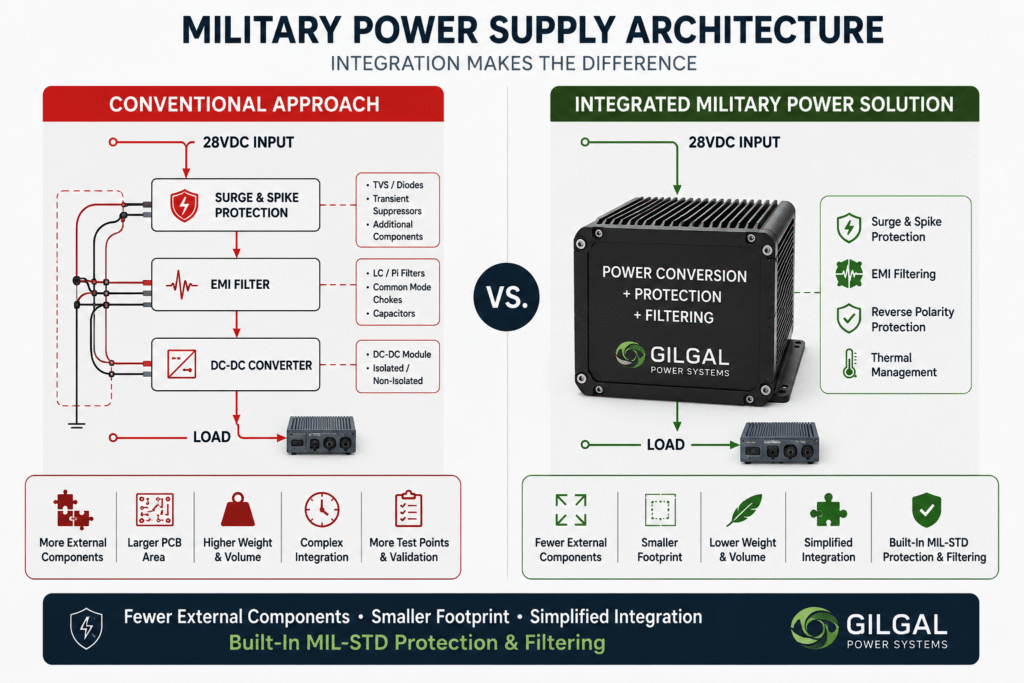
The actual power architecture may therefore include:

Input Protection → Surge & Spike Protection → EMI Filtering → DC-DC Conversion → Load

When each of these functions requires separate components and circuits, the overall solution begins to occupy more space, add weight, and increase system integration complexity.

This is where one of the key advantages of compact military power solutions becomes particularly important:

Integrating power conversion, filtering, and the required protection circuitry into a single solution.

Rather than viewing the DC-DC converter as a standalone component, it is often more useful to consider it as part of a complete Power Conditioning solution.

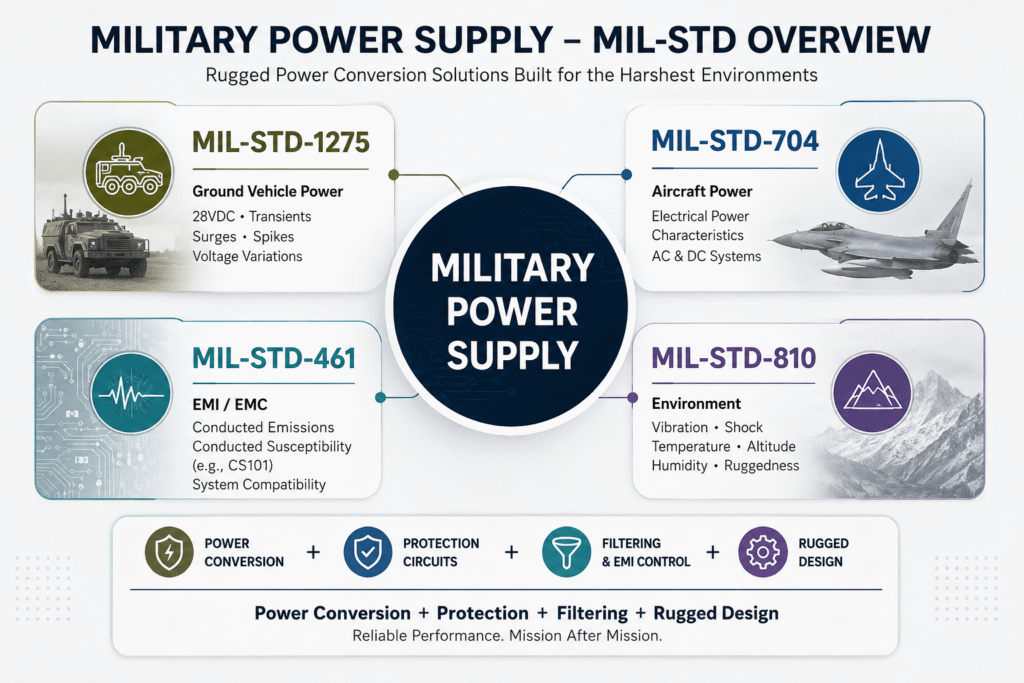
Four Key MIL-STD Families to Know

When designing or selecting power supplies and DC-DC converters for military and aerospace systems, four MIL-STD families are particularly important:

MIL-STD-1275 – Defines the characteristics of 28VDC input power supplied to equipment connected to military ground vehicle electrical systems.

MIL-STD-704 – Defines the characteristics of electrical power supplied to equipment aboard aircraft.

MIL-STD-461 – Defines requirements related to EMI/EMC, including electromagnetic emissions and susceptibility.

MIL-STD-810 – Defines environmental test methods that may include vibration, shock, temperature, and other environmental conditions, depending on the application.

Each standard addresses a different aspect of the challenge.

Together, they demonstrate why the term Military Power Supply describes much more than simply a power supply with a wide operating temperature range.

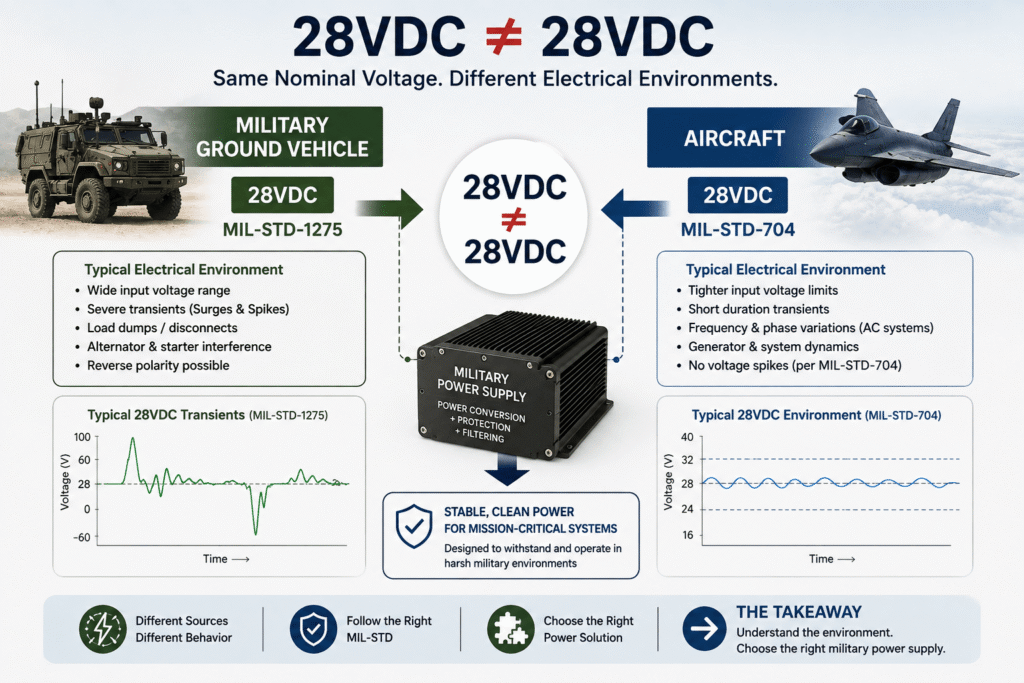
MIL-STD-1275 – Why 28VDC in a Military Vehicle Is Not Simply 28VDC

One of the key standards for power supplies used in military ground vehicles is MIL-STD-1275.

The standard defines the operating voltage limits and transient characteristics of 28VDC electrical power supplied to equipment connected to military ground vehicle electrical systems.

This is an important distinction: when a system specification states 28VDC Input, it does not mean that the equipment will receive a clean and constant 28 volts at all times.

A military vehicle electrical system is a dynamic environment. Engine starting, loads being connected or disconnected, charging systems, and various electrical loads sharing the same power bus can create voltage conditions that connected electronics must be able to handle.

MIL-STD-1275 therefore defines more than just a nominal 28VDC value. It also addresses voltage limits and electrical transients that equipment may encounter at its input.

The current active revision is MIL-STD-1275F, published in September 2022, which superseded MIL-STD-1275E.

What Does This Mean for the Power Supply?

Suppose our system requires 12VDC.

A commercial DC-DC converter might be specified as:

Input: 18-36VDC
Output: 12VDC

On paper, it appears suitable for a 28VDC system.

But this specification alone does not mean that the converter is suitable for a military ground vehicle.

The more important question is:

What happens when the input voltage temporarily moves outside normal operating conditions?

Is the converter protected?

Will it continue to operate as required?

Will it recover and return to normal operation after the event?

And will additional external protection and filtering circuits be required for the complete system to meet the project requirements?

Therefore, when selecting a MIL-STD-1275 Power Supply or a Military DC-DC Converter for 28VDC Vehicles, it is important to evaluate the entire power input solution, not just the input voltage range of the DC-DC converter.


MIL-STD-704 – When the 28VDC Comes from an Aircraft

This is where the distinction becomes even more important.

Aircraft also use 28VDC electrical systems. As a result, two different projects may appear to have exactly the same requirement:

Input Voltage: 28VDC

But one may be intended for a military ground vehicle and the other for an aircraft.

These are not necessarily the same electrical requirements.

MIL-STD-704 defines the characteristics of electrical power supplied to utilization equipment aboard aircraft. In other words, it defines the electrical power environment that airborne equipment is expected to encounter at its input.

The standard is not limited to 28VDC. The MIL-STD-704 family also addresses other types of electrical power used in aircraft, including various AC and DC power systems.

For 28VDC utilization equipment, dedicated test guidance is also provided within the MIL-HDBK-704 series.

Same Voltage, Different Electrical Environment

This is an important misconception to avoid at the beginning of a project:

28VDC does not automatically mean the same electrical environment.

A DC-DC converter designed for a 28VDC military ground vehicle power bus is not automatically suitable for a 28VDC aircraft power system, and vice versa.

MIL-STD-1275 addresses the 28VDC electrical power environment for equipment connected to military ground vehicle electrical systems.

MIL-STD-704 addresses the characteristics of electrical power supplied to utilization equipment aboard aircraft.

Therefore, before selecting a power supply or DC-DC converter, it is important to know not only the input voltage, but also which platform supplies that power and which standard the system is required to meet.

In some systems, the requirement can be even more complex: the same product may need to operate across more than one type of platform or meet requirements originating from more than one electrical power environment.

In such cases, selecting the Power Front End becomes an important part of the overall system design, rather than simply a matter of choosing a voltage converter.

MIL-STD-461 – When the Challenge Goes Beyond Input Voltage

So far, we have focused mainly on what reaches the power supply through the platform’s electrical power system.

But military systems face another important challenge: EMI – Electromagnetic Interference.

Military electronic systems can operate in electromagnetically dense environments. Power supplies, communication systems, computers, motors, radars, RF systems, and other electronic equipment may operate in close proximity and may share common power sources.

Therefore, converting voltage is only part of the job.

We also need to consider how the power supply and the overall system behave in the presence of electromagnetic interference.

This is where MIL-STD-461 comes into play. The standard establishes requirements for controlling the electromagnetic interference characteristics of equipment and subsystems.

In simple terms, we need to consider the relationship in both directions:

What interference does the equipment generate and introduce into the surrounding environment or power lines?

And:

What happens to the equipment when it is exposed to interference from the environment or through its power lines?

This leads to two important concepts:

Emissions – Electromagnetic interference generated by the equipment itself.

Susceptibility – The equipment’s response to external electromagnetic interference.


Conducted vs. Radiated EMI

Electromagnetic interference can reach equipment in different ways.

Conducted EMI refers to interference that travels through conductors, such as power supply lines.

Radiated EMI refers to electromagnetic energy that propagates through the electromagnetic field and is received by the equipment.

From a power supply perspective, conducted EMI is particularly important because the power supply is directly connected to the platform’s power lines.

It effectively sits at the interface between the platform power source and the electronics we need to power.


What Is CS101?

One of the well-known requirements within MIL-STD-461 is CS101 – Conducted Susceptibility, Power Leads.

CS101 evaluates the ability of equipment to withstand disturbances coupled onto its power input leads over the frequency range specified by the requirement.

In simple terms:

A controlled disturbance is applied to the equipment’s power input, and the equipment is evaluated to determine whether it continues to operate as required.

This is particularly important when designing a military power supply.

A DC-DC converter may perform very well in terms of input voltage, output voltage, efficiency, and power, while the complete system may still require additional filtering to meet the project’s EMI/EMC requirements.

Therefore, when a requirement such as MIL-STD-461 CS101 applies, the Power Front End should be evaluated as a complete system.


Why Is the Input Filter So Important?

An Input Filter can be viewed as an electrical interface between two environments:

Platform Power Bus ↔ Filter / Protection ↔ DC-DC Converter ↔ Sensitive Electronics

On one side is the electrical power system of the vehicle or platform.

On the other side is the sensitive electronics that need to be powered.

Between them, the design must manage both power quality and electromagnetic interference.

In a conventional solution, a system engineer may select a DC-DC converter and then design the additional circuitry required around it:

Protection Circuit

Surge / Transient Protection

EMI Filter

DC-DC Converter

Additional components may also be required depending on the specific project requirements.

Each of these elements may be necessary on its own.

But together, they require space.

They add components to the BOM, require additional PCB area or wiring, affect thermal management, and increase integration and testing effort.

This brings us to one of the most important considerations in modern military power supply design:

Can All of This Be Integrated Into the Power Supply?

In suitable applications, yes.

Instead of treating a Military DC-DC Converter simply as a “box that converts 28VDC to 12VDC,” the power solution can be designed to incorporate Input Protection and Filtering functions according to the requirements of the product and the project.

This can mean fewer external components, a smaller footprint, less wiring, and reduced integration complexity for the system designer.

In a space-constrained military system, these advantages can be significant.

MIL-STD-810 – When the Challenge Comes from the Environment, Not the Power Line

So far, we have focused mainly on the electrical environment of the power supply: input voltage, transients, and EMI.

But a military power supply does not operate only in a challenging electrical environment.

It may be installed in an off-road vehicle, mobile system, aircraft, electro-optical system, or other equipment that must continue to operate under harsh environmental conditions.

This is where MIL-STD-810 comes into play.

Unlike MIL-STD-1275 or MIL-STD-704, which address the electrical power environment, MIL-STD-810 focuses on environmental test methods intended to tailor equipment testing to the conditions it is expected to encounter throughout its service life.

Depending on the product and application, relevant requirements may include:

  • Vibration
  • Shock
  • High Temperature
  • Low Temperature
  • Humidity
  • Altitude
  • Dust and Sand
  • Other environmental conditions depending on the project

Not every power supply is required to undergo all of these tests.

For this reason, it is important to avoid broad statements such as “MIL-STD-810 compliant” without identifying the specific Methods, Procedures, and test conditions required for the project.

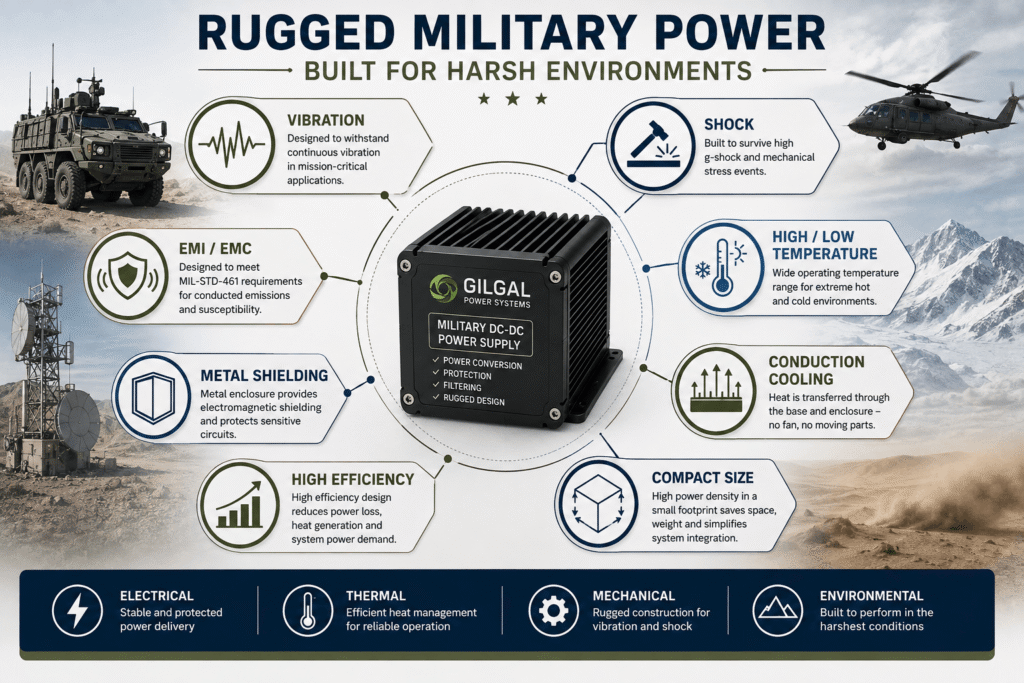
Why Is Vibration Particularly Important for a Power Supply?

A power supply contains electronic components, magnetic components, connectors, solder joints, and sometimes components with significant mass.

In an environment subject to continuous vibration, mechanical design becomes an integral part of the electrical design.

This is why, in military applications, rugged design is about much more than simply using an enclosure that looks strong.

The product must be considered as a complete system:

Electronics + PCB + Components + Connectors + Mechanical Structure + Thermal Design

All of these elements must work together in the environment for which the product is intended.


Size, Weight and Power – Why Every Millimeter Matters

In military and aerospace system design, the term SWaP – Size, Weight and Power is frequently used.

The concept is straightforward: achieve the required performance while minimizing size and weight and using available power as efficiently as possible.

For a military power supply, these requirements create an inherent design challenge.

On one hand, we want a compact converter.

On the other hand, we may also want to integrate:

  • DC-DC Conversion
  • Input Protection
  • Filtering
  • Isolation, when required
  • Thermal Management
  • Mechanical Protection
  • Connectors

And all of these functions must operate within the required temperature range and environmental conditions.

This makes Power Density an important consideration in military power supply design.

But high power density alone is not enough.

The heat still needs to go somewhere.


High Efficiency Is Also a Thermal Consideration

Power supply efficiency is more than just an electrical specification.

Every watt entering the power supply that does not reach the load ultimately becomes primarily heat that must be dissipated.

Consider a simple example.

A system delivers 200W to the load.

At 80% efficiency, the power supply requires 250W at its input, resulting in approximately 50W of power loss.

At 90% efficiency, it requires approximately 222W at its input, reducing the losses to approximately 22W.

In this example, a ten-percentage-point improvement in efficiency reduces the power that must be dissipated as heat by more than half.

In a compact, sealed, or fanless system, that can make a significant difference.

A High Efficiency Military Power Supply can therefore provide benefits beyond reduced power consumption, including:

  • Less heat generation
  • Reduced cooling requirements
  • The possibility of a more compact enclosure
  • Improved thermal conditions for nearby components
  • Easier implementation of fanless systems

Some Gilgal Power Systems solutions offer high-efficiency power conversion, depending on the specific model, power level, and operating conditions.


Conduction Cooling – When a Fan Is Not the Answer

In commercial equipment, thermal challenges can sometimes be addressed by adding a fan.

In a military system, however, a fan is not always desirable or even practical.

A fan adds a mechanical component, consumes power, may introduce dust and contaminants into the system, and requires an appropriate airflow path.

In sealed systems, this option becomes even more limited.

For this reason, many military power solutions are designed to transfer heat through Conduction Cooling to the enclosure, chassis, or other system structure.

In such a design, the enclosure is not simply packaging.

It becomes part of the thermal management system.


Metal Shielding – The Enclosure Is Part of the Electromagnetic Design

A metal power supply enclosure can serve another important function: Shielding.

In a densely integrated military system, power supplies, computers, communication equipment, RF systems, sensors, and sensitive electronics may all operate in close proximity.

A metal enclosure around the power converter can form part of the strategy for reducing electromagnetic coupling between the power supply and its surroundings.

Depending on the product design, some power solutions may use metal shielding around five or six sides of the converter.

However, it is important to emphasize:

Metal Shielding alone does not guarantee compliance with MIL-STD-461.

Meeting EMI/EMC requirements depends on the complete design:

Filtering + PCB Layout + Grounding + Shielding + Cabling + Connectors + Mechanical Design

Metal shielding should therefore be considered one part of the overall solution, not a substitute for proper EMI design.


Connectors Matter Too

A connector may appear to be a relatively small detail in a power supply specification, but at the system level it can have a significant impact on ease of integration.

Selecting commonly available connectors that are appropriate for the application can simplify:

  • Harness Design
  • Assembly
  • Maintenance
  • Replacement
  • System Integration

For a custom product, it may also be possible to adapt the connector type, pinout, and other mechanical parameters to the specific requirements of the system.

This can be a significant advantage when the power supply needs to fit into an existing system, rather than requiring the system to be redesigned around the power supply.

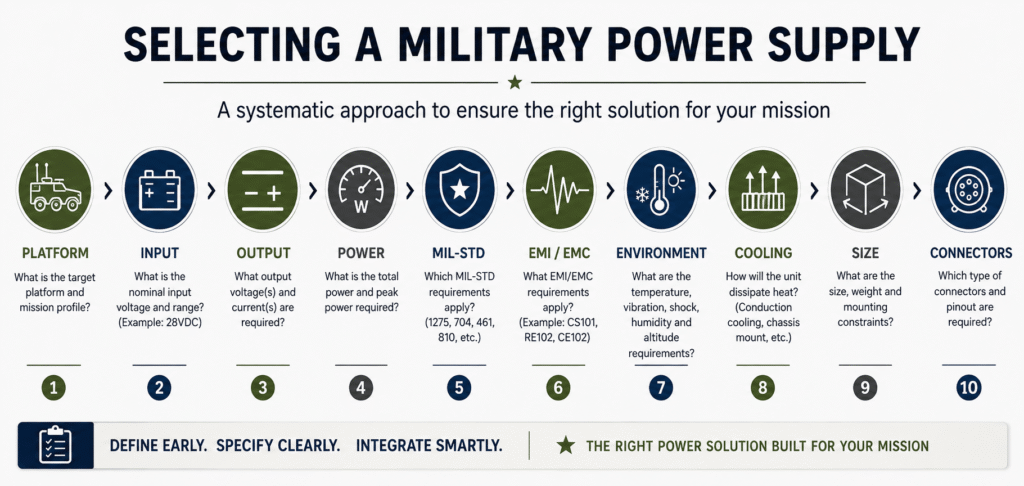
How to Select a Military Power Supply or DC-DC Converter

Now that we understand the differences between MIL-STD-1275, MIL-STD-704, MIL-STD-461, and MIL-STD-810, we can return to the practical question:

How do you select the right power supply for your system?

A common mistake is to start with only three parameters:

Input Voltage → Output Voltage → Power

These are, of course, essential specifications, but in a military project they are not enough.

The right selection process begins by defining the environment in which the power supply will operate.

1. What Is the Target Platform?

Is the power supply intended for a:

  • Military ground vehicle
  • Aircraft
  • Ground-based system
  • Communication system
  • Electro-optical system
  • Radar system
  • Mobile system
  • Sealed system
  • Other military application

The platform directly influences the electrical, environmental, vibration, cooling, and EMI requirements.


2. What Is the Input Voltage?

Do not consider only the nominal voltage.

For example:

Nominal Input: 28VDC

The actual input voltage range and the abnormal conditions that the product may need to withstand must also be considered.

Especially in military ground vehicle applications, 28VDC is the beginning of the discussion, not the end.


3. What Output Voltage and Power Are Required?

The following parameters should be defined:

Output Voltage

Output Current

Required Power

It is also important to determine whether the system requires a single output or multiple outputs.

For example:

28VDC Input → 12VDC / 200W

Or the system may require several output voltages for different loads.


4. Which MIL-STD Requirements Apply?

This is one of the most important pieces of information.

For example:

MIL-STD-1275

MIL-STD-704

MIL-STD-461

MIL-STD-810

However, simply specifying the name of a standard may not be sufficient.

Where applicable, the requirement should be defined as precisely as possible:

Revision + Requirement + Method + Procedure

depending on the relevant standard and project requirements.

Simply stating “MIL-STD required” is not a complete technical specification.


5. What Are the EMI/EMC Requirements?

If MIL-STD-461 applies, it is important to understand which specific requirements are relevant to the system.

For example, if CS101 is required, this should be considered during the design of the Power Front End rather than discovering at the end of system integration that an additional filter is needed.

The same principle applies to other EMI/EMC requirements.


6. What Are the Environmental Conditions?

Depending on the application, relevant parameters may include:

  • Operating Temperature
  • Storage Temperature
  • Vibration
  • Shock
  • Humidity
  • Altitude
  • Dust / Sand
  • Sealing Requirements

These conditions should be defined according to the actual application.


7. How Will the Heat Be Dissipated?

A forced-air-cooled system, a sealed system, and a system based on Conduction Cooling require different thermal approaches.

It is therefore important to understand from the beginning:

How will the power supply be mounted, and how will heat be transferred away from it?

Especially at higher power levels and in compact enclosures, thermal management is a key factor in selecting the right power supply.


8. How Much Space and Weight Are Available?

In a densely integrated military system, a more compact solution can save much more than just the physical volume of the power supply itself.

If protection and filtering functions are integrated into the power supply, it may also be possible to reduce:

  • PCB Area
  • External Components
  • Wiring
  • Connectors
  • Weight
  • Integration Effort

For this reason, it is important to compare the complete power solution, not only the dimensions of the DC-DC converter module.


9. Which Connectors Are Required?

Connector type, pinout, current ratings, environmental conditions, and system maintenance requirements should all be considered.

Using common and application-appropriate connectors can significantly simplify system integration and field maintenance.


Standard or Custom?

Not every project requires a new design.

When an existing standard product meets the electrical, mechanical, and environmental requirements, using it can reduce development time and cost.

However, military systems often have requirements that do not fit a standard configuration.

These may include a special input voltage, multiple outputs, a customer-specified connector, a unique mechanical envelope, height restrictions, specific cooling requirements, or a particular combination of MIL-STD requirements.

In these cases, a Custom Military Power Supply or a modified version of an existing solution may be considered to meet the specific system requirements.


Gilgal Power Systems – Military Power Expertise

Gilgal Power Systems specializes in the development and manufacture of power conversion solutions for military, aerospace, and industrial applications.

Depending on the product family and application requirements, solutions include:

  • Military Power Supplies
  • DC-DC Converters
  • Rugged Power Supplies
  • Input Protection Circuits
  • Active Filters
  • Sealed Power Solutions
  • Custom Power Solutions

Experience in military applications makes it possible to approach the power supply not simply as a voltage converter, but as an integral part of the system’s Power Front End.

One of the key advantages is the ability to integrate power conversion with the required Protection and Filtering functions within a compact solution.

Instead of starting with a commercial converter and building an entire system of external protection and filtering around it, suitable applications can begin with a power solution designed from the outset for the military operating environment.


Conclusion – A Military Power Supply Is a System, Not Just a Voltage Converter

Selecting a military power supply is about much more than:

28VDC IN → 12VDC OUT

The complete picture needs to be considered:

Electrical Environment

Surges & Transients

Protection

EMI / EMC

Filtering

Temperature

Vibration & Shock

Thermal Management

Size & Weight

Mechanical Integration

Standards such as MIL-STD-1275, MIL-STD-704, MIL-STD-461, and MIL-STD-810 help define different aspects of the environment in which the system is expected to operate.

The more of the required functions that can be integrated into a compact, purpose-designed power conversion solution, the greater the potential to reduce external components and simplify system integration.

Looking for a Military Power Supply for a New Project?

Amironic represents Gilgal Power Systems in Israel, providing military power supplies, DC-DC converters, filters, and protection circuits for defense applications.

To evaluate the most suitable solution, it is recommended to provide:

Input Voltage • Output Voltage • Power • MIL-STD Requirements • Temperature • Mechanical Requirements • Connectors

Based on the project requirements, either a standard product or a custom power solution can be evaluated for the application.

Frequently Asked Questions – FAQ on Military Power Supplies and MIL-STD Standards

What Is a Military Power Supply?

A Military Power Supply is a power supply designed to operate as part of a military or defense system.

In addition to voltage conversion, it may need to withstand abnormal input conditions, EMI/EMC disturbances, extreme temperatures, vibration, shock, and other environmental requirements.

The exact requirements depend on the platform, application, and the relevant MIL-STD requirements for the project.

What Is a Military DC-DC Converter?

A Military DC-DC Converter is a DC-DC power converter designed for military applications.

For example, a converter may accept 28VDC from a military vehicle and convert it to 12VDC, 5VDC, or another voltage required by the system electronics.

Unlike a standard commercial DC-DC converter, a military application may also require consideration of the input power environment, transients, EMI/EMC requirements, temperature, vibration, and other system-level requirements.

Is Every Power Supply with a 28VDC Input Suitable for a Military Vehicle?

No.

The fact that a power supply or DC-DC converter can accept 28VDC does not, by itself, mean that it is suitable for a military ground vehicle electrical system.

Where MIL-STD-1275 applies, the operating voltage limits, transients, and other project-specific requirements must also be considered.

Therefore:

28VDC Input does not necessarily mean a MIL-STD-1275 Power Supply.

What Is MIL-STD-1275?

MIL-STD-1275 addresses the characteristics of 28VDC electrical power at the input terminals of equipment connected to military ground vehicle electrical systems.

The standard defines, among other things, operating voltage limits and transient characteristics that must be considered when designing equipment connected to the vehicle power bus.

What Is MIL-STD-704?

MIL-STD-704 addresses the characteristics of electrical power supplied to utilization equipment aboard aircraft.

The standard covers different types of aircraft electrical power systems, including AC and DC systems.

When selecting a power supply for an airborne system, the relevant MIL-STD-704 requirements for the platform and project must be evaluated.

What Is the Difference Between MIL-STD-1275 and MIL-STD-704?

MIL-STD-1275 addresses the 28VDC power environment for equipment connected to military ground vehicle electrical systems.

MIL-STD-704 addresses the characteristics of electrical power supplied to utilization equipment aboard aircraft.

Therefore, even if two systems are both specified as 28VDC, this does not mean they operate in the same electrical environment or that the same power supply is automatically suitable for both.

Same nominal voltage does not mean the same electrical environment.

What Is MIL-STD-461?

MIL-STD-461 defines requirements for controlling electromagnetic interference, or EMI, in equipment and subsystems.

Depending on the application, these requirements address both the interference generated by the equipment and its ability to continue operating when exposed to electromagnetic disturbances.

What Is the Difference Between EMI and EMC?

EMI – Electromagnetic Interference refers to electromagnetic disturbances that may affect the operation of electronic equipment.

EMC – Electromagnetic Compatibility refers to the ability of equipment to operate properly within its electromagnetic environment without creating unacceptable interference for other equipment.

In military systems, EMI/EMC design is an important part of both power supply design and overall system integration.

What Is CS101?

CS101 is a Conducted Susceptibility requirement within MIL-STD-461.

It evaluates the ability of equipment to continue operating as required when a specified disturbance is applied to its power input leads.

From a power supply perspective, CS101 highlights the importance of proper Power Front End design and input filtering.

What Is MIL-STD-810?

MIL-STD-810 contains environmental test methods used to evaluate equipment against conditions it may encounter throughout its service life.

Depending on the product and project, relevant tests may include temperature, vibration, shock, humidity, altitude, sand, dust, and other environmental conditions.

A general statement that a product is simply “MIL-STD-810 compliant” is not sufficient without identifying the relevant Methods, Procedures, and test conditions.

Can an EMI Filter Be Integrated Into the Power Supply?

Yes.

In some military power solutions, filtering functions can be integrated into the power supply or DC-DC converter itself.

This can reduce the need for external filters and components, save space, and simplify power supply integration within the system.

Actual suitability depends on the EMI/EMC requirements and the performance of the specific product.

What Are the Benefits of Built-In MIL-STD Protection and Filtering?

When protection and filtering functions are integrated into the power solution, the number of external components required around the DC-DC converter can often be reduced.

Potential benefits include:

  • Fewer external components
  • Smaller footprint
  • Less wiring
  • Lower weight and volume
  • Simplified integration
  • Fewer interfaces and test points within the system

This can be particularly valuable in military systems with strict SWaP – Size, Weight and Power constraints.

Why Is High Efficiency Important in a Military Power Supply?

Higher efficiency reduces the amount of input power that is converted into heat.

In compact, sealed, or fanless systems, reducing heat generation can significantly simplify thermal design and support higher power density.

Efficiency is therefore not only about power consumption. It is also an important part of the system’s Thermal Management strategy.

What Is Conduction Cooling?

Conduction Cooling is a thermal management method in which heat is transferred from the power supply through direct conduction to a baseplate, enclosure, cold plate, or other structural element.

This approach is commonly used in applications where a fan is undesirable or impractical.

In such systems, the mechanical design of the power supply and its thermal interface with the system are important parts of the cooling strategy.

Can a Custom Military Power Supply Be Developed?

Yes.

When a standard product does not meet the required input voltage, output voltages, power level, connectors, mechanical envelope, size, cooling method, or MIL-STD requirements, a Custom Military Power Supply can be considered.

What Information Is Needed to Select a Military Power Supply?

To evaluate a suitable Military Power Supply or Military DC-DC Converter, it is recommended to define at least:

Platform • Input Voltage • Output Voltage • Output Current • Power • MIL-STD Requirements • EMI/EMC Requirements • Operating Temperature • Cooling • Mechanical Constraints • Connectors

The earlier these requirements are defined, the easier it is to select the right solution and reduce the risk of design changes later in the project.

Glossary – Military Power Supply & MIL-STD

Military Power Supply

A power supply designed for operation in a military system and selected or designed according to the electrical, environmental, and mechanical requirements of the application.

Military DC-DC Converter

A power converter that accepts a DC input voltage and converts it to another DC voltage for a military system.

In addition to voltage conversion, the application may require protection, filtering, a wide temperature range, and environmental durability depending on the project requirements.

MIL-STD

Military Standard – A family of standards and technical documents used by the U.S. Department of Defense to define requirements, interfaces, test methods, and other technical criteria.

MIL-STD-1275

A standard addressing the characteristics of 28VDC electrical power at the input terminals of equipment connected to military ground vehicle electrical systems.

MIL-STD-704

A standard addressing the characteristics of electrical power supplied to utilization equipment aboard aircraft.

MIL-STD-461

A standard defining requirements for the control of Electromagnetic Interference characteristics in equipment and subsystems.

MIL-STD-810

A standard containing environmental test methods used to evaluate equipment against conditions it is expected to encounter during its service life.

EMI – Electromagnetic Interference

Electromagnetic disturbance that may affect the operation of electronic equipment.

EMC – Electromagnetic Compatibility

The ability of equipment to operate properly in its electromagnetic environment without producing unacceptable interference for other equipment.

CS101 – Conducted Susceptibility

A requirement within MIL-STD-461 that evaluates the immunity of equipment to disturbances applied through its power input leads.

Conducted Emissions

Electromagnetic interference generated by equipment and transferred through conductors such as power supply lines.

Conducted Susceptibility

The ability of equipment to continue operating as required when electromagnetic disturbances reach it through conductors.

Radiated Emissions

Electromagnetic energy emitted by equipment into the surrounding environment through radiation.

Radiated Susceptibility

The ability of equipment to operate as required when exposed to an external electromagnetic field.

Transient

A temporary change in the voltage or current conditions of an electrical system.

In military systems, transients on the power input line are an important consideration in Power Front End design.

Surge

An abnormal voltage or current event with relatively significant duration and energy that may require appropriate protection circuitry.

Spike

A very short and fast voltage event.

Depending on the electrical environment, such events may require suitable protection at the system input.

Input Protection

Protection circuitry at the power supply input designed to protect the system against abnormal input conditions according to the application requirements.

EMI Filter

A filtering circuit designed to reduce conducted electromagnetic interference over the frequency range for which it is designed.

Input Filter

A filter installed at the input of the power supply or system to control disturbances arriving through the power lines or being conducted back onto them.

Power Conditioning

The process of conditioning electrical power before it reaches the load.

Power Conditioning may include filtering, protection, regulation, isolation, and voltage conversion depending on the application.

Power Front End

The input section of a system that manages electrical power arriving from the platform before it is supplied to the internal electronics.

It may include protection, filtering, and power conversion functions.

Reverse Polarity Protection

Protection designed to prevent damage if the input power polarity is connected incorrectly.

Conduction Cooling

A cooling method in which heat is transferred by conduction from the power supply to a baseplate, enclosure, cold plate, or other structural cooling element instead of relying on a fan.

Power Density

The relationship between the amount of power a power supply can deliver and its physical size or volume.

Higher power density allows more power to be delivered within a smaller physical envelope.

High Efficiency Power Supply

A power supply with high conversion efficiency, meaning that a larger portion of the input power reaches the load and less energy is converted into heat.

Metal Shielding

The use of a metal enclosure or structure as part of the product’s EMI/EMC strategy.

Shielding can help reduce electromagnetic coupling, but it does not replace proper filtering and complete EMI design.

Rugged Power Supply

A power supply designed for operation under demanding environmental conditions according to the application requirements, such as temperature, vibration, shock, and other mechanical or environmental stresses.

SWaP – Size, Weight and Power

A term describing the size, weight, and power considerations involved in system design.

SWaP is particularly important in military, airborne, and mobile systems.

Custom Power Supply

A power supply designed or modified for specific system requirements such as input and output voltages, power, connectors, mechanical dimensions, cooling, and MIL-STD requirements.

Tags: GilGal

Related Articles

MIL-STD-1275 – Power Supplies and DC-DC Converters for Military Vehicles

01/09/2026amironicLTD

Smart Power Protector – The Ultimate Solution for Reliability and Protection in Military and Industrial Systems

20/02/2025amironicLTD

MIL-STD-1275F: Advanced Protection in Military Power Systems – In-Depth Understanding of Transient Surge

29/06/2025amironicLTD

Recent Posts

  • Heavy Duty Foot Controls for Specialty Vehicles – An Engineer’s Guide to Foot Control Interface Design
  • Switches and Controls for Special Purpose Vehicles – Heavy Duty Controls for Harsh Environments
  • Footswitches for Vehicles and Mobile Equipment – When Does Foot Control Make Sense?
  • Waterproof Switches for Military and Industrial Systems – CPI B2000 Series Overview and B2030-15 Case Study
  • When the Mission Goes High-Dynamic: What Happens to a Tactical IMU Under Extreme Motion?

Categories

  • Air Switch
  • Circuit Breakers
  • Elapsed Time Indicator
  • Feedthrough
  • Footswitches
  • Gears & Transmission
  • Hour Meters
  • Infra Red Switches
  • INFRARED LAMPS
  • Low Noise Inertial MEMS
  • Mechanics
  • MEMS Gyroscope
  • MEMS Inertial
  • Microelectronics
  • Motors
  • Position Sensors
  • Power Supply
  • Pressure Sensors
  • Pressure Switch
  • Switches
  • Temperature Sensors
  • Tungsten and Molybdenum
  • Uncategorized
  • Vacuum Switches

Quick Contact

Fill out the form and our representatives will return to you

    Name (required)

    Email (required)

    Phone

    Message

    This site is protected by reCAPTCHA and the Google
    Privacy Policy and
    Terms of Service apply.

    Amironic Ltd.

    3 Rabinovich Street, Petah Tikva 4928144 , Israel. Tel: +972-3-9047744 E-mail: office@amironic.co.il
    Email
    Facebook
    Twitter
    LinkedIn
    YouTube
    Press on the ISO Certificate below for download
    ISO 9001:2015 Certification
    • MEMS Inertial
    • Circuit Breakers
    • Footswitches
    • Mechanical & Transmisions
    • Sensors
    • Motors
    • Electronics
    • Hand Control
    • Power Solutions

    News

    • Heavy Duty Foot Controls for Specialty Vehicles – An Engineer’s Guide to Foot Control Interface Design
    • Switches and Controls for Special Purpose Vehicles – Heavy Duty Controls for Harsh Environments
    • Footswitches for Vehicles and Mobile Equipment – When Does Foot Control Make Sense?
    • Waterproof Switches for Military and Industrial Systems – CPI B2000 Series Overview and B2030-15 Case Study
    • When the Mission Goes High-Dynamic: What Happens to a Tactical IMU Under Extreme Motion?
    About AmironicContactעברית
    © 2022 Amironic All rights reserved. All Trademarks are the property of their respective owners.
    • Increase Font
    • Decrease Font
    • Black & White
    • Inverse Colors
    • Highlight Links
    • Regular Font
    • Reset