A power supply designed for a military system must withstand much more than just input voltage, output power and efficiency requirements.
When a power supply is installed in a military vehicle, airborne system, mobile platform or equipment operating under field conditions, it may also be exposed to vibration, shock, extreme temperatures and harsh environmental conditions.
This is where MIL-STD-810 becomes relevant.
MIL-STD-810 is a U.S. military standard addressing the effects of environmental conditions on equipment throughout its life cycle and the methods used to test its ability to withstand those conditions. The current active version is MIL-STD-810H Change 1, dated May 18, 2022.
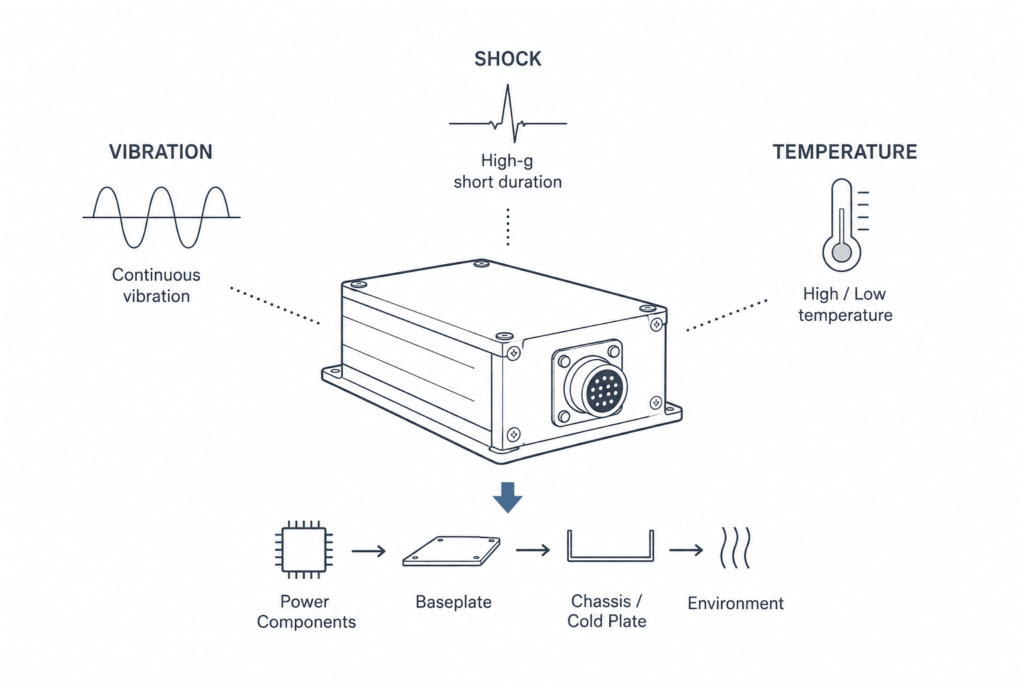
For power supplies and DC-DC converters, the standard is particularly relevant to areas such as Vibration, Shock, High Temperature, Low Temperature and Temperature Shock, although it actually covers a much broader range of environmental conditions.
It is particularly important to understand that MIL-STD-810 does not define a single uniform test that every power supply must pass.
The standard uses an Environmental Tailoring approach, in which test conditions are tailored to the environment in which the equipment is expected to operate. The U.S. Department of Defense also explicitly states that the standard does not, by itself, impose fixed design or test specifications, but rather provides processes and methods for developing realistic environmental requirements based on the intended application.
Therefore, the statement:
MIL-STD-810 Compliant
does not necessarily provide complete engineering information on its own.
When evaluating a military power supply, it is important to know which test methods were performed, under what conditions, at what severity levels and in what mounting configuration.
Why Is MIL-STD-810 Particularly Important for Power Supplies?
A power supply is an electronic system, but its ability to withstand environmental conditions depends to a large extent on its mechanical and thermal design.
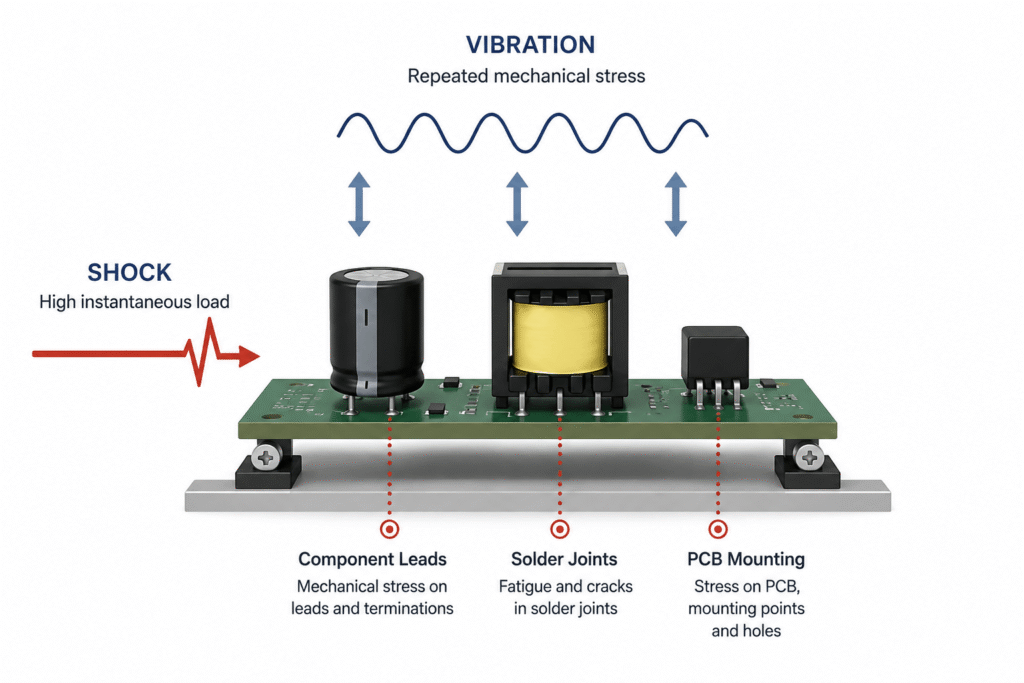
A power supply typically contains components with relatively significant mass, such as transformers, inductors, capacitors, power components, connectors and heat sinks. When the system is exposed to vibration or shock, mechanical forces act on these components, the PCB, solder joints and enclosure.
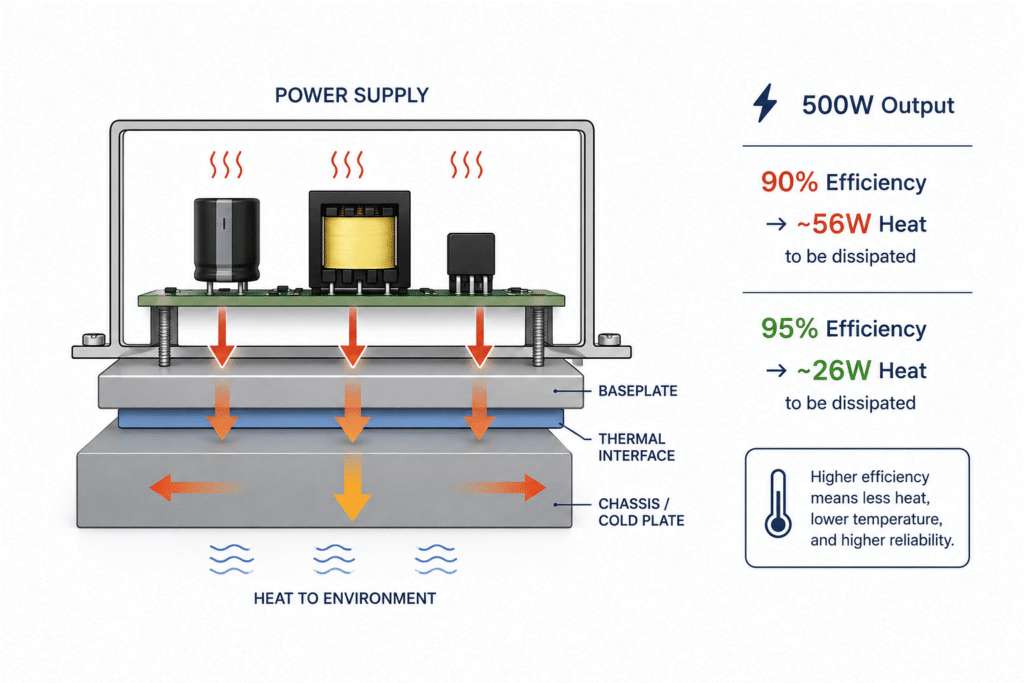
At the same time, the power supply must dissipate the heat generated by its internal power losses.
In many military systems, it is not possible to rely solely on natural airflow or a fan. Some power supplies therefore use Conduction Cooling, transferring heat to the baseplate and from there to the system chassis, a heat sink or a Cold Plate.
As a result, the mechanical and thermal design of a military power supply are closely interconnected.
The enclosure must be rigid enough to withstand Vibration and Shock, while in many designs it also forms part of the thermal path used to conduct heat away from the power supply.
This is one of the reasons why selecting a military power supply cannot be reduced to a single question:
What is the operating temperature range of the power supply?
It is also necessary to consider how the power supply is mounted, how heat is dissipated and what temperature applies at the relevant thermal reference point.
Three Key Areas: Vibration, Shock and Temperature
For power supply applications, environmental requirements can be considered in three key areas:
Vibration – Continuous or Repetitive Mechanical Vibration
Vibration generated by engines, road conditions, drive systems, propellers, motors or the structure of the platform itself.
Shock – Mechanical Shock
Short-duration, high-acceleration events that may occur, for example, during off-road operation, landing, mechanical impact, transportation or other platform-dependent events.
Temperature – Temperature and Thermal Management
The ability of the power supply to operate or survive at high and low temperatures while also safely dissipating the heat it generates internally.
These three areas are not independent of one another.
Vibration affects the mechanical design, the mechanical design affects how the power supply can be mounted to the system, and the mounting method directly affects both Conduction Cooling and the temperature of the power components.
For this reason, in a military power supply, Mechanical Design and Thermal Design should be considered as one integrated system.