In military systems, a power supply is required to do more than simply provide a stable voltage to the load.
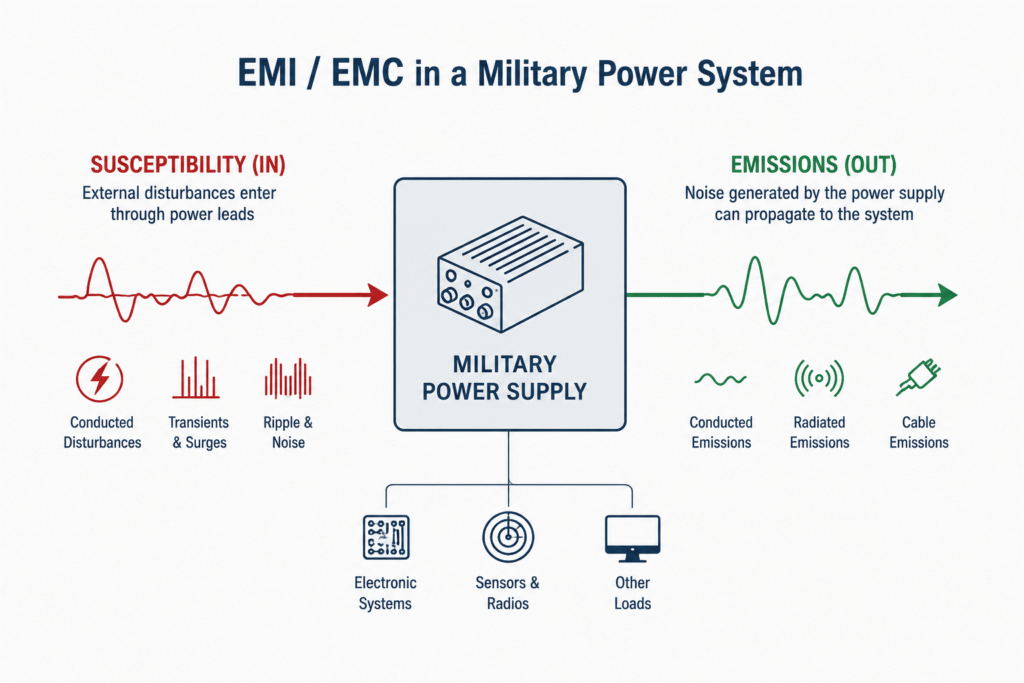
It operates within a complex electromagnetic environment, where disturbances can enter through power lines, cables, and the surrounding electromagnetic environment. At the same time, the power supply itself can generate interference that may affect other equipment in the system.
This is where MIL-STD-461 comes into play. It is one of the key military standards addressing EMI – Electromagnetic Interference and EMC – Electromagnetic Compatibility.
The standard addresses two main areas:
- Emissions – how much electromagnetic interference the equipment generates and propagates into its surroundings.
- Susceptibility – the ability of the equipment to continue operating properly when exposed to electromagnetic disturbances.
For power supplies and DC-DC converters, this is particularly important because the power lines form a two-way path: noise generated by the converter can propagate back into the power system, while disturbances from the power system can enter through the same lines and reach the power supply and its load.
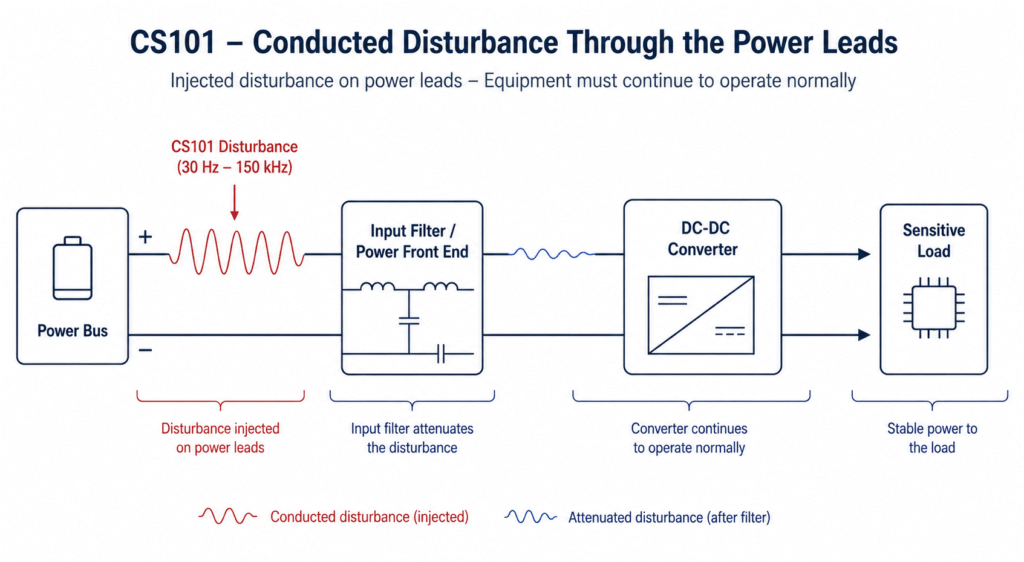
One of the important tests in this context is CS101 – Conducted Susceptibility, Power Leads, which evaluates the equipment’s ability to withstand disturbances coupled onto its input power leads.
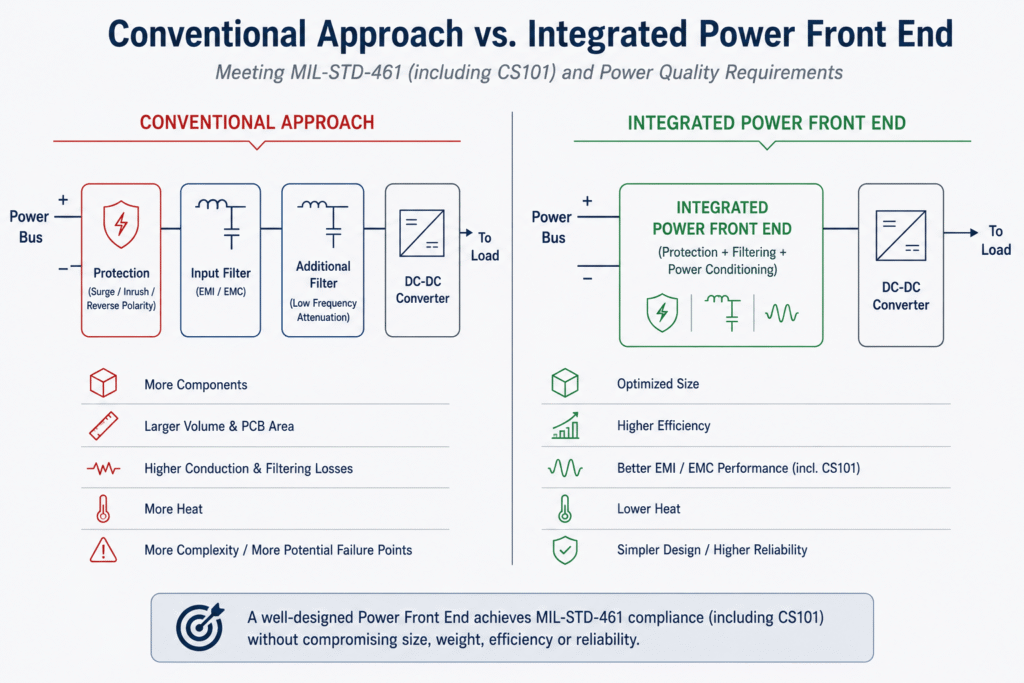
For power supply designers, CS101 can become a significant requirement in the design of the Input Filter and Power Front End. A conventional solution based simply on increasing the size of filtering components may come at the cost of additional volume, weight, power losses, and reduced efficiency.
Therefore, the engineering question is not only:
Does the power supply meet CS101?
But also:
How can CS101 compliance be achieved without making the Power Front End large, heavy, and inefficient?
This is exactly where proper Input Filtering and Power Front End design become a critical part of military power supply design.
What is MIL-STD-461?
MIL-STD-461 is a U.S. Department of Defense standard that defines requirements and test methods for controlling the EMI characteristics of electrical and electronic equipment and subsystems.
Unlike standards that focus primarily on power quality or environmental conditions, MIL-STD-461 focuses on the ability of equipment to operate within the electromagnetic environment of the system.
For a military power supply, therefore, it is not enough to ask:
Does it provide the required output voltage and power?
We must also ask:
Does it do so without interfering with other equipment, and does it continue to operate properly when exposed to external electromagnetic disturbances?
As of 2026, the latest revision of the standard is MIL-STD-461H, published in April 2026, which superseded MIL-STD-461G. However, existing systems and programs may still specify an earlier revision, so the applicable revision should always be determined by the specific project requirements.
EMI vs. EMC – What Is the Difference?
The two terms are closely related, but they are not the same.
EMI – Electromagnetic Interference refers to the electromagnetic interference itself.
For example, a switching DC-DC converter can generate noise due to its switching frequency and harmonics. This noise can propagate through the power lines or be radiated into the surrounding environment.
EMC – Electromagnetic Compatibility is the ability of equipment to operate properly within its electromagnetic environment without causing unacceptable interference to other equipment and without being excessively susceptible to external disturbances.
Simply put, a power supply with appropriate EMC performance needs to address both sides:
Do not interfere with other equipment – and continue operating when exposed to interference from other sources.