flagעברית
flagEnglish
3 Rabinovich St., Petah-Tikva, Israel
+972 3 9047744
office@amironic.co.il
Facebook
Twitter
LinkedIn
YouTube
  • Products
    • MEMS Inertial
      • Gyros & Accels
      • IMU
      • Inertial Navigation
      • AHRS
    • Circuit Breakers
      • Airpax Circuit Breakers
      • Electronic Circuit Breakers
      • Aircraft Circuit Breakers
      • Thermal Circuit Breakers
      • Sealing Solutions & Guards
    • Footswitches
      • Pedals & Bellows
      • USB
      • Air Switches
      • Medical
      • Modular Bases System
      • Industrial
      • Foot Potentiometers
      • Wireless
    • Mechanical & Transmisions
      • Gears
      • Sealing Solutions
      • Gearboxes
      • Couplings
      • Shafts & Bearings
      • Fasteners
      • Mechanical & Springs
      • Linear Motion
      • Anti-Vibration
    • Sensors
      • Thermostats
      • Temperature
      • Position
      • Pressure
      • Speed
      • Level Sensor
      • Load Cells
      • Flex Sensors
      • Membrane Potentiometer
    • Motors
      • Geared DC
      • Brushless DC
      • Step Motors with Gearbox
      • Torque Motors & Brushless Servo
      • AC Motors
      • DC Motors
    • Electronics
      • Xenon & IR Lamps
      • Counters & Meters
      • Microelectronics Packaging
      • Waterproof Switches
      • Micro Switches
    • Hand Control
      • Operator Controls (JOYSTICK)
      • Electrical
      • Pneumatic (Medical)
      • USB Hand Control
      • Air Push Button
      • Pressure Switch
      • IR Switch
    • Power Solutions
      • Rugged & Military Power Supply
      • Input Power Protection
      • Sealed Military Power Adaptor
      • Triple Output Military Power Supply Series – up to 250 W
    • Materials
      • Molybdenum and Advanced Alloys (TZM, MOLA, HCT)
      • Tungsten (Wolfram) and Advanced Alloys – High-Performance Materials for Extreme Conditions
      • Materials for Gears
  • Shop
  • Companies
  • About Amironic
  • News
  • Contact
Product was added to your cart

Cart

waze

Pneumatic Foot Bellows vs. Electrical Footswitch – Do You Really Need to Run Electricity to the Foot Pedal?

Footswitches06/07/2026amironicLTD

🧩 Further Reading

This article is part of a broader series exploring how footswitches function as critical human-machine control interfaces across medical and industrial systems. For additional technical context and application insights, you may also find the following articles useful:

  • HERGA Control Solutions: More Than a Footswitch – The Human Interface That Defines System Performance
  • HERGA Medical Footswitches: Engineering the Right Control Interface for Clinical Systems
  • HERGA Industrial Footswitches: Reliable Control Solutions for Harsh and High-Duty Environments
  • Pneumatic Footswitches in Medical and Aesthetic Equipment
  • Industrial Safety Footswitches: Reliable Machine Control for Heavy-Duty and High-Risk Environments
  • Wired vs Wireless (Bluetooth) Footswitches: When Does It Actually Matter?
  • Footswitches for Medical and Aesthetic Laser Systems – Not Just a Trigger, but a Critical Part of System Safety
  • Medical Footswitches for IEC / UL 60601-1 Systems – Safety, Reliability and Design Considerations Every Engineer Should Know
  • 6 Switching Technologies Every Systems Engineer Should Know – And How to Choose the Right One
  • Why Foot Switches Fail – And What Experienced OEM Designers Do Differently
Introduction

When engineers select a footswitch, they typically focus on parameters such as the number of contacts, current rating, IP protection level, switching configuration, or cable length.

In many cases, however, these are not the first questions that should be asked.

The more important question is:

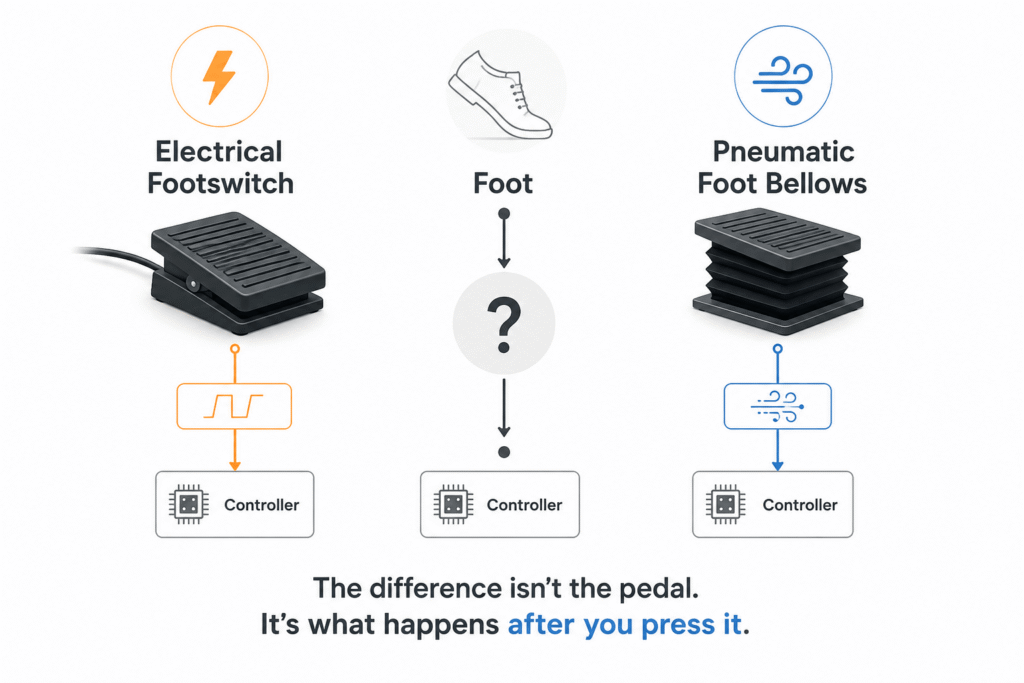
Do you really need to run electricity to the foot pedal?

This is the fundamental difference between an electrical footswitch and a pneumatic foot bellows.

Both solutions perform exactly the same function – the operator presses the pedal, and the system responds. Behind this seemingly simple action, however, are two completely different engineering approaches.

The choice affects far more than the type of pedal. It can influence operator safety, system reliability, immunity to electromagnetic interference (EMI), regulatory compliance, overall system architecture, and long-term performance.


If an Electrical Footswitch Works Perfectly, Why Was the Foot Bellows Developed?

It’s a fair question.

Electrical footswitches are reliable, simple, and have been used successfully for decades.

So why do manufacturers of medical equipment, laser systems, and other advanced devices continue to specify pneumatic foot bellows?

The answer is straightforward.

The issue is not that an electrical footswitch is unsafe.

The issue is that, in certain applications, the design objective is to eliminate electrical components entirely from the operator’s area.

When the goal is to keep all electrical circuitry away from the user, a pneumatic solution offers a completely different system architecture.

Instead of transmitting an electrical signal, it transmits air pressure.

In other words, the electrical contact does not disappear – it is simply relocated to another part of the system.


The Same Result – Two Completely Different Operating Principles

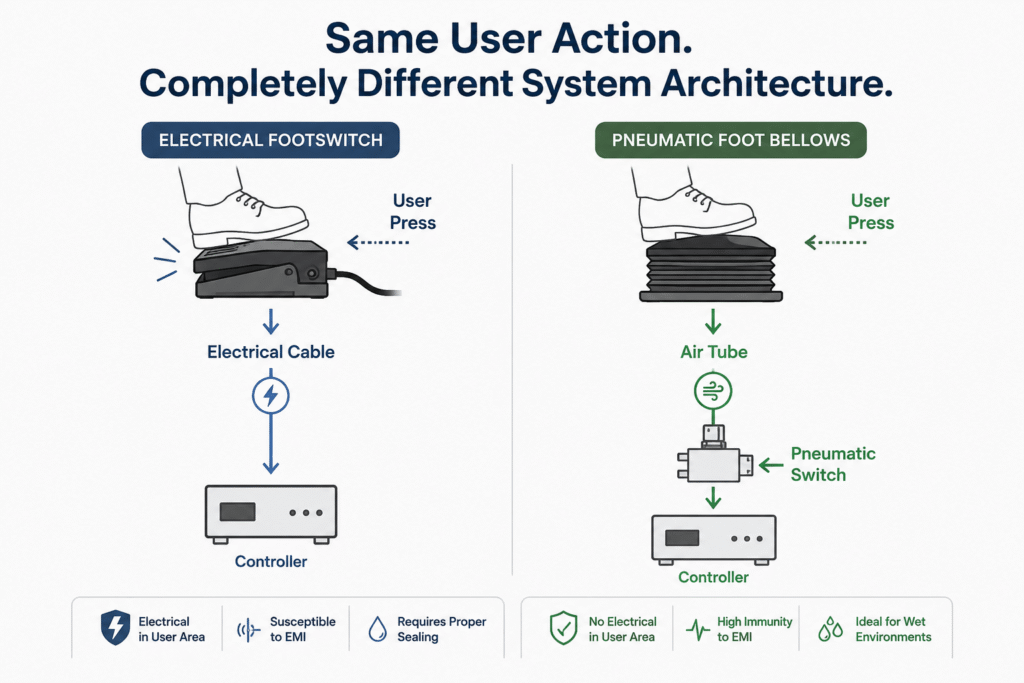
Electrical Footswitch

An electrical footswitch operates by opening or closing an electrical contact when the pedal is pressed.

The electrical signal is transmitted directly through a cable to the control system, just like any conventional electrical switch.

It is a simple, fast, and highly effective solution for a wide range of industrial and medical applications.

Pneumatic Foot Bellows

A pneumatic foot bellows contains no electrical contacts inside the pedal.

When the operator presses the bellows, a small volume of air is compressed, creating a pressure pulse inside a pneumatic tube.

At the opposite end of the tube, a pneumatic switch or pressure sensor converts that air pulse into an electrical signal for the control system.

As a result, there are no electrical components inside the foot pedal itself – only mechanical components and air.

This is the fundamental difference between the two technologies.


Comparing the Two Technologies

Feature Electrical Footswitch Pneumatic Foot Bellows
Signal transmission Electrical signal Air pressure
Electrical components inside the pedal Yes No
Electricity at the operator’s location Present None
EMI susceptibility Depends on system design Largely immune
Wet environment suitability Requires appropriate sealing Particularly well suited
High-voltage applications Requires careful design Significant advantage
Maintenance Low Very low
Response time Extremely fast Fast enough for the vast majority of applications

There Is No “Better” Solution

It is easy to assume that a pneumatic foot bellows is an upgrade over an electrical footswitch, or vice versa.

In reality, they are not competing technologies.

They are two different engineering solutions, each designed to solve a different design challenge.

The real question is not:

“Which footswitch is better?”

It is:

“Which technology is better suited to the application’s requirements?”


When Is an Electrical Footswitch the Right Choice?

For most industrial applications, there is no reason to avoid an electrical footswitch.

When there are no special electrical isolation requirements, no unusually sensitive equipment, and no demanding environmental conditions, an electrical footswitch provides a simple, reliable, and cost-effective solution.

This is why it is commonly used in CNC machines, assembly stations, automated production equipment, industrial machinery, and test systems.


When Does a Foot Bellows Offer a Real Advantage?

Some applications require more than simply activating a machine.

Their objective is to completely separate the operator from the electrical control system.

In these cases, transmitting the command through air rather than electricity simplifies the overall design while providing an inherent layer of electrical isolation.

Typical applications include:

  • Medical laser systems
  • Aesthetic laser equipment
  • Operating room equipment
  • Dental equipment
  • Medical devices
  • Wet environments
  • High-voltage systems
  • Equipment sensitive to electromagnetic interference (EMI)

Is a Foot Bellows Slower?

At first glance, transmitting a command using air pressure might appear slower than using an electrical contact.

In practice, this is rarely an issue.

The response time of a pneumatic foot bellows is extremely fast and fully suitable for the vast majority of medical and industrial applications.

For this reason, engineers typically select between the two technologies based on safety requirements, environmental conditions, and overall system architecture rather than response speed.


When Should You Not Use a Foot Bellows?

Like any engineering solution, a pneumatic foot bellows is not the right choice for every application.

If there is no need for electrical isolation, no challenging operating environment, and no requirement to separate the operator from the electrical circuitry, an electrical footswitch will generally be the simpler and more economical solution.

The objective is not to choose the technology that sounds more advanced, but the one that best fits the application’s engineering requirements.


It Is Not About “Old” Versus “New”

Some engineers assume that pneumatic foot bellows are an outdated technology that has largely been replaced by electrical footswitches.

In reality, the opposite is true.

Leading manufacturers of medical equipment continue to incorporate pneumatic foot bellows into newly developed systems.

Not because better alternatives are unavailable, but because, for certain applications, they remain the simplest, most elegant, and safest method of transferring an operator command.


Conclusion

An electrical footswitch and a pneumatic foot bellows may appear to perform exactly the same task.

In reality, they solve two fundamentally different engineering problems.

When the priority is a simple, direct, and cost-effective electrical interface, an electrical footswitch is typically the right choice.

When the objective is to completely remove electrical components from the operator’s area, improve immunity to electromagnetic interference, or meet stringent safety requirements, a pneumatic foot bellows offers a fundamentally different system architecture.

From the operator’s perspective, the action is identical – simply press the pedal.

From the engineer’s perspective, however, deciding whether that command is transmitted through an electrical contact or through air pressure is an architectural design decision that can significantly influence the safety, reliability, maintainability, and long-term performance of the entire system.

Case Study – When the Challenge Isn’t the Foot Pedal, but the System Architecture

The Application

A manufacturer developing a medical laser system selected the HERGA 6448-AAAB-0000 pneumatic Foot Bellows, supplied with a 2-meter tube and a 3 mm internal diameter, as the user interface for reliable foot-operated activation.

In the initial design, the pneumatic tube from the foot bellows was connected directly to the pneumatic switch located inside the equipment enclosure.

As the project progressed, however, the engineering team discovered that the location of the control assembly created several mechanical and serviceability constraints.


The Challenge

The system had to meet several design requirements simultaneously:

  • Completely isolate all electrical components from the operator’s area.
  • Maintain fast response time and consistent pedal feel.
  • Allow quick removal of the equipment cover during servicing.
  • Avoid disconnecting the entire pneumatic tube every time the enclosure was opened.

Although the direct tube connection functioned correctly, it complicated assembly, servicing, and future replacement of internal components.


The Solution

Instead of routing the pneumatic tube directly into the pneumatic switch, the engineers introduced a HERGA 6419-00 Bulkhead Connector as the interface between the external foot pedal and the internal pneumatic circuit.

The 6419-00 is specifically designed for 3 mm I.D. pneumatic tubing and incorporates a tube-locking mechanism that enables quick connection and disconnection while maintaining a reliable, leak-free interface.

This created a clear separation between the external and internal sections of the system.

Outside the enclosure

  • HERGA 6448-AAAB-0000 Foot Bellows
  • External pneumatic tube

Inside the enclosure

  • HERGA 6419-00 Bulkhead Connector
  • Short internal pneumatic tube
  • Pneumatic switch
  • Control electronics

With this architecture, all internal pneumatic connections remained permanently installed, while the foot pedal assembly could be disconnected or replaced without disturbing the internal control system.


Why Was This a Better Engineering Solution?

At first glance, adding another connector appears to increase system complexity.

In practice, it significantly improved the overall system architecture by providing:

  • A clear separation between external and internal pneumatic circuits.
  • Faster assembly and simplified servicing.
  • Foot pedal replacement without dismantling the control electronics.
  • Improved protection of the internal pneumatic tubing against mechanical stress.
  • A cleaner, more modular system design.

The Result

The system retained all the advantages of a pneumatic Foot Bellows:

  • No electrical components in the operator’s area.
  • Complete electrical isolation between the user and the control electronics.
  • Consistent pedal feel.
  • Response time fully suitable for the application.

At the same time, incorporating the HERGA 6419-00 Bulkhead Connector made the product easier to manufacture, assemble, service, and maintain – without changing the operator’s experience.


Engineering Takeaway

When designing pneumatic control systems, engineers often focus on selecting the foot pedal itself.

However, the overall performance, reliability, and serviceability of the system are also influenced by how the pneumatic tubing is routed and how the interfaces between external and internal components are designed.

In this project, the HERGA 6448-AAAB-0000 Foot Bellows was only one part of the solution.

The smaller HERGA 6419-00 Bulkhead Connector proved equally important, enabling a more serviceable, modular, and reliable system architecture without affecting the functionality experienced by the operator.

Frequently Asked Questions (FAQ)

Is a Foot Bellows safer than an electrical footswitch?

Not necessarily. Both solutions can be extremely safe when properly designed for the intended application. The main advantage of a Foot Bellows is that the pedal itself contains no electrical components. In systems where electrical isolation between the operator and the control electronics is required, this can be a significant design advantage.


Can a Foot Bellows replace an electrical footswitch in every application?

No. For most industrial applications, an electrical footswitch remains a simple, reliable, and cost-effective solution. A Foot Bellows is typically selected when the application requires electrical isolation, operation in wet environments, medical compliance, or improved immunity to electromagnetic interference (EMI).


Is a pneumatic system slower than an electrical one?

For the vast majority of applications, the difference is negligible. Pneumatic Foot Bellows systems provide response times that are fully suitable for medical and industrial equipment. In practice, the choice between the two technologies is usually driven by system requirements rather than switching speed.


Does a Foot Bellows require a compressed air supply?

No. A Foot Bellows operates by compressing a small volume of air inside the bellows and pneumatic tube. It does not require connection to a factory compressed air system or an external compressor.


Can a long pneumatic tube be used between the Foot Bellows and the pneumatic switch?

Yes, but the tube length, internal diameter, and total air volume influence the system’s characteristics. In some applications, these parameters should be selected carefully to achieve the desired response time and pedal feel.


Can a Foot Bellows be mounted inside equipment or integrated into a panel?

Yes. Depending on the model, a Foot Bellows can be used as a free-standing floor pedal or integrated into equipment using dedicated mounting accessories and connection hardware to suit the application.


Can the Foot Bellows be disconnected for maintenance?

Yes. Many systems incorporate Bulkhead Connectors, such as the HERGA 6419-00, allowing the Foot Bellows to be disconnected without dismantling the internal pneumatic tubing or the control electronics. This simplifies servicing and improves system maintainability.


What is the most important consideration when choosing between a Foot Bellows and an electrical footswitch?

The key consideration is not the pedal itself, but the overall system architecture. If the application simply requires an electrical signal to be sent directly to the controller, an electrical footswitch is often the most appropriate solution. If the design requires complete electrical isolation between the operator and the control circuitry, a Foot Bellows may be the better engineering choice.

Tags: Herga

Related Articles

Ensuring spa safety and comfort with pneumatic, air and pressure switches

03/03/2025amironicLTD

The 6773 Double Diaphragm Pressure Switch from HergaPrecision, Safety, and Reliability in Coffee Machines

27/02/2025amironicLTD

The Role of Vacuum Switches in Fume Extraction Systems

25/02/2025amironicLTD

Recent Posts

  • Pneumatic Foot Bellows vs. Electrical Footswitch – Do You Really Need to Run Electricity to the Foot Pedal?
  • The Gearbox Isn’t the Problem – It’s Simply the First to Pay for Design Mistakes
  • Your Image Still Shakes Despite Choosing a Gyroscope with Excellent Bias Stability
  • Circuit Breaker or Control Device? Why Military Circuit Breakers Do More Than Protect
  • Measuring Pressure Without Temperature Is Only Half the Picture

Categories

  • Air Switch
  • Circuit Breakers
  • Elapsed Time Indicator
  • Feedthrough
  • Footswitches
  • Gears & Transmission
  • Hour Meters
  • Infra Red Switches
  • INFRARED LAMPS
  • Low Noise Inertial MEMS
  • Mechanics
  • MEMS Gyroscope
  • MEMS Inertial
  • Microelectronics
  • Motors
  • Position Sensors
  • Power Supply
  • Pressure Sensors
  • Pressure Switch
  • Temperature Sensors
  • Tungsten and Molybdenum
  • Uncategorized
  • Vacuum Switches

Quick Contact

Fill out the form and our representatives will return to you

    Name (required)

    Email (required)

    Phone

    Message

    This site is protected by reCAPTCHA and the Google
    Privacy Policy and
    Terms of Service apply.

    Amironic Ltd.

    3 Rabinovich Street, Petah Tikva 4928144 , Israel. Tel: +972-3-9047744 E-mail: office@amironic.co.il
    Email
    Facebook
    Twitter
    LinkedIn
    YouTube
    Press on the ISO Certificate below for download
    ISO 9001:2015 Certification
    • MEMS Inertial
    • Circuit Breakers
    • Footswitches
    • Mechanical & Transmisions
    • Sensors
    • Motors
    • Electronics
    • Hand Control
    • Power Solutions

    News

    • Pneumatic Foot Bellows vs. Electrical Footswitch – Do You Really Need to Run Electricity to the Foot Pedal?
    • The Gearbox Isn’t the Problem – It’s Simply the First to Pay for Design Mistakes
    • Your Image Still Shakes Despite Choosing a Gyroscope with Excellent Bias Stability
    • Circuit Breaker or Control Device? Why Military Circuit Breakers Do More Than Protect
    • Measuring Pressure Without Temperature Is Only Half the Picture
    About AmironicContactעברית
    © 2022 Amironic All rights reserved. All Trademarks are the property of their respective owners.
    • Increase Font
    • Decrease Font
    • Black & White
    • Inverse Colors
    • Highlight Links
    • Regular Font
    • Reset