


- MIL-PRF-39019 Circuit Breakers: Selection, Trip Curves, and Aerospace Power Protection
- Why M39019 Is Not Just a Standard – It’s an Identity
- Understanding Trip Curves in Hydraulic-Magnetic Circuit Breakers
- Power Protection in Military Ground Platforms: Electrical Stability Under Vibration, Shock, and 28V Vehicle Systems
- The Airpax AP Series: The Engineering Logic Behind a Hydraulic-Magnetic Circuit Breaker That Became a Military Standard
- Hydraulic-Magnetic vs Thermal Circuit Breakers
- Airpax IULN and IUGN Circuit Breakers: Sealed Hydraulic-Magnetic Protection for Rugged Electronic Systems
- How Engineers Choose Between Airpax AP, IUL, IUG, and Commercial Circuit Breakers
- SNAPAK Circuit Protectors: When Circuit Protection Becomes a User Interface
- DIN Rail Circuit Breakers – Why Industrial Systems Demand More Than a Standard MCB
- Why MIL-PRF-39019 Circuit Breakers Still Appear in New Defense Programs
- Why a 10A Circuit Breaker Is Not Always Suitable for a 10A Load
- Keeping Data Centers Running: The Role of Circuit Protection
| Step | Action |
|---|---|
| 1 | Mission Computer / PLC sends a 24VDC Trip Command |
| 2 | The Shunt Trip Coil mechanically trips the circuit breaker |
| 3 | The 3-Pole Hydraulic-Magnetic Circuit Breaker disconnects the 28VDC Bus |
| 4 | Power to the Critical Loads is removed |
| 5 | The Auxiliary Contact sends breaker status feedback to the Mission Computer |
Case Study – Emergency Power Isolation in a 28VDC Military Vehicle System
The Application
A military vehicle’s electronic subsystem distributed 28VDC power to several mission-critical loads through a 3-pole, 40A hydraulic-magnetic circuit breaker.
The system design required:
- Overcurrent protection
- Remote power disconnect in the event of a fault
- Positive confirmation that power had actually been removed before maintenance or subsequent system operations
The Challenge
In the original design, an Emergency Stop command deactivated all loads by opening several power relays.
From the software’s perspective, the system was OFF.
However, the primary 28VDC power source remained connected.
For a mission-critical military platform, this was not sufficient. During maintenance, troubleshooting, or emergency shutdown procedures, engineers needed to ensure that the power source itself was physically disconnected—not merely that the loads had stopped operating.
In addition, the mission computer required positive confirmation that power had actually been isolated before allowing the system to transition into maintenance mode or continue with the next operational sequence.
The Solution
Rather than relying solely on power relays, the design incorporated a 3-pole, 40A hydraulic-magnetic circuit breaker equipped with:
- 24VDC Shunt Trip
- Auxiliary Contact
When a fault condition was detected or an Emergency Stop was activated, the mission computer energized the 24VDC Shunt Trip.
The breaker immediately opened all three poles, physically disconnecting the 28VDC power bus from the downstream loads.
Once the breaker reached the open position, the Auxiliary Contact changed state and provided positive status feedback to the mission computer.
Only after receiving this confirmation did the control software allow the system to proceed to maintenance mode or continue the programmed shutdown sequence.
The Results
- Physical isolation of the 28VDC power source
- Remote breaker operation directly from the control system
- Positive confirmation of breaker status through the Auxiliary Contact
- Improved maintenance safety and system reliability
- Integration of the circuit breaker as an active component of the control architecture rather than solely an overcurrent protection device
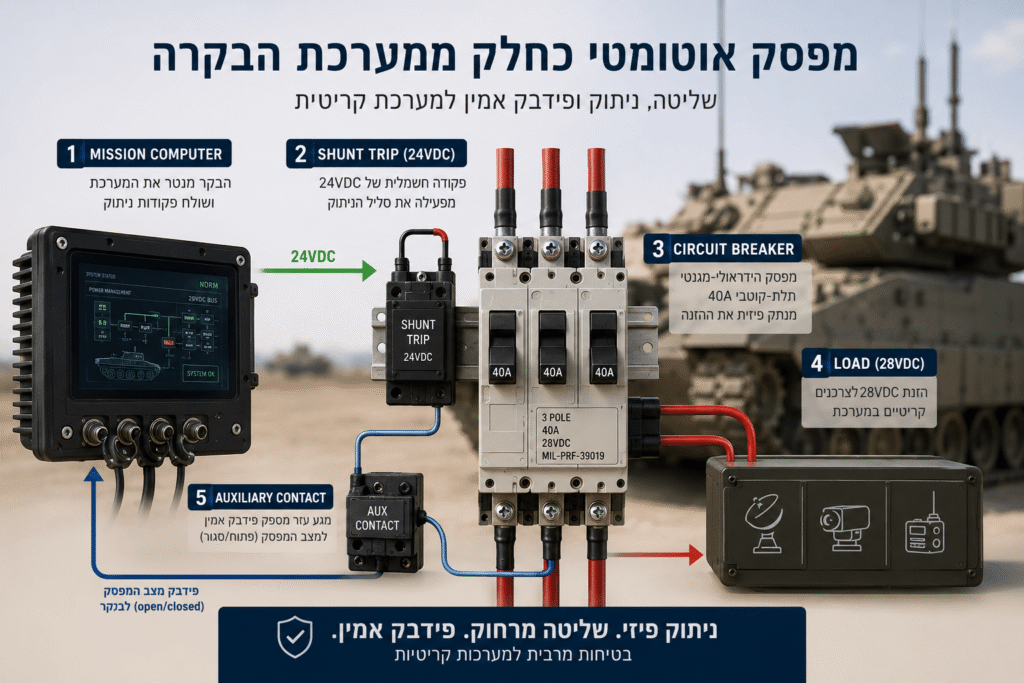
How Does a Circuit Breaker Become Part of the Control System?
The diagram illustrates the operating principle of a typical control architecture. The Mission Computer or PLC sends a 24VDC control signal to the Shunt Trip coil, causing the circuit breaker to open and physically disconnect power from the downstream loads.
At the same time, the Auxiliary Contact provides mechanical position feedback (Open/Closed) to the controller, allowing the control system to verify the actual status of the breaker rather than relying solely on the command that was issued.
This creates a closed-loop control system, where the circuit breaker serves not only as an overcurrent and short-circuit protection device, but also as an active component of the system’s control and safety architecture.
💡 In Simple Terms
- The controller sends a trip command.
- The circuit breaker physically disconnects power.
- The Auxiliary Contact confirms that the breaker has actually opened.
That is the difference between a system that assumes the circuit has been disconnected and one that knows it has.
Frequently Asked Questions (FAQ)
Does a Shunt Trip replace overcurrent protection?
No. A Shunt Trip is designed to intentionally trip the circuit breaker in response to an external control signal. Protection against overloads and short circuits continues to be provided by the breaker’s internal protection mechanism.
Can a Shunt Trip be used as part of an Emergency Stop system?
Yes. In many applications, the Emergency Stop (E-Stop) function energizes the Shunt Trip, causing the circuit breaker to physically disconnect the power source rather than simply stopping the control logic.
What is the purpose of an Auxiliary Contact?
An Auxiliary Contact provides mechanical position feedback indicating whether the circuit breaker is open or closed. This allows the control system to verify the actual status of the breaker instead of relying solely on the command that was issued.
Why isn’t a relay or contactor sufficient?
Relays and contactors are primarily designed for switching electrical loads. They do not replace a circuit breaker, which provides both overcurrent protection and the ability to safely isolate the circuit when required.
Can a circuit breaker include both a Shunt Trip and an Auxiliary Contact?
Yes. Many circuit breakers can be equipped with both accessories, allowing them to be remotely tripped while simultaneously providing reliable status feedback to the control system.
Where is this type of solution commonly used?
Applications include military vehicles, armored platforms, naval systems, aerospace equipment, communications systems, EO/IR systems, robotic platforms, and any application requiring a combination of circuit protection, remote operation, and reliable status feedback.
Can a Shunt Trip open the breaker even when there is no overcurrent?
Yes. That is precisely its purpose. Energizing the Shunt Trip causes the circuit breaker to open regardless of the load current, in response to a command from the control system.
Does the Auxiliary Contact carry the load current?
No. An Auxiliary Contact is a low-power signaling contact intended for status indication to a PLC, mission computer, or other control system. It is not designed to carry the main load current.