flagעברית
flagEnglish
3 Rabinovich St., Petah-Tikva, Israel
+972 3 9047744
office@amironic.co.il
Facebook
Twitter
LinkedIn
YouTube
  • Products
    • MEMS Inertial
      • Gyros & Accels
      • IMU
      • Inertial Navigation
      • AHRS
    • Circuit Breakers
      • Airpax Circuit Breakers
      • Electronic Circuit Breakers
      • Aircraft Circuit Breakers
      • Thermal Circuit Breakers
      • Sealing Solutions & Guards
    • Footswitches
      • Pedals & Bellows
      • USB
      • Air Switches
      • Medical
      • Modular Bases System
      • Industrial
      • Foot Potentiometers
      • Wireless
    • Mechanical & Transmisions
      • Gears
      • Sealing Solutions
      • Gearboxes
      • Couplings
      • Shafts & Bearings
      • Fasteners
      • Mechanical & Springs
      • Linear Motion
      • Anti-Vibration
    • Sensors
      • Thermostats
      • Temperature
      • Position
      • Pressure
      • Speed
      • Level Sensor
      • Load Cells
      • Flex Sensors
      • Membrane Potentiometer
    • Motors
      • Geared DC
      • Brushless DC
      • Step Motors with Gearbox
      • Torque Motors & Brushless Servo
      • AC Motors
      • DC Motors
    • Electronics
      • Xenon & IR Lamps
      • Counters & Meters
      • Microelectronics Packaging
      • Waterproof Switches
      • Micro Switches
    • Hand Control
      • Operator Controls (JOYSTICK)
      • Electrical
      • Pneumatic (Medical)
      • USB Hand Control
      • Air Push Button
      • Pressure Switch
      • IR Switch
    • Power Solutions
      • Rugged & Military Power Supply
      • Input Power Protection
      • Sealed Military Power Adaptor
      • Triple Output Military Power Supply Series – up to 250 W
    • Materials
      • Molybdenum and Advanced Alloys (TZM, MOLA, HCT)
      • Tungsten (Wolfram) and Advanced Alloys – High-Performance Materials for Extreme Conditions
      • Materials for Gears
  • Shop
  • Companies
  • About Amironic
  • News
  • Contact
Product was added to your cart

Cart

waze

Why Foot Switches Fail – And What Experienced OEM Designers Do Differently

Footswitches29/06/2026amironicLTD

🧩 Further Reading

This article is part of a broader series exploring how footswitches function as critical human-machine control interfaces across medical and industrial systems. For additional technical context and application insights, you may also find the following articles useful:

  • HERGA Control Solutions: More Than a Footswitch – The Human Interface That Defines System Performance
  • HERGA Medical Footswitches: Engineering the Right Control Interface for Clinical Systems
  • HERGA Industrial Footswitches: Reliable Control Solutions for Harsh and High-Duty Environments
  • Pneumatic Footswitches in Medical and Aesthetic Equipment
  • Industrial Safety Footswitches: Reliable Machine Control for Heavy-Duty and High-Risk Environments
  • Wired vs Wireless (Bluetooth) Footswitches: When Does It Actually Matter?
  • Footswitches for Medical and Aesthetic Laser Systems – Not Just a Trigger, but a Critical Part of System Safety
  • Medical Footswitches for IEC / UL 60601-1 Systems – Safety, Reliability and Design Considerations Every Engineer Should Know
  • 6 Switching Technologies Every Systems Engineer Should Know – And How to Choose the Right One
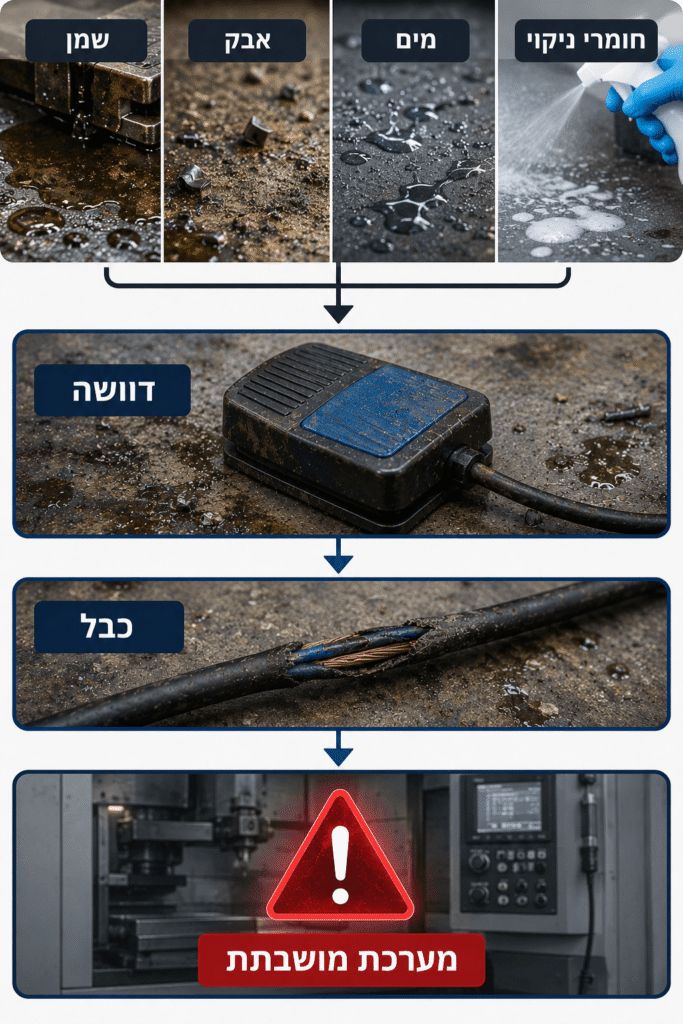
When a System Fails, the Foot Switch Is Rarely the First Suspect

A machine stops working.

The first instinct is to check the controller.

Then the electronics.

Perhaps the sensor.

Or the software.

The foot switch?

It’s usually one of the last components anyone suspects.

And that’s exactly the problem.

Not because it’s an insignificant component—but because it looks deceptively simple. In reality, a foot switch is often one of the hardest-working parts of the entire system.

Over the years, we’ve supported numerous OEM projects where engineers initially investigated almost every other component, only to discover that the root cause was the foot switch – or, more commonly, its cable or application-specific configuration.

It Looks Simple. In Reality, It Works Harder Than Almost Any Other Component.

At first glance, a foot switch appears to be one of the simplest components in a machine.

Press the pedal.

The system responds.

Release it.

The operation stops.

Simple.

Except it isn’t.

Throughout its service life, a foot switch may be expected to withstand:

  • Millions of operating cycles
  • Daily dragging across concrete floors
  • Repeated use with safety boots or heavy footwear
  • Accidental impacts from carts and mobile equipment
  • Exposure to water, oils, dust and cleaning chemicals
  • Thousands of cable bending cycles

Few components combine continuous mechanical stress, harsh environmental exposure and constant human interaction to the same extent.

This is why a foot switch should never be considered “just another switch.” It is one of the most critical human-machine interface (HMI) components in the entire system.


The Surprising Truth: In Many Cases, the Switch Isn’t the Problem

When a foot switch stops working, the natural assumption is that the internal switch mechanism has failed.

Surprisingly, this is often not the case.

After supporting OEMs across medical, industrial and laboratory applications, we’ve repeatedly seen failures caused by factors outside the switching mechanism itself.

Typical examples include:

  • Cable fatigue after thousands of flexing cycles
  • Damage around the cable entry due to repeated pulling
  • Seal degradation caused by aggressive cleaning agents
  • Moisture ingress because the enclosure was not suited to the operating environment
  • A foot switch selected for an application beyond its intended mechanical duty

In other words, replacing the foot switch may solve the symptom while leaving the real engineering issue unresolved.


A Common Engineering Mistake

Engineering teams typically spend weeks—or even months—selecting the controller, power supply, sensors, communication interfaces and software architecture.

Then comes the foot switch.

The discussion often focuses on only three questions:

  • How many contacts?
  • What electrical rating?
  • How much does it cost?

Unfortunately, the questions that matter most are often overlooked.

For example:

  • Will it survive one million operating cycles?
  • Is the cable designed for continuous movement?
  • Are the seals compatible with the cleaning chemicals used in this application?
  • Will operators be wearing gloves or safety boots?
  • Is accidental activation a safety concern?
  • Could a wireless solution improve ergonomics or workflow?

These are the questions that determine whether the foot switch will still be operating reliably five years from now.


There Is No “Best” Foot Switch

One of the most common misconceptions is that there is a universal solution.

There isn’t.

A foot switch designed for a medical laser system is unlikely to be the ideal choice for a CNC machining centre.

Likewise, a pedal that performs perfectly in a clean laboratory may have a significantly shorter service life on a production floor exposed to oil, metal chips and coolant.

Conversely, an industrial heavy-duty pedal may not offer the ergonomics, hygiene characteristics or regulatory compliance required for medical equipment.

The objective is therefore not to find the best foot switch.

It is to select the right foot switch for the application.


Don’t Select Only the Pedal. Select the Cable Too.

One component is consistently underestimated.

The cable.

Ironically, it often determines the long-term reliability of the entire assembly.

Before selecting a foot switch, engineers should also consider:

  • Is the cable jacket compatible with oils or chemicals?
  • Will it withstand repeated cleaning and disinfectants?
  • Is it designed for continuous flexing?
  • Does it incorporate proper strain relief?
  • Is the cable length suitable for the operator’s workstation?

The cable should never be viewed as an accessory.

It is an integral part of the foot switch’s reliability.


Why Does HERGA Offer So Many Different Foot Switches?

Engineers occasionally ask why manufacturers such as HERGA Technology offer such an extensive range of foot switches.

The answer is straightforward.

Because no two applications are identical.

Different systems require different combinations of:

  • Momentary or maintained operation
  • Single, dual or multiple pedals
  • Safety guards against accidental activation
  • Medical approvals
  • High ingress protection (IP)
  • Special cable constructions
  • Wireless Bluetooth® operation
  • Pneumatic switching instead of electrical contacts

The broad HERGA portfolio is not about offering more products.

It is about enabling engineers to select the most appropriate solution for the environment, the operator and the application.


Real-World Examples

Medical Laser Equipment

Foot switches may be activated thousands of times every day while also being cleaned repeatedly with aggressive disinfectants. Even when the internal switch remains fully operational, unsuitable cable materials or sealing systems can significantly reduce product life.

Industrial Manufacturing

On factory floors, foot switches are routinely dragged across concrete, exposed to oils and metal chips, and operated with heavy safety footwear. Under these conditions, cable fatigue and strain relief failures often occur long before the switching mechanism itself wears out.

Laboratory and Test Equipment

Testing systems demand consistent pedal feel and repeatable operation over many years. Even minor mechanical wear can affect operator confidence and process repeatability.

OEM Equipment

Selecting a foot switch based solely on electrical specifications may satisfy the initial design requirements. However, long-term reliability depends equally on mechanical durability, ergonomics, cable design, environmental resistance and suitability for the intended application.


Conclusion

A foot switch may be one of the smallest components in a system.

Yet it is often one of the hardest-working.

To the end user, the distinction between the machine and the foot switch simply doesn’t exist.

If the pedal fails, the machine has failed.

The good news is that most of these failures are preventable.

Not by selecting the most expensive foot switch—but by selecting the right one.

By considering the application, operating environment, cable design, mechanical duty and user interaction at the beginning of the design process, engineers can significantly improve long-term system reliability while reducing maintenance costs and unexpected downtime.

Engineering Lessons from Real-World Applications

Medical Laser Systems – Not Every Material Can Withstand Disinfectants

In medical laser equipment, foot switches may be actuated hundreds or even thousands of times every day. Between patients, they are routinely cleaned using disinfectants and aggressive cleaning agents.

If the sealing materials, cable jacket or enclosure plastics are not designed for this environment, premature wear can occur—even when the internal switching mechanism remains fully functional.

Engineering Lesson:
Ingress protection (IP) is only part of the equation. Material compatibility with the actual cleaning agents used in daily operation is equally important for long-term reliability.


Industrial CNC Machinery – The Cable Often Fails Before the Switch

On a production floor, foot switches are continuously dragged across concrete, operated with heavy safety footwear and exposed to oils, metal chips and coolant.

In many cases, the first point of failure is not the switching mechanism itself, but the cable or cable entry.

Engineering Lesson:
In demanding industrial environments, cable construction and strain relief are just as critical as the switch mechanism itself.


Laboratory & Test Equipment – Reliability Includes Consistent Feel

Laboratory automation and test systems often require thousands of precise actuations every day.

Even if the switch continues to function electrically, changes in pedal feel, mechanical wear or inconsistent actuation force can affect operator confidence and process repeatability.

Engineering Lesson:
A reliable foot switch should not only continue working—it should continue operating with the same feel and consistency throughout its service life.


OEM Equipment – Meeting the Specification Isn’t Always Enough

During product development, engineers often select a foot switch that satisfies the electrical specification and project budget.

Only after the equipment enters daily operation do other factors become apparent: cable durability, environmental resistance, ergonomics and mechanical robustness.

Engineering Lesson:
The right foot switch is selected based on the application—not solely on electrical ratings or purchase price.


Medical Equipment – Preventing Accidental Activation

In fast-paced clinical environments, accidental activation can occur when operators or equipment unintentionally contact the pedal.

For certain applications, features such as protective guards, recessed pedal designs or different actuation concepts can significantly reduce this risk.

Engineering Lesson:
Sometimes a simple mechanical design feature contributes more to system safety than additional electronic controls.


The Common Theme

Although these examples represent very different applications, they all illustrate the same engineering principle.

The issue was not that the foot switch was poorly manufactured.

The issue was that it was not the right foot switch for the application.

This is precisely why companies such as HERGA Technology offer such a broad range of foot switch solutions. Different environments require different mechanical designs, cable constructions, sealing systems, operating forces and switching technologies.

Selecting the right foot switch begins with understanding the application—not simply choosing a part number.


The Good News

The vast majority of these failures are preventable.

Not by selecting the most expensive foot switch.

But by selecting the right foot switch.

When the application, operating environment, cable design, sealing system and installation method are considered from the beginning of the design process, engineers can significantly improve long-term reliability, reduce maintenance costs and minimise unexpected downtime.

Frequently Asked Questions (FAQ)

Can any foot switch be used in any application?

No. A foot switch should be selected based on the application, operating environment, safety requirements, expected duty cycle and user interaction. A switch that performs perfectly in a laboratory may not be suitable for a CNC machine or a medical laser system.


What is the most common cause of foot switch failure?

Surprisingly, it is not always the switching mechanism itself.

Many failures are caused by cable fatigue, damage around the cable entry, seal degradation, moisture ingress or selecting a foot switch that was not designed for the actual operating environment.


Is an IP67 rating enough?

Not necessarily.

An IP rating indicates protection against dust and water under defined test conditions. It does not guarantee resistance to disinfectants, oils, coolants or aggressive cleaning chemicals commonly found in medical and industrial environments.


When should I choose a pneumatic foot switch?

Pneumatic foot switches are often the preferred solution when electrical contacts should be kept away from the operator or when safety, hygiene or regulatory requirements make pneumatic actuation the better choice.


When is Bluetooth® a better choice than a wired foot switch?

Wireless foot switches can improve ergonomics, eliminate cable wear and reduce trip hazards.

However, they are not suitable for every application. Battery management, wireless interference, response time and regulatory requirements should all be considered during system design.


Is the cable really as important as the foot switch itself?

Absolutely.

In many applications, the cable is the first component exposed to continuous movement, pulling, twisting and harsh environmental conditions. Selecting the correct cable construction is often just as important as selecting the foot switch itself.


How long should a foot switch last?

There is no single answer.

Service life depends on operating cycles, mechanical loading, environmental conditions, cable design, maintenance and selecting the right product for the application.

A properly specified industrial or medical foot switch should provide many years of reliable service.


Should I select a foot switch based only on its electrical specification?

No.

Electrical ratings represent only one part of the selection process.

Mechanical durability, ergonomics, ingress protection, cable construction, environmental resistance, operator safety and long-term reliability are equally important.


Not Sure Which Foot Switch Is Right for Your Application?

Before requesting a quotation, try answering the following questions:

  • What type of equipment is the foot switch intended for?
  • How many operating cycles are expected per day?
  • Will it be exposed to water, oils, dust, coolants or disinfectants?
  • Will operators wear gloves or safety footwear?
  • Are medical, industrial or other regulatory approvals required?
  • Would a wired, wireless (Bluetooth®) or pneumatic solution be most appropriate?
  • Is accidental activation a safety concern?
  • Does the application require a specific cable type, connector or ingress protection rating?

The more information available during the design stage, the easier it becomes to select the most suitable HERGA foot switch for long-term reliability and performance.

Tags: Herga

Related Articles

New Ultra-Low-Profile Electric Footswitch Offers Improved Operator Comfort

23/08/2016amironicLTD

6 Switching Technologies Every Systems Engineer Should Know – And How to Choose the Right One

17/06/2026amironicLTD

HERGA Medical Footswitches: Engineering the Right Control Interface for Clinical Systems

18/02/2026amironicLTD

Recent Posts

  • Why Foot Switches Fail – And What Experienced OEM Designers Do Differently
  • Why the Number of Starts in a Worm Gear Matters More Than the Gear Ratio
  • SX3: Pushing MEMS Beyond Traditional Stabilization
  • Keeping Data Centers Running: The Role of Circuit Protection
  • 6 Switching Technologies Every Systems Engineer Should Know – And How to Choose the Right One

Categories

  • Air Switch
  • Circuit Breakers
  • Elapsed Time Indicator
  • Feedthrough
  • Footswitches
  • Gears & Transmission
  • Infra Red Switches
  • INFRARED LAMPS
  • Low Noise Inertial MEMS
  • Mechanics
  • MEMS Gyroscope
  • MEMS Inertial
  • Microelectronics
  • Motors
  • Position Sensors
  • Power Supply
  • Pressure Sensors
  • Pressure Switch
  • Temperature Sensors
  • Tungsten and Molybdenum
  • Uncategorized
  • Vacuum Switches

Quick Contact

Fill out the form and our representatives will return to you

    Name (required)

    Email (required)

    Phone

    Message

    This site is protected by reCAPTCHA and the Google
    Privacy Policy and
    Terms of Service apply.

    Amironic Ltd.

    3 Rabinovich Street, Petah Tikva 4928144 , Israel. Tel: +972-3-9047744 E-mail: office@amironic.co.il
    Email
    Facebook
    Twitter
    LinkedIn
    YouTube
    Press on the ISO Certificate below for download
    ISO 9001:2015 Certification
    • MEMS Inertial
    • Circuit Breakers
    • Footswitches
    • Mechanical & Transmisions
    • Sensors
    • Motors
    • Electronics
    • Hand Control
    • Power Solutions

    News

    • Why Foot Switches Fail – And What Experienced OEM Designers Do Differently
    • Why the Number of Starts in a Worm Gear Matters More Than the Gear Ratio
    • SX3: Pushing MEMS Beyond Traditional Stabilization
    • Keeping Data Centers Running: The Role of Circuit Protection
    • 6 Switching Technologies Every Systems Engineer Should Know – And How to Choose the Right One
    About AmironicContactעברית
    © 2022 Amironic All rights reserved. All Trademarks are the property of their respective owners.
    • Increase Font
    • Decrease Font
    • Black & White
    • Inverse Colors
    • Highlight Links
    • Regular Font
    • Reset