flagעברית
flagEnglish
3 Rabinovich St., Petah-Tikva, Israel
+972 3 9047744
office@amironic.co.il
Facebook
Twitter
LinkedIn
YouTube
  • Products
    • MEMS Inertial
      • Gyros & Accels
      • IMU
      • Inertial Navigation
      • AHRS
    • Circuit Breakers
      • Airpax Circuit Breakers
      • Electronic Circuit Breakers
      • Aircraft Circuit Breakers
      • Thermal Circuit Breakers
      • Sealing Solutions & Guards
    • Footswitches
      • Pedals & Bellows
      • USB
      • Air Switches
      • Medical
      • Modular Bases System
      • Industrial
      • Foot Potentiometers
      • Wireless
    • Mechanical & Transmisions
      • Gears
      • Sealing Solutions
      • Gearboxes
      • Couplings
      • Shafts & Bearings
      • Fasteners
      • Mechanical & Springs
      • Linear Motion
      • Anti-Vibration
    • Sensors
      • Thermostats
      • Temperature
      • Position
      • Pressure
      • Speed
      • Level Sensor
      • Load Cells
      • Flex Sensors
      • Membrane Potentiometer
    • Motors
      • Geared DC
      • Brushless DC
      • Step Motors with Gearbox
      • Torque Motors & Brushless Servo
      • DC Motors
    • Electronics
      • Xenon & IR Lamps
      • Counters & Meters
      • Microelectronics Packaging
      • Waterproof Switches
      • Micro Switches
    • Hand Control
      • Operator Controls (JOYSTICK)
      • Electrical
      • Pneumatic (Medical)
      • USB Hand Control
      • Air Push Button
      • Pressure Switch
      • IR Switch
    • Power Solutions
      • Rugged & Military Power Supply
      • Input Power Protection
      • Sealed Military Power Adaptor
      • Triple Output Military Power Supply Series – up to 250 W
    • Materials
      • Molybdenum and Advanced Alloys (TZM, MOLA, HCT)
      • Tungsten (Wolfram) and Advanced Alloys – High-Performance Materials for Extreme Conditions
      • Materials for Gears
  • Shop
  • Companies
  • About Amironic
  • News
  • Contact
Product was added to your cart

Cart

waze

Standards for Power Supplies and DC-DC Converters – A Guide to Military, Aerospace, and Automotive Applications

Power Supply10/09/2026amironicLTD

Selecting a power supply or DC-DC converter is not simply a matter of input voltage, output voltage, and power rating.

In military, aerospace, and automotive systems, the power source itself is part of the system’s operating environment. Power lines may be exposed to voltage spikes, voltage dips, conducted disturbances, electrical noise, and short-duration transients. At the same time, the equipment may be required to meet EMC, temperature, vibration, shock, and in some cases lightning and other harsh environmental requirements.

This is why different standards exist for different operating environments.

MIL-STD-1275 addresses the electrical environment of military vehicles, MIL-STD-704 defines aircraft electric power characteristics, MIL-STD-461 covers EMI/EMC requirements for military equipment, and MIL-STD-810 addresses environmental conditions and testing.

In civil and commercial aviation, RTCA DO-160 is widely used, while automotive applications may involve standards such as ISO 16750, ISO 7637, and requirements for Heavy-Duty applications such as SAE J1455.

The purpose of this guide is to make these requirements easier to understand: what each standard covers, where it applies, how the standards differ, and which requirements should be considered when selecting a power supply or DC-DC converter for a system.


Not Every Standard Tests the Same Thing

One common mistake is to treat a list of standards as a list of “certifications.”

In practice, different standards address completely different questions.

One standard may define what voltage conditions can appear at the power supply input, another may evaluate how much electromagnetic interference the equipment generates or can tolerate, while another may focus on whether the equipment can continue operating after exposure to vibration, shock, or temperature variations.

Therefore, equipment that complies with one standard does not automatically meet all of the system’s requirements.

The standards can be viewed as four main layers:

Area Examples of Standards What Do They Cover?
Input Power Quality & Environment MIL-STD-1275, MIL-STD-704, ISO 16750 Variations, abnormal conditions, and disturbances in the input power
Transients ISO 7637, MIL-STD-1275 Fast voltage events on power lines
EMI / EMC MIL-STD-461, DO-160, civilian EMC standards Electromagnetic emissions and immunity/susceptibility
Environmental MIL-STD-810, DO-160, SAE J1455 Temperature, vibration, shock, and environmental conditions

This distinction is particularly important when designing the Power Architecture. The question is not only “Which standard does the power supply comply with?”, but also “Which electrical and environmental phenomena does that standard actually cover?”


MIL-STD – The Key Standards for Military Systems

A military system may be subject to several standards simultaneously, even for the same power supply or DC-DC converter.

Four of the most important standards in this context are:

MIL-STD-1275 – Electrical power characteristics for military vehicles.

MIL-STD-704 – Aircraft electric power characteristics.

MIL-STD-461 – EMI and EMC requirements for equipment and subsystems.

MIL-STD-810 – Environmental conditions and testing, including temperature, vibration, and shock.

It is important to understand that these standards do not replace one another. A system may, for example, need to meet requirements related to input power characteristics, EMC, and environmental conditions at the same time.

We have published a separate in-depth guide for each of these standards, so here we will focus on the overall picture and how military requirements compare with aerospace and automotive applications.

Further reading: Military Power Supplies and DC-DC Converters – A Guide to MIL-STD Standards
MIL-STD-1275 – The Electrical Environment of Military Vehicles

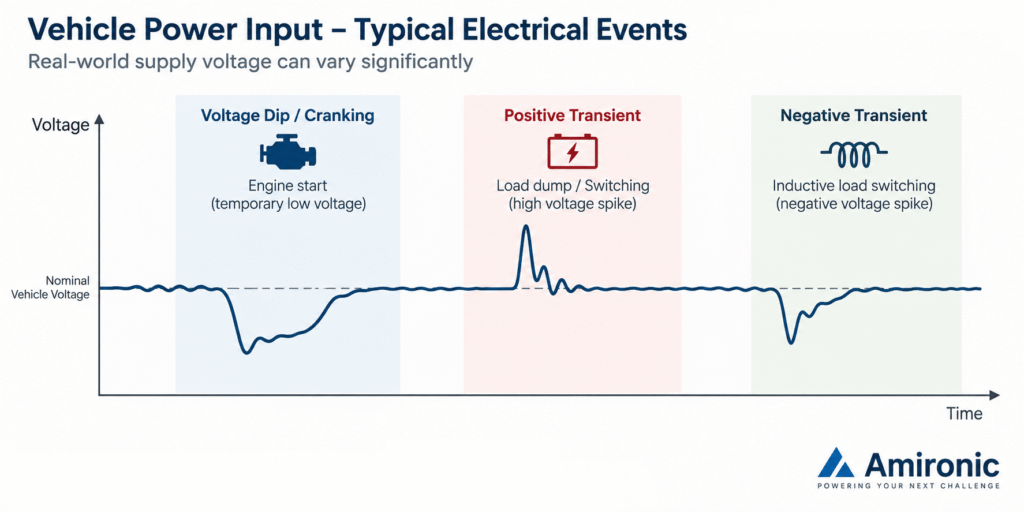
A military vehicle’s electrical system is not an ideal DC power source.

Engine starting, alternator operation, inductive loads, load switching, and multiple systems connected to the same power bus can create conditions that are significantly more demanding than a stable DC source in a laboratory.

MIL-STD-1275 defines the characteristics of the electrical power environment for equipment connected to DC power systems in military vehicles.

From the perspective of a power supply or DC-DC converter designer, this means that the input must be designed not only for the nominal voltage, but also for abnormal events and variations originating from the vehicle’s electrical system.

Such a system may require:

  • Wide input voltage range
  • Overvoltage protection
  • Reverse polarity protection
  • Transient protection
  • EMI filtering
  • Continuous operation or defined recovery following an electrical event

This is exactly why Front-End Protection is an essential part of power supply design in many military applications.


MIL-STD-704 – When the Power Source Is an Aircraft Electrical System

In an aerospace environment, the situation is different.

MIL-STD-704 addresses aircraft electric power characteristics and defines the electrical power environment in which airborne equipment is required to operate.

For a power supply, this means understanding the characteristics of the aircraft power source and the required behavior when supply voltage or frequency deviates from nominal conditions.

However, there is an important distinction:

MIL-STD-704 is not an “all-in-one aerospace standard.”

It focuses on the aircraft electrical power system and its power characteristics. When evaluating the overall operating environment of airborne equipment, another important standard comes into play – RTCA DO-160.


RTCA DO-160 – Much More Than Input Power

RTCA DO-160 – Environmental Conditions and Test Procedures for Airborne Equipment is one of the key standards used for testing equipment intended for installation on aircraft.

Unlike a standard focused primarily on the power source, DO-160 addresses a broad range of environmental and electromagnetic conditions that airborne equipment may be required to withstand.

These include temperature and altitude conditions, vibration, Power Input, RF susceptibility, transient events, ESD, and lightning-related effects.

Therefore, when evaluating a power supply for an aerospace system, the question is not necessarily:

MIL-STD-704 or DO-160?

In many cases, the better question is:

Which part of the system requirements is addressed by each standard?

MIL-STD-704 describes the aircraft electrical power environment, while DO-160 provides a broader framework for environmental and electromagnetic testing of airborne equipment.


MIL-STD-704 vs. DO-160

Topic MIL-STD-704 RTCA DO-160
Primary Focus Aircraft electric power characteristics Environmental testing of airborne equipment
Power Input Primary focus Included
Temperature & Altitude Not the primary focus Yes
Vibration Not the primary focus Yes
EMI / RF Not the primary focus Yes
Lightning Not the primary focus Yes
Typical Use Defining the electrical power environment Qualification / Environmental Testing

In other words, these standards should not necessarily be viewed as competing alternatives.

They can be complementary.

ISO 16750 – The Electrical Operating Environment in Civilian Vehicles

Even in civilian vehicles, a 12V or 24V supply is not necessarily a stable, clean DC power source.

The vehicle’s electrical system is affected by engine starting, the battery, alternator operation, load switching, and numerous electronic systems connected to the same electrical infrastructure. As a result, electronic equipment installed in a vehicle must be able to handle voltage variations and electrical events that would not normally occur with a standard laboratory power supply.

The ISO 16750 family addresses environmental conditions and testing for electrical and electronic equipment installed in road vehicles.

For power supplies and DC-DC converters, ISO 16750-2, which addresses Electrical Loads, is particularly important.

From a Power Input design perspective, this means evaluating not only the nominal operating voltage, but also system behavior during voltage variations, overvoltage and undervoltage conditions, engine starting, supply interruptions, and other abnormal electrical conditions defined for the application.

Depending on the system and its specific requirements, an automotive power supply may therefore require:

  • Wide input voltage range
  • Overvoltage protection
  • Reverse Polarity Protection
  • Operation during voltage dips
  • Transient protection
  • Appropriate input filtering

It is also important to distinguish between Electrical Loads and EMC. Compliance with ISO 16750-2 does not necessarily mean that the equipment meets all of the system’s EMI and EMC requirements.

ISO 7637 – Transients on Vehicle Power Lines

Alongside ISO 16750, the ISO 7637 family addresses electrical disturbances originating within vehicle electrical systems.

For power supply applications, ISO 7637-2 is particularly relevant because it addresses electrical transient conduction along supply lines.

A transient may be extremely short in duration but have a significant amplitude. For a DC-DC converter, such an event may cause a reset, disrupt operation, or, if the input stage is not adequately protected, damage components.

This is why, in automotive applications, it is not enough to select a converter simply because its datasheet states:

Input: 9–36VDC

The input voltage range is only part of the picture.

It is essential to understand what happens outside the normal operating range and for how long: which transients are expected, how much energy they contain, whether continuous operation is required during the event, and how the converter is expected to behave after the event has ended.

In many cases, the input stage may include a combination of TVS protection, filtering, current limiting, Reverse Polarity Protection, and Surge Protection ahead of the power conversion stage.

MIL-STD-1275 vs. ISO 16750 and ISO 7637 – Military vs. Civilian Vehicles

From an engineering perspective, there are clear similarities.

Both military and civilian vehicles use non-ideal power sources, batteries, charging systems, engine starting, variable loads, and wiring that may be exposed to electrical disturbances.

However, this does not mean that the standards are equivalent.

MIL-STD-1275 addresses the electrical power environment for equipment connected to military vehicles.

ISO 16750 addresses environmental conditions and loads for electrical and electronic equipment in road vehicles, with ISO 16750-2 specifically focusing on electrical loads.

ISO 7637 addresses electrical disturbances from conduction and coupling in road vehicle systems, with ISO 7637-2 specifically covering transients along supply lines.

They can therefore be viewed as different approaches to the same fundamental question:

What can appear at the equipment input when it is connected to the vehicle’s electrical system?

The answer, however, depends on the type of vehicle and the specific project requirements.

This is also an important consideration when selecting a power supply. The fact that a converter was designed for Automotive applications does not mean that it is suitable for a military vehicle, and vice versa. The actual standard and project requirements must be evaluated rather than relying on broad terms such as Rugged, Automotive, or Military Grade.

SAE J1455 – Power Supplies and DC-DC Converters for Trucks and Heavy-Duty Vehicles

Electrical systems in trucks, buses, construction equipment, and other heavy-duty vehicles present different challenges from those found in standard passenger vehicles.

In these environments, electronic equipment may be exposed to a combination of demanding electrical conditions, long operating hours, vibration, shock, temperature variations, humidity, and harsh environmental conditions.

SAE J1455 provides recommended environmental practices for the design of electronic equipment used in Heavy-Duty Vehicle applications.

From the perspective of a power supply or DC-DC converter, the key point is that input voltage alone is not enough. The entire operating environment of the product must be considered.

For example:

  • Vehicle electrical system conditions
  • Transients and disturbances on power lines
  • Operating and storage temperatures
  • Vibration and shock
  • Humidity and environmental exposure
  • Installation conditions and equipment location within the vehicle

This means that a DC-DC converter that is electrically suitable for a 24V system is not necessarily suitable for installation in a truck or other Heavy-Duty equipment.

The mechanical design, temperature range, cooling, connectors, protection features, and the product’s ability to operate reliably over time in its installed environment must also be considered.

Passenger Vehicles, Trucks, and Military Vehicles – Similar Platforms, Different Requirements

It is easy to see why these three application areas may appear similar.

All of them include a battery, charging system, engine starting, variable loads, and DC-DC converters supplying sensitive electronics.

However, their system requirements are not the same.

Application Key Standards Covered in This Guide Primary Focus
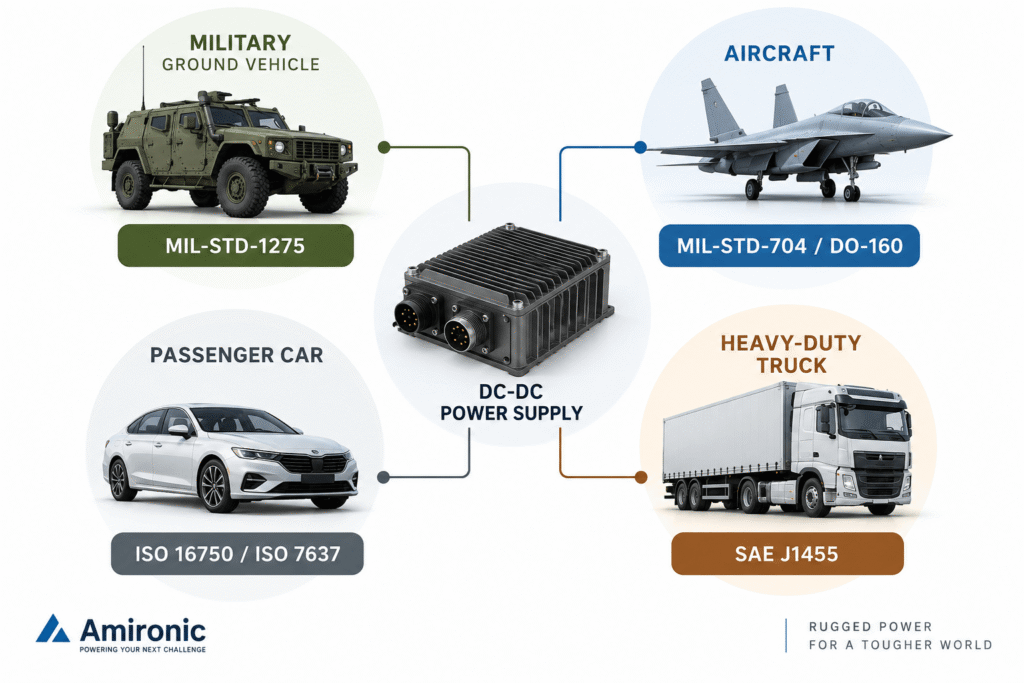
Military Vehicle MIL-STD-1275 Military vehicle electrical power environment
Civilian Vehicle ISO 16750 / ISO 7637 Electrical loads and transients
Heavy-Duty Vehicle SAE J1455 Operating environment for heavy-duty vehicle electronics
Military Aviation MIL-STD-704 Aircraft electric power characteristics
Airborne Equipment RTCA DO-160 Environmental and electromagnetic testing

This comparison also illustrates why there is no single “rugged power supply standard.”

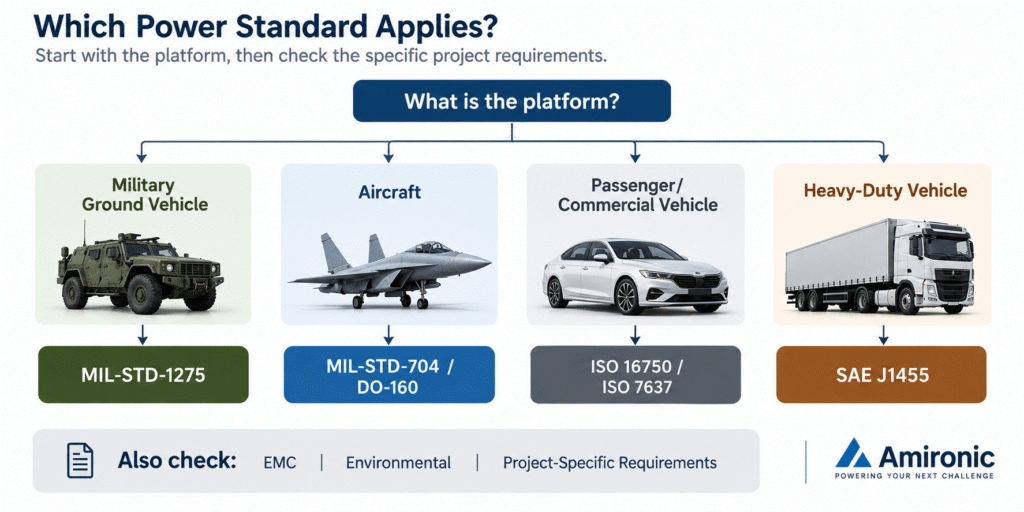
The applicable standard is determined first and foremost by the platform and the specific requirements defined for the system.

EMI and EMC – A Power Supply Must Withstand Interference Without Creating It

So far, we have focused primarily on what reaches the power supply input.

But there is another side to the equation.

A switching power supply can itself be a potential source of electromagnetic noise. Switching frequency, rapidly changing currents, magnetic components, wiring, and PCB layout can all generate conducted and radiated interference.

Therefore, EMC generally involves two key questions:

Emissions – How much electromagnetic interference does the equipment generate?

and

Susceptibility / Immunity – How well can the equipment continue to operate when exposed to external electromagnetic interference?

The manufacturer’s documentation also illustrates the distinction between military, aerospace, and commercial EMC standards.

In military applications, one of the key standards is MIL-STD-461.

In aerospace applications, various EMC requirements are included within RTCA DO-160.

In civilian applications, additional IEC, CISPR, and EN standard families may apply depending on the product and application. The manufacturer’s documentation also identifies separate requirements for Radiated Immunity, ESD, Fast Transients, and Emissions.

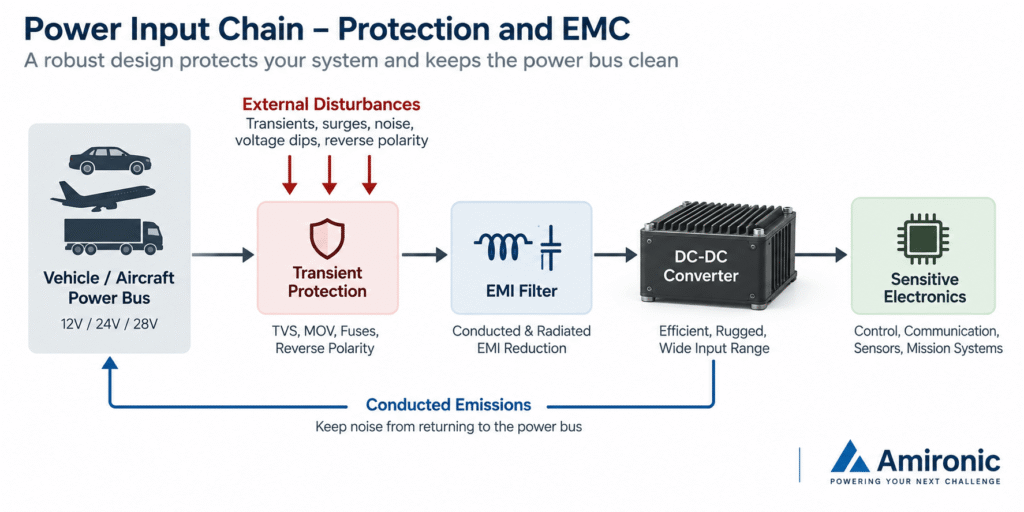
From a power supply design perspective, this distinction is important:

Input Protection and EMI Filtering are not the same thing.

A component that protects a converter against a Surge or Transient does not necessarily solve a Conducted Emissions problem. Likewise, an excellent EMI filter does not necessarily provide the protection required against a high-energy event on the input power line.

In many cases, the input stage requires multiple layers of protection and filtering.

EMC Standards for Power Supplies – MIL-STD-461, DO-160, and Civilian Standards

When discussing EMC, it is important to avoid oversimplified comparisons between standards.

MIL-STD-461, RTCA DO-160, and civilian EMC standards are not simply three versions of the same standard. Each was developed for a different application environment, with test methods, levels, and requirements based on the conditions in which the equipment is expected to operate.

In military systems, MIL-STD-461 defines requirements for controlling electromagnetic interference in equipment and subsystems. For power supplies and DC-DC converters, Conducted Emissions and Conducted Susceptibility tests can be particularly important because the converter is connected directly to the Power Bus.

In aerospace systems, DO-160 includes several test categories related to the electromagnetic environment of airborne equipment as part of a broader framework of environmental testing.

In civilian applications, different families of standards apply depending on the product, market, and application. The manufacturer’s documentation clearly illustrates this distinction between Military, Aerospace, and Commercial Standards.

Therefore, the right question is not:

“Which EMC standard is the best?”

but rather:

“On which platform is the equipment installed, and which EMC requirements must the system meet?”

MIL-STD-461 and CS101 – An Example of Why System Design Matters

One particularly relevant requirement for power supplies is CS101 – Conducted Susceptibility, Power Leads.

The purpose of this test is to evaluate the equipment’s immunity to disturbances injected onto its power leads.

From a power supply perspective, this is significant: the converter must continue to provide an appropriate output voltage to sensitive electronics even when the input power line is not “clean.”

In systems with stringent requirements, attempting to solve the problem solely with an external filter may add size, weight, and components, and may even affect overall system performance.

This is why it is important to select a Power Conversion solution in which EMI filtering and input protection are considered as part of the product and system design from the beginning, rather than being added later simply to pass a test.

This is also one of the potential advantages of an integrated solution: fewer external components, fewer interfaces between components, and the potential for a more compact overall design.

Further reading: MIL-STD-461 for Military Power Supplies – EMI, EMC and CS101

What About Safety, Radio, and Telecommunications?

Power Input and EMC standards are not necessarily the end of the story.

Depending on the product and its target market, additional requirements related to safety, communications, or RF equipment may also apply.

The documentation provided by the manufacturer, for example, includes separate references to Radio, Telephone, and Safety requirements. These documents mention standards such as FCC Part 90 for radio equipment, as well as FCC Part 68 and CTR 12 for telecommunications.

The safety section also references standards intended for telecommunications and Information Technology Equipment.

However, these are not necessarily the primary standards when selecting a military or aerospace DC-DC converter, and some of the standards and markings referenced in the historical documentation have been replaced or updated over the years.

Therefore, when designing a new system, it is important to verify the specific standards and revisions required for the project, rather than relying on a general or historical list of standards.

MIL-STD-810 and DO-160 – Because Electrical Requirements Are Only Part of the Challenge

A power supply can be well designed from an electrical perspective and still be unsuitable for the environment in which it is expected to operate.

In military and aerospace systems, additional factors may include:

  • Temperature
  • Altitude
  • Vibration
  • Shock
  • Humidity
  • Storage and transportation conditions
  • Other environmental conditions depending on the application

In military applications, MIL-STD-810 provides a framework for environmental testing.

In aerospace applications, many environmental requirements are covered within DO-160.

Here too, a general statement such as “the product complies with MIL-STD-810” has limited meaning without additional information.

It is important to determine which test was performed, which method was used, under what conditions, and what acceptance criteria were applied.

This is particularly important for power supplies, where ambient temperature, heat dissipation, vibration, and installation method can directly affect product performance and service life.

Further reading: MIL-STD-810 – Vibration, Shock and Environmental Conditions in Military Power Supplies

How Do the Standards Fit Together?

After reviewing all these standards – MIL-STD-1275, MIL-STD-704, MIL-STD-461, MIL-STD-810, DO-160, ISO 16750, ISO 7637, and SAE J1455 – it is easy to lose track of how they relate to one another.

The simplest approach is to start with the application.

For a military vehicle, MIL-STD-1275 may be the starting point, together with EMC and environmental requirements such as MIL-STD-461 and MIL-STD-810, depending on the system specification.

For an aerospace system, both the aircraft electrical power requirements and the airborne equipment requirements must be considered. Therefore, MIL-STD-704 and/or DO-160 may be relevant depending on the platform and the specific project.

For a civilian vehicle, ISO 16750 and ISO 7637 are among the key standards that should be evaluated.

For equipment intended for a Heavy-Duty Vehicle, SAE J1455 may also be relevant.

However, a standard should never be selected solely based on the name of the platform.

The project specification is what ultimately determines the applicable requirements.

Comparison Table – Which Standard Applies to Which Application?

The following table summarizes the key standards covered in this guide and the primary role of each:

Standard Primary Application What It Mainly Covers
MIL-STD-1275 Military vehicles Electrical power environment of military vehicles
MIL-STD-704 Military aircraft Aircraft electric power characteristics
MIL-STD-461 Military equipment and subsystems EMI / EMC
MIL-STD-810 Military equipment Environmental conditions and testing, including temperature, vibration, and shock
RTCA DO-160 Airborne equipment Environmental, Power Input, and EMC testing for airborne equipment
ISO 16750 Civilian vehicles Environmental conditions and electrical loads for vehicle equipment
ISO 7637 Civilian and commercial vehicles Electrical disturbances and transients in vehicles
SAE J1455 Trucks and Heavy-Duty vehicles Environmental conditions for electronic equipment in heavy-duty vehicles

This table is only a starting point. In an actual project, always verify the specific revision, part, test method, and test levels required by the specification.

How Do You Select a Power Supply or DC-DC Converter Based on the Standard?

When you receive a requirement such as:

“A DC-DC converter compliant with MIL-STD-1275 is required.”

It is usually not a good idea to immediately search for a converter whose datasheet simply mentions the standard.

The first step is to understand the system.

1. What Is the Power Source?

Is it a 28VDC military vehicle? A 12V or 24V automotive system? An aircraft electrical system? Another DC source?

Nominal voltage alone is not enough. You need to understand the actual input voltage range and the abnormal electrical events that the system may generate.

2. What Is Required During an Abnormal Event?

This is a critical question.

There is a significant difference between a system that must continue operating without interruption, one that allows a temporary deviation at the output, and one that may shut down during the event but must recover afterward without damage.

Therefore, the statement “complies with the standard” is not always sufficient to determine whether a product is suitable for the system.

3. Are the Protection Functions Built Into the Converter?

In some systems, a DC-DC converter can be used with an external Front-End providing the required protection and filtering.

In other systems, an integrated solution in which many of these functions are already built into the product may be preferable.

For example:

Transient Protection + EMI Filter + DC-DC Conversion

An integrated solution can sometimes reduce the number of components, wiring, and board space required in the system. However, it is still necessary to verify that the integrated solution actually meets the project requirements rather than relying on a general manufacturer claim.

4. What Are the EMC Requirements?

Both directions need to be considered:

What does the system do to the power supply – and what does the power supply do to the system?

In other words, both immunity to interference and Emissions must be considered.

A military system may include requirements from MIL-STD-461; airborne equipment may have applicable requirements from DO-160; and in civilian systems, the requirements will depend on the type of product and the applicable standards.

5. What Are the Environmental Conditions?

Even a power supply that meets all electrical requirements may still be the wrong choice if it is not suitable for the operating environment.

Factors to consider include:

Operating temperature, cooling, vibration, shock, altitude, humidity, installation method, and enclosure.

6. Was the Product Actually Tested – or Only Designed to Meet the Requirement?

This is another important distinction.

Manufacturer documentation may use terms such as:

Designed to meet
Compliant with
Tested to
Qualified to

These statements should not be assumed to mean the same thing.

When compliance with a standard is a mandatory project requirement, it is important to verify exactly what was tested, on which product or configuration, according to which revision, and under what test conditions.

A Standard Is Not a Substitute for System Engineering

This may be the most important point in this guide.

Standards provide an excellent framework for defining the operating environment and testing equipment, but they do not replace an analysis of the system itself.

For example, two projects that both require MIL-STD-1275 may differ in power level, output voltage, required Hold-Up time, operating temperature, EMC requirements, available space, and cooling method.

Similarly, two products intended to comply with DO-160 are not necessarily required to meet the same categories or undergo the same tests.

The right approach to selecting a Power solution is therefore to start with the System Requirements, identify the applicable standards and tests, and only then select the power architecture and the appropriate product.

Frequently Asked Questions – FAQ

Does a Power Supply That Complies with MIL-STD-1275 Also Comply with MIL-STD-461?

Not necessarily.

The standards address different requirements. MIL-STD-1275 relates to the electrical power environment of military vehicles, while MIL-STD-461 addresses EMI/EMC requirements for military equipment and subsystems.

A system may require compliance with both.

Are MIL-STD-704 and DO-160 the Same Type of Standard?

No.

MIL-STD-704 focuses on aircraft electric power characteristics. DO-160 provides a broader framework for environmental testing of airborne equipment and also includes electrical and electromagnetic requirements.

Therefore, depending on the project, the requirements may be complementary rather than alternatives.

What Is the Civilian Automotive Equivalent of MIL-STD-1275?

There is no single standard that can be considered the “civilian MIL-STD-1275.”

In automotive applications, relevant standards may include ISO 16750, particularly its Electrical Loads requirements, and ISO 7637 for electrical disturbances and transients.

Some of the engineering challenges are similar, but the standards are not equivalent.

What Is the Difference Between ISO 16750 and ISO 7637?

In simple terms, ISO 16750 addresses a range of environmental conditions and loads affecting electrical and electronic equipment in road vehicles, with ISO 16750-2 specifically focusing on electrical loads.

ISO 7637 addresses electrical disturbances caused by conduction and coupling, with ISO 7637-2 specifically covering electrical transients along supply lines.

What Is the Difference Between ISO 16750 / ISO 7637 and SAE J1455?

ISO 16750 and ISO 7637 are primarily associated with electrical and electronic equipment for road vehicles, while SAE J1455 addresses environmental conditions for electronic equipment used in Heavy-Duty Vehicle applications.

Therefore, for trucks or heavy equipment, the specific project requirements should be evaluated rather than assuming that a particular Automotive standard covers the entire operating environment.

Is a Wide Input Range Enough to Protect a DC-DC Converter?

No.

An input range such as 9–36VDC describes the converter’s operating range, but it does not necessarily mean that the input can withstand every Transient, Surge, or Reverse Voltage event that the system may generate.

Protection requirements and product specifications must be evaluated separately.

Does an EMI Filter Also Protect Against Transients?

Not necessarily.

EMI Filtering and Transient Protection address different problems. In a ruggedized system, both functions may be integrated into a single Front-End, but the actual design and requirements must be evaluated.

Is It Enough for a Manufacturer to State “MIL-STD Compliant”?

No.

It is important to verify which standard, which revision, which tests, and under what conditions the statement applies.

In projects where compliance is a contractual or engineering requirement, it is particularly important to distinguish between a product that has actually been tested and one described only as “Designed to meet.”

Conclusion – Start with the Platform, but Finish with the System Requirements

There is no single standard that defines a “rugged power supply.”

Military vehicles may require compliance with standards such as MIL-STD-1275. Aerospace systems may involve MIL-STD-704 and RTCA DO-160. Civilian automotive applications may require ISO 16750 and ISO 7637, while Heavy-Duty applications may also involve SAE J1455.

In addition, EMC requirements such as MIL-STD-461 and environmental requirements such as MIL-STD-810, or the applicable requirements within DO-160, must also be considered.

But the list of standards is only the starting point.

Selecting the right power supply or DC-DC converter requires considering input voltage, transients, EMI/EMC, environmental conditions, power rating, efficiency, cooling, size, and the specific requirements of the system as a whole.

In military and aerospace systems, where multiple requirements often apply simultaneously, defining the Power Architecture correctly at an early stage can reduce the need for additional filters, protection circuits, and mechanical modifications later in the design process.

For more information about military standards, see our complete guide: Military Power Supplies and DC-DC Converters – A Guide to MIL-STD Standards
Key Terms

DC-DC Converter – A device that converts DC voltage from one level to another.

Power Input – The equipment’s power input interface and the electrical requirements that apply to it.

Transient – A short-duration, rapid change in voltage or current.

Surge – An abnormal voltage or energy event that may require dedicated protection.

EMI – Electromagnetic Interference – Electromagnetic interference that may affect other equipment or the system itself.

EMC – Electromagnetic Compatibility – The ability of equipment to operate properly in its electromagnetic environment without generating unacceptable interference or being excessively susceptible to external interference.

Conducted Emissions – Electromagnetic disturbances transmitted through conductors, such as power supply lines.

Conducted Susceptibility – The ability of equipment to withstand electromagnetic disturbances coupled through conductors.

Reverse Polarity Protection – Protection against incorrect reversal of the input power polarity.

Front-End Protection – The protection and filtering circuitry located ahead of the power conversion stage.

Heavy-Duty Vehicle – A category that includes heavy vehicle applications such as trucks, buses, and On-Road or Off-Road equipment, depending on the application.

Qualification – The process of testing and demonstrating that a product meets its specified requirements.

Tags: GilGal

Related Articles

Military Power Supplies and DC-DC Converters – A Guide to MIL-STD Standards
31/08/2026amironicLTD

SPP-F330A Rev B1 — Smart Power Protector for Rugged Military and Industrial Systems

21/10/2025amironicLTD

A Silent Revolution in Military DC/DC Power Supply

08/06/2025amironicLTD

Recent Posts

  • How to Identify an Existing Gear Without a Drawing – A Practical Measurement Guide for Engineers
  • Standards for Power Supplies and DC-DC Converters – A Guide to Military, Aerospace, and Automotive Applications
  • How to Choose an IMU for a Dynamic System – Why “More Accurate” Doesn’t Always Mean “Better”
  • Electrical, Pneumatic, USB, Bluetooth or Contactless – How Do You Choose the Right Switch for Your System?
  • Military DC-DC Converters with Built-In EMI Filtering and Input Protection

Categories

  • Air Switch
  • Circuit Breakers
  • Elapsed Time Indicator
  • Feedthrough
  • Footswitches
  • Gears & Transmission
  • Hour Meters
  • Infra Red Switches
  • INFRARED LAMPS
  • Low Noise Inertial MEMS
  • Mechanics
  • MEMS Gyroscope
  • MEMS Inertial
  • Microelectronics
  • Motors
  • Position Sensors
  • Power Supply
  • Pressure Sensors
  • Pressure Switch
  • Temperature Sensors
  • Tungsten and Molybdenum
  • Uncategorized
  • Vacuum Switches

Quick Contact

Fill out the form and our representatives will return to you

    Name (required)

    Email (required)

    Phone

    Message

    This site is protected by reCAPTCHA and the Google
    Privacy Policy and
    Terms of Service apply.

    Amironic Ltd.

    3 Rabinovich Street, Petah Tikva 4928144 , Israel. Tel: +972-3-9047744 E-mail: office@amironic.co.il
    Email
    Facebook
    Twitter
    LinkedIn
    YouTube
    Press on the ISO Certificate below for download
    ISO 9001:2015 Certification
    • MEMS Inertial
    • Circuit Breakers
    • Footswitches
    • Mechanical & Transmisions
    • Sensors
    • Motors
    • Electronics
    • Hand Control
    • Power Solutions

    News

    • How to Identify an Existing Gear Without a Drawing – A Practical Measurement Guide for Engineers
    • Standards for Power Supplies and DC-DC Converters – A Guide to Military, Aerospace, and Automotive Applications
    • How to Choose an IMU for a Dynamic System – Why “More Accurate” Doesn’t Always Mean “Better”
    • Electrical, Pneumatic, USB, Bluetooth or Contactless – How Do You Choose the Right Switch for Your System?
    • Military DC-DC Converters with Built-In EMI Filtering and Input Protection
    About AmironicContactעברית
    © 2022 Amironic All rights reserved. All Trademarks are the property of their respective owners.
    • Increase Font
    • Decrease Font
    • Black & White
    • Inverse Colors
    • Highlight Links
    • Regular Font
    • Reset