1. Introduction – Why Doesn’t an IP67 Rating Guarantee Long-Term Protection Against Moisture Ingress?
In military, aerospace, and defense applications, inertial sensors are required to operate under extreme environmental conditions, sometimes for years without a practical opportunity for maintenance or replacement. Inertial Measurement Units (IMUs) and gyroscopes measure acceleration and angular velocity in navigation, stabilization, guidance, and control systems, where measurement reliability is an essential part of overall system reliability.
When selecting an inertial sensor, engineers typically evaluate parameters such as measurement noise, Bias Stability, Scale Factor Error, Bandwidth, Latency, and resistance to shock and vibration.
However, another important parameter sometimes receives less attention: Package Hermeticity.
Even a sensor with excellent measurement performance may be vulnerable to long-term failure mechanisms if its enclosure allows moisture or gases to enter the internal environment containing sensitive electronic components.
1.1 Environmental Protection vs. Hermetic Sealing
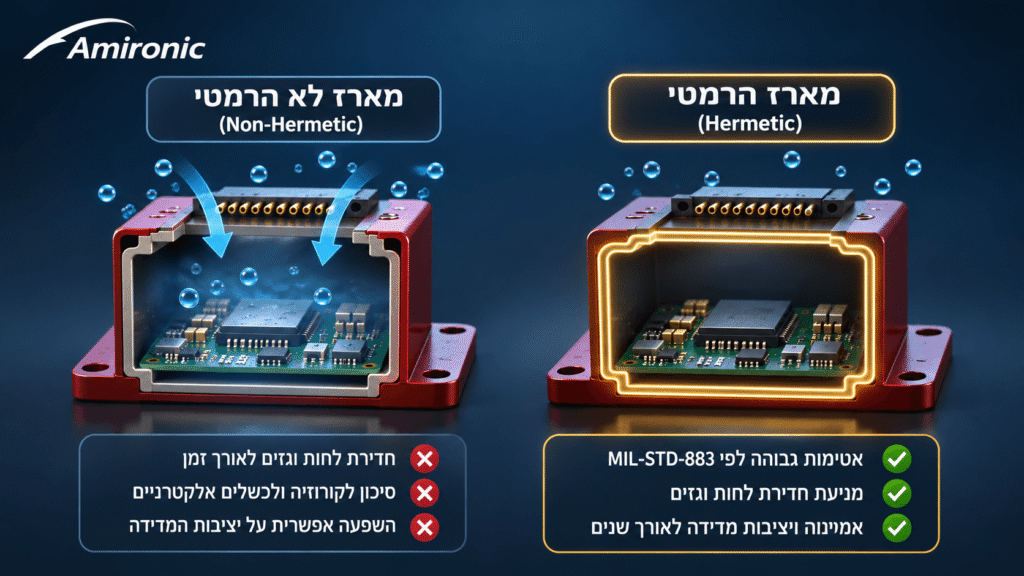
An enclosure may successfully pass a water immersion test while still allowing gases or water vapor to gradually pass through microscopic leakage paths, depending on its construction and sealing method.
Therefore, IP67 compliance does not demonstrate hermetic sealing and cannot replace dedicated leak-rate testing.
1.2 Why Is Hermetic Sealing Particularly Important in Military Systems?
In military applications, environmental challenges extend far beyond direct exposure to water or dust.
An inertial sensor installed in an electro-optical/infrared (EO/IR) system, an Unmanned Aerial Vehicle (UAV), an air defense system, or a guidance platform may encounter a wide range of conditions:
-
Extreme temperature cycling: Transitions between low-temperature storage and high-temperature operation can cause expansion and contraction of enclosure materials and mechanical joints.
-
Humidity and condensation: Changes in temperature and pressure may promote condensation when moisture is present inside the enclosure.
-
Long-term storage: Military systems may remain in storage for years, yet sensor reliability must be maintained even after extended periods without operation.
-
Marine environments: Systems installed aboard vessels or near coastal areas are exposed to high humidity and potentially corrosive conditions.
-
Limited maintenance access: In some applications, a sensor failure after installation may require complex disassembly or result in reduced operational availability.
Moisture ingress into an electronic enclosure can contribute to corrosion, electrical leakage currents, degradation of electrical connections, and long-term changes in component behavior.
In inertial systems, these effects may also lead to changes in measurement performance or signal reliability, depending on the sensor architecture and the underlying failure mechanism.
It is important to distinguish between hermetic sealing at the sensor package level and internal sealing of the MEMS sensing element itself. Even when the micromechanical structure is sealed at the chip level, additional electronic components may remain outside that sealed cavity.
1.3 The Next Generation of Hermetic Packages from Gladiator Technologies
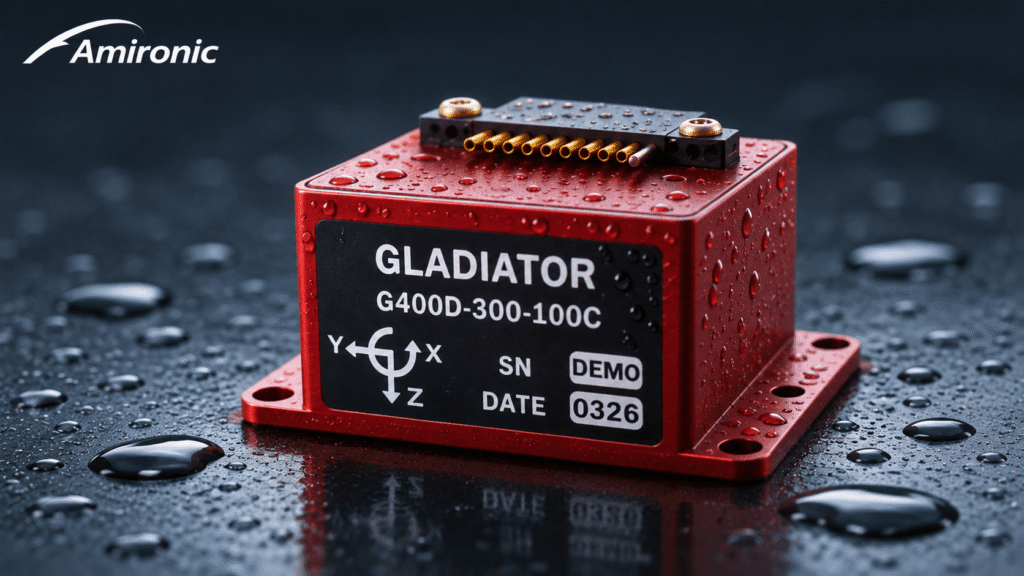
Gladiator Technologies specializes in the development and manufacturing of MEMS-based inertial sensors. In 2026, the company introduced new hermetic packaging solutions for several key product families:
-
G300D – A digital triaxial gyroscope.
-
LandMark 005 – An Inertial Measurement Unit (IMU) designed for stabilization, navigation, and control applications.
-
LandMark 007 – An IMU designed for high-dynamic applications.
According to the manufacturer’s published specifications, the new hermetic packages offer a stated leak rate of:
1 × 10⁻⁹ atm·cm³/s
Manufacturer-stated hermetic leak rate
The manufacturer states that the hermeticity level is defined and qualified in accordance with MIL-STD-883 requirements, with particular relevance to high-reliability applications.
This exceptionally low leak rate reflects a packaging approach designed to minimize the risk of gas and moisture ingress into the internal sensor cavity.
By combining advanced inertial sensing technology, high measurement performance, and hermetic packaging, Gladiator Technologies enables system engineers to consider its solutions for applications requiring not only accurate measurements but also stringent long-term environmental reliability.
However, when selecting a specific model, engineers should verify with the manufacturer the availability of the hermetic configuration, its qualified leak-rate specification, and the relevant test documentation.