1. Introduction – Does an IMU That Survives Mechanical Shock Necessarily Maintain Measurement Accuracy?
Inertial Measurement Units (IMUs) are used to measure acceleration and angular velocity in navigation, stabilization, and control systems. They are integrated into a wide range of applications, including Unmanned Aerial Vehicles (UAVs), electro-optical and infrared (EO/IR) systems, stabilized weapon systems, military vehicles, robotics, and industrial equipment operating in dynamic environments.
In these environments, IMUs are frequently exposed to mechanical vibration, short-duration shocks, and rapid changes in acceleration.
Sources of these disturbances may include engines, propellers, transmissions, vehicles traveling over rough terrain, weapon firing, hard landings, or mechanical mechanisms operating near the sensor.
One common mistake when selecting an IMU is assuming that a sensor designed to withstand high levels of vibration and mechanical shock will necessarily maintain accurate measurements during exposure to these conditions.
In reality, these are two distinct engineering requirements.
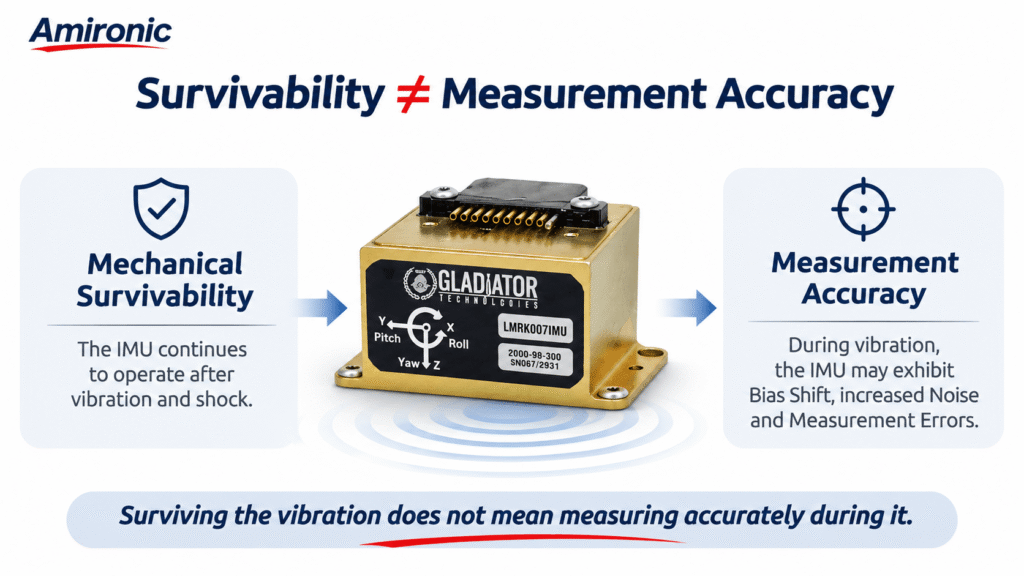
Mechanical Survivability describes the sensor’s ability to withstand mechanical loads without sustaining damage or losing functionality.
Measurement Accuracy Under Dynamic Conditions describes its ability to provide reliable acceleration and angular velocity data while the system is exposed to vibration and mechanical disturbances.
An IMU may survive a severe mechanical shock, continue operating afterward, and pass a functional inspection, yet still exhibit increased measurement noise, bias shifts, nonlinear errors, or temporary sensor saturation during the event itself.
In an inertial navigation system, such errors may accumulate over time and affect position, velocity, and orientation estimates. In an EO/IR stabilization system, they may cause incorrect stabilization commands, image jitter, and reduced pointing or tracking accuracy.
Therefore, when selecting an IMU for dynamic applications, reviewing the Shock and Vibration ratings in the technical datasheet is not sufficient.
Engineers must also consider noise characteristics, bias stability, measurement range, bandwidth, sampling rate, and sensor behavior during exposure to mechanical disturbances.
The key engineering question is not simply whether the IMU can survive the environment, but how much confidence can be placed in its measurements while operating within it.
2. Understanding the Difference Between Vibration and Mechanical Shock
Although vibration and mechanical shock are both forms of dynamic mechanical loading, they differ in their characteristics, duration, and effects on sensor performance.
2.1 Mechanical Vibration
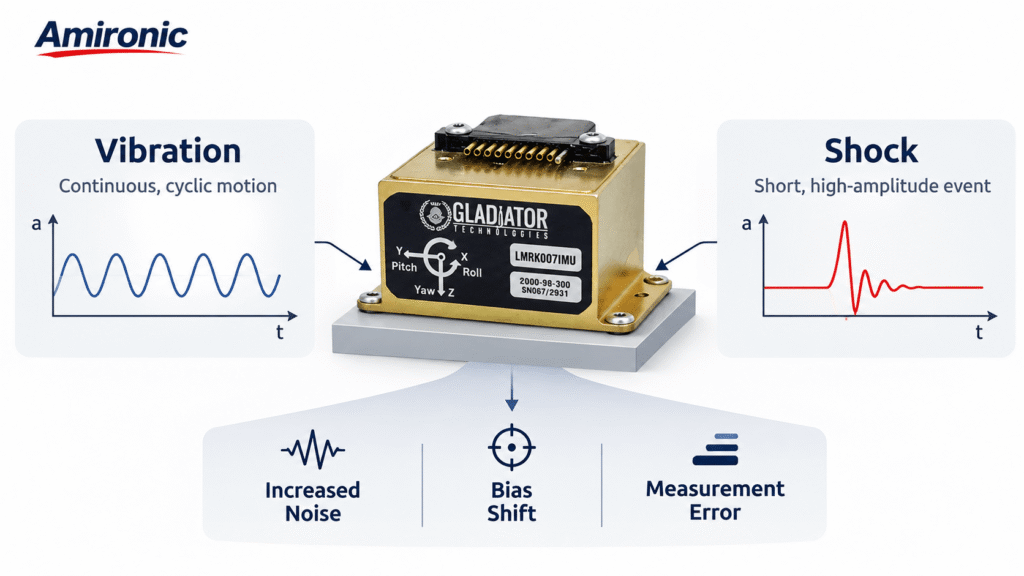
Mechanical vibration refers to repetitive oscillatory motion around an equilibrium position. It may be periodic, random, or a combination of multiple excitation sources and frequencies.
For example, an IMU installed in a UAV may be exposed to vibrations generated by the engine, propeller, and aircraft structure. These vibrations are transmitted through the mounting points to the IMU housing and the MEMS sensing elements inside.
Their impact on measurement performance depends on several factors:
- Vibration Frequency: Different frequencies may affect the mechanical and electronic response of the sensor differently.
- Vibration Amplitude: Higher dynamic acceleration levels generally increase the risk of measurement errors and exceeding the sensor’s measurement range.
- Exposure Duration: Continuous vibration may affect measurement stability over extended periods.
- Mounting Characteristics: The mechanical mounting structure may amplify or attenuate vibration at certain frequencies.
- Sensor Bandwidth: Determines which frequency components are measured and transmitted through the signal chain, and how strongly they are represented.
It is important to emphasize that vibration does not necessarily cause physical damage to the sensor.
In many cases, the IMU continues to operate normally from an electrical and mechanical standpoint, while measurement quality deteriorates.
This degradation may appear as increased measurement noise, vibration-induced bias errors, or unwanted sensor responses to mechanical excitation frequencies.
2.2 Mechanical Shock
Mechanical shock is a relatively short-duration event characterized by a rapid change in acceleration, typically involving a high peak load.
Such events may occur during weapon firing, ground impact, hard landings, collisions, or sudden activation of mechanical mechanisms.
Unlike continuous vibration, mechanical shock generally involves a brief event with a high instantaneous acceleration.
When evaluating a sensor’s resistance to mechanical shock, engineers must consider not only peak acceleration but also pulse duration, pulse shape, and frequency content.
For example, two shock events with the same peak acceleration of 500g may affect a sensor differently if their pulse durations and shapes are different.
From a measurement perspective, mechanical shock may cause several effects:
- Temporary sensor saturation when acceleration exceeds the measurement range.
- Transient measurement errors during the event and subsequent recovery.
- Mechanical ringing caused by excitation of resonant frequencies.
- Temporary or permanent bias shifts following significant mechanical loading.
- In extreme cases, mechanical damage or changes in calibration characteristics.
Therefore, a high Shock rating does not guarantee that the IMU can accurately measure the shock event itself.
2.3 Why Does This Distinction Matter?
Consider two different systems.
In a camera stabilization system installed on a UAV, the primary challenge may be continuous vibration across multiple frequencies. In this case, measurement noise, frequency response, and vibration-induced errors are key factors affecting system performance.
By contrast, in a system installed on a platform exposed to severe mechanical shocks, engineers must also evaluate accelerometer range, mechanical survivability, sensor behavior during the shock event, and recovery time afterward.
Both applications require an IMU suitable for dynamic environments, but the selection criteria are not necessarily the same.
Key Takeaway: Vibration resistance, mechanical shock resistance, and measurement accuracy during exposure are three distinct characteristics that must be evaluated separately when selecting an IMU.