flagעברית
flagEnglish
3 Rabinovich St., Petah-Tikva, Israel
+972 3 9047744
office@amironic.co.il
Facebook
Twitter
LinkedIn
YouTube
  • Products
    • MEMS Inertial
      • Gyros & Accels
      • IMU
      • Inertial Navigation
      • AHRS
    • Circuit Breakers
      • Airpax Circuit Breakers
      • Electronic Circuit Breakers
      • Aircraft Circuit Breakers
      • Thermal Circuit Breakers
      • Sealing Solutions & Guards
    • Footswitches
      • Pedals & Bellows
      • USB
      • Air Switches
      • Medical
      • Modular Bases System
      • Industrial
      • Foot Potentiometers
      • Wireless
    • Mechanical & Transmisions
      • Gears
      • Sealing Solutions
      • Gearboxes
      • Couplings
      • Shafts & Bearings
      • Fasteners
      • Mechanical & Springs
      • Linear Motion
      • Anti-Vibration
    • Sensors
      • Thermostats
      • Temperature
      • Position
      • Pressure
      • Speed
      • Level Sensor
      • Load Cells
      • Flex Sensors
      • Membrane Potentiometer
    • Motors
      • Geared DC
      • Brushless DC
      • Step Motors with Gearbox
      • Torque Motors & Brushless Servo
      • DC Motors
    • Electronics
      • Xenon & IR Lamps
      • Counters & Meters
      • Microelectronics Packaging
      • Waterproof Switches
      • Micro Switches
    • Hand Control
      • Operator Controls (JOYSTICK)
      • Electrical
      • Pneumatic (Medical)
      • USB Hand Control
      • Air Push Button
      • Pressure Switch
      • IR Switch
    • Power Solutions
      • Rugged & Military Power Supply
      • Input Power Protection
      • Sealed Military Power Adaptor
      • Triple Output Military Power Supply Series – up to 250 W
    • Materials
      • Molybdenum and Advanced Alloys (TZM, MOLA, HCT)
      • Tungsten (Wolfram) and Advanced Alloys – High-Performance Materials for Extreme Conditions
      • Materials for Gears
  • Shop
  • Companies
  • About Amironic
  • News
  • Contact
Product was added to your cart

Cart

waze

Why a Dual-Channel Rotary Position Sensor Is Not Just a Backup Sensor

Position Sensors03/08/2026amironicLTD

When engineers hear the term Redundant Rotary Position Sensor, many assume it simply refers to two identical sensors, so that if one fails, the other can continue operating.

That is certainly one of the purposes of redundancy.

However, in modern systems – especially those where reliability and accuracy are critical – this is far from the only reason for having an additional measurement channel.

In many applications, both measurement channels operate simultaneously, not sequentially. The control system does not wait for one channel to fail before using the other. Instead, it continuously compares the two outputs to verify that they provide consistent and reliable position information.

This approach allows developing faults to be detected long before they become complete failures.

For example, a slight deviation in one channel, a wiring fault, a voltage drop, magnet misalignment, or the early stages of an internal electronic failure can often be identified by continuously comparing the two output signals, even while the system continues to operate normally.

This is one of the reasons why modern Hall Effect rotary position sensors with redundant outputs have become a common choice in applications where it is not enough for the system to simply keep running – it must also know when the position information can no longer be trusted.

Such applications can be found across a wide range of industries, including industrial automation, robotics, medical equipment, specialty vehicles, agricultural machinery, and mission-critical systems in the defense industry, where the reliability of position feedback is just as important as keeping the system operational.
                 Rotating Shaft
                       │
                       ▼
         ┌─────────────────────────┐
         │ Rotary Position Sensor  │
         │                         │
         │   Channel 1 (Output)    ├────────────► Output 1
         │                         │
         │   Channel 2 (Output)    ├────────────► Output 2
         └─────────────────────────┘

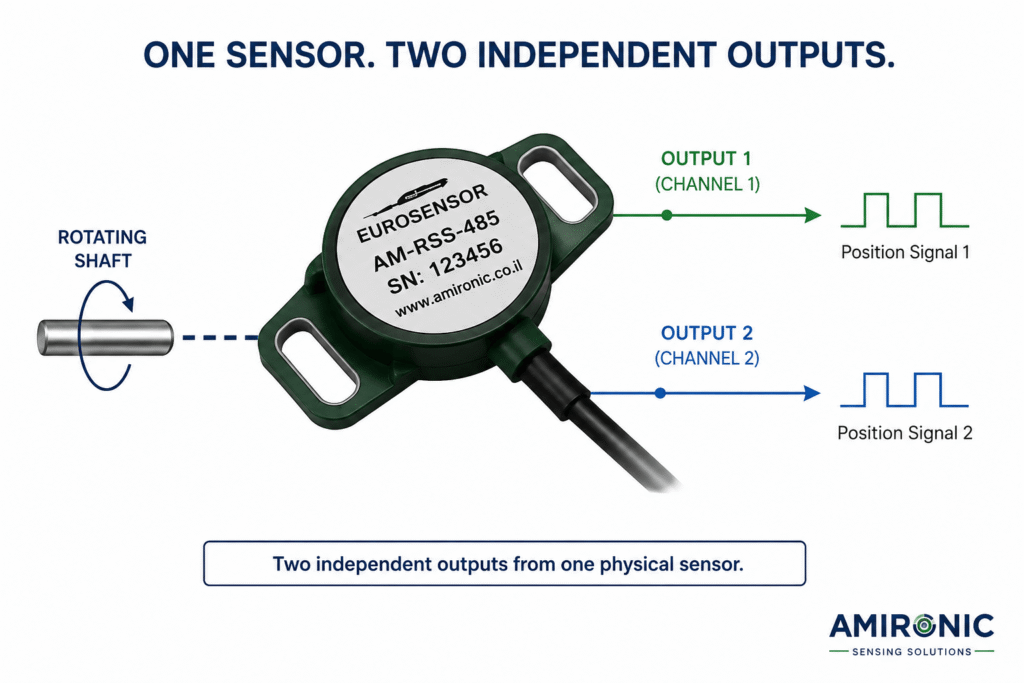
Two Independent Outputs from a Single Sensor

Why Do We Need Two Channels If They Measure the Same Thing?

Once it becomes clear that a Rotary Position Sensor contains two independent output channels, the next question naturally arises:

If both channels measure the same shaft angle, why are two signals needed?

The answer is that, in modern systems, the two channels are not intended solely to keep the system operating if one channel fails.

In many applications, the control system reads both outputs simultaneously and continuously compares them. As long as both channels provide consistent position information, the controller knows that the measurement is reliable and normal operation can continue.

However, if even a small deviation begins to appear between the two channels, the control system can recognize that something is no longer behaving as intended.

In other words, redundancy becomes a diagnostic tool, not just a backup mechanism.

In many systems, detecting a fault at an early stage is just as important as being able to continue operating after a failure occurs. Early fault detection allows the controller to alert the operator, switch the system to a safe operating mode, perform a controlled shutdown, or schedule maintenance before a developing issue becomes a complete failure.

This is why continuous comparison between two measurement channels has become an integral part of control system design in applications where reliability is a fundamental requirement – from industrial automation equipment and medical devices to mission-critical systems where dependable position feedback is essential.

    Rotary Position Sensor

        Output 1 ───────┐
                         │
                         ▼
                  Continuous
                  Comparison
                         │
        Output 2 ───────┘
                         │
           ┌─────────────┴─────────────┐
           │                           │
      ✓ Signals Match            ⚠ Deviation
        System OK             Warning / Fault

Figure 2. A Redundant Output rotary position sensor provides two independent output channels from a single physical sensor. Both channels operate simultaneously and measure the same shaft position, allowing the control system to continuously validate the position data, detect deviations and developing faults at an early stage, and improve overall system reliability.

What Faults Can Be Detected Using Two Measurement Channels?

When both output channels operate simultaneously, the control system does more than simply verify that the sensor is producing a signal. It can also monitor whether the two channels remain consistent throughout the entire range of motion.

As long as both outputs maintain their expected relationship, the position measurement system can be considered to be operating normally.

However, if a deviation begins to appear between the two channels – even while the system continues to operate – it may indicate that a fault is developing somewhere within the measurement chain.

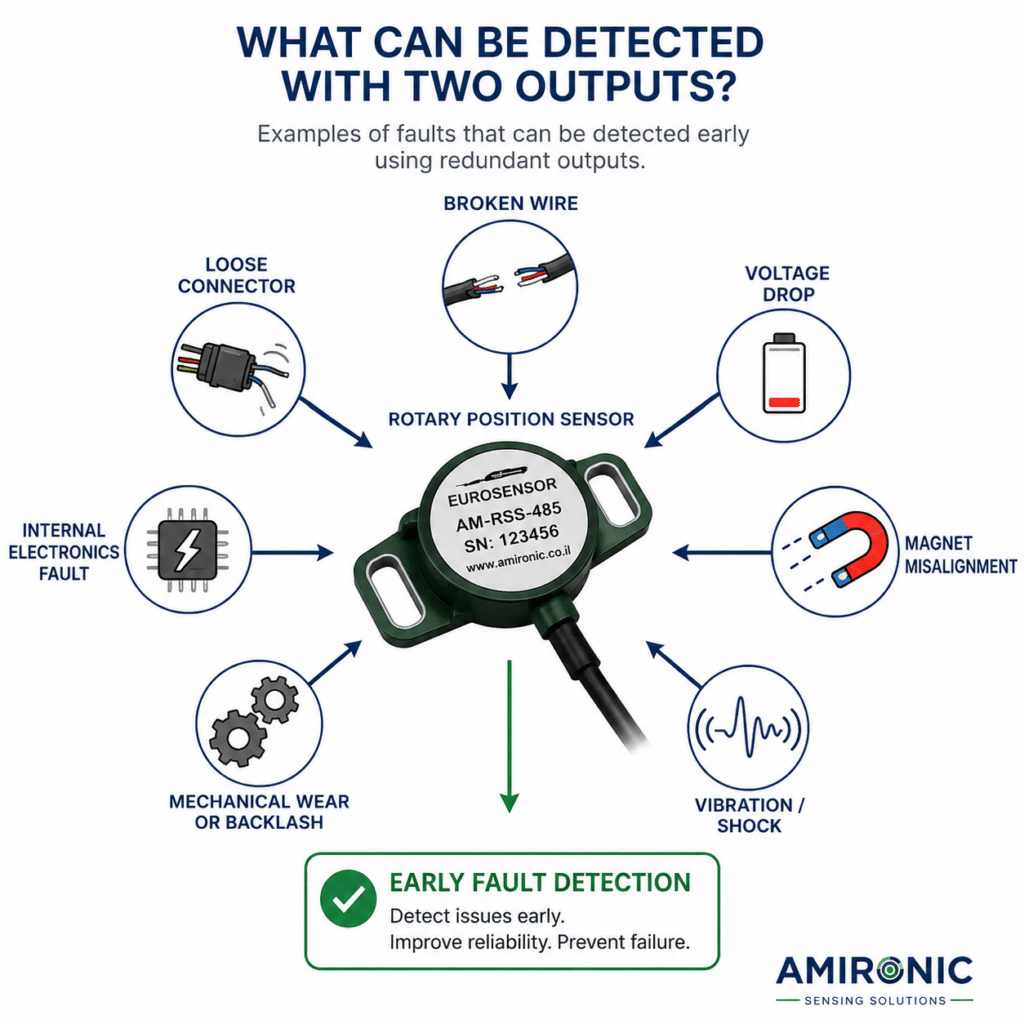
Such deviations can result from a variety of causes, including:

  • A broken or damaged wire.
  • A loose electrical connector.
  • A voltage drop in one of the supply circuits.
  • An internal fault in one of the output channels.
  • Magnet misalignment.
  • Mechanical wear or excessive play between the shaft and the sensor.
  • Damage caused by vibration, shock, or harsh operating conditions.

It is important to understand that, in many cases, none of these faults will cause the sensor to stop working immediately. The sensor may continue to generate an output signal, but the quality and reliability of the position information may already be compromised.

Without a second measurement channel, the control system may continue relying on position data that no longer accurately represents the true shaft position.

With two independent output channels, however, the controller can detect inconsistencies at an early stage, alert the operator, or transition the system to a safe operating mode before a developing fault becomes a complete failure.

For this reason, the value of redundancy in many modern systems is measured not only by the ability to continue operating after a failure, but even more importantly by the ability to detect that a failure is beginning to develop.

Figure 3. Examples of faults that can be detected using a Redundant Output rotary position sensor. By continuously comparing the two independent output channels, the control system can identify developing issues such as broken wiring, loose connectors, voltage drops, internal electronic faults, magnet misalignment, mechanical wear, or excessive vibration. In many applications, early detection of these deviations allows corrective action to be taken before they develop into a complete system failure.

Early Fault Detection Is More Important Than Continuing Operation After a Failure

When discussing redundancy, it is easy to focus on one question:

What happens if one of the channels fails?

In many systems, however, that is not the most important question.

The real question is:

Can the system detect that something is beginning to go wrong before a complete failure occurs?

In a position feedback system, failures rarely begin with the sensor suddenly stopping altogether. More often, they start with a small deviation that initially appears insignificant. Over time, that deviation can grow and begin affecting measurement quality and overall control system performance.

When both measurement channels operate simultaneously, the control system can detect these changes at an early stage. Instead of waiting until the position signal is completely lost, it can issue a warning, switch the system to a safe operating mode, or allow scheduled maintenance before the developing fault affects system operation.

From this perspective, redundancy is not only about maintaining operation after a failure – it is also about reducing the risk of making control decisions based on unreliable position data.

In applications where reliability is a fundamental requirement, the ability to detect developing faults early is often more valuable than the ability to continue operating after the failure has already occurred.

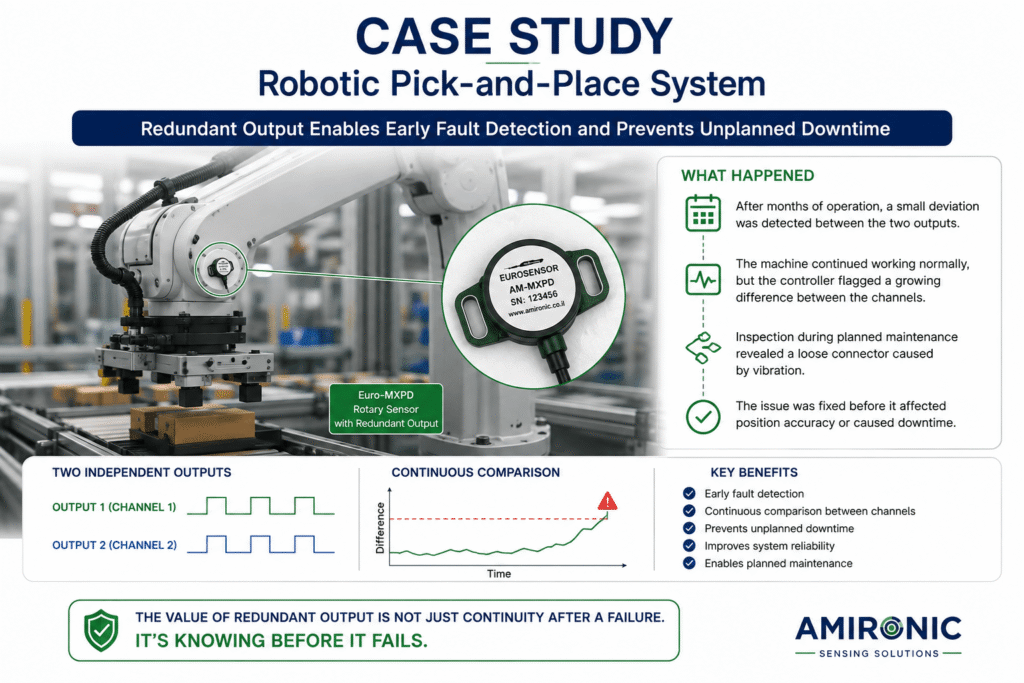
Case Study – Robotic Pick-and-Place System

In an industrial Pick-and-Place system, the position of a rotating arm had to be measured continuously while maintaining high accuracy over millions of operating cycles.

The system operated in an environment characterized by constant vibration, rapid acceleration, and frequent changes in direction. In addition to accurate position feedback, the design required a mechanism capable of detecting developing faults before they could lead to unplanned machine downtime.

To meet these requirements, a Euro-MXPD rotary position sensor was selected. The sensor features contactless Hall Effect technology, two independent output channels (Redundant Output), a programmable measurement angle, and IP68 environmental protection.

During normal operation, the control system continuously monitored and compared both output channels. After an extended period of operation, a small deviation began to appear between the two signals, even though the machine continued to operate normally and no fault had yet been reported.

A scheduled maintenance inspection revealed that an electrical connector had gradually loosened due to continuous vibration, causing subtle variations in one of the measurement channels.

The issue was identified and corrected before it affected positioning accuracy or caused an unexpected machine shutdown.

From the control system’s perspective, this approach provided several important advantages:

  • Early detection of a developing fault before a complete failure occurred.
  • Continuous cross-checking of both measurement channels.
  • Prevention of unplanned production downtime.
  • Improved reliability of the position feedback system.
  • The ability to perform scheduled maintenance instead of emergency repairs.

It is important to emphasize that the two output channels were not included simply to keep the machine operating if one channel failed. Their primary value was enabling the control system to recognize that something was beginning to deviate from normal operation, allowing corrective action to be taken before the issue developed into a system-stopping failure.

Figure 4. Example of an industrial Pick-and-Place application. Although the machine continued operating normally, continuous comparison of the two output channels from a Redundant Output rotary position sensor enabled the control system to detect a developing deviation at an early stage, perform scheduled maintenance, and prevent unplanned production downtime.

Not Every System Requires a Redundant Output Sensor

It is important to recognize that a dual-channel rotary position sensor is not the right solution for every application.

In relatively simple systems, where a temporary shutdown does not result in significant costs and a sensor failure poses no major safety or operational risk, a single-output sensor may be the most practical and cost-effective choice.

However, as systems become more complex, more expensive, or increasingly mission-critical, the consequences of losing reliable position feedback become far more significant.

Whenever a control system makes decisions based on shaft position – such as opening or closing a valve, positioning a robotic arm, controlling a steering mechanism, or operating an electric actuator – the reliability of the position data becomes just as important as the measurement itself.

In these applications, the ability to compare two independent measurement channels, detect inconsistencies, and identify developing faults provides an additional diagnostic layer that is simply not available with a single-output sensor.

This is why Redundant Output rotary position sensors are increasingly used in applications such as:

  • Industrial robotics and automation
  • Manufacturing and packaging equipment
  • Medical devices and rehabilitation systems
  • Agricultural and off-highway machinery
  • Specialty vehicles
  • Food and pharmaceutical processing equipment
  • Mission-critical systems in the defense industry

In each of these applications, redundancy is not intended solely to keep the system running after a failure. Its primary purpose is to provide the control system with the information it needs to continuously assess the reliability of the position measurement.

Ultimately, Redundant Output is more than just a sensor feature.

It is part of a broader engineering philosophy in which the control system is designed not only to know the position of the shaft, but also to continuously verify whether that position information can be trusted.


Key Takeaways

✔ Don’t think of Redundant Output as simply a backup sensor. In many applications, both output channels operate simultaneously to continuously validate the position measurement.

✔ The real value of redundancy is early fault detection. Continuous comparison of two independent measurement channels allows developing faults to be identified long before they become complete failures.

✔ Not every system requires Redundant Output. However, whenever the reliability of position feedback affects safety, availability, or operational continuity, dual-channel sensing can provide a valuable additional layer of diagnostics.


When Should You Choose a Rotary Position Sensor with Redundant Output?

A single-output rotary position sensor is perfectly suitable for many applications. However, when the reliability of position feedback is a critical part of system performance, a Redundant Output sensor should be considered.

Its value lies not only in maintaining operation after a fault, but also in enabling the control system to continuously evaluate the reliability of the position data it receives.

This approach is particularly beneficial in applications such as:

  • Industrial robotics and automation
  • Manufacturing and packaging equipment
  • Electric valves and actuators
  • Steering and motion control systems
  • Medical devices and rehabilitation equipment
  • Agricultural and mobile machinery
  • Specialty vehicles
  • Food and pharmaceutical processing equipment
  • Mission-critical defense systems

In these applications, dual measurement channels enable the control system to detect anomalies in real time, support predictive maintenance, reduce unplanned downtime, and improve the long-term reliability of the position feedback system.

Ultimately, the most important engineering decision is often not which sensor to choose, but whether the control system should simply know where the shaft is, or also how much it can trust the position information it receives.


💡 Engineering Tip

Redundant Output is not just about maintaining operation after a failure. By continuously comparing two independent measurement channels, the control system can detect developing faults at an early stage, improve diagnostic capability, and significantly increase overall system reliability-long before a complete failure occurs.


When Position Feedback Reliability Becomes Critical

In some applications, a temporary loss of position feedback has little impact beyond stopping the machine until the faulty sensor is replaced.

In many other applications, however, simply receiving a position signal is not enough. The control system must also know that the information it is receiving is reliable.

This requirement exists across a wide range of industries.

In robotic systems, even a small deviation in position feedback can affect motion accuracy and overall process quality.

In medical equipment, where moving mechanisms operate near patients or directly influence treatment, early detection of measurement anomalies is essential before they develop into complete failures.

The same principle applies to mission-critical defense applications such as stabilization systems, steering mechanisms, antennas, EO/IR systems, and electric actuators. In these systems, the reliability of position feedback directly affects overall system performance, making early fault detection just as important as continued operation after a failure.

Although these applications differ significantly, the engineering requirement remains the same:

The control system must not only know the position of the shaft—it must also know whether the position information can be trusted.


Summary

When engineers hear the term Redundant Rotary Position Sensor, many immediately think of backup operation in the event of a failure. In modern systems, however, that represents only part of the picture.

In many applications, both output channels operate simultaneously, allowing the control system to continuously validate position feedback. This approach enables early detection of deviations and developing faults, improves diagnostic capability, and increases overall system reliability-long before a complete failure occurs.

This principle applies across a broad range of industries. In industrial automation and robotics, it helps maintain positioning accuracy and production continuity. In medical equipment, it enables developing faults to be detected before they can affect patient safety or treatment quality. In mission-critical defense systems, including stabilization platforms, antennas, EO/IR systems, and electric actuators, it provides an additional layer of diagnostics wherever reliable position feedback is essential for system performance.

The EuroSensor product family from Variohm, including models such as Euro-MXPD, Euro-XP, Euro-XPD, and AM-RSS, demonstrates this engineering approach. By combining contactless Hall Effect technology, programmable measurement angles, high environmental protection, and Redundant Output, these sensors provide engineers with more than accurate position measurement-they provide the ability to continuously assess the reliability of the position data itself.

Ultimately, the true value of Redundant Output is not simply that the system can continue operating after a failure. Its greatest value lies in enabling the system to recognize that a fault is beginning to develop, respond before it becomes critical, and maintain long-term reliability, availability, and operational safety.

🧩 Further Reading – Measurement as a System

This article is part of an engineering series exploring how reliable measurement depends on proper system design rather than on a single sensor component.

Before diving deeper into industrial temperature sensing, you may also find the following articles in the series useful:

  • VARIOHM Group – When Measurement Is a System, Not a Component
  • How to Select Sensors for Harsh Environments: An Engineering Guide for Reliable Measurement in the Real World
  • VARIOHM Position Sensors – Engineering Position as a System, Not Just a Signal
  • Industrial Pressure Sensors – When Pressure Measurement Becomes a System Engineering Challenge
  • Industrial Temperature Sensors – When Temperature Measurement Becomes a System Engineering Challenge
  • Choosing the Right Linear Position Sensor: Why Stroke Length Is Only the Beginning
  • Contactless Rotary Position Sensors – Why More and More Systems Are Moving to Non-Contact Sensing
  • Choosing the Right Temperature Probe Mounting
  • How Differential Pressure (ΔP) Can Reveal Problems Long Before a System Shuts Down
  • Your Temperature Sensor Says 80°C. The Real Hot Spot Could Already Be at 130°C
  • Measuring Pressure Without Temperature Is Only Half the Picture
  • Does Your Thermal Protector Really Solve the Problem? Or Just Give the System Another Chance to Fail?
  • Why a Linear Position Sensor Shouldn’t Be Selected by Stroke Alone
  • Your System Has Powered Up – But Does It Know Where It Is? Absolute Position Sensors vs. Homing
  • Your Pressure Sensor May Be Accurate. Your Measurement May Not Be – Why a ±0.5% Accuracy Specification Doesn’t Guarantee a ±0.5% Measurement
  • Why Programming a Rotary Position Sensor to 360° Is Sometimes the First Design Mistake

Frequently Asked Questions (FAQ)

What is a Redundant Rotary Position Sensor?

A Redundant Rotary Position Sensor is a rotary position sensor that provides two independent output channels from a single physical sensor. Both channels operate simultaneously, allowing the control system to continuously compare the position signals, improve diagnostic capability, and increase overall system reliability.


Is Redundant Output Intended Only as a Backup in Case of Failure?

No. Although one benefit of redundancy is continued operation after a fault, in many applications the primary value of Redundant Output is its ability to detect anomalies and developing faults through continuous comparison of the two measurement channels.


What Types of Faults Can Be Detected Using Two Output Channels?

Continuous comparison of the two outputs can help identify a wide range of developing faults, including:

  • Broken or damaged wiring
  • Loose electrical connectors
  • Voltage drops
  • Internal electronic faults
  • Magnet misalignment
  • Mechanical wear
  • Excessive vibration
  • Progressive deviations in one of the measurement channels

Do Both Channels Have to Produce Identical Signals?

Not necessarily. In some sensor designs, both channels provide identical outputs, while in others they may be configured with different output characteristics depending on the application requirements. The control system compares them according to the intended system architecture.


Does Redundant Output Replace Other Safety Mechanisms?

No. A Redundant Output sensor adds an additional layer of diagnostics and position validation, but it does not replace proper control system design, safety functions, or other system-level protection mechanisms.


Which Applications Benefit Most from a Redundant Output Rotary Position Sensor?

Redundant Output is particularly valuable in applications where reliable position feedback is critical, including:

  • Industrial robotics and automation
  • Medical devices and rehabilitation equipment
  • Steering and motion control systems
  • Electric actuators
  • Agricultural and mobile machinery
  • Specialty vehicles
  • Mission-critical defense systems

Does Redundant Output Improve Sensor Accuracy?

No. Redundant output channels do not increase the sensor’s intrinsic accuracy. Their primary benefit is improving the reliability of the position measurement through continuous signal validation and early fault detection.


Does Every System Require a Redundant Output Sensor?

No. In simpler applications where a sensor failure presents little operational or safety risk, a single-output sensor may be entirely sufficient. However, in systems where availability, safety, or reliability are critical, a Redundant Output sensor can provide an important additional diagnostic layer by identifying developing faults before they affect system performance.


Key Terms

Redundant Output

A sensor architecture in which a single physical sensor provides two independent output channels. Both outputs operate simultaneously, allowing continuous validation of position data and early fault detection.


Rotary Position Sensor

A sensor that measures the angular position of a rotating shaft or mechanism and converts it into an electrical signal for use by a control system.


Hall Effect

A contactless sensing technology that detects changes in a magnetic field. Hall Effect sensors contain no mechanical contacts between moving parts, providing long service life, high reliability, and excellent resistance to wear.


Continuous Diagnostics

The process of continuously monitoring the health of the measurement system by comparing the sensor’s two independent output channels to identify developing faults before they become complete failures.


Early Fault Detection

The ability to identify the first signs of a developing fault, such as a deviation between two measurement channels, before the system loses its measurement capability or experiences a complete failure.


Functional Safety

An engineering approach that ensures a system responds safely when faults occur. Sensors with Redundant Output are often used as part of functional safety architectures.


Signal Comparison

Continuous comparison of the two sensor output channels to verify signal consistency. Any deviation between the channels may indicate a developing fault within the measurement system.


Diagnostic Coverage

A measure of a system’s ability to detect faults using built-in diagnostic functions. Dual-channel measurement architectures can significantly improve diagnostic coverage.


Contactless Sensor

A sensor that operates without mechanical contact between moving components, reducing wear, extending service life, and improving long-term reliability.


IP68

An environmental protection rating indicating complete protection against dust ingress and suitability for continuous immersion in water under conditions specified by the manufacturer.


Mechanical Wear

The gradual deterioration of mechanical components, such as shafts, bearings, or couplings, which can affect long-term positioning accuracy.


Magnet Misalignment

A change in the relative position between the magnet and the sensing element, potentially causing deviations in the sensor output and reducing measurement accuracy.


Preventive Maintenance

A maintenance strategy based on detecting developing faults early, allowing scheduled repairs before a failure causes unexpected system downtime.


Mission-Critical System

A system in which reliability and continuous operation are essential for successful performance. Examples include advanced industrial automation, medical equipment, and defense applications where dependable position feedback is fundamental to system operation.

Tags: Variohm

Related Articles

VTP11 Rotary Sensor

21/07/2016amironicLTD

Choosing the Right Temperature Probe Mounting

27/05/2026amironicLTD

Your System Has Powered Up – But Does It Know Where It Is? Absolute Position Sensors vs. Homing

15/07/2026amironicLTD

Recent Posts

  • Why a Dual-Channel Rotary Position Sensor Is Not Just a Backup Sensor
  • Why Position Feedback Matters More Than Ever in Counter-UAS Swarm Defense
  • Why Military Power Distribution Is Becoming the New Battlefield
  • High-Energy Laser Interception – The Engineering Behind Stable Line of Sight, Power Delivery, and Thermal Management
  • Why Do Counter-UAS Systems Lose Track of a Drone Right After Detecting It?

Categories

  • Air Switch
  • Circuit Breakers
  • Elapsed Time Indicator
  • Feedthrough
  • Footswitches
  • Gears & Transmission
  • Hour Meters
  • Infra Red Switches
  • INFRARED LAMPS
  • Low Noise Inertial MEMS
  • Mechanics
  • MEMS Gyroscope
  • MEMS Inertial
  • Microelectronics
  • Motors
  • Position Sensors
  • Power Supply
  • Pressure Sensors
  • Pressure Switch
  • Temperature Sensors
  • Tungsten and Molybdenum
  • Uncategorized
  • Vacuum Switches

Quick Contact

Fill out the form and our representatives will return to you

    Name (required)

    Email (required)

    Phone

    Message

    This site is protected by reCAPTCHA and the Google
    Privacy Policy and
    Terms of Service apply.

    Amironic Ltd.

    3 Rabinovich Street, Petah Tikva 4928144 , Israel. Tel: +972-3-9047744 E-mail: office@amironic.co.il
    Email
    Facebook
    Twitter
    LinkedIn
    YouTube
    Press on the ISO Certificate below for download
    ISO 9001:2015 Certification
    • MEMS Inertial
    • Circuit Breakers
    • Footswitches
    • Mechanical & Transmisions
    • Sensors
    • Motors
    • Electronics
    • Hand Control
    • Power Solutions

    News

    • Why a Dual-Channel Rotary Position Sensor Is Not Just a Backup Sensor
    • Why Position Feedback Matters More Than Ever in Counter-UAS Swarm Defense
    • Why Military Power Distribution Is Becoming the New Battlefield
    • High-Energy Laser Interception – The Engineering Behind Stable Line of Sight, Power Delivery, and Thermal Management
    • Why Do Counter-UAS Systems Lose Track of a Drone Right After Detecting It?
    About AmironicContactעברית
    © 2022 Amironic All rights reserved. All Trademarks are the property of their respective owners.
    • Increase Font
    • Decrease Font
    • Black & White
    • Inverse Colors
    • Highlight Links
    • Regular Font
    • Reset