flagעברית
flagEnglish
3 Rabinovich St., Petah-Tikva, Israel
+972 3 9047744
office@amironic.co.il
Facebook
Twitter
LinkedIn
YouTube
  • Products
    • MEMS Inertial
      • Gyros & Accels
      • IMU
      • Inertial Navigation
      • AHRS
    • Circuit Breakers
      • Airpax Circuit Breakers
      • Electronic Circuit Breakers
      • Aircraft Circuit Breakers
      • Thermal Circuit Breakers
      • Sealing Solutions & Guards
    • Footswitches
      • Pedals & Bellows
      • USB
      • Air Switches
      • Medical
      • Modular Bases System
      • Industrial
      • Foot Potentiometers
      • Wireless
    • Mechanical & Transmisions
      • Gears
      • Sealing Solutions
      • Gearboxes
      • Couplings
      • Shafts & Bearings
      • Fasteners
      • Mechanical & Springs
      • Linear Motion
      • Anti-Vibration
    • Sensors
      • Thermostats
      • Temperature
      • Position
      • Pressure
      • Speed
      • Level Sensor
      • Load Cells
      • Flex Sensors
      • Membrane Potentiometer
    • Motors
      • Geared DC
      • Brushless DC
      • Step Motors with Gearbox
      • Torque Motors & Brushless Servo
      • DC Motors
    • Electronics
      • Xenon & IR Lamps
      • Counters & Meters
      • Microelectronics Packaging
      • Waterproof Switches
      • Micro Switches
    • Hand Control
      • Operator Controls (JOYSTICK)
      • Electrical
      • Pneumatic (Medical)
      • USB Hand Control
      • Air Push Button
      • Pressure Switch
      • IR Switch
    • Power Solutions
      • Rugged & Military Power Supply
      • Input Power Protection
      • Sealed Military Power Adaptor
      • Triple Output Military Power Supply Series – up to 250 W
    • Materials
      • Molybdenum and Advanced Alloys (TZM, MOLA, HCT)
      • Tungsten (Wolfram) and Advanced Alloys – High-Performance Materials for Extreme Conditions
      • Materials for Gears
  • Shop
  • Companies
  • About Amironic
  • News
  • Contact
Product was added to your cart

Cart

waze

Why Wireless Footswitches Are Becoming the Standard in Mobile Medical Equipment

Footswitches04/08/2026amironicLTD

In many medical systems, the footswitch is one of the most important interfaces between the user and the equipment. It allows physicians and clinicians to activate system functions while keeping their hands on the patient or the procedure, improving precision, efficiency, and overall workflow.

For decades, medical footswitches have almost exclusively relied on wired connections. For stationary equipment, this was a logical and effective solution. However, as medical devices have become increasingly portable, including mobile carts, point-of-care ultrasound systems, medical lasers, and compact diagnostic equipment, the cable has gradually become a limitation rather than an advantage.

A cable lying on the floor can obstruct staff movement, become entangled in cart wheels, restrict footswitch placement, and suffer damage after thousands of equipment relocations between examination rooms. In addition, every extra cable complicates cleaning procedures and makes it more difficult to maintain a tidy clinical workspace.

As a result, an increasing number of medical equipment manufacturers are adopting wireless footswitches. This transition is driven not only by convenience, but also by improvements in ergonomics, infection control, reliability, maintenance, and the overall user experience.

The Real Problem Isn’t the Cable – It’s the Limitations It Creates

In a modern mobile medical system, nearly every component is designed to be moved quickly between rooms, connected to power, and ready for use within minutes. Ironically, one of the simplest components in the system, the footswitch, can become a bottleneck that slows the entire workflow.

Every time the equipment is relocated, the cable must be routed again, checked to ensure it is not trapped beneath the cart wheels, positioned to avoid creating a trip hazard, and long enough to allow comfortable operation. The more crowded the clinical environment, the greater the likelihood that the cable will interfere with staff movement or become damaged during everyday use.

For equipment that operates for years and is transported hundreds or even thousands of times, the cable and its connectors often become some of the most failure-prone mechanical components. Repeated bending, pulling, and connector wear can eventually lead to failures that are unrelated to the footswitch itself, but simply to the physical connection between the pedal and the medical system.
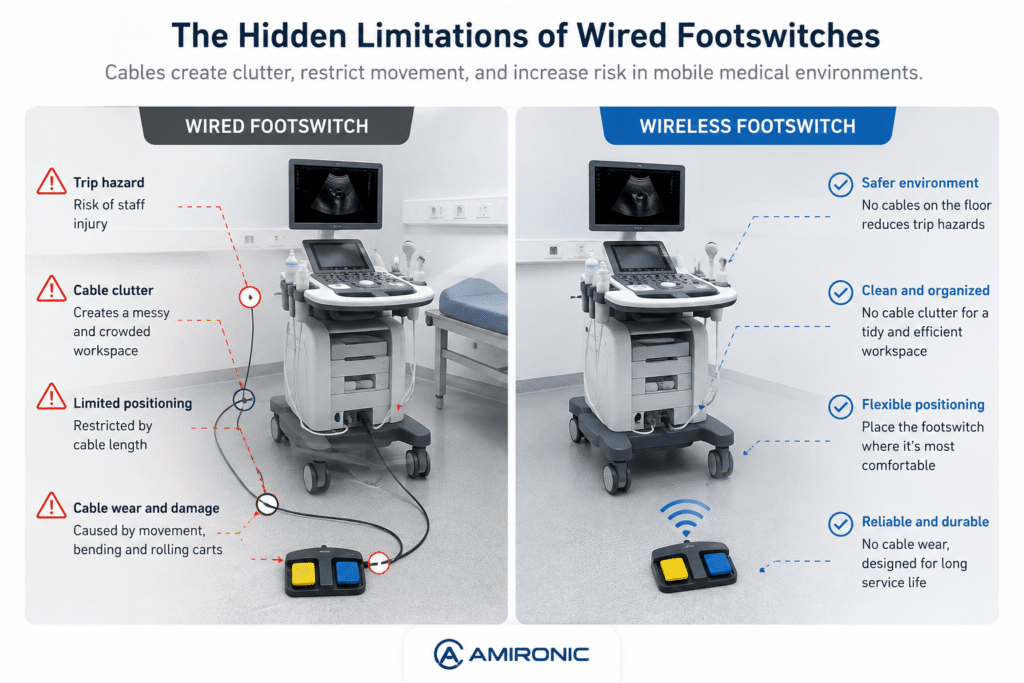
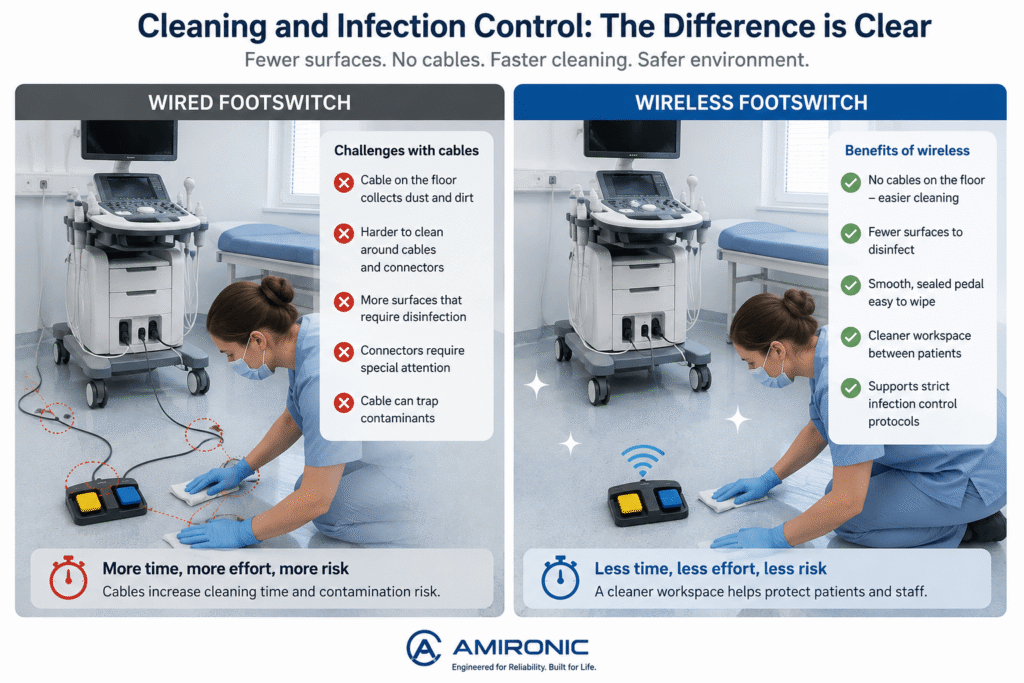
Figure 1. Comparison of wired and wireless footswitches in mobile medical equipment. Eliminating the cable reduces trip hazards, improves system mobility, helps maintain a cleaner and more organized workspace, and minimizes wear caused by repeated cable bending, pulling, and movement.

Benefits of Wireless Footswitches in Mobile Medical Equipment

Removing the cable is about far more than improving appearance or user convenience. In many cases, it fundamentally changes how clinical staff interact with the equipment and how the entire system is designed.

In mobile medical systems, the footswitch is no longer constrained by cable length or the location of a connector on the device. Clinicians can position the pedal wherever it is most comfortable, regardless of how the medical cart is oriented or how crowded the clinical environment may be.

The benefits become particularly evident in equipment that is moved between treatment rooms dozens of times each day. Instead of repeatedly routing, coiling, and reconnecting a cable, the footswitch is immediately ready for use. The result is a faster workflow and fewer opportunities for mechanical damage or user error.

Eliminating the cable also significantly reduces mechanical wear. In many wired footswitches, the cable and its connectors—not the switching mechanism itself—are the most common sources of failure. Repeated bending, pulling, accidental stepping, or medical carts rolling over the cable can eventually cause internal conductor damage, resulting in unexpected downtime and costly repairs.

For medical equipment manufacturers, this translates into fewer service calls, fewer cable replacements, and lower maintenance costs throughout the product’s lifecycle.

Improved Infection Control and Easier Cleaning

Maintaining a clean clinical environment is an essential part of modern medical equipment design. Every component located on the treatment room floor must be easy to clean and capable of withstanding routine disinfection procedures.

When a cable runs across the floor, it creates additional surfaces that are more difficult to clean and can accumulate dirt during normal operation. Cable connectors and entry points also require additional attention during maintenance and cleaning.

A wireless footswitch simplifies the clinical workspace by eliminating the floor cable entirely. The treatment area remains cleaner and more organized, while routine cleaning and disinfection between patients become faster and easier.

It is important to note that cleanability depends not only on wireless operation, but also on the mechanical design of the footswitch itself. High-quality medical footswitches are typically designed with sealed enclosures, smooth exterior surfaces, and materials that are compatible with commonly used medical disinfectants.

Figure 2. A wireless footswitch helps create a cleaner and more organized clinical workspace. Eliminating the cable reduces the number of surfaces that require cleaning, simplifies disinfection between patients, and supports effective infection control practices in mobile medical equipment.

Can a Wireless Footswitch Be as Reliable as a Wired Connection?

One of the first questions engineers ask when considering a wireless footswitch is whether wireless communication can be trusted in a medical environment, where reliability is not simply desirable—it is essential.

A decade ago, this concern was justified. Early wireless systems were sometimes affected by communication interference, higher latency, and relatively high power consumption. However, wireless technology has advanced significantly, and today’s medical-grade wireless footswitches are specifically designed to deliver high reliability, availability, and consistent performance.

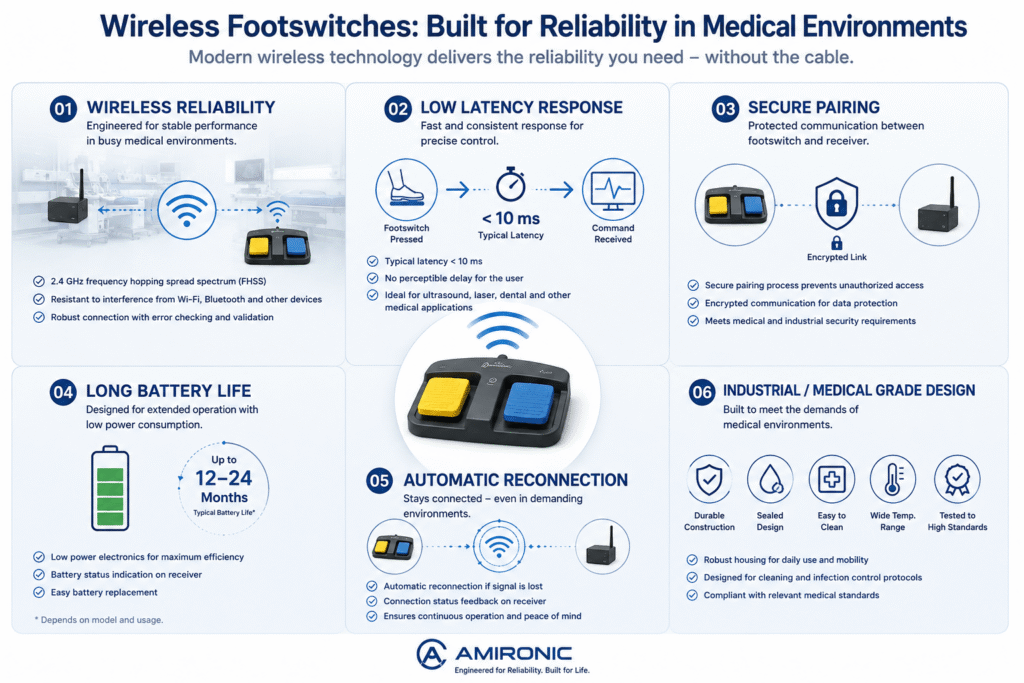
These systems typically incorporate secure pairing mechanisms, bidirectional communication, continuous link monitoring, and automatic reconnection if communication is temporarily interrupted. They are also engineered to operate reliably in environments where multiple wireless technologies, including Wi-Fi, Bluetooth, and other radio devices, are active simultaneously.

Latency, once considered one of the main limitations of wireless control, is no longer a significant concern for most medical applications. In ultrasound systems, medical lasers, dental equipment, rehabilitation devices, and aesthetic medical systems, the response time of modern wireless footswitches is fast enough that users experience virtually no perceptible difference compared with a wired pedal.

Battery Life and Maintenance

Battery technology has also improved dramatically in recent years.

Where early wireless devices often required frequent battery replacement, modern wireless footswitches are designed for extremely low power consumption. Depending on the application and usage profile, battery life can extend from several months to multiple years before replacement is required.

Many systems also provide battery status indication, allowing preventive battery replacement during scheduled maintenance rather than waiting for the battery to become depleted.

From a maintenance perspective, wireless footswitches can actually reduce the overall number of service issues. Instead of dealing with damaged cables, worn connectors, or broken conductors, routine maintenance is generally limited to periodic battery inspection and basic functional testing of the system.

Figure 3. Key factors for evaluating the reliability of a wireless footswitch in medical equipment include low latency, secure pairing, long battery life, automatic reconnection, and a mechanical design optimized for clinical use, routine cleaning, and disinfection.

Which Applications Benefit the Most from Wireless Footswitches?

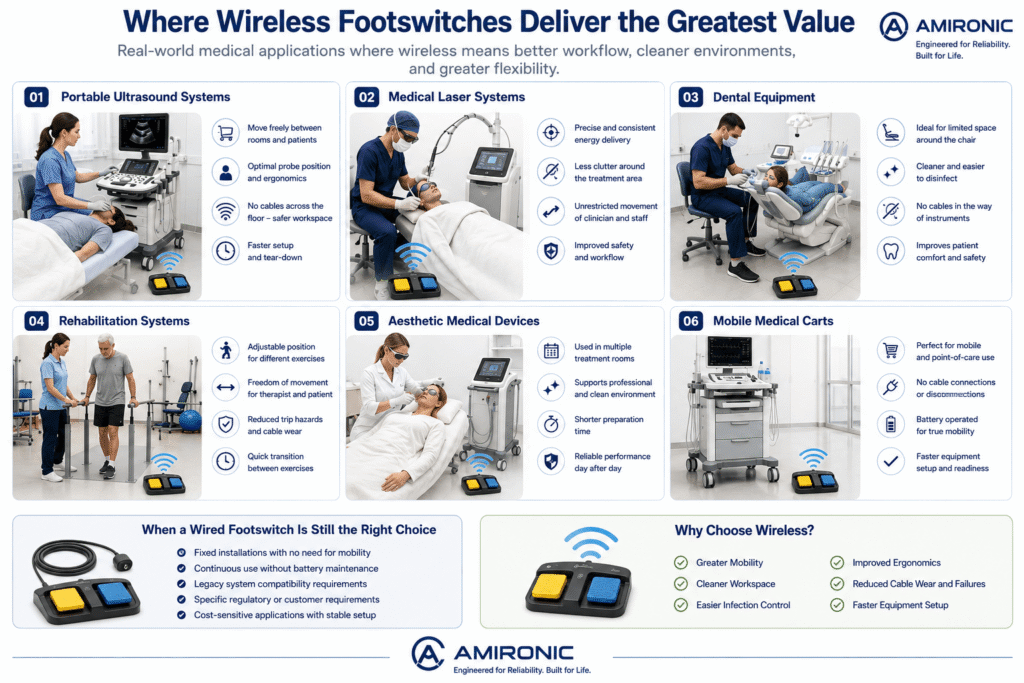
Not every medical system will benefit equally from switching to a wireless footswitch. In stationary equipment that remains in the same location for years, a wired footswitch may still be the simplest, most reliable, and most cost-effective solution.

However, as medical equipment becomes more portable and is moved more frequently between treatment rooms, the advantages of a wireless solution become increasingly significant.

Portable Ultrasound Systems

Portable ultrasound systems are routinely moved between examination rooms, hospital departments, and even operating rooms. A wireless footswitch allows clinicians to position the pedal wherever it is most comfortable, regardless of the orientation or location of the medical cart.

Medical Laser Systems

Medical laser procedures require precise and intuitive control, while the treatment area often contains numerous cables connected to the equipment. Eliminating the footswitch cable reduces workspace clutter and provides clinicians with greater freedom of movement.

Dental Equipment

Dental clinics typically operate in confined workspaces where every centimeter matters. A wireless footswitch helps maintain a cleaner, more organized treatment area while reducing cable interference around the dental chair.

Rehabilitation and Physiotherapy Equipment

During rehabilitation sessions, both the therapist and the patient frequently change position, and equipment may need to be repositioned throughout the treatment. A wireless footswitch allows the pedal to be placed wherever it is most convenient, without being restricted by cable length.

Aesthetic Medical Equipment

Aesthetic treatment systems are often moved between treatment rooms throughout the day. A wireless footswitch shortens setup time, simplifies workstation organization, and contributes to a cleaner, more professional clinical environment.

When Is a Wired Footswitch Still the Better Choice?

Despite the many advantages of wireless technology, there is no single solution that fits every application.

For permanently installed equipment, systems that are rarely moved, or applications where continuous operation without battery maintenance is preferred, a wired footswitch may still be the most appropriate choice.

Likewise, some medical systems are designed around a wired architecture or must comply with specific customer requirements or regulatory specifications that favor a wired interface.

Ultimately, the decision between a wired and a wireless footswitch should be based on the application’s operational requirements, clinical environment, and system architecture-not simply on the technology itself.

Figure 4. Wireless footswitches provide the greatest benefits in mobile medical equipment or systems that are frequently moved between treatment rooms, including portable ultrasound systems, medical laser equipment, dental systems, rehabilitation devices, and aesthetic medical equipment. In contrast, for permanently installed systems where mobility is not a requirement, a wired footswitch may still be the preferred solution.

Compliance with IEC 60601-1 and UL 60601-1

When selecting a footswitch for medical equipment, user convenience and communication technology are only part of the equation. One of the most important considerations is compliance with the relevant medical safety standards. Footswitches intended for medical applications should be integrated into systems designed to meet the requirements of IEC 60601-1, also recognized in certain markets as UL 60601-1, the internationally accepted standard defining the essential safety and performance requirements for medical electrical equipment.

Herga footswitches designed to comply with IEC 60601-1 / UL 60601-1 provide medical equipment manufacturers with confidence that they are selecting components specifically developed for healthcare applications. For OEMs, choosing components that meet these requirements can simplify system development, support verification and regulatory approval processes, and help reduce technical risks throughout the product development lifecycle.

Electromagnetic Compatibility (EMC) in Medical Environments

One of the most common concerns when integrating wireless devices into medical equipment is electromagnetic compatibility (EMC). Hospitals and healthcare facilities contain numerous electronic systems operating simultaneously, including Wi-Fi networks, Bluetooth devices, patient monitoring equipment, and other medical electronics. For this reason, selecting a wireless footswitch that has been designed to meet the appropriate EMC requirements is essential for reliable operation.

Herga’s Bluetooth platform utilizes modules that comply with the Radio Equipment Directive (RED) and relevant EMC standards, including EN 301 489-1, EN 301 489-17, and EN 61000-6-2. The medical version also complies with EN 60601-1-2, the standard covering electromagnetic compatibility for medical electrical equipment. Selecting components that are designed to meet these requirements helps OEM manufacturers develop more reliable systems while reducing technical and regulatory risks during product validation and certification.

How to Choose the Right Footswitch

Selecting between a wired and a wireless footswitch should not be based solely on the latest technology, but rather on the specific requirements of the application.

When specifying a footswitch for medical equipment, engineers should consider several key factors:

  • Is the equipment portable or permanently installed?
  • How frequently is the system moved between treatment rooms?
  • Is reducing cable clutter an important design objective?
  • What are the cleaning and infection control requirements?
  • Is ultra-low response time required?
  • What is the electromagnetic environment in which the system will operate?
  • Are there specific regulatory or customer requirements that must be satisfied?

Answering these questions early in the design process helps ensure the most appropriate solution is selected while minimizing costly redesigns later in the project.

Conclusion

Wireless footswitches are not intended to replace wired solutions in every application. However, for mobile medical equipment they offer significant advantages in ergonomics, workspace organization, infection control, maintenance, and overall system flexibility.

Advances in wireless communication technology have made it possible to achieve low latency, long battery life, secure communication, and high reliability, enabling wireless footswitches to meet the demands of many modern medical applications.

Ultimately, the right choice is not simply between a wired or wireless footswitch. It is about selecting the solution that best matches the application’s operational requirements, clinical environment, and long-term performance objectives.

Case Study – Upgrading a Portable Ultrasound System from a Wired to a Wireless Footswitch

Background

A manufacturer of portable ultrasound systems set out to improve the user experience, reduce service issues, and simplify the cleaning and disinfection of its equipment.

The original design utilized a conventional wired footswitch. Although reliable, years of field use revealed that the cable had become one of the system’s most vulnerable components due to frequent movement of the ultrasound cart between examination rooms, accidental foot traffic, and repeated bending during everyday operation.

The engineering team therefore evaluated replacing the wired solution with a wireless system based on the Herga 6210-BLE2-003 wireless transmitter and the Herga 6311 BLE USB Receiver.

Design Requirements

The development team established the following key design objectives:

Parameter Requirement
Operating range Minimum 10 m
Response time Less than 200 ms
Host interface USB Plug-and-Play
Operating system compatibility Windows, Linux, macOS
Power consumption As low as possible
Maintenance Simple battery replacement
Medical compliance UL 60601-1

Selected Solution

Herga 6210-BLE2-003 Wireless Transmitter

The selected wireless transmitter provides:

  • Typical operating range of 10 m
  • Up to 15 m line-of-sight range
  • Two selectable latency modes:
    • <100 ms
    • <200 ms
  • Ultra-low sleep current of only 1 µA
  • Powered by two AAA batteries
  • IPX7 battery compartment
  • Automatic wake-up when the pedal is pressed
  • Battery status indication
  • Redundant switching capability using an additional microswitch
  • UL 60601-1 approval (UL File E353500)

Herga 6311 BLE USB Receiver

The receiver features:

  • Driver-free USB Plug-and-Play connection
  • Compatibility with Windows, Linux, and macOS
  • Support for up to two wireless transmitters
  • Keyboard and mouse emulation
  • Up to three simultaneous keyboard commands
  • Selectable latency modes (<100 ms or <200 ms)
  • Power consumption of 20 mA at 5 VDC
  • Battery status indication
  • Automatic reconnection after sleep mode

Engineering Comparison

Parameter Wired Footswitch Wireless BLE Footswitch
Operating range Limited by cable length 10 m typical (15 m line-of-sight)
Response time Immediate <100 ms or <200 ms
Floor cable Required Eliminated
Trip hazard Present Significantly reduced
Cable wear Subject to mechanical damage Eliminated
Workspace cleaning More complex Easier
Equipment mobility Cable management required Unrestricted

Results

Replacing the wired footswitch with a wireless solution completely eliminated the cable between the pedal and the medical system, removing several common failure points.

Key improvements included:

  • Elimination of cable damage caused by bending, pulling, or crushing.
  • Removal of external connectors that could loosen or fail over time.
  • Flexible footswitch positioning within a 10-meter operating range, independent of cart location.
  • Automatic wake-up functionality that minimizes power consumption without compromising system availability.
  • An IPX7-rated battery compartment that allows quick battery replacement while maintaining protection against liquid ingress.
  • Compliance with UL 60601-1 and EN 60601-1-2, supporting integration into medical systems requiring electrical safety and EMC compliance.

Conclusion

For portable medical equipment, replacing a wired footswitch with a wireless solution is far more than a convenience upgrade. It reduces mechanical wear, improves workspace organization, simplifies cleaning and disinfection, and provides clinicians with greater operational flexibility.

With a wireless range of up to 15 meters, response times as low as 100 ms, ultra-low standby power consumption of just 1 µA, and compliance with UL 60601-1, Herga’s Bluetooth footswitch platform is well suited for portable ultrasound systems, medical laser equipment, rehabilitation devices, dental systems, and many other types of mobile medical equipment.

🧩 Further Reading

This article is part of a broader series exploring how footswitches function as critical human-machine control interfaces across medical and industrial systems. For additional technical context and application insights, you may also find the following articles useful:

  • HERGA Control Solutions: More Than a Footswitch – The Human Interface That Defines System Performance
  • HERGA Medical Footswitches: Engineering the Right Control Interface for Clinical Systems
  • HERGA Industrial Footswitches: Reliable Control Solutions for Harsh and High-Duty Environments
  • Pneumatic Footswitches in Medical and Aesthetic Equipment
  • Industrial Safety Footswitches: Reliable Machine Control for Heavy-Duty and High-Risk Environments
  • Wired vs Wireless (Bluetooth) Footswitches: When Does It Actually Matter?
  • Footswitches for Medical and Aesthetic Laser Systems – Not Just a Trigger, but a Critical Part of System Safety
  • Medical Footswitches for IEC / UL 60601-1 Systems – Safety, Reliability and Design Considerations Every Engineer Should Know
  • 6 Switching Technologies Every Systems Engineer Should Know – And How to Choose the Right One
  • Why Foot Switches Fail – And What Experienced OEM Designers Do Differently
  • Pneumatic Foot Bellows vs. Electrical Footswitch – Do You Really Need to Run Electricity to the Foot Pedal?
  • Momentary or Latching? How to Choose the Right Switch for Industrial, Medical, and OEM Applications
  • Why Did Your Footswitch Fail After Just Six Months – Even Though It Was Rated for One Million Operations?
  • USB Foot Pedals for Medical & Industrial Systems – Why the USB Connector Is Only Part of the Story
  • Don’t Design a New Footswitch – Build It from a Modular Platform

Frequently Asked Questions (FAQ)

Is a wireless footswitch as reliable as a wired footswitch?

Yes. Modern wireless footswitches designed for medical applications provide stable communication, low latency, and automatic reconnection if the system enters sleep mode. Herga wireless footswitches offer selectable response times of less than 100 ms or less than 200 ms, depending on the application requirements.

What is the operating range of a wireless footswitch?

The typical operating range is approximately 10 meters, with a line-of-sight range of up to 15 meters. Actual performance depends on the installation environment and any physical obstacles between the transmitter and receiver.

Is special software or a driver required?

No. The Herga USB receiver supports true Plug-and-Play operation and is compatible with Windows, Linux, and macOS without requiring additional drivers.

How is wireless communication reliability maintained?

The system utilizes Bluetooth Secure PAN (Personal Area Network) technology with secure pairing, automatic reconnection after sleep mode, battery status monitoring, and continuous communication between the transmitter and receiver.

How many footswitches can be connected to a single receiver?

The Herga 6311 BLE USB Receiver supports up to two wireless transmitters, depending on the system configuration.

Is the wireless footswitch suitable for medical equipment?

Yes. The Herga 6210-BLE2-003 is approved to UL 60601-1 (UL File E353500), complies with EN 60601-1-2, and has been developed according to the principles of ISO 14971 risk management, making it well suited for integration into medical equipment, subject to the approval of the complete medical system.

How is the wireless footswitch powered?

The footswitch is powered by two standard AAA batteries and features an ultra-low-power sleep mode with a standby current of only 1 µA, enabling exceptionally long battery life.

Which applications benefit most from wireless footswitches?

Wireless footswitches are particularly well suited for portable ultrasound systems, medical laser equipment, dental systems, rehabilitation devices, aesthetic medical equipment, and mobile medical carts, where reducing cable clutter improves mobility, ergonomics, workspace organization, and infection control.


Glossary

Wireless Footswitch

A foot-operated control device that communicates with the medical system wirelessly, eliminating the need for a physical cable between the pedal and the equipment.

Wired Footswitch

A foot-operated control device connected directly to the equipment through an electrical cable.

Bluetooth Low Energy (BLE)

A low-power wireless communication technology that enables reliable data transmission while minimizing battery consumption.

Latency

The time between pressing the footswitch and the corresponding action being executed by the medical system. Low latency contributes to a fast and natural user experience.

Secure PAN (Personal Area Network)

A secure wireless communication network established between the transmitter and receiver to prevent unauthorized connections while ensuring reliable communication.

Pairing

The initial process of securely linking the wireless transmitter and receiver so they can communicate exclusively with each other.

Plug-and-Play

The ability of a hardware device to operate immediately after connection without requiring additional software or driver installation.

Auto Wake-Up

A power-saving feature that automatically wakes the footswitch from sleep mode as soon as the pedal is pressed, ensuring immediate availability while maximizing battery life.

Redundant Function

A redundant switching capability that incorporates an additional switching channel or microswitch to improve reliability and safety in critical medical applications.

IPX7

A protection rating indicating that the device can withstand temporary immersion in water under specified conditions, providing protection against liquid ingress.

IEC 60601-1 / UL 60601-1

International medical safety standards defining the essential safety and performance requirements for medical electrical equipment.

EN 60601-1-2

The medical EMC standard specifying electromagnetic compatibility requirements for medical electrical equipment to ensure reliable operation in environments containing electromagnetic interference.

ISO 14971

An international standard describing the risk management process for medical devices throughout their entire product lifecycle.

OEM (Original Equipment Manufacturer)

A company that integrates components from multiple suppliers into a complete medical system marketed under its own brand.

Mobile Medical Equipment

Portable medical devices, including ultrasound systems, medical carts, laser equipment, and diagnostic instruments, designed to be moved between examination rooms, departments, or treatment areas.

Infection Control

The combination of engineering practices and clinical procedures intended to reduce the risk of contamination and cross-infection through effective cleaning and disinfection of medical equipment.

Tags: Herga

Related Articles

USB Foot Pedals for Medical & Industrial Systems – Why the USB Connector Is Only Part of the Story

21/07/2026amironicLTD

Revolutionizing Industrial Control Solutions in Israel

23/02/2025amironicLTD

Bluetooth foot switches for medical lasers

10/03/2019amironicLTD

Recent Posts

  • Why Wireless Footswitches Are Becoming the Standard in Mobile Medical Equipment
  • Why a Dual-Channel Rotary Position Sensor Is Not Just a Backup Sensor
  • Why Position Feedback Matters More Than Ever in Counter-UAS Swarm Defense
  • Why Military Power Distribution Is Becoming the New Battlefield
  • High-Energy Laser Interception – The Engineering Behind Stable Line of Sight, Power Delivery, and Thermal Management

Categories

  • Air Switch
  • Circuit Breakers
  • Elapsed Time Indicator
  • Feedthrough
  • Footswitches
  • Gears & Transmission
  • Hour Meters
  • Infra Red Switches
  • INFRARED LAMPS
  • Low Noise Inertial MEMS
  • Mechanics
  • MEMS Gyroscope
  • MEMS Inertial
  • Microelectronics
  • Motors
  • Position Sensors
  • Power Supply
  • Pressure Sensors
  • Pressure Switch
  • Temperature Sensors
  • Tungsten and Molybdenum
  • Uncategorized
  • Vacuum Switches

Quick Contact

Fill out the form and our representatives will return to you

    Name (required)

    Email (required)

    Phone

    Message

    This site is protected by reCAPTCHA and the Google
    Privacy Policy and
    Terms of Service apply.

    Amironic Ltd.

    3 Rabinovich Street, Petah Tikva 4928144 , Israel. Tel: +972-3-9047744 E-mail: office@amironic.co.il
    Email
    Facebook
    Twitter
    LinkedIn
    YouTube
    Press on the ISO Certificate below for download
    ISO 9001:2015 Certification
    • MEMS Inertial
    • Circuit Breakers
    • Footswitches
    • Mechanical & Transmisions
    • Sensors
    • Motors
    • Electronics
    • Hand Control
    • Power Solutions

    News

    • Why Wireless Footswitches Are Becoming the Standard in Mobile Medical Equipment
    • Why a Dual-Channel Rotary Position Sensor Is Not Just a Backup Sensor
    • Why Position Feedback Matters More Than Ever in Counter-UAS Swarm Defense
    • Why Military Power Distribution Is Becoming the New Battlefield
    • High-Energy Laser Interception – The Engineering Behind Stable Line of Sight, Power Delivery, and Thermal Management
    About AmironicContactעברית
    © 2022 Amironic All rights reserved. All Trademarks are the property of their respective owners.
    • Increase Font
    • Decrease Font
    • Black & White
    • Inverse Colors
    • Highlight Links
    • Regular Font
    • Reset