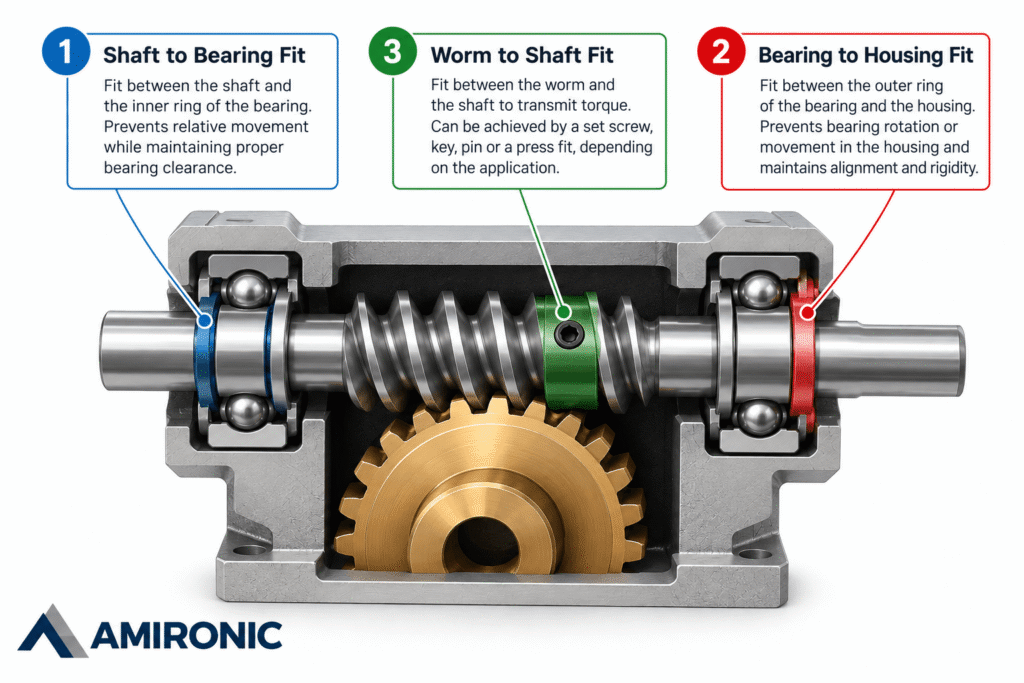
A difference of just 0.05 mm can turn a seemingly simple mechanical assembly into an engineering challenge. When designing a worm and worm wheel transmission (Worm & Worm Wheel), selecting the correct module, gear ratio, and materials is not enough. The fits between shafts, bores, and bearings must also be precisely defined.
The Problem: When a Solution Intended to Eliminate Mechanical Play Creates a New Problem
Consider an engineer designing a compact motion mechanism based on a worm and worm wheel transmission. The system includes two shafts supported by radial bearings with nominal inner diameters of 4 mm and 5 mm.
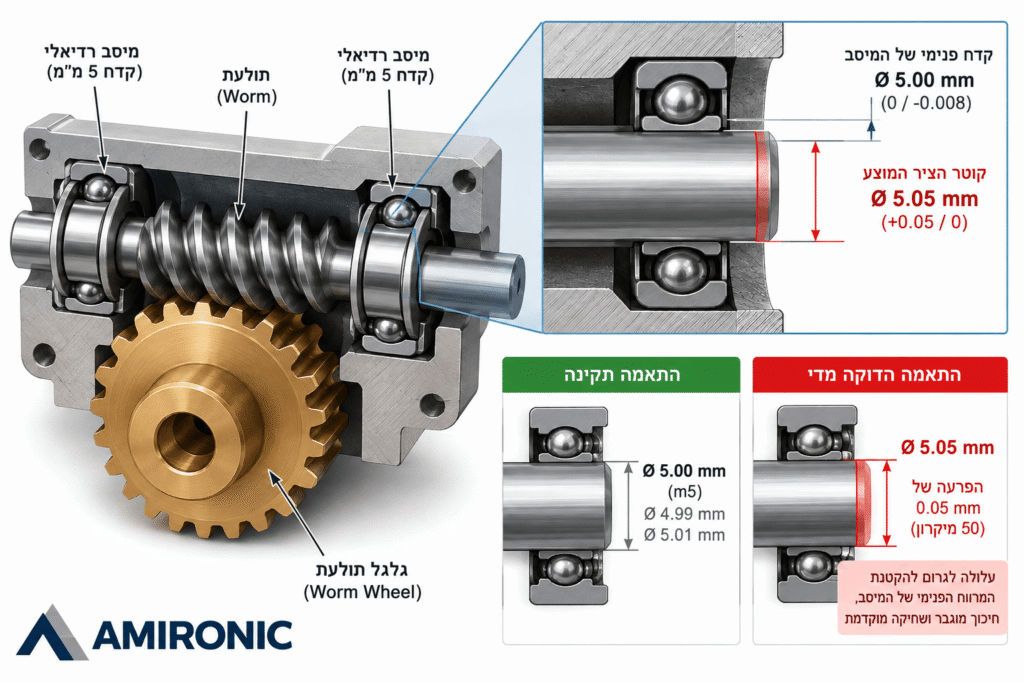
To ensure that the bearings remain securely mounted and do not slip on the shafts, the engineer decides to increase the shaft diameters to 4.05 mm and 5.05 mm, respectively.
At first glance, the reasoning seems straightforward: if the shaft is slightly larger than the bearing bore, an interference fit will be created, keeping the bearing firmly in place.
However, this is precisely where the problem begins.
A nominal difference of 0.05 mm may sound insignificant, but in a small bearing, it represents 50 microns. Such an interference can be substantially greater than the permissible interference for bearing installation.
When the bearing’s inner ring is pressed onto an oversized shaft, it may expand, reducing the bearing’s internal clearance. The potential consequences include increased friction, overheating, premature wear, and even bearing damage during assembly.
The problem is not necessarily the use of an interference fit, but rather selecting the amount of interference without considering manufacturing tolerances, bearing type, and the manufacturer’s recommendations.
The engineering takeaway: A tighter fit is not necessarily a better fit.