flagעברית
flagEnglish
3 Rabinovich St., Petah-Tikva, Israel
+972 3 9047744
office@amironic.co.il
Facebook
Twitter
LinkedIn
YouTube
  • Products
    • MEMS Inertial
      • Gyros & Accels
      • IMU
      • Inertial Navigation
      • AHRS
    • Circuit Breakers
      • Airpax Circuit Breakers
      • Electronic Circuit Breakers
      • Aircraft Circuit Breakers
      • Thermal Circuit Breakers
      • Sealing Solutions & Guards
    • Footswitches
      • Pedals & Bellows
      • USB
      • Air Switches
      • Medical
      • Modular Bases System
      • Industrial
      • Foot Potentiometers
      • Wireless
    • Mechanical & Transmisions
      • Gears
      • Sealing Solutions
      • Gearboxes
      • Couplings
      • Shafts & Bearings
      • Fasteners
      • Mechanical & Springs
      • Linear Motion
      • Anti-Vibration
    • Sensors
      • Thermostats
      • Temperature
      • Position
      • Pressure
      • Speed
      • Level Sensor
      • Load Cells
      • Flex Sensors
      • Membrane Potentiometer
    • Motors
      • Geared DC
      • Brushless DC
      • Step Motors with Gearbox
      • Torque Motors & Brushless Servo
      • AC Motors
      • DC Motors
    • Electronics
      • Xenon & IR Lamps
      • Counters & Meters
      • Microelectronics Packaging
      • Waterproof Switches
      • Micro Switches
    • Hand Control
      • Operator Controls (JOYSTICK)
      • Electrical
      • Pneumatic (Medical)
      • USB Hand Control
      • Air Push Button
      • Pressure Switch
      • IR Switch
    • Power Solutions
      • Rugged & Military Power Supply
      • Input Power Protection
      • Sealed Military Power Adaptor
      • Triple Output Military Power Supply Series – up to 250 W
    • Materials
      • Molybdenum and Advanced Alloys (TZM, MOLA, HCT)
      • Tungsten (Wolfram) and Advanced Alloys – High-Performance Materials for Extreme Conditions
      • Materials for Gears
  • Shop
  • Companies
  • About Amironic
  • News
  • Contact
Product was added to your cart

Cart

waze

Circuit Breaker or Control Device? Why Military Circuit Breakers Do More Than Protect

Circuit Breakers02/07/2026amironicLTD

🧩 Further Reading:
To place this comparison in a broader engineering context, it is recommended to review the earlier articles in this series. These provide deeper insight into the MIL-PRF-39019 specification, the behavior and importance of trip curves in hydraulic-magnetic circuit breakers, and the real-world challenges of power protection in rugged military and aerospace platforms.

  • MIL-PRF-39019 Circuit Breakers: Selection, Trip Curves, and Aerospace Power Protection
  • Why M39019 Is Not Just a Standard – It’s an Identity
  • Understanding Trip Curves in Hydraulic-Magnetic Circuit Breakers
  • Power Protection in Military Ground Platforms: Electrical Stability Under Vibration, Shock, and 28V Vehicle Systems
  • The Airpax AP Series: The Engineering Logic Behind a Hydraulic-Magnetic Circuit Breaker That Became a Military Standard
  • Hydraulic-Magnetic vs Thermal Circuit Breakers
  • Airpax IULN and IUGN Circuit Breakers: Sealed Hydraulic-Magnetic Protection for Rugged Electronic Systems
  • How Engineers Choose Between Airpax AP, IUL, IUG, and Commercial Circuit Breakers
  • SNAPAK Circuit Protectors: When Circuit Protection Becomes a User Interface
  • DIN Rail Circuit Breakers – Why Industrial Systems Demand More Than a Standard MCB
  • Why MIL-PRF-39019 Circuit Breakers Still Appear in New Defense Programs
  • Why a 10A Circuit Breaker Is Not Always Suitable for a 10A Load
  • Keeping Data Centers Running: The Role of Circuit Protection

Circuit Breaker or Control Device? Why a Circuit Breaker Is No Longer Just a Protective Device in Military Systems

A weapon system has successfully completed its test sequence.

The controller issues a STOP command.

All relays open.

The HMI indicates that everything is normal.

The system appears to be OFF.

But it isn’t.

The power bus is still energized.

All it takes is a single fault, an incorrect command sequence, or a maintenance error for a circuit that should have been isolated to remain live.

In military systems, assumptions are unacceptable.

You don’t assume that a relay actually opened.

You don’t assume that a software command was successfully executed.

And you certainly don’t assume that a system is de-energized simply because the HMI displays “OFF.”

Critical systems require a physical disconnection of the power source, and in many cases, positive confirmation that the disconnection has actually occurred.

This is one of the reasons why, in modern military platforms, a circuit breaker is no longer viewed as merely a protective device.

It has become an integral part of the control system.


When the Circuit Breaker Becomes Part of the System Architecture

At first glance, the role of a circuit breaker seems straightforward: protect the circuit against overloads and short circuits.

However, in military vehicles, naval platforms, radar systems, communications equipment, EO/IR systems, and airborne electronics, the design requirements extend far beyond overcurrent protection.

The question is no longer simply:

“At what current will the breaker trip?”

Engineers must also consider:

  • Can the breaker be tripped remotely?
  • Can the control system verify that it has actually opened?
  • Can it be integrated into an Emergency Stop function?
  • Can it participate in automated startup and shutdown sequences?
  • Will it operate reliably for years under shock, vibration, and extreme temperatures?

At this point, the circuit breaker is no longer a passive protective component.

It becomes an active element of the control architecture.


Shunt Trip – When the Control System Must Disconnect Power

There are situations where waiting for an operator to reach the electrical panel simply isn’t an option.

For example:

  • Overtemperature conditions
  • Secondary short circuits
  • Smoke or fire detection
  • Propulsion system failures
  • Weapon system faults
  • Emergency shutdown procedures

In these situations, the control system can energize the Shunt Trip coil.

Within milliseconds, the breaker mechanically opens and physically disconnects the power source.

Not just a software stop.

Not just an open relay.

A true physical isolation of electrical power.


Auxiliary Contacts – Knowing What Actually Happened

Sending a command is one thing.

Knowing that it was executed is something entirely different.

In mission-critical applications, the control system must receive reliable confirmation that the circuit breaker has actually opened.

Auxiliary Contacts provide mechanical position feedback, allowing the control system to:

  • Verify that power has been disconnected
  • Report breaker status to the mission computer or PLC
  • Log events and maintenance records
  • Prevent the next operational sequence if the breaker remains open
  • Improve overall functional safety

In other words, the system no longer relies solely on the command that was sent.

It knows the actual state of the breaker.


A Circuit Breaker That Protects — and Participates

For this reason, selecting a circuit breaker for military applications is no longer based solely on current rating, trip curve, or interrupting capacity.

System engineers also ask questions such as:

  • Can the breaker be controlled remotely?
  • Does it provide reliable position feedback?
  • Can it be integrated into the system control architecture?
  • Will it meet the environmental and reliability requirements of the platform?
  • Can it serve as part of the functional safety strategy rather than merely protecting the circuit?

When the answer to these questions is yes, the circuit breaker ceases to be just another component inside the electrical panel.

It becomes an integral part of the control system itself.

And in modern military platforms, that distinction is often what separates a system that simply works from one that can truly be trusted.

Step Action
1 Mission Computer / PLC sends a 24VDC Trip Command
2 The Shunt Trip Coil mechanically trips the circuit breaker
3 The 3-Pole Hydraulic-Magnetic Circuit Breaker disconnects the 28VDC Bus
4 Power to the Critical Loads is removed
5 The Auxiliary Contact sends breaker status feedback to the Mission Computer

Case Study – Emergency Power Isolation in a 28VDC Military Vehicle System

The Application

A military vehicle’s electronic subsystem distributed 28VDC power to several mission-critical loads through a 3-pole, 40A hydraulic-magnetic circuit breaker.

The system design required:

  • Overcurrent protection
  • Remote power disconnect in the event of a fault
  • Positive confirmation that power had actually been removed before maintenance or subsequent system operations

The Challenge

In the original design, an Emergency Stop command deactivated all loads by opening several power relays.

From the software’s perspective, the system was OFF.

However, the primary 28VDC power source remained connected.

For a mission-critical military platform, this was not sufficient. During maintenance, troubleshooting, or emergency shutdown procedures, engineers needed to ensure that the power source itself was physically disconnected—not merely that the loads had stopped operating.

In addition, the mission computer required positive confirmation that power had actually been isolated before allowing the system to transition into maintenance mode or continue with the next operational sequence.


The Solution

Rather than relying solely on power relays, the design incorporated a 3-pole, 40A hydraulic-magnetic circuit breaker equipped with:

  • 24VDC Shunt Trip
  • Auxiliary Contact

When a fault condition was detected or an Emergency Stop was activated, the mission computer energized the 24VDC Shunt Trip.

The breaker immediately opened all three poles, physically disconnecting the 28VDC power bus from the downstream loads.

Once the breaker reached the open position, the Auxiliary Contact changed state and provided positive status feedback to the mission computer.

Only after receiving this confirmation did the control software allow the system to proceed to maintenance mode or continue the programmed shutdown sequence.


The Results

  • Physical isolation of the 28VDC power source
  • Remote breaker operation directly from the control system
  • Positive confirmation of breaker status through the Auxiliary Contact
  • Improved maintenance safety and system reliability
  • Integration of the circuit breaker as an active component of the control architecture rather than solely an overcurrent protection device
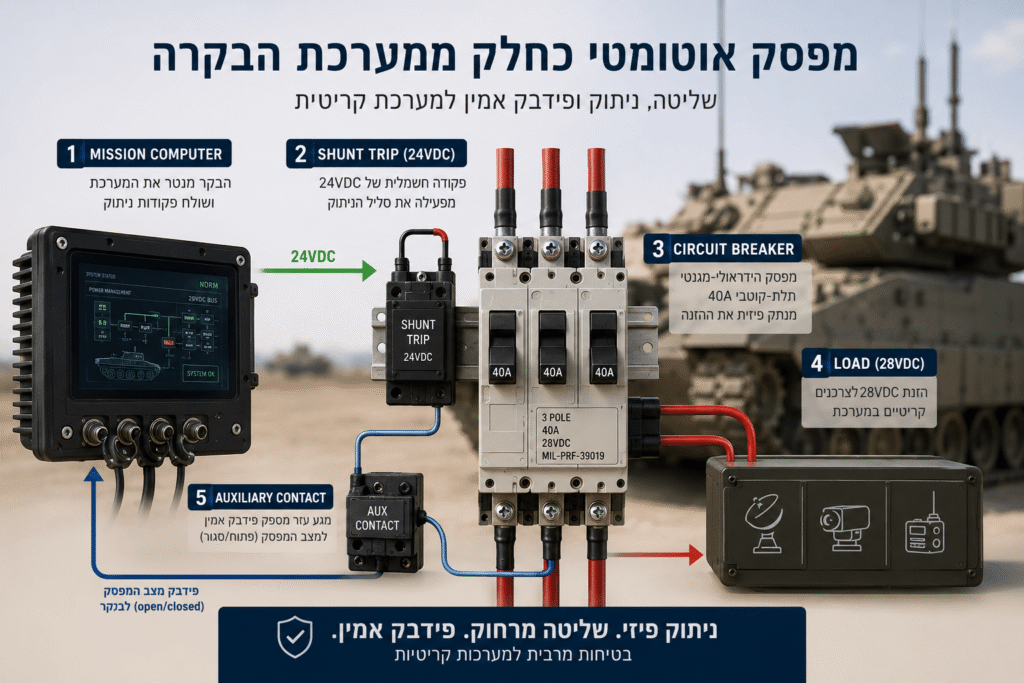
How Does a Circuit Breaker Become Part of the Control System?

The diagram illustrates the operating principle of a typical control architecture. The Mission Computer or PLC sends a 24VDC control signal to the Shunt Trip coil, causing the circuit breaker to open and physically disconnect power from the downstream loads.

At the same time, the Auxiliary Contact provides mechanical position feedback (Open/Closed) to the controller, allowing the control system to verify the actual status of the breaker rather than relying solely on the command that was issued.

This creates a closed-loop control system, where the circuit breaker serves not only as an overcurrent and short-circuit protection device, but also as an active component of the system’s control and safety architecture.


💡 In Simple Terms

  • The controller sends a trip command.
  • The circuit breaker physically disconnects power.
  • The Auxiliary Contact confirms that the breaker has actually opened.

That is the difference between a system that assumes the circuit has been disconnected and one that knows it has.

Frequently Asked Questions (FAQ)

Does a Shunt Trip replace overcurrent protection?

No. A Shunt Trip is designed to intentionally trip the circuit breaker in response to an external control signal. Protection against overloads and short circuits continues to be provided by the breaker’s internal protection mechanism.


Can a Shunt Trip be used as part of an Emergency Stop system?

Yes. In many applications, the Emergency Stop (E-Stop) function energizes the Shunt Trip, causing the circuit breaker to physically disconnect the power source rather than simply stopping the control logic.


What is the purpose of an Auxiliary Contact?

An Auxiliary Contact provides mechanical position feedback indicating whether the circuit breaker is open or closed. This allows the control system to verify the actual status of the breaker instead of relying solely on the command that was issued.


Why isn’t a relay or contactor sufficient?

Relays and contactors are primarily designed for switching electrical loads. They do not replace a circuit breaker, which provides both overcurrent protection and the ability to safely isolate the circuit when required.


Can a circuit breaker include both a Shunt Trip and an Auxiliary Contact?

Yes. Many circuit breakers can be equipped with both accessories, allowing them to be remotely tripped while simultaneously providing reliable status feedback to the control system.


Where is this type of solution commonly used?

Applications include military vehicles, armored platforms, naval systems, aerospace equipment, communications systems, EO/IR systems, robotic platforms, and any application requiring a combination of circuit protection, remote operation, and reliable status feedback.


Can a Shunt Trip open the breaker even when there is no overcurrent?

Yes. That is precisely its purpose. Energizing the Shunt Trip causes the circuit breaker to open regardless of the load current, in response to a command from the control system.


Does the Auxiliary Contact carry the load current?

No. An Auxiliary Contact is a low-power signaling contact intended for status indication to a PLC, mission computer, or other control system. It is not designed to carry the main load current.

Tags: Airpax

Related Articles

Auxiliary Switch – The Eyes of the Circuit Breaker

05/11/2025amironicLTD

Trip Coil – Turning a Standard Breaker into a Smart Relay

25/10/2025amironicLTD

MIL-PRF-39019 Circuit Breakers: Selection, Trip Curves, and Aerospace Power Protection

25/02/2026amironicLTD

Recent Posts

  • Your Image Still Shakes Despite Choosing a Gyroscope with Excellent Bias Stability
  • Circuit Breaker or Control Device? Why Military Circuit Breakers Do More Than Protect
  • Measuring Pressure Without Temperature Is Only Half the Picture
  • Why a Smaller IMU Can Save Months of Development
  • Hour Meter: Why Machines with Advanced PLCs Still Need One

Categories

  • Air Switch
  • Circuit Breakers
  • Elapsed Time Indicator
  • Feedthrough
  • Footswitches
  • Gears & Transmission
  • Hour Meters
  • Infra Red Switches
  • INFRARED LAMPS
  • Low Noise Inertial MEMS
  • Mechanics
  • MEMS Gyroscope
  • MEMS Inertial
  • Microelectronics
  • Motors
  • Position Sensors
  • Power Supply
  • Pressure Sensors
  • Pressure Switch
  • Temperature Sensors
  • Tungsten and Molybdenum
  • Uncategorized
  • Vacuum Switches

Quick Contact

Fill out the form and our representatives will return to you

    Name (required)

    Email (required)

    Phone

    Message

    This site is protected by reCAPTCHA and the Google
    Privacy Policy and
    Terms of Service apply.

    Amironic Ltd.

    3 Rabinovich Street, Petah Tikva 4928144 , Israel. Tel: +972-3-9047744 E-mail: office@amironic.co.il
    Email
    Facebook
    Twitter
    LinkedIn
    YouTube
    Press on the ISO Certificate below for download
    ISO 9001:2015 Certification
    • MEMS Inertial
    • Circuit Breakers
    • Footswitches
    • Mechanical & Transmisions
    • Sensors
    • Motors
    • Electronics
    • Hand Control
    • Power Solutions

    News

    • Your Image Still Shakes Despite Choosing a Gyroscope with Excellent Bias Stability
    • Circuit Breaker or Control Device? Why Military Circuit Breakers Do More Than Protect
    • Measuring Pressure Without Temperature Is Only Half the Picture
    • Why a Smaller IMU Can Save Months of Development
    • Hour Meter: Why Machines with Advanced PLCs Still Need One
    About AmironicContactעברית
    © 2022 Amironic All rights reserved. All Trademarks are the property of their respective owners.
    • Increase Font
    • Decrease Font
    • Black & White
    • Inverse Colors
    • Highlight Links
    • Regular Font
    • Reset