flagעברית
flagEnglish
3 Rabinovich St., Petah-Tikva, Israel
+972 3 9047744
office@amironic.co.il
Facebook
Twitter
LinkedIn
YouTube
  • Products
    • MEMS Inertial
      • Gyros & Accels
      • IMU
      • Inertial Navigation
      • AHRS
    • Circuit Breakers
      • Airpax Circuit Breakers
      • Electronic Circuit Breakers
      • Aircraft Circuit Breakers
      • Thermal Circuit Breakers
      • Sealing Solutions & Guards
    • Footswitches
      • Pedals & Bellows
      • USB
      • Air Switches
      • Medical
      • Modular Bases System
      • Industrial
      • Foot Potentiometers
      • Wireless
    • Mechanical & Transmisions
      • Gears
      • Sealing Solutions
      • Gearboxes
      • Couplings
      • Shafts & Bearings
      • Fasteners
      • Mechanical & Springs
      • Linear Motion
      • Anti-Vibration
    • Sensors
      • Thermostats
      • Temperature
      • Position
      • Pressure
      • Speed
      • Level Sensor
      • Load Cells
      • Flex Sensors
      • Membrane Potentiometer
    • Motors
      • Geared DC
      • Brushless DC
      • Step Motors with Gearbox
      • Torque Motors & Brushless Servo
      • DC Motors
    • Electronics
      • Xenon & IR Lamps
      • Counters & Meters
      • Microelectronics Packaging
      • Waterproof Switches
      • Micro Switches
    • Hand Control
      • Operator Controls (JOYSTICK)
      • Electrical
      • Pneumatic (Medical)
      • USB Hand Control
      • Air Push Button
      • Pressure Switch
      • IR Switch
    • Power Solutions
      • Rugged & Military Power Supply
      • Input Power Protection
      • Sealed Military Power Adaptor
      • Triple Output Military Power Supply Series – up to 250 W
    • Materials
      • Molybdenum and Advanced Alloys (TZM, MOLA, HCT)
      • Tungsten (Wolfram) and Advanced Alloys – High-Performance Materials for Extreme Conditions
      • Materials for Gears
  • Shop
  • Companies
  • About Amironic
  • News
  • Contact
Product was added to your cart

Cart

waze

MIL-STD-704 – Power Supplies for Military and Aerospace Systems

Power Supply02/09/2026amironicLTD

Aircraft electrical systems present significantly different requirements compared with conventional industrial electrical systems.

When an electronic system is powered from the electrical network of an aircraft, helicopter, or other airborne platform, knowing that the nominal supply voltage is, for example, 28VDC is not enough.

In practice, airborne equipment may be exposed to voltage variations, voltage dips, surges, disturbances, and other electrical events occurring during system startup, switching between power sources, load changes, and different operating conditions of the electrical system.

This is where MIL-STD-704 comes into play.

MIL-STD-704 is a U.S. military standard that defines the electrical power characteristics at the interface between the aircraft electrical power system and the electrical and electronic equipment connected to it.

The standard addresses characteristics such as:

  • Voltage levels
  • Frequency
  • Voltage and frequency variations
  • Ripple
  • Transients
  • Abnormal operating conditions
  • Short-duration power disturbances and interruptions

Therefore, when selecting a Power Supply or DC-DC Converter for an airborne system, the nominal input voltage is only the starting point.

The solution must be suitable for the actual electrical environment in which it is expected to operate.

What Is MIL-STD-704?

MIL-STD-704 defines aircraft electrical power characteristics and the electrical conditions that connected equipment may encounter at its interface with the aircraft power system.

The standard covers several types of aircraft electrical power systems, including:

  • 28VDC
  • 270VDC
  • 115VAC at 400Hz
  • Variable-frequency AC systems

It is important to understand that MIL-STD-704 is not a specification for a particular power supply.

It defines the electrical environment at the interface between the aircraft and its equipment, and from this environment come the requirements that the power supply, DC-DC converter, or input protection system must be able to handle.

For example, a converter specified for a nominal 28VDC input is not automatically suitable for an aircraft electrical system based on 28VDC.

The reason is simple: 28VDC is a nominal value, not a complete description of the electrical environment.

A converter intended for an airborne system must be selected according to the input voltage ranges and electrical conditions relevant to the application, rather than solely according to the nominal voltage stated in the system specification.

Aircraft Electrical Environment – Much More Than Nominal Voltage

One of the most common mistakes when selecting a power supply or DC-DC converter for an airborne system is considering only the nominal supply voltage.

If the system is specified as 28VDC, it is easy to assume that a converter designed for a 28VDC input will be sufficient.

In practice, the aircraft electrical system is dynamic.

The voltage supplied to the equipment may vary due to different aircraft operating conditions, load changes, system startup, switching between power sources, and other electrical events.

MIL-STD-704 is intended, among other things, to define the characteristics of this electrical environment in order to ensure compatibility between the aircraft electrical power system and the equipment connected to it.

Steady-State vs. Transient Conditions

It is important to distinguish between two main types of electrical conditions.

Steady-State Conditions are conditions in which voltage and frequency remain relatively stable over time.

Even under these conditions, however, the voltage is not necessarily a fixed and precise value. Equipment intended for a 28VDC system must be designed for the input range relevant to the application, rather than for a single 28V operating point.

Transient Conditions, on the other hand, are short-duration events during which the voltage may deviate significantly from normal operating conditions.

Such events may occur, for example, as a result of:

  • Load switching
  • Switching or transfer between electrical power sources
  • Starting motors or other systems
  • Load disconnection
  • Dynamic behavior within the electrical power generation and distribution system

From the power supply’s perspective, the difference is significant.

A converter may operate perfectly at 28VDC under laboratory conditions and still be unsuitable for an airborne system if it cannot handle the dynamic electrical conditions present on the power bus.

Voltage Surges, Dips, Transients and Interruptions

When selecting a Power Supply or DC-DC Converter for an aerospace system, it is important to examine how the solution behaves when the input voltage is outside normal operating conditions.

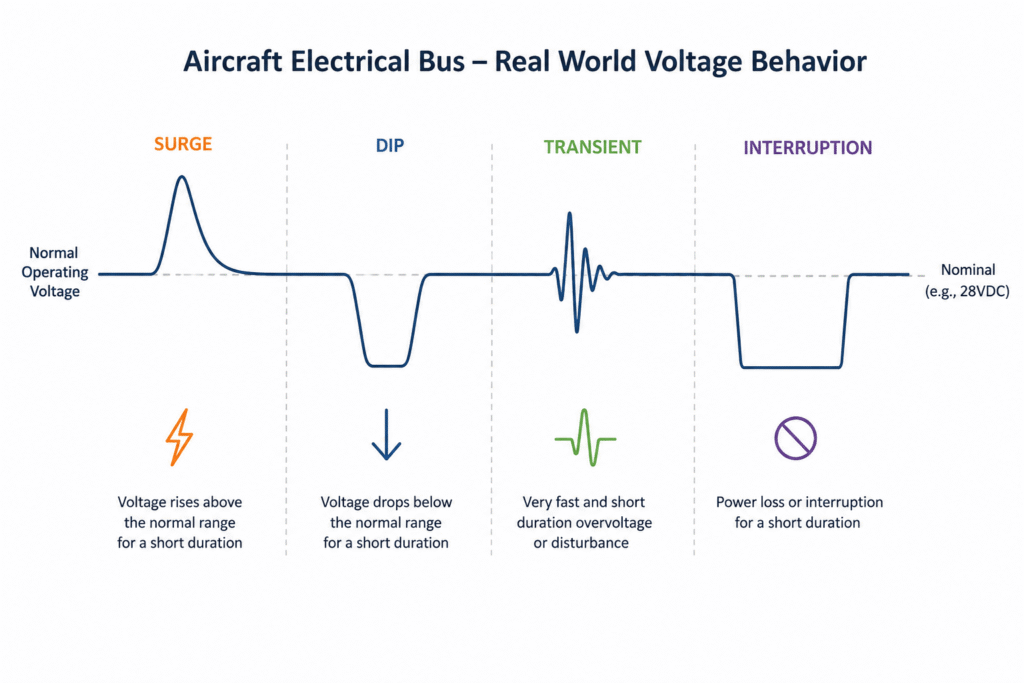
Voltage Surge

A surge is a condition in which the input voltage rises above its normal operating range for a certain period of time.

The solution must be designed so that the event does not damage components, cause power supply failure, or result in an abnormal voltage being passed to the equipment powered by the supply.

Voltage Dip

A voltage dip is a temporary reduction in the supply voltage.

The question here is not only whether the power supply can survive the event, but also whether it is required to continue providing a regulated output throughout the event.

Transient

A transient is a rapid, short-duration change in voltage.

Although such an event may be very brief, it can reach levels outside the acceptable input range of a conventional DC-DC converter and may therefore require appropriate input protection.

Power Interruption

Under certain conditions, a short interruption of the electrical power supply may occur.

If the system is required to continue operating without a reset or loss of data, an appropriate Hold-Up solution or stored energy within the power system may be required.

This leads to an important principle:

Survive and Operate are not the same thing.

A power supply may be designed to survive a particular electrical event without damage, but this does not necessarily mean that it will continue to provide a regulated output throughout the event.

Therefore, when selecting a power supply for a critical system, it is important to determine not only which input conditions it can survive, but also what the system is required to do during each event.

Selecting a Power Supply or DC-DC Converter for a MIL-STD-704 System

When selecting a power supply or DC-DC converter for an airborne system, the question is not simply:

“What is the input voltage?”

The right question is:

“What electrical environment must the converter be designed for, and what is it required to do during each electrical event?”

Several key parameters should therefore be considered.

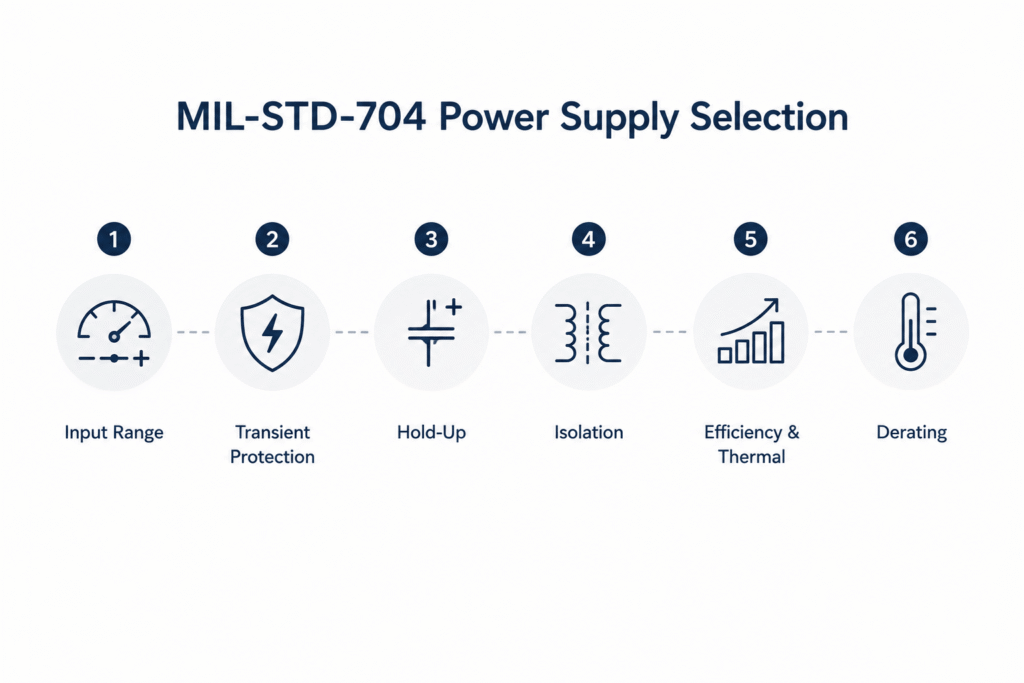
1. Input Voltage Range

The first step is to verify the converter’s continuous input voltage range.

For a 28VDC system, for example, a converter should not be selected simply because its datasheet states “28VDC Input.”

The complete input range over which the converter can operate and provide the required output voltage and power must be examined.

It is also important to distinguish between:

  • Continuous Operating Range – the range over which the converter is designed to operate continuously
  • Transient / Survival Range – abnormal input conditions that the converter can withstand or survive
  • Full Performance Range – the range over which the required output performance is guaranteed

These ranges are not necessarily the same.

2. Protection Against Transients and Surges

Short-duration voltage events can exceed the normal input range of a DC-DC converter.

An aerospace power solution may therefore include protection components or a dedicated Front-End designed to prevent abnormal input events from reaching the power conversion stage directly.

Depending on the application, such a solution may include functions such as:

  • Voltage limiting
  • Filtering
  • Overvoltage protection
  • Overcurrent protection
  • Reverse polarity protection, when required
  • Disconnection or blocking under abnormal input conditions

The objective is not only to protect the power supply itself, but also to prevent an input event from affecting the powered system in an uncontrolled manner.

3. Hold-Up and Continuity of Operation

In some systems, the equipment must continue operating during a voltage dip or short power interruption.

In such cases, the converter’s ability to survive the event is not enough.

It is necessary to determine whether Hold-Up Time is required, meaning the ability to maintain the output voltage for a defined period when the input voltage drops or disappears.

Such a requirement can significantly affect the power supply design, capacitor size, power density, and the physical dimensions of the solution.

4. Electrical Isolation

Many airborne applications require electrical isolation between the input and output of the power supply.

When isolation is required, it is important to consider not only whether the converter is specified as isolated, but also:

  • Isolation voltage
  • How the isolation rating is defined
  • Grounding requirements
  • Leakage current
  • The overall electrical system architecture

Isolation should be selected as part of the overall system architecture rather than treated as a standalone converter feature.

5. Efficiency and Thermal Management

High efficiency is particularly important in airborne systems.

Every Watt lost in the power supply ultimately becomes heat that must be dissipated.

In systems with weight, space, and airflow limitations, even a difference of a few percentage points in efficiency can have a significant impact on the thermal design.

Efficiency should therefore be evaluated not only at a single operating point, but under the actual input voltage, load, and temperature conditions expected in the application.

6. Operating Temperature and Derating

Aerospace systems may be required to operate over a wide temperature range.

It is important to ensure that the power supply can deliver the required power at the relevant operating temperature rather than relying only on the maximum power rating shown on the datasheet.

For example, a power supply rated at 300W may not necessarily be capable of delivering 300W at every temperature or without specified cooling conditions.

The manufacturer’s derating curves and cooling requirements should therefore be carefully reviewed.

Does a “MIL-STD-704 Compliant” Power Supply Really Meet the Standard?

Terminology matters here.

MIL-STD-704 defines the electrical power characteristics at the interface between the aircraft electrical system and the equipment connected to it.

Therefore, the statement “MIL-STD-704 Compliant” alone is not always sufficient to determine whether a product is suitable for a particular application.

When a manufacturer claims compliance with MIL-STD-704, it is recommended to verify:

  • Which revision of the standard the statement refers to
  • Which type of electrical power system it applies to
  • Which conditions and events were tested
  • Whether actual testing was performed or compliance is based on design analysis
  • Whether the product continues to operate during the event or merely survives it without damage
  • Whether any external components or conditions are required to achieve compliance

This is particularly important when comparing several power supplies that appear, on paper, to be “MIL-STD-704 compliant.”

Two similar statements on datasheets do not necessarily represent the same level of performance or the same scope of testing.

MIL-STD-704 Is Not Enough on Its Own

Meeting the electrical power environment requirements of MIL-STD-704 does not automatically mean that a power supply meets all the requirements applicable to a military or aerospace product.

In a real system, several standards may apply simultaneously, with each addressing a different aspect of the system.

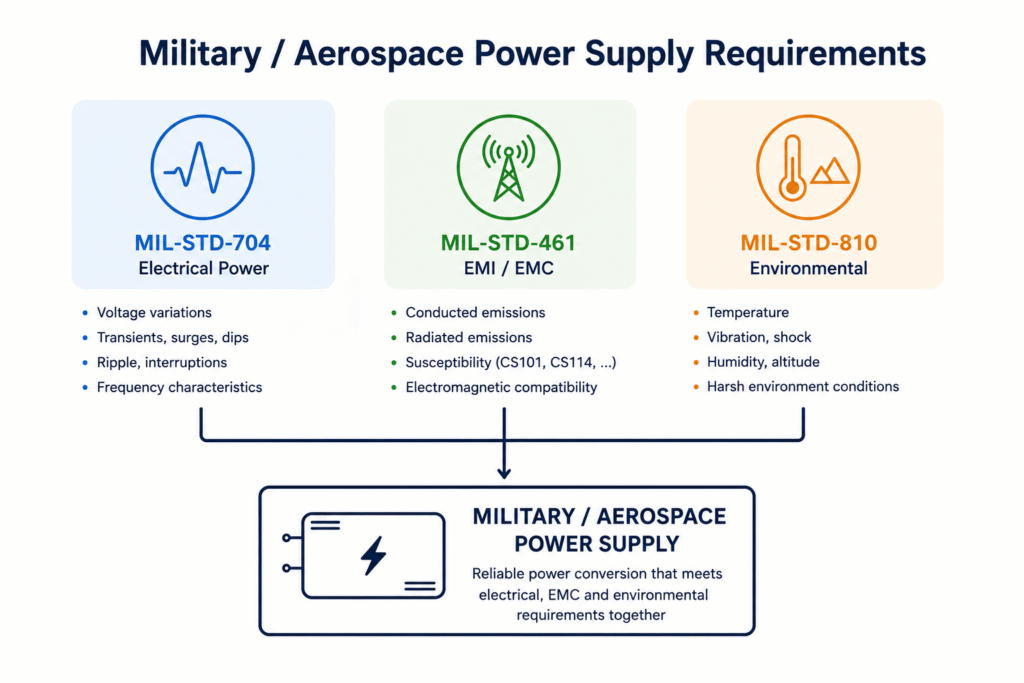
Three standards are particularly important in the context of power supplies for airborne systems:

  • MIL-STD-704 – Aircraft electrical power environment
  • MIL-STD-461 – Electromagnetic compatibility, EMI/EMC
  • MIL-STD-810 – Environmental conditions such as temperature, vibration, shock, and altitude

Therefore, stating that a power supply is suitable for MIL-STD-704 does not, by itself, mean that it also meets MIL-STD-461 or MIL-STD-810.

MIL-STD-704 vs. MIL-STD-461

MIL-STD-704 addresses the electrical power characteristics that equipment receives from the aircraft electrical system.

MIL-STD-461 addresses a different issue: electromagnetic interference and the way military equipment generates and is affected by electromagnetic disturbances.

This distinction is particularly important for switching power supplies.

A power supply or DC-DC converter can itself be a potential source of electrical noise. Switching operation can generate conducted and radiated emissions, so a solution that handles MIL-STD-704 transients effectively may still require additional filtering to meet the system’s EMI/EMC requirements.

The reverse is also true: a power supply with good EMI performance is not necessarily protected against the electrical events associated with the MIL-STD-704 environment.

In simple terms:

MIL-STD-704 primarily addresses what the equipment receives through the electrical power system.

MIL-STD-461 addresses the electromagnetic interaction between the equipment and its environment.

In a separate article in this series, we will discuss MIL-STD-461 requirements for power supplies, including the specific challenges associated with Conducted Susceptibility tests such as CS101.

MIL-STD-704 vs. MIL-STD-810

MIL-STD-810 addresses the physical and environmental conditions under which military equipment may be required to operate or survive.

Depending on the application and the relevant test methods, these may include:

  • High and low temperatures
  • Temperature changes
  • Vibration
  • Shock
  • Humidity
  • Altitude and low pressure
  • Other environmental conditions

A power supply may therefore be electrically suitable for the MIL-STD-704 environment while still being mechanically or environmentally unsuitable for installation in a particular aircraft.

For an airborne system, the complete picture must be considered: Electrical + EMC + Environmental.

MIL-STD-704 vs. MIL-STD-1275

MIL-STD-704 and MIL-STD-1275 are often mentioned together because both directly affect the design of the power input stage of military equipment.

However, they apply to different platforms.

MIL-STD-704 addresses electrical power characteristics in aircraft systems.

MIL-STD-1275 addresses the electrical power environment of 28VDC military ground vehicle systems.

Despite the differences between the standards, the basic engineering principle is similar in both cases:

A power supply or DC-DC converter should not be selected solely according to the platform’s nominal voltage.

The complete electrical environment to which the product input will be exposed must be considered.

In some applications, there is even a requirement for a single Power Conversion solution capable of addressing requirements derived from both MIL-STD-704 and MIL-STD-1275.

Such a solution may be relevant, for example, when the same electronic unit is intended for use on multiple platforms or when the manufacturer wants to use a common power supply architecture across several systems.

However, compliance with one standard should not be assumed to guarantee compliance with the other. The requirements of both standards and the specific application conditions must be evaluated individually.

Complete Power Supply or Front-End Protection?

It is not always necessary to replace an existing DC-DC converter in order to adapt a system to a military or aerospace electrical environment.

In some cases, an architecture that separates the two functions can be used:

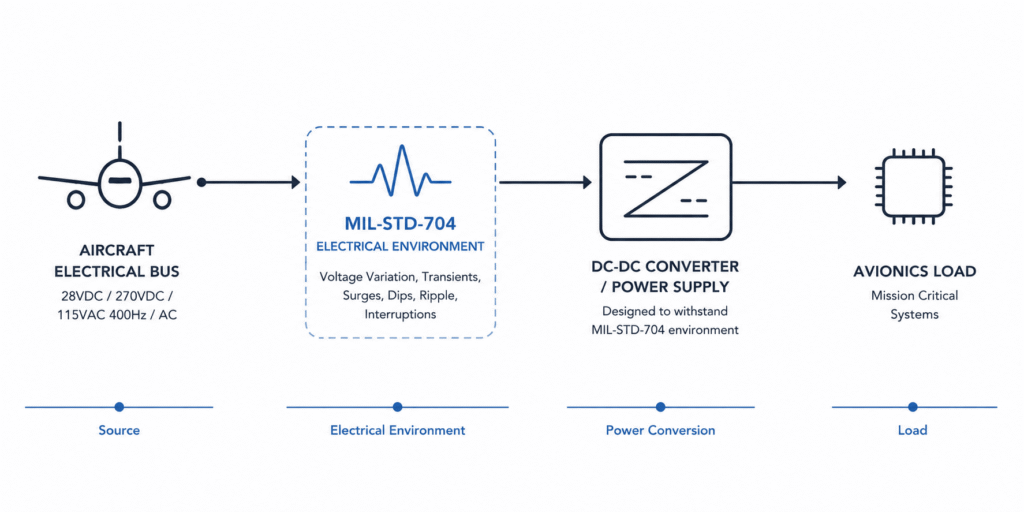
Aircraft / Military Bus → Input Protection & Filtering → DC-DC Converter → Load

In this approach, the Front-End stage handles some of the demanding conditions coming from the power bus, while the DC-DC converter performs the voltage conversion and electrical isolation required by the system.

This approach can offer advantages when a suitable converter already exists in terms of power, output voltage, efficiency, or dimensions, but its input range or protection capability is insufficient for the required electrical environment.

Alternatively, an integrated solution can be used in which protection, filtering, and power conversion are designed as part of a single Power Supply unit.

The choice between these two architectures depends on factors including power level, space and weight limitations, efficiency requirements, isolation requirements, EMI/EMC requirements, and the environmental conditions of the system.

Checklist for Selecting a Power Supply for a MIL-STD-704 System

Before selecting a Power Supply or DC-DC Converter for an airborne system, it is recommended to clearly define the operating environment and system requirements.

Key points to consider include:

Electrical Power System Type

First, identify the power source relevant to the system.

For example:

  • 28VDC
  • 270VDC
  • 115VAC / 400Hz
  • Variable-frequency AC
  • Another electrical power system defined for the platform

Do not assume that the term “MIL-STD-704” alone defines the input voltage.

Input Voltage Range

Verify the continuous input voltage range of the power supply and ensure that it is suitable for the required operating conditions.

It is important to distinguish between nominal voltage, continuous operating range, and voltage conditions that the product can survive for limited periods of time.

Transients, Surges and Dips

Identify the relevant voltage events and determine how the power supply behaves during each one.

The question is not only whether the product can survive the event.

In critical systems, it is also necessary to determine whether the power supply must continue providing a regulated output throughout the event.

Power Interruptions and Hold-Up

If the system cannot tolerate a reset or interruption of operation during a short power disturbance, the Hold-Up requirement must be defined.

This requirement should specify how long the output voltage must remain within the permitted range and how much power the system consumes during that period.

Output Voltage and Power

Define:

  • Output voltage
  • Maximum current or power
  • Continuous load and peak loads
  • Required regulation
  • Maximum permitted output ripple

Isolation

When electrical isolation is required, the required isolation level should be defined and the grounding architecture of the complete system should be considered.

Efficiency and Cooling

Efficiency should be evaluated under actual operating conditions rather than only under ideal test conditions.

In an airborne system, efficiency directly affects the amount of heat that must be dissipated as well as the size and mass of the cooling solution.

Temperature and Derating

Verify that the power supply can deliver the required power throughout the application’s complete operating temperature range.

Particular attention should be given to the manufacturer’s derating curves and the cooling conditions on which the published specifications are based.

EMI / EMC

If the system must also comply with MIL-STD-461, this should be considered during the power supply selection process.

Adding an EMI filter at a later stage can affect system volume, weight, efficiency, and overall behavior.

Environmental Conditions

The environmental and mechanical requirements of the system should be evaluated separately, including MIL-STD-810 when applicable.

Compliance with the MIL-STD-704 electrical environment does not demonstrate resistance to vibration, shock, temperature, humidity, or altitude.

What Information Should Be Provided to the Power Supply Manufacturer?

The better the requirements are defined at the beginning of the project, the easier it is to select an appropriate solution and avoid changes later in the development process.

Instead of sending the manufacturer a general request such as:

“Need a 28VDC MIL-STD-704 power supply”

it is recommended to provide as much detailed information as possible:

  • Input voltage and electrical power system type
  • Applicable standard revision and project-specific requirements
  • Output voltages
  • Continuous power and peak power requirements
  • Isolation requirements
  • Hold-Up Time, if required
  • Operating temperature range
  • Size and weight limitations
  • Cooling method
  • MIL-STD-461 requirements
  • MIL-STD-810 requirements
  • Mechanical and connector requirements
  • Qualification or Test Report requirements
  • Expected quantities

This information allows the manufacturer to determine whether an existing product is suitable for the application, whether an additional Front-End is required, or whether a custom or modified power supply solution is needed.

MIL-STD-704 in a Complete Power Supply System

When designing an airborne system, it is important to consider the entire power supply chain as a single system.

For example:

Aircraft Bus → Input Protection → EMI Filter → DC-DC Conversion → Output Filtering → Electronic Load

Each stage can affect the others.

Transient protection can affect efficiency.

An EMI filter can affect DC-DC converter stability.

A Hold-Up requirement can significantly increase the volume required for energy storage.

Thermal derating can affect the actual available power.

Therefore, in complex military and aerospace systems, it is often preferable to evaluate the complete power supply solution rather than selecting each component independently.

Combined Solutions for MIL-STD-704 and MIL-STD-1275

In projects involving multiple platforms, there may be an advantage to using a common Power Supply architecture.

For example, a solution can be designed with an input stage capable of addressing the relevant requirements of the MIL-STD-704 environment while also addressing relevant MIL-STD-1275 requirements.

This approach may allow the same family of power supplies or DC-DC converters to be used across several systems, reducing the number of configurations and part numbers required for the project.

However, each application must be evaluated individually.

MIL-STD-704 and MIL-STD-1275 are not identical standards, and compliance with one does not automatically demonstrate compliance with the other.

Summary

MIL-STD-704 is one of the key standards that must be understood when designing or selecting a power supply for a military airborne system.

The most important point is that nominal supply voltage does not tell the whole story.

A system specified as 28VDC, for example, does not necessarily provide a constant 28VDC at all times. The power supply may be exposed to voltage variations, transients, surges, dips, disturbances, and short power interruptions.

Therefore, selecting a power supply or DC-DC converter for a MIL-STD-704 system should be based on the complete electrical environment and the required system behavior under each operating condition.

In addition, MIL-STD-704 is only one part of the overall picture.

A military or aerospace system may simultaneously be subject to MIL-STD-461 requirements for EMI/EMC, MIL-STD-810 environmental requirements, and additional platform-specific and project-specific requirements.

Selecting the right Power Conversion solution begins with a precise definition of the requirements and an evaluation of the complete power supply system.


Frequently Asked Questions – MIL-STD-704 and Power Supplies for Airborne Systems

What Is MIL-STD-704?

MIL-STD-704 is a U.S. military standard that addresses aircraft electrical power characteristics and the interface between the aircraft electrical power system and the equipment connected to it.

The standard addresses characteristics such as voltage, frequency, ripple, transients, and various operating conditions of the electrical power system.

Is a 28VDC Power Supply Automatically Suitable for MIL-STD-704?

No.

28VDC is only a nominal voltage.

The input voltage range, relevant electrical events, ability to handle transients and surges, and power supply behavior during voltage dips and power interruptions must all be evaluated.

Does MIL-STD-704 Apply Only to 28VDC Systems?

No.

The standard addresses several types of aircraft electrical power systems, including both DC and AC systems.

It is therefore important to identify the electrical power system type and the specific requirements of the platform and project.

Is MIL-STD-704 a Power Supply Standard?

Not exactly.

MIL-STD-704 defines the electrical power characteristics at the interface of the aircraft electrical power system.

A power supply or DC-DC converter installed in the system must be designed or protected so that it can handle the relevant electrical environment.

What Is the Difference Between MIL-STD-704 and MIL-STD-461?

MIL-STD-704 addresses the aircraft electrical power environment.

MIL-STD-461 addresses EMI/EMC, including electromagnetic emissions from equipment and its susceptibility to electromagnetic interference.

Both standards may apply simultaneously to an airborne system.

What Is the Difference Between MIL-STD-704 and MIL-STD-810?

MIL-STD-704 addresses electrical power characteristics.

MIL-STD-810 addresses environmental conditions and associated test methods which, depending on the application, may include temperature, vibration, shock, humidity, altitude, and other environmental conditions.

Compliance with MIL-STD-704 does not automatically demonstrate compliance with MIL-STD-810.

What Is the Difference Between MIL-STD-704 and MIL-STD-1275?

MIL-STD-704 applies to aircraft electrical power systems.

MIL-STD-1275 applies to the 28VDC electrical power environment of military ground vehicles.

Although there are common engineering principles in input protection and power conversion design, these are different standards and the requirements of each must be evaluated separately.

Can the Same Power Supply Be Used for MIL-STD-704 and MIL-STD-1275?

In some cases, yes.

A Power Supply or Front-End can be designed to address the relevant requirements of both electrical environments.

However, it is important to verify specifically that the solution has been tested or designed according to the applicable requirements of both standards.

What Is Hold-Up Time?

Hold-Up Time is the period during which a power supply can continue providing a valid output voltage after the input voltage drops or is lost.

This requirement is particularly important in systems where a short power interruption could cause a reset, data loss, or interruption of a critical function.

Can a Front-End Be Added to an Existing DC-DC Converter?

In some cases, yes.

An appropriate Front-End can provide functions such as transient protection, voltage limiting, and filtering ahead of the DC-DC converter.

The complete solution should be evaluated as a system to ensure that the combination meets the electrical, efficiency, EMI, and stability requirements.

What Should Be Checked When a Manufacturer Claims “MIL-STD-704 Compliant”?

It is recommended to verify which revision and electrical power system type the claim refers to, which tests were performed, what the results were, and what is required from the product during each event.

It is particularly important to distinguish between a requirement for the product to continue operating and a requirement for it only to survive the event without damage.


Glossary

MIL-STD-704 – A standard describing electrical power characteristics in aircraft electrical power systems.

DC-DC Converter – A converter that converts one DC voltage level to another.

Power Supply – A power unit that provides the voltage and current required by an electronic system.

Transient – A rapid, short-duration change in voltage.

Surge – An increase in voltage above the normal operating range for a certain period of time.

Voltage Dip – A temporary reduction in supply voltage.

Power Interruption – A temporary interruption of the electrical power supply.

Hold-Up Time – The period during which the power supply continues providing a valid output after the input voltage drops or is lost.

Ripple – An unwanted periodic component superimposed on a DC voltage.

Isolation – Electrical separation between the input and output of a power supply.

Derating – Reduction of allowable power or performance depending on operating conditions such as temperature.

Front-End Protection – A protection circuit installed ahead of the power conversion stage to protect it against abnormal input conditions.

EMI – Electromagnetic Interference.

EMC – Electromagnetic Compatibility.

Tags: GilGal

Related Articles

Understanding MIL-STD-704: Power Standards for Military Aviation

02/02/2025amironicLTD

A Silent Revolution in Military DC/DC Power Supply

08/06/2025amironicLTD

Intelligent Protection for Critical Electrical Systems: Smart Power Protector

16/07/2025amironicLTD

Recent Posts

  • MIL-STD-704 – Power Supplies for Military and Aerospace Systems
  • MIL-STD-1275 – Power Supplies and DC-DC Converters for Military Vehicles
  • Military Power Supplies and DC-DC Converters – A Guide to MIL-STD Standards
  • How Do You Know If a Liquid Cooling System Is Really Working? Pressure and Temperature Tell the Story
  • Tactical Grade IMU: What Happens When the Mission Stops Behaving Like the Lab?

Categories

  • Air Switch
  • Circuit Breakers
  • Elapsed Time Indicator
  • Feedthrough
  • Footswitches
  • Gears & Transmission
  • Hour Meters
  • Infra Red Switches
  • INFRARED LAMPS
  • Low Noise Inertial MEMS
  • Mechanics
  • MEMS Gyroscope
  • MEMS Inertial
  • Microelectronics
  • Motors
  • Position Sensors
  • Power Supply
  • Pressure Sensors
  • Pressure Switch
  • Temperature Sensors
  • Tungsten and Molybdenum
  • Uncategorized
  • Vacuum Switches

Quick Contact

Fill out the form and our representatives will return to you

    Name (required)

    Email (required)

    Phone

    Message

    This site is protected by reCAPTCHA and the Google
    Privacy Policy and
    Terms of Service apply.

    Amironic Ltd.

    3 Rabinovich Street, Petah Tikva 4928144 , Israel. Tel: +972-3-9047744 E-mail: office@amironic.co.il
    Email
    Facebook
    Twitter
    LinkedIn
    YouTube
    Press on the ISO Certificate below for download
    ISO 9001:2015 Certification
    • MEMS Inertial
    • Circuit Breakers
    • Footswitches
    • Mechanical & Transmisions
    • Sensors
    • Motors
    • Electronics
    • Hand Control
    • Power Solutions

    News

    • MIL-STD-704 – Power Supplies for Military and Aerospace Systems
    • MIL-STD-1275 – Power Supplies and DC-DC Converters for Military Vehicles
    • Military Power Supplies and DC-DC Converters – A Guide to MIL-STD Standards
    • How Do You Know If a Liquid Cooling System Is Really Working? Pressure and Temperature Tell the Story
    • Tactical Grade IMU: What Happens When the Mission Stops Behaving Like the Lab?
    About AmironicContactעברית
    © 2022 Amironic All rights reserved. All Trademarks are the property of their respective owners.
    • Increase Font
    • Decrease Font
    • Black & White
    • Inverse Colors
    • Highlight Links
    • Regular Font
    • Reset