flagעברית
flagEnglish
3 Rabinovich St., Petah-Tikva, Israel
+972 3 9047744
office@amironic.co.il
Facebook
Twitter
LinkedIn
YouTube
  • Products
    • MEMS Inertial
      • Gyros & Accels
      • IMU
      • Inertial Navigation
      • AHRS
    • Circuit Breakers
      • Airpax Circuit Breakers
      • Electronic Circuit Breakers
      • Aircraft Circuit Breakers
      • Thermal Circuit Breakers
      • Sealing Solutions & Guards
    • Footswitches
      • Pedals & Bellows
      • USB
      • Air Switches
      • Medical
      • Modular Bases System
      • Industrial
      • Foot Potentiometers
      • Wireless
    • Mechanical & Transmisions
      • Gears
      • Sealing Solutions
      • Gearboxes
      • Couplings
      • Shafts & Bearings
      • Fasteners
      • Mechanical & Springs
      • Linear Motion
      • Anti-Vibration
    • Sensors
      • Thermostats
      • Temperature
      • Position
      • Pressure
      • Speed
      • Level Sensor
      • Load Cells
      • Flex Sensors
      • Membrane Potentiometer
    • Motors
      • Geared DC
      • Brushless DC
      • Step Motors with Gearbox
      • Torque Motors & Brushless Servo
      • DC Motors
    • Electronics
      • Xenon & IR Lamps
      • Counters & Meters
      • Microelectronics Packaging
      • Waterproof Switches
      • Micro Switches
    • Hand Control
      • Operator Controls (JOYSTICK)
      • Electrical
      • Pneumatic (Medical)
      • USB Hand Control
      • Air Push Button
      • Pressure Switch
      • IR Switch
    • Power Solutions
      • Rugged & Military Power Supply
      • Input Power Protection
      • Sealed Military Power Adaptor
      • Triple Output Military Power Supply Series – up to 250 W
    • Materials
      • Molybdenum and Advanced Alloys (TZM, MOLA, HCT)
      • Tungsten (Wolfram) and Advanced Alloys – High-Performance Materials for Extreme Conditions
      • Materials for Gears
  • Shop
  • Companies
  • About Amironic
  • News
  • Contact
Product was added to your cart

Cart

waze

Medical Footswitches – Precision Control, Modular Design and UL 60601-1 Certification

Footswitches14/10/2026amironicLTD

In a modern operating room, every action must be performed with precision and proper timing. Surgeons are required to control advanced medical equipment, often while using both hands, without diverting their attention from the procedure. In such situations, a footswitch is more than just an auxiliary control device. It is an integral part of the system’s control interface.

Medical footswitches from HERGA Technology, particularly the MD1G and MD2G series, are designed for medical applications that demand reliability, precise operation, durability in clinical environments, and compliance with medical electrical equipment safety requirements.

One of the key advantages of this platform is its UL certification to the 60601-1 family of medical safety standards, combined with modular design options that allow Original Equipment Manufacturers (OEMs) to customize the control interface to meet their specific system requirements.

Why Is a Medical Footswitch an Important Engineering Component?

Unlike a switch mounted on a control panel, a medical footswitch is often operated without the user looking directly at it. A surgeon or healthcare professional may be focused on an imaging monitor, a surgical microscope, or the treatment area itself.

Therefore, proper footswitch design requires careful consideration of several characteristics:

  • Intuitive Operation: Clear differentiation between functions through pedal positioning, colors, tactile feedback, and physical separation.

  • Predictable Response: Consistent correspondence between pedal activation and the electrical signal received by the control system.

  • Fluid Resistance: Protection against liquid ingress in environments where regular cleaning and disinfection are required.

  • Mechanical Stability: Minimizing unintended movement of the footswitch during operation.

  • Medical System Compatibility: Selecting the appropriate contact configuration, electrical rating, cable, and connection method according to the equipment’s requirements.

The combination of these characteristics is particularly important in medical systems that incorporate multiple functions, each requiring a separate and clearly defined activation command.
UL 60601-1 Certification – A Significant Advantage in Medical Device Design

When developing medical equipment, engineers must consider more than just mechanical and electrical compatibility when selecting components. Safety requirements, regulatory compliance, technical documentation, and the testing and certification processes of the final system must also be taken into account.

HERGA’s MD series medical footswitches offer an important advantage: UL certification to medical electrical equipment safety standards within the IEC 60601-1 family.

The certification is documented under UL File E353500 and covers a range of configurations within the MD family, including the MD1G and MD2G series.

The standards referenced in the certification include:

  • ANSI/AAMI ES60601-1 – Safety requirements for medical electrical equipment in the US market.

  • CAN/CSA-C22.2 No. 60601-1:14 – Canadian safety requirements for medical electrical equipment.

  • IEC 60601-1 Edition 3.1 – International safety standard for medical electrical equipment.

  • EN 60601-1 – The corresponding European standard, according to the editions specified in the certificate.

For Medical Original Equipment Manufacturers (OEMs), integrating a suitably certified switch can simplify component selection, support technical documentation, and reduce engineering uncertainty during the development process.

However, it is important to distinguish between component certification and certification of the complete medical device. UL certification applies only to the configurations covered by the certificate and bearing the appropriate UL Certification Mark. Integrating a certified footswitch does not eliminate the manufacturer’s responsibility to verify that the complete medical system complies with all applicable safety and regulatory requirements.

MD1G and MD2G – A Modular Medical Footswitch Platform

One of the key features of HERGA’s medical footswitch platform is the ability to select the number of pedals and switching configurations according to the application’s requirements.

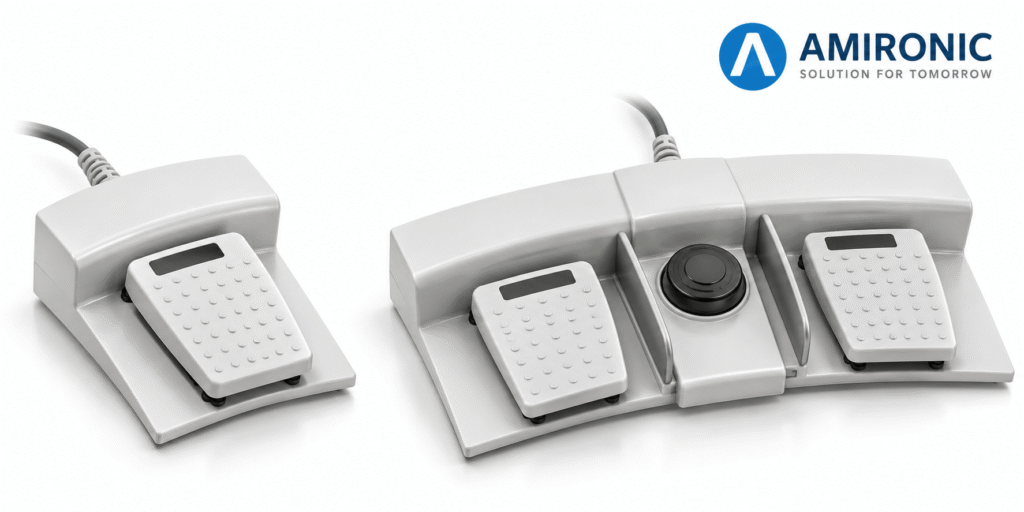
MD1G provides a single-pedal interface, suitable for medical systems requiring one primary activation function.

MD2G incorporates two pedals within a common base, allowing each pedal to control a separate system function.

The modular platform also supports more advanced configurations, including additional switches, dividers, handles, and various connection options.

For example, the MD2G-BAA-BA1-EZZ-000 model combines two foot pedals with a centrally mounted 6244 series haptic switch. This configuration allows engineers to assign three separate functions to a single control interface.

For medical equipment manufacturers, this means that the control interface can be customized to meet specific system requirements without having to develop an entirely new footswitch mechanism from scratch.

Fluid Protection, Cleaning, and Durability in Clinical Environments

In operating rooms and clinical environments, equipment positioned at floor level is exposed to different conditions than components installed inside electrical enclosures or control panels.

Liquids, cleaning agents, movement of medical personnel, and repeated operation over time require special consideration of the footswitch’s construction and installation.

The MD2G models featured in this article offer an IPX7 protection rating, indicating resistance to water ingress under specified immersion test conditions. For the MD2G-BAA-BA1-EZZ-000 model, IPX8 protection is also available upon request.

It is important to emphasize that an IP rating alone does not guarantee compatibility with all disinfectants, cleaning chemicals, or sterilization procedures. The compatibility of housing materials and seals with the medical equipment’s cleaning and disinfection protocols must be evaluated separately.

Mechanical design features such as pedal dividers, carrying handles, cable exit positions, and mounting options also play an important role in creating a reliable, ergonomic, and practical control interface for medical applications.

Medical Applications – From Surgical Systems to Advanced Diagnostic Equipment

HERGA medical footswitches serve as control interfaces in a wide range of medical systems. Although the applications vary, the engineering objective remains the same: enabling users to control equipment functions conveniently, precisely, and predictably without interrupting clinical procedures.

HERGA’s medical footswitch platform is suitable for several key application areas:

Electrosurgical Systems (Electrosurgery)

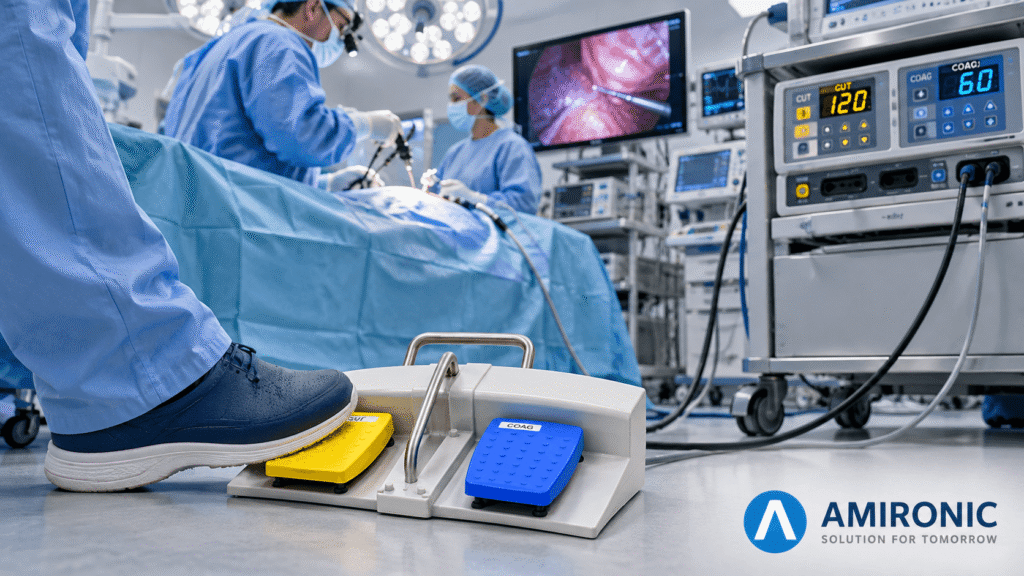
Electrosurgical systems often require separate controls for tissue cutting (CUT) and coagulation (COAG). A dual-pedal footswitch allows each function to be assigned to a dedicated switch, using colors, markings, and a physical divider to help users distinguish between the two functions.

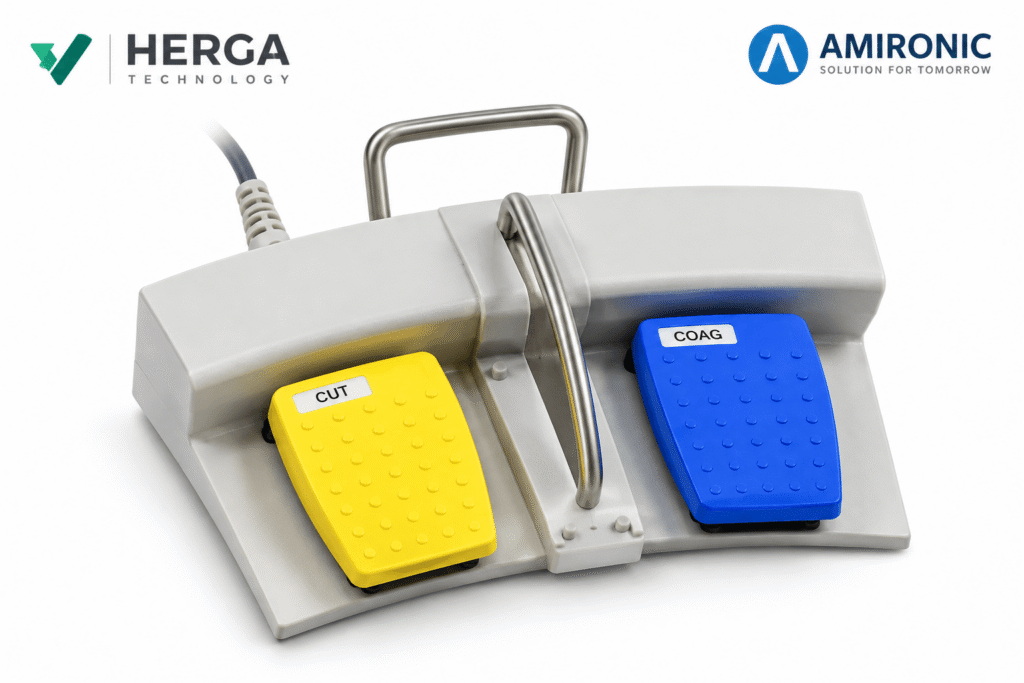
The HERGA MD2G-CGA-BA0-ZZC-001 features two pedals: a yellow pedal for CUT and a blue pedal for COAG, separated by a metal divider and equipped with a rear carrying handle. Each pedal incorporates a Normally Open (NO) contact, and the model offers IPX7 protection and an electrical rating of 1.75A at 24VDC.

Endoscopy and Laparoscopy Systems

During minimally invasive surgical procedures, surgeons often operate cameras, surgical instruments, and imaging displays simultaneously. A medical footswitch can be used to activate various system functions, depending on the equipment’s control architecture.

Medical and Aesthetic Laser Systems

In laser systems, a footswitch may serve as an activation input connected to the system controller. Proper design requires coordination between the switch type, controller response, and the equipment’s safety mechanisms.

The footswitch does not replace the interlock mechanisms or other protective measures required in medical laser systems.

Medical Imaging Systems

In imaging equipment such as X-ray systems, CT scanners, and other medical imaging devices, footswitches can be used to activate specific functions while allowing operators to keep their hands free.

MRI applications require additional evaluation to determine whether the component is suitable for use in a magnetic environment. UL 60601-1 certification alone does not establish MRI compatibility.

Operating Tables and Medical Treatment Chairs

Medical footswitches can provide hands-free control of movement, height adjustment, and positioning functions in medical equipment.

In these applications, selecting the appropriate switching mechanism and designing controls that prevent unintended movement are particularly important.

What Should Engineers Consider Before Integrating a Medical Footswitch into an OEM System?

Selecting a medical footswitch begins with defining the functions the operator needs to perform, but the process involves much more than choosing the number of pedals.

System engineers must also consider the electrical interface, environmental conditions, and maintenance requirements.

Engineering Parameter Design Considerations
Number of Functions Single pedal, dual pedal, or an extended modular configuration
Contact Configuration Normally Open (NO), Normally Closed (NC), or Changeover, depending on the model
Electrical Rating Compatibility with the control input voltage and current
Environmental Protection IPX7 or another protection rating, depending on the configuration
Mechanical Interface Pedal dividers, handles, base design, and mounting options
System Connection Cable length, cable exit position, and electrical termination
Certification Verification that the selected configuration is covered by the relevant UL certification

Another advantage of HERGA’s modular platform is the ability to combine multiple control features within a single footswitch assembly, depending on the selected configuration.

For example, integrating two foot pedals with a centrally mounted haptic switch can provide three separate control commands without requiring an additional standalone footswitch on the treatment room floor.

The ability to customize the footswitch configuration to meet specific system requirements is particularly valuable for medical equipment manufacturers developing multiple products based on a common control platform.

CASE STUDY – Designing an Operating Room Control Interface with a HERGA Medical Footswitch

An illustrative engineering case study based on the characteristics of HERGA MD2G footswitch models. This example does not represent an actual customer project.

The Challenge: Two Surgical Functions, One Control Interface

In an electrosurgical system used in an operating room, the surgeon needs to control two primary functions: tissue cutting (CUT) and coagulation (COAG).

During the procedure, the surgeon’s hands are occupied with surgical instruments, while their attention may be focused on an imaging monitor. Switching to manual operation through a control panel could interrupt the surgical workflow.

The engineering challenge is to design a control interface that enables clear, independent activation of both functions while minimizing the risk of unintended operation.

The Solution: MD2G Dual-Pedal Medical Footswitch

One possible solution is to integrate the HERGA MD2G-CGA-BA0-ZZC-001, a dual-pedal footswitch specifically designed for electrosurgical applications.

The model features:

  • A yellow pedal marked CUT, designed to activate the cutting function.

  • A blue pedal marked COAG, designed to activate the coagulation function.

  • A central metal divider providing physical separation between the two activation areas.

  • A rear metal carrying handle for convenient positioning and movement of the footswitch assembly.

  • Normally Open (NO) electrical contacts.

  • A 3-meter cable with free wire ends.

  • IPX7 protection and a switching rating of 1.75A at 24VDC.

The switches used in this platform belong to a UL-certified product family, subject to the applicable configuration and marking requirements. The datasheet for this specific model explicitly states that UL approval applies to the individual footswitches only.

How Does the System Operate?

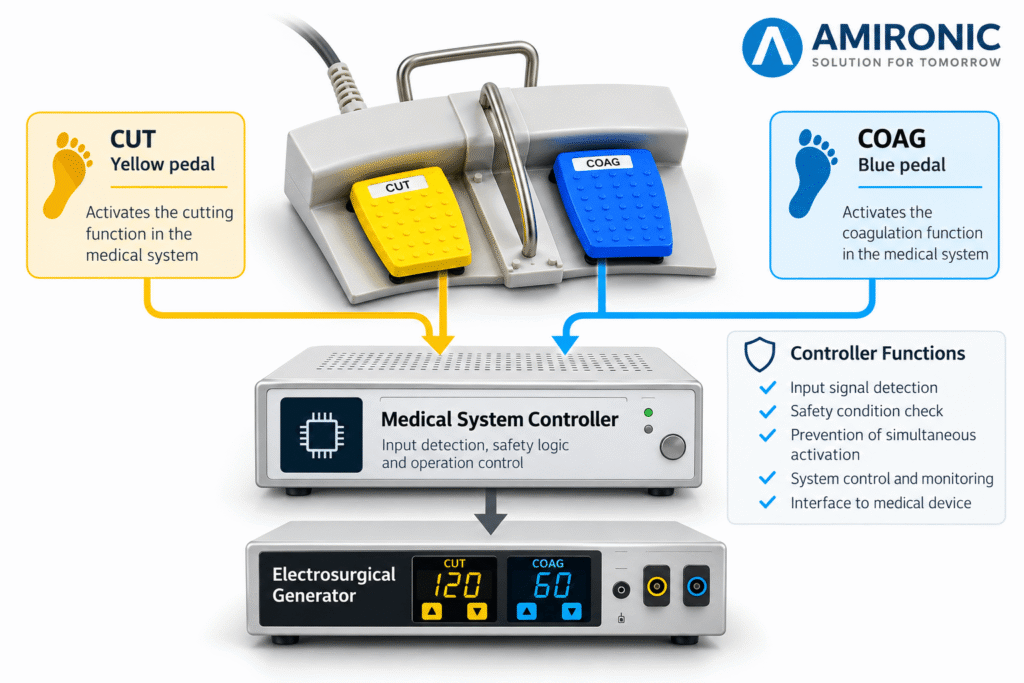
In a possible system design, each pedal is connected to a separate input on the electrosurgical system controller.

When the surgeon presses the yellow pedal, the corresponding electrical contact closes, and the controller receives a request to activate the CUT function.

Pressing the blue pedal sends a separate request to activate the COAG function.

Releasing either pedal returns its electrical contact to its normal state.

It is important to emphasize that the footswitch provides an activation signal only. The system controller is responsible for verifying safety conditions, managing operating modes, and preventing unintended activation, including handling simultaneous activation of both pedals.

The Engineering Outcome

Selecting a dual-pedal footswitch allows engineers to separate two surgical commands through a clearly defined mechanical interface while keeping the surgeon’s hands free.

Potential benefits include intuitive operation, clear visual and mechanical differentiation between functions, suitability for clinical environments, and the use of a medical switching platform supported by relevant certification documentation.

However, successful integration also depends on the design of the system controller, risk assessment, and verification testing of the complete medical device.

Conclusion – A Small Component with Significant Engineering Impact

A medical footswitch may appear to be a relatively simple component, but it serves as a critical interface between the operator and a complex medical system.

Proper selection requires careful consideration of operating characteristics, the number of control functions, environmental conditions, electrical interfaces, and applicable safety standards.

The HERGA MD1G and MD2G series provide medical equipment manufacturers with a modular platform that can be adapted to various applications, together with the significant advantage of UL certification to applicable medical electrical equipment safety standards within the 60601-1 family.

For development engineers, the benefit goes beyond the switch itself. It is the ability to integrate a documented, flexible medical control solution tailored to the system’s requirements from the earliest stages of product development.

Amironic Ltd., the authorized representative of HERGA Technology in Israel, supplies switching and control solutions for medical and industrial applications, including technical support in selecting suitable footswitch configurations for OEM projects.

For additional information, technical datasheets, or assistance in selecting the right footswitch solution for your medical system, please contact the Amironic team.

🧩 Further Reading

This article is part of a broader series exploring how footswitches function as critical human-machine control interfaces across medical and industrial systems. For additional technical context and application insights, you may also find the following articles useful:

  • HERGA Control Solutions: More Than a Footswitch – The Human Interface That Defines System Performance
  • HERGA Medical Footswitches: Engineering the Right Control Interface for Clinical Systems
  • HERGA Industrial Footswitches: Reliable Control Solutions for Harsh and High-Duty Environments
  • Pneumatic Footswitches in Medical and Aesthetic Equipment
  • Industrial Safety Footswitches: Reliable Machine Control for Heavy-Duty and High-Risk Environments
  • Wired vs Wireless (Bluetooth) Footswitches: When Does It Actually Matter?
  • Footswitches for Medical and Aesthetic Laser Systems – Not Just a Trigger, but a Critical Part of System Safety
  • Medical Footswitches for IEC / UL 60601-1 Systems – Safety, Reliability and Design Considerations Every Engineer Should Know
  • 6 Switching Technologies Every Systems Engineer Should Know – And How to Choose the Right One
  • Why Foot Switches Fail – And What Experienced OEM Designers Do Differently
  • Pneumatic Foot Bellows vs. Electrical Footswitch – Do You Really Need to Run Electricity to the Foot Pedal?
  • Momentary or Latching? How to Choose the Right Switch for Industrial, Medical, and OEM Applications
  • Why Did Your Footswitch Fail After Just Six Months – Even Though It Was Rated for One Million Operations?
  • USB Foot Pedals for Medical & Industrial Systems – Why the USB Connector Is Only Part of the Story
  • Don’t Design a New Footswitch – Build It from a Modular Platform
  • Why Wireless Footswitches Are Becoming the Standard in Mobile Medical Equipment
  • Why a Dirty Lens Is More Than Just an Optical Problem – It’s an Engineering Challenge in Endoscopy Systems
  • Hands on the Keyboard, Foot on the Radio – Why Push-to-Talk Is Moving to the Floor in Control Rooms
  • Why Run Electricity to the Button When Herga Can Switch It with Air?
  • Electrical, Pneumatic, USB, Bluetooth or Contactless – How Do You Choose the Right Switch for Your System?
  • Hands on the Patient, Foot on the System – Why Footswitches Are Still Essential in Medical Imaging

Frequently Asked Questions (FAQ) – HERGA Medical Footswitches

What Is the Difference Between a Medical Footswitch and an Industrial Footswitch?

A medical footswitch is designed for integration into medical equipment, taking into account electrical safety requirements, cleaning procedures, fluid resistance, and precise operation.

Unlike standard industrial footswitches, certain medical models also carry certifications to specific medical safety standards. The HERGA MD1G and MD2G series belong to a family of medical footswitches with UL certification to applicable 60601-1 standards, subject to the approved configuration.

Are HERGA Medical Footswitches UL 60601-1 Certified?

Yes. HERGA’s MD family includes UL-certified models under UL File E353500, covering ANSI/AAMI ES60601-1 and CAN/CSA-C22.2 No. 60601-1, along with the IEC and EN standards referenced in the certificate.

It is important to verify that the specific part number is covered by the certification and bears the appropriate UL Certification Mark. Certification of the footswitch does not replace the certification process required for the complete medical device.

What Is the Difference Between HERGA MD1G and MD2G?

The MD1G is a single-pedal footswitch configuration, while the MD2G incorporates two pedals within a common base.

A dual-pedal configuration is suitable for medical systems requiring independent control of two functions, such as cutting and coagulation in electrosurgical equipment.

What Is a CUT/COAG Footswitch in Medical Equipment?

A CUT/COAG footswitch is a control interface used in electrosurgical units (ESUs). Typically, one pedal sends a cutting command (CUT), while the other sends a coagulation command (COAG).

The HERGA MD2G-CGA-BA0-ZZC-001 features a yellow pedal for cutting and a blue pedal for coagulation, with a metal divider separating the two activation areas.

Is an IPX7 Medical Footswitch Resistant to Water and Disinfectants?

An IPX7 rating indicates protection against water ingress under specified immersion test conditions according to IEC 60529.

However, IPX7 does not guarantee resistance to all disinfectants, cleaning chemicals, or sterilization procedures. The compatibility of housing materials and seals with the required cleaning methods must be evaluated separately.

Can Multiple Functions Be Integrated into a Single Medical Footswitch Assembly?

Yes. HERGA’s modular platform allows multiple pedals and switches to be integrated into a single assembly.

For example, the MD2G-BAA-BA1-EZZ-000 incorporates two foot pedals and a centrally mounted 6244 series haptic switch, providing three separate control inputs within one footswitch assembly.

What Does Normally Open (NO) Mean in a Medical Footswitch?

A Normally Open (NO) contact is an electrical contact that remains open when the switch is not activated and closes when the switch is pressed.

In a medical system, this change in contact state can be used as an input signal to the controller. The actual operation of the medical device is determined by the system’s control logic and safety mechanisms.

Are HERGA Footswitches Suitable for Medical Laser Systems?

Yes. HERGA offers footswitch configurations suitable for integration into medical and aesthetic laser systems.

Selecting the appropriate model requires evaluating the contact configuration, electrical rating, environmental conditions, and safety requirements of the laser system, including its interlock mechanisms.

Can HERGA Medical Footswitches Be Customized for OEM Applications?

Yes. HERGA’s medical footswitch platform offers customization options, including the number of pedals, colors, dividers, handles, cable exit positions, cable configurations, and switching arrangements.

The availability of specific customization options and the scope of applicable certifications depend on the selected configuration.

Where Can I Buy HERGA Medical Footswitches in Israel?

Amironic Ltd. represents HERGA Technology in Israel, supplying switching and control solutions to medical equipment manufacturers, engineering companies, and OEM customers.

Contact Amironic for technical datasheets, assistance in selecting the appropriate footswitch configuration, and quotations for your medical device application.

Technical Glossary – Medical Footswitch Terminology

Term Definition
Medical Footswitch A foot-operated switch used to activate or control functions in medical equipment.
Electrosurgical Footswitch A foot-operated control interface designed for electrosurgical systems.
CUT / COAG Cutting and coagulation functions used in electrosurgical equipment.
IEC 60601-1 International standard specifying requirements for basic safety and essential performance of medical electrical equipment.
UL Certification Certification issued by UL confirming compliance with applicable standards within the defined scope of certification.
IPX7 An ingress protection rating indicating resistance to water penetration under specified immersion test conditions.
Normally Open (NO) An electrical contact that remains open in its normal state and closes when activated.
Momentary Switch A switch that automatically returns to its normal state when the actuating force is released.
Haptic Switch A switch that provides tactile feedback, sometimes accompanied by an audible click, when activated.
Modular Footswitch A configurable footswitch platform that allows multiple switching elements and control arrangements to be combined.
OEM Medical Device Medical equipment developed or manufactured by an Original Equipment Manufacturer (OEM).
SELV (Safety Extra-Low Voltage)

An extra-low-voltage electrical system designed to provide protection against electric shock under conditions defined by applicable safety standards.

Tags: Herga

Related Articles

Pneumatic Foot Bellows vs. Electrical Footswitch – Do You Really Need to Run Electricity to the Foot Pedal?

06/07/2026amironicLTD

Why Foot Switches Fail – And What Experienced OEM Designers Do Differently

29/06/2026amironicLTD

The Role of Vacuum Switches in Fume Extraction Systems

25/02/2025amironicLTD

Recent Posts

  • Inertial Sensors in Loitering Munitions and Unmanned Systems – Engineering Challenges Beyond the Datasheet
  • Medical Footswitches – Precision Control, Modular Design and UL 60601-1 Certification
  • 5 mm Shaft & Bearing – Worm Gear Fits and Tolerances
  • Filter Monitoring in Fume Extraction Systems – Detecting Filter Clogging with Pressure & Vacuum Switches
  • Pressure in HVAC/R Systems – More Than Protection, It’s a Control Variable

Categories

  • Air Switch
  • Circuit Breakers
  • Elapsed Time Indicator
  • Feedthrough
  • Footswitches
  • Gears & Transmission
  • Hour Meters
  • Infra Red Switches
  • INFRARED LAMPS
  • Low Noise Inertial MEMS
  • Mechanics
  • MEMS Gyroscope
  • MEMS Inertial
  • Microelectronics
  • Motors
  • Position Sensors
  • Power Supply
  • Pressure Sensors
  • Pressure Switch
  • Switches
  • Temperature Sensors
  • Tungsten and Molybdenum
  • Uncategorized
  • Vacuum Switches

Quick Contact

Fill out the form and our representatives will return to you

    Name (required)

    Email (required)

    Phone

    Message

    This site is protected by reCAPTCHA and the Google
    Privacy Policy and
    Terms of Service apply.

    Amironic Ltd.

    3 Rabinovich Street, Petah Tikva 4928144 , Israel. Tel: +972-3-9047744 E-mail: office@amironic.co.il
    Email
    Facebook
    Twitter
    LinkedIn
    YouTube
    Press on the ISO Certificate below for download
    ISO 9001:2015 Certification
    • MEMS Inertial
    • Circuit Breakers
    • Footswitches
    • Mechanical & Transmisions
    • Sensors
    • Motors
    • Electronics
    • Hand Control
    • Power Solutions

    News

    • Inertial Sensors in Loitering Munitions and Unmanned Systems – Engineering Challenges Beyond the Datasheet
    • Medical Footswitches – Precision Control, Modular Design and UL 60601-1 Certification
    • 5 mm Shaft & Bearing – Worm Gear Fits and Tolerances
    • Filter Monitoring in Fume Extraction Systems – Detecting Filter Clogging with Pressure & Vacuum Switches
    • Pressure in HVAC/R Systems – More Than Protection, It’s a Control Variable
    About AmironicContactעברית
    © 2022 Amironic All rights reserved. All Trademarks are the property of their respective owners.
    • Increase Font
    • Decrease Font
    • Black & White
    • Inverse Colors
    • Highlight Links
    • Regular Font
    • Reset