flagעברית
flagEnglish
3 Rabinovich St., Petah-Tikva, Israel
+972 3 9047744
office@amironic.co.il
Facebook
Twitter
LinkedIn
YouTube
  • Products
    • MEMS Inertial
      • Gyros & Accels
      • IMU
      • Inertial Navigation
      • AHRS
    • Circuit Breakers
      • Airpax Circuit Breakers
      • Electronic Circuit Breakers
      • Aircraft Circuit Breakers
      • Thermal Circuit Breakers
      • Sealing Solutions & Guards
    • Footswitches
      • Pedals & Bellows
      • USB
      • Air Switches
      • Medical
      • Modular Bases System
      • Industrial
      • Foot Potentiometers
      • Wireless
    • Mechanical & Transmisions
      • Gears
      • Sealing Solutions
      • Gearboxes
      • Couplings
      • Shafts & Bearings
      • Fasteners
      • Mechanical & Springs
      • Linear Motion
      • Anti-Vibration
    • Sensors
      • Thermostats
      • Temperature
      • Position
      • Pressure
      • Speed
      • Level Sensor
      • Load Cells
      • Flex Sensors
      • Membrane Potentiometer
    • Motors
      • Geared DC
      • Brushless DC
      • Step Motors with Gearbox
      • Torque Motors & Brushless Servo
      • DC Motors
    • Electronics
      • Xenon & IR Lamps
      • Counters & Meters
      • Microelectronics Packaging
      • Waterproof Switches
      • Micro Switches
    • Hand Control
      • Operator Controls (JOYSTICK)
      • Electrical
      • Pneumatic (Medical)
      • USB Hand Control
      • Air Push Button
      • Pressure Switch
      • IR Switch
    • Power Solutions
      • Rugged & Military Power Supply
      • Input Power Protection
      • Sealed Military Power Adaptor
      • Triple Output Military Power Supply Series – up to 250 W
    • Materials
      • Molybdenum and Advanced Alloys (TZM, MOLA, HCT)
      • Tungsten (Wolfram) and Advanced Alloys – High-Performance Materials for Extreme Conditions
      • Materials for Gears
  • Shop
  • Companies
  • About Amironic
  • News
  • Contact
Product was added to your cart

Cart

waze

MIL-STD-1275 vs. MIL-STD-704 – What’s the Difference and How Do You Choose the Right Power Supply?

Power Supply06/09/2026amironicLTD

📚 Our Guide Series to Military Power Supplies and MIL-STD Standards

This article is part of our guide series covering the design and selection of power supplies and DC-DC converters for military and aerospace systems.

⭐ Main Guide:

Military Power Supplies and DC-DC Converters – A Guide to MIL-STD Standards

📖 Additional Guides in the Series:

MIL-STD-1275 – Power Supplies and DC-DC Converters for Military Vehicles

MIL-STD-704 – Power Supplies for Military and Aerospace Systems

MIL-STD-461 for Military Power Supplies – EMI, EMC and CS101

MIL-STD-810 – Vibration, Shock and Environmental Conditions in Military Power Supplies

MIL-STD-1275 vs. MIL-STD-704 – What’s the Difference and How Do You Choose the Right Power Supply?

Military DC-DC Converters with Built-In EMI Filtering and Input Protection

Each guide focuses on a different aspect of the power system. Together, they provide a broader understanding of the electrical requirements, EMI/EMC requirements, environmental conditions, and integration considerations involved in selecting a power solution for military and aerospace applications.
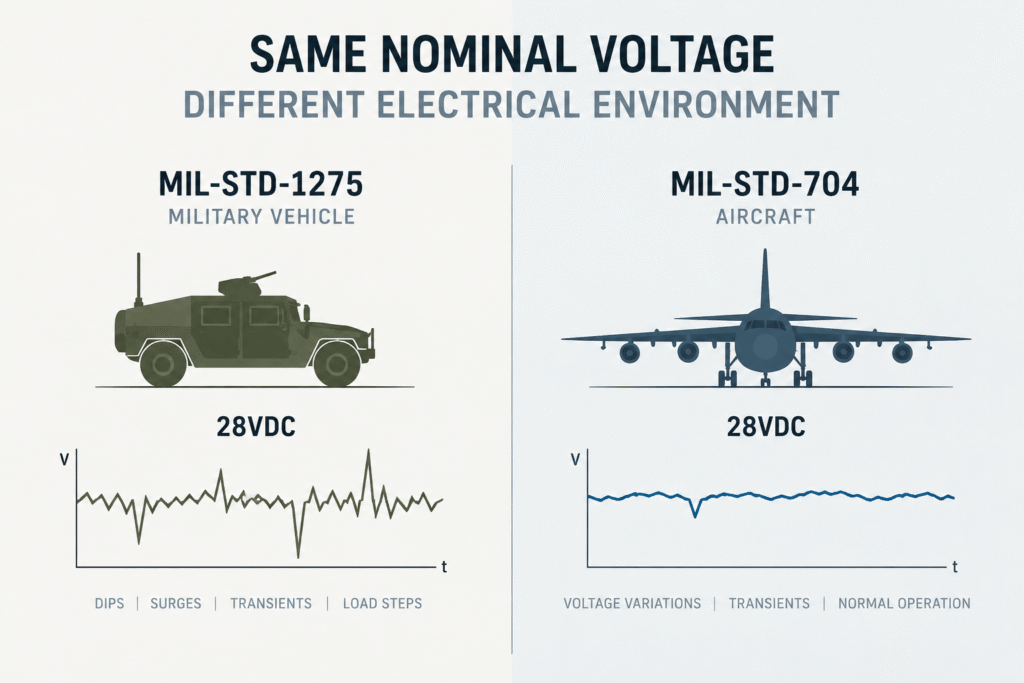
When designing a military or aerospace system powered by DC voltage, it is easy to look at the nominal supply voltage and assume that two systems operating at a similar voltage require a similar solution.

In practice, this can be a significant mistake.

The electrical system of a military vehicle and that of an aircraft may operate around the same nominal voltage, yet the power supply or DC-DC converter connected to them may be exposed to very different electrical conditions.

This is precisely where MIL-STD-1275 and MIL-STD-704 differ.

MIL-STD-1275 addresses the electrical environment of DC power systems in military vehicles, while MIL-STD-704 defines the characteristics of aircraft electric power systems.

Therefore, when selecting a military power supply, the question is not simply:

“What is the input voltage?”

but rather:

“What electrical environment will the power supply be connected to, and what events must it withstand, survive, and continue operating through?”

In other words:

Same nominal voltage does not mean the same electrical environment.

Why Does This Difference Matter?

A power supply is not connected to an ideal laboratory power source.

It is connected to a real electrical system that may include generators, alternators, batteries, converters, changing loads, switching devices, motors, and other electronic equipment.

As a result, the voltage appearing at the power supply input is not necessarily a clean and constant DC voltage.

Depending on the platform and its operating condition, the power supply may be exposed to events such as:

  • Extended voltage variations
  • Voltage dips
  • Surges
  • Spikes and transients
  • Ripple
  • Disturbances caused by load switching
  • Events occurring during startup, changes in system operating mode, or fault conditions

However, the shape, magnitude, duration, and requirements associated with these events are not necessarily the same under MIL-STD-1275 and MIL-STD-704.

A power supply designed to handle one input environment is therefore not automatically suitable for the other simply because the nominal input voltage appears similar.


28VDC Is Only a Nominal Value

One of the most common mistakes is to see the following in a specification:

28VDC Input

and conclude that the power supply is suitable for any 28VDC system.

But 28VDC describes only the nominal operating point.

It does not tell us what happens when the voltage rises, falls, or changes rapidly.

Nor does it tell us:

What is the continuous input voltage range?

How long must the product operate under an abnormal voltage condition?

What transients may reach the input?

How much energy is associated with those events?

Must the power supply continue providing a valid output during the event, or does it only need to survive the event without damage?

And how must it behave once the event has ended?

This is why two products both specified as 28VDC Input can be completely different in terms of their suitability for a military vehicle or aircraft system.


MIL-STD-1275 – The Military Vehicle Electrical Environment

MIL-STD-1275 is primarily associated with DC electrical power systems in military vehicles.

Such an environment may include a battery, charging system, alternator, and significant electrical loads connected to the same power bus.

Sudden load changes, equipment connection or disconnection, system startup, and other events on the electrical network can create conditions very different from the nominal DC voltage.

From the power supply’s perspective, this means that the input stage must be designed not simply for “28V,” but for the electrical environment defined for the application.

A basic solution specified, for example, with an 18-36VDC input range may not be sufficient.

Additional functions may be required, such as:

  • Overvoltage protection
  • Undervoltage protection
  • Spike and transient handling
  • Surge protection
  • Reverse polarity protection, where required by the system
  • Inrush current control
  • Hold-up capability or the ability to handle short supply interruptions
  • Additional input filtering and protection

In some cases, these protection functions are integrated into the power supply itself. In others, a separate Power Front End or protection module is placed ahead of the DC-DC converter.


MIL-STD-704 – The Aircraft Electrical Environment

MIL-STD-704 addresses the characteristics of electric power supplied to utilization equipment in aircraft.

Here too, nominal voltage alone is not sufficient.

The standard addresses the characteristics of the aircraft electrical power system that connected equipment must be designed to operate with, and the applicable requirements vary according to the type of power system involved.

These systems may include, among others:

28VDC, 270VDC, 115VAC/400Hz, and variable-frequency AC systems.

Therefore, the statement:

“MIL-STD-704 compliant power supply”

is not, by itself, sufficient for selecting a product.

It is necessary to understand which aircraft power system the product is intended for, which electrical conditions apply to the application, and what behavior is required from the equipment during and after each relevant event.

It is also important to distinguish between:

Normal Operation – the conditions under which the system is expected to operate routinely.

Abnormal Conditions – conditions outside normal operation that the equipment may be exposed to.

Transient Conditions – short-duration changes in the electrical supply.

From a power supply selection perspective, it is also essential to distinguish between continued operation during an event and surviving the event without damage. A product may be able to withstand a particular electrical condition without necessarily being required to maintain full output performance throughout that condition.

Performance During the Event must therefore be defined separately: the system requirements should specify what the power supply is expected to do while the event is actually occurring.

These distinctions are critical when selecting a power supply or DC-DC converter for an airborne system.


So What Is the Difference in Practice?

The fundamental differences can be summarized as follows:

Topic MIL-STD-1275 MIL-STD-704
Primary environment Military vehicles Aircraft
Typical power system DC DC and AC
28VDC Common Used in applicable systems
Typical sources and influences Vehicle electrical system, charging system, battery, and loads Aircraft electrical power generation and distribution system
Voltage variations Yes Yes
Transients Yes Yes
Surges / abnormal conditions According to the applicable requirements According to the applicable power system and requirements
Selecting by nominal voltage alone Not sufficient Not sufficient
Need for input protection Depends on the product and system Depends on the product and system

The important point is not that one standard is “harder” or “more demanding” than the other.

That comparison can be misleading.

They represent two different electrical environments, with different events, profiles, and requirements.

A product may be an excellent solution for MIL-STD-1275 and still not be the right solution for MIL-STD-704, and vice versa.

Not All Transients Are the Same

One reason why a power supply should not be selected based solely on a 28VDC rating is that voltage events are not defined only by their maximum voltage.

To understand the true significance of a transient or surge, several factors must be considered:

  • Amplitude – how high or low the voltage reaches
  • Duration of the event
  • Rise and fall times
  • Energy associated with the event
  • Repetition rate
  • Operating condition in which the event occurs
  • Required equipment behavior during and after the event

A very short, high-voltage transient can present a completely different challenge from a more moderate voltage increase that lasts significantly longer.

For example, a protection device capable of clamping a short spike is not necessarily an appropriate solution for a longer-duration surge. As the duration increases, the energy that the protection system must handle can become significant, potentially requiring a different protection architecture.

This is particularly important when comparing MIL-STD-1275 and MIL-STD-704.

It is not enough to ask:

“What is the maximum transient voltage?”

The better question is:

“What is the complete event profile, and what must the power supply do while the event is occurring?”


Survival Does Not Necessarily Mean Normal Operation

Even when a datasheet states that a product can withstand a certain voltage, it is important to understand exactly what the manufacturer is specifying.

There are significant differences between:

Operating Input Range
The input voltage range over which the power supply is designed to operate continuously while providing its specified performance.

Transient Capability
The ability to handle a short-duration event outside the normal operating input range.

Survival / Withstand
The ability to withstand an electrical event without permanent damage.

Ride-Through
The ability to continue operating through a particular event according to defined system requirements.

Therefore, a statement such as:

“The power supply can withstand 80V”

does not necessarily mean that the power supply can continue delivering its full specified output while 80V is present at its input.

It may mean only that the unit can survive the event without permanent damage and return to normal operation afterward.

This distinction is important when evaluating power supplies for both MIL-STD-1275 and MIL-STD-704. It is one of the reasons why actual system requirements must be compared with the product’s specified and tested capabilities, rather than relying on a general MIL-STD compliant statement.


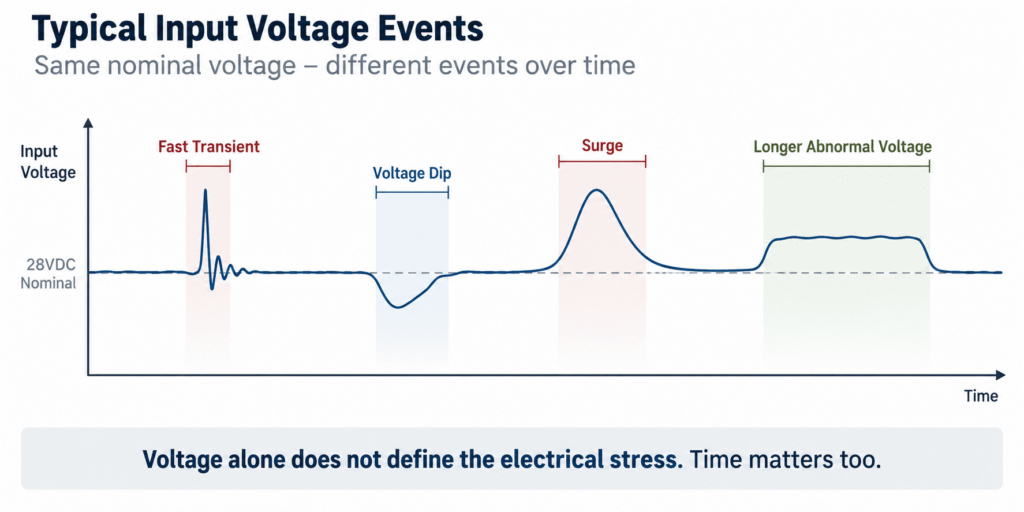
The Same 28VDC – Different Events Over Time

A useful way to understand the difference is to look at input voltage as a function of time.

Two systems may begin at the same nominal operating point of 28VDC, but when an electrical event occurs, their voltage profiles can be very different.

In one environment, for example, the primary challenge may be a very fast spike. In another, it may be a voltage deviation that persists for a much longer period.

From the power supply’s perspective, voltage and time must be considered together.

This is also why MIL-STD-1275 and MIL-STD-704 should not be reduced to two simple voltage envelopes and compared by asking which one is “higher” or “more severe.”

A more useful way to evaluate the electrical stress is as a voltage-time profile.

Is a Power Supply Designed for MIL-STD-1275 Also Suitable for MIL-STD-704?

Not necessarily.

Even when both applications use a 28VDC system, compliance with one standard does not automatically demonstrate suitability for the other.

To answer this question, the product must be evaluated against the specific requirements of both electrical environments.

For example, the following should be examined:

  • Continuous input voltage range
  • Transients and surges
  • Voltage dips
  • Event duration
  • Power supply behavior during the event
  • Survival and ride-through capability
  • Current and power limitations
  • System requirements after the input returns to normal

A power supply may have been designed from the outset with an input stage robust and flexible enough to address the applicable requirements of both environments.

In other cases, a power supply suitable for one environment may require an additional Power Front End to meet the requirements of the other.

Therefore, the correct conclusion is not:

“MIL-STD-1275 includes MIL-STD-704”

or vice versa.

Rather:

A single power solution can be designed to address the applicable requirements of both environments, provided that its input stage is designed and tested accordingly.

This distinction is particularly important when the same power supply is intended for use across multiple platforms.


Two Approaches to Designing the Input Stage

When the DC-DC converter alone does not provide all the required protection functions, there are two main approaches.

Integrated Protection

In this approach, the required protection functions are integrated directly into the power supply or DC-DC converter.

The main advantage is a relatively compact solution with fewer external components and fewer interfaces between separate units.

However, this comes with engineering trade-offs.

As the input requirements become more demanding, integrating protection, filtering, and power conversion into a single unit becomes increasingly challenging while maintaining:

  • Efficiency
  • Size
  • Weight
  • Thermal performance
  • Reliability

Separate Power Front End

The second approach is to place a dedicated module ahead of the DC-DC converter to manage the electrical input environment.

Schematically:

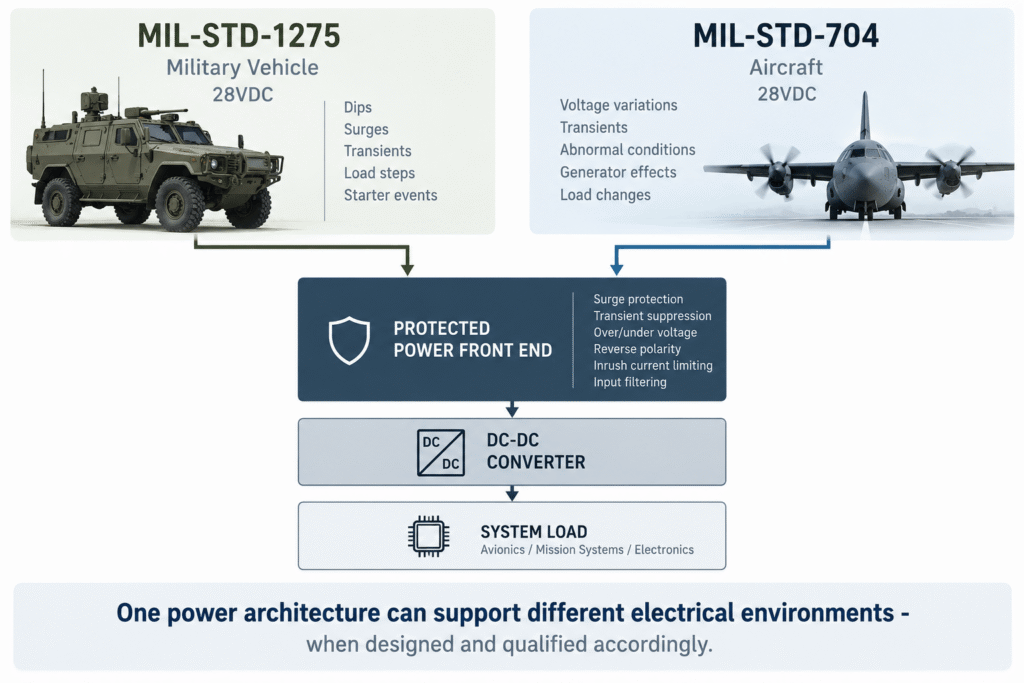
Vehicle / Aircraft Bus → Power Front End → DC-DC Converter → Load

Depending on its design and the applicable requirements, the Power Front End may provide functions such as:

  • Surge protection
  • Transient suppression
  • Overvoltage protection
  • Undervoltage protection
  • Reverse polarity protection
  • Inrush current limiting
  • Input filtering

This approach can be particularly useful when the same basic DC-DC converter is intended for use across multiple platforms, while the input stage is adapted to the specific electrical environment.


The Advantage of a Common Power Front End

This leads to an interesting system-level approach.

Instead of designing one converter for a military vehicle and another for an aircraft, it may be possible in some applications to design an Input Protection Stage with an operating and protection envelope that addresses the applicable requirements of both environments.

This can create an architecture in which the same basic power solution can be used across more than one type of platform.

For example:

28VDC Military Vehicle Bus
↓
Protected Power Front End
↓
DC-DC Converter
↓
System Electronics

And in another application:

28VDC Aircraft Bus
↓
Protected Power Front End
↓
DC-DC Converter
↓
System Electronics

The advantage is not only technical.

A common solution may reduce the number of part numbers, simplify qualification activities, reduce inventory requirements, and enable a more standardized power architecture across different systems.

However, this does not mean that any Power Front End suitable for one standard is automatically suitable for the other.

Its actual electrical and protection envelope must be evaluated to ensure that it covers the applicable requirements of each platform in practice.

MIL-STD-1275 and MIL-STD-704 Do Not Replace MIL-STD-461

It is important to distinguish between requirements that are sometimes mistakenly treated as interchangeable.

MIL-STD-1275 and MIL-STD-704 address the electrical power environment to which the equipment is connected.

However, meeting either of these standards does not automatically mean that the product meets EMI/EMC requirements.

This is where MIL-STD-461 comes into the picture.

In simple terms:

MIL-STD-1275 / MIL-STD-704
primarily address the question:

What power input environment must the equipment be able to accept and operate within?

In contrast:

MIL-STD-461
addresses questions such as:

How much electromagnetic interference does the equipment generate, and how susceptible is it to electromagnetic disturbances from its environment?

A complete power system may therefore need to address both types of challenges simultaneously.

On one hand, it must survive and operate through voltage dips, surges, and transients coming from the electrical power system.

On the other, it may also need to meet the applicable conducted and radiated emissions and susceptibility requirements.


Electrical Protection and EMI Filtering Are Not the Same Thing

This distinction is particularly important when designing the input stage.

A component or circuit designed to protect a power supply against a surge does not necessarily provide the required EMI filtering.

The reverse is also true.

An input filter designed to reduce conducted emissions is not necessarily capable of handling a significant high-energy event arriving from the power bus.

In a real system, both challenges meet at the same input.

An advanced Power Front End may therefore incorporate both:

Protection Functions
such as overvoltage protection, transient suppression, reverse polarity protection, and inrush current control.

and:

Filtering Functions
associated with EMI/EMC and the applicable MIL-STD-461 requirements.

The interaction between these functions must also be considered as part of the overall design.

Adding a filter is not “free.” It can affect size, weight, power losses, efficiency, and the dynamic behavior of the system.

For certain requirements, particularly conducted susceptibility tests such as CS101, a conventional solution may require significant filtering components. Designing the power stage and EMI filter as an integrated system can therefore be especially important when SWaP constraints are critical.


What About MIL-STD-810?

This addresses another part of the design environment.

MIL-STD-1275 and MIL-STD-704 focus on the electrical power environment.

MIL-STD-461 focuses on EMI/EMC.

MIL-STD-810 addresses the physical environment in which the equipment must operate and withstand conditions such as:

  • High and low temperatures
  • Vibration
  • Shock
  • Other environmental conditions, depending on the application and applicable test profile

Therefore, the fact that a power supply is electrically suitable for MIL-STD-1275 or MIL-STD-704 does not necessarily mean that it is suitable for installation on the platform itself.

For example, a power supply may handle the required input transients successfully, but if its mechanical construction cannot withstand the platform’s vibration profile, it is still not a suitable solution.

Similarly, a power supply may meet the electrical requirements in a laboratory but reach its thermal limits when installed in an enclosed space at a high ambient temperature.

The final selection must therefore always be made at the system level.


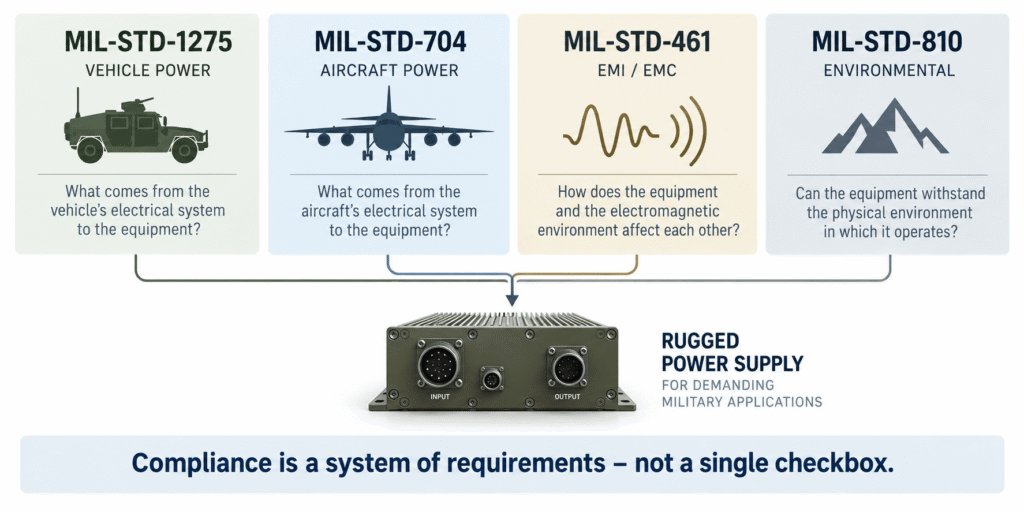
Four Standards – Four Different Questions

A simple way to think about these requirements is:

MIL-STD-1275
What does the equipment receive from the military vehicle’s electrical power system?

MIL-STD-704
What does the equipment receive from the aircraft’s electrical power system?

MIL-STD-461
How do the equipment and its electromagnetic environment affect each other?

MIL-STD-810
Can the equipment withstand the physical environment in which it is installed?

These standards are not substitutes for one another.

A single military or aerospace system may need to address several of them simultaneously.

How Do You Choose a Power Supply for MIL-STD-1275 vs. MIL-STD-704?

The first step is not to choose a power supply.

The first step is to define the input environment.

Before approaching a manufacturer or searching for a DC-DC converter, you need to understand which electrical system the product will be connected to and exactly what will be required of it.

1. What Is the Platform?

Is the system intended for:

  • A military vehicle
  • An aircraft
  • A ground-based system
  • Multiple platforms

For a military vehicle, MIL-STD-1275 may be applicable.

For an airborne system, the applicable MIL-STD-704 requirements for the specific aircraft electrical power system must be identified.

If the same equipment is intended for use across multiple platforms, all applicable requirements should ideally be identified early in the design process.

2. What Is the Actual Power Source?

It is not enough to specify:

Input: 28VDC

At a minimum, the following should be defined:

  • Nominal voltage
  • Continuous input voltage range
  • Minimum and maximum voltage
  • Abnormal conditions
  • Applicable transients and surges
  • Duration of the events
  • Requirements during voltage dips or interruptions
  • Startup and shutdown requirements, where applicable

For a MIL-STD-704 application, it is also necessary to determine whether the relevant power system is actually 28VDC or another system, such as 270VDC or AC.

3. What Must the Power Supply Do During the Event?

This is one of the most important questions, and one of the most frequently overlooked.

Is the power supply required to:

Continue operating without interruption?

Continue operating with a defined temporary deviation at the output?

Reset and then return to normal operation?

Or simply:

Survive without damage?

Two applications exposed to exactly the same input transient may require completely different power supplies if the required output behavior during the event is different.

4. Is the Protection Integrated into the Power Supply?

It is important to understand what is actually included in the product.

For example:

  • Is transient protection integrated?
  • Is an external TVS required?
  • Is active overvoltage protection included?
  • Is reverse polarity protection included?
  • Is inrush current limiting provided?
  • Is external hold-up required?
  • Is an input filter included?

A MIL-STD-1275 or MIL-STD-704 statement in a datasheet does not replace the need to evaluate the actual input architecture and protection functions.

5. Are There Also MIL-STD-461 Requirements?

If so, EMI/EMC should be considered during the power supply selection process rather than left until the end of the project.

A filter added later in the design can affect:

  • Size
  • Weight
  • Efficiency
  • Cost
  • Temperature
  • System stability

This is particularly important when challenging conducted susceptibility requirements such as CS101 apply. Early consideration of the power stage and input filter can help avoid larger and less efficient solutions later in the design process.

6. What Are the Environmental Conditions?

Finally, the power supply selection must also take the mechanical and thermal requirements into account.

Depending on the application, factors to consider include:

  • Operating temperature
  • Derating
  • Cooling method
  • Altitude
  • Vibration
  • Shock
  • Mounting method
  • Size and weight constraints

A power supply that meets the electrical requirements but cannot dissipate its heat under the actual installation conditions is not a suitable solution.


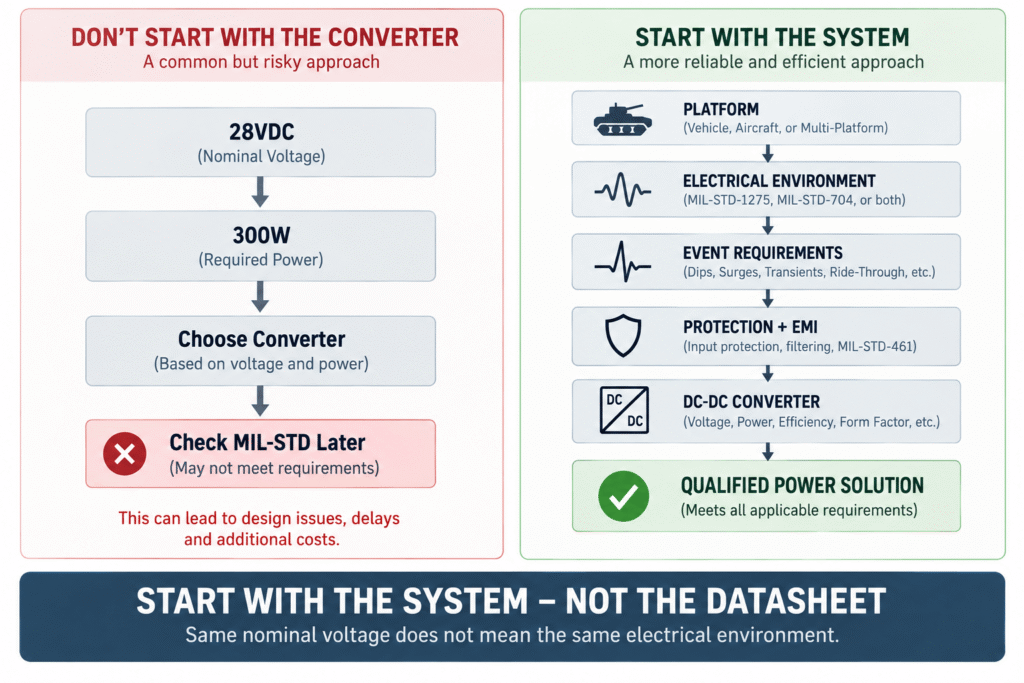
Don’t Start with the Datasheet – Start with the System

In many projects, the selection process begins in the opposite direction.

The search starts with something like:

28VDC → 12VDC, 300W

A converter is selected based on voltage and power, and only afterward does the team begin investigating whether it can handle the applicable military electrical requirements.

A better approach is to start with the platform:

Platform
↓
Applicable Electrical Standard
↓
Actual Input Requirements
↓
Required Behavior During Events
↓
Protection / Filtering Architecture
↓
DC-DC Converter
↓
Environmental Requirements

Only then should the product be selected.

This way, the power supply is selected as part of the overall system rather than as an isolated component.


What If the System Must Meet Both MIL-STD-1275 and MIL-STD-704?

In this case, simply selecting the “more stringent standard” is not the right approach.

There is not necessarily one standard that is more demanding across every parameter.

Instead, a combined Requirement Envelope should be created.

The applicable requirements of both electrical environments should be reviewed, and the solution evaluated against each relevant area:

Continuous Input Range

Overvoltage Events

Undervoltage Events

Transients

Surges

Interruptions / Dips

Reverse Polarity, where applicable

Required Output Behavior

Recovery

The power supply or Power Front End can then be designed to meet this combined requirement envelope.

The result may be a single solution suitable for both platforms, but that suitability comes from designing and testing the solution against both sets of applicable requirements.

Not from the fact that the product is labeled 28VDC.

Comparison Table – MIL-STD-1275 vs. MIL-STD-704

Before selecting a power supply, it is useful to look at these two standards not simply as sets of numerical limits, but as two different electrical environments.

Topic MIL-STD-1275 MIL-STD-704
Primary platform Military vehicles Aircraft
Electrical environment Primarily vehicle DC power systems Aircraft DC and AC power systems
28VDC Common Used in applicable systems
Typical power sources Battery, alternator/charging system, and vehicle loads Aircraft electrical power generation and distribution system
Voltage variations Relevant Relevant
Dips / Interruptions Evaluate according to the applicable requirements Evaluate according to the applicable power system and requirements
Surges / Transients Relevant Relevant
Normal / Abnormal Conditions Evaluate according to system requirements Important distinction within aircraft power requirements
Selection based on 28VDC alone Not sufficient Not sufficient
External Power Front End May be required May be required
MIL-STD-461 Separate requirement, where applicable Separate requirement, where applicable
MIL-STD-810 Separate requirement, where applicable Separate requirement, where applicable

The table illustrates the key point:

There is little value in asking which standard is “more demanding.”

The correct question is:

What is the specific electrical environment of the system, and what is the power supply required to do during each relevant event?


Power Supply Selection Checklist

Before selecting a power supply or DC-DC converter for a military vehicle or aircraft system, it is recommended to answer the following questions:

Platform

  • Military vehicle or aircraft?
  • Is the product intended for more than one platform?
  • Which standards and contractual requirements apply to the project?

Electrical Power System

  • What is the nominal voltage?
  • What is the continuous input voltage range?
  • Is the system DC or AC?
  • For an aircraft application, which specific electrical power system is relevant?

Voltage Events

  • Which transients are applicable?
  • Which surges are applicable?
  • Which voltage dips are relevant?
  • How long does each event last?
  • Are there extended overvoltage or undervoltage conditions?
  • Is reverse polarity part of the system requirements?

Behavior During the Event

  • Must the power supply continue operating?
  • Is a temporary output deviation permitted?
  • Is a reset permitted?
  • Is ride-through required?
  • Is only survival without damage required?
  • How must the product recover after the event?

Protection Architecture

  • Are the protection functions integrated into the power supply?
  • Is a Power Front End required?
  • Is an external input filter required?
  • Is inrush current limiting included?
  • Is additional hold-up capability required?

Additional Requirements

  • Is MIL-STD-461 applicable?
  • Which EMI/EMC tests are required?
  • Is CS101 applicable?
  • Which MIL-STD-810 requirements are relevant?
  • What are the temperature, vibration, and shock requirements?
  • How is the power supply cooled?
  • What are the size, weight, and efficiency constraints?

Only after these points have been defined can different power solutions be compared properly.


Frequently Asked Questions – FAQ

Are MIL-STD-1275 and MIL-STD-704 the Same for a 28VDC System?

No.

Even when both systems use a nominal 28VDC supply, they represent different electrical environments.

Nominal voltage is only one parameter. The applicable voltage ranges, abnormal conditions, transients, surges, dips, event durations, and required equipment behavior must also be evaluated.

Same nominal voltage does not mean the same electrical environment.


Is an 18-36VDC Input Power Supply Suitable for MIL-STD-1275?

Not necessarily.

18-36VDC typically describes the product’s continuous input voltage range.

It does not demonstrate that the power supply can handle all surges, transients, dips, and other events relevant to the system requirements.

Additional protection or a Power Front End may be required ahead of the converter.


Is a Power Supply Suitable for MIL-STD-1275 Also Suitable for MIL-STD-704?

Not automatically.

The product’s capabilities must be compared with the applicable requirements of the specific MIL-STD-704 electrical environment.

A product may be designed to address requirements from both environments, but this should be verified against the product specification, system requirements, and relevant test data.


Does MIL-STD-704 Apply Only to 28VDC?

No.

MIL-STD-704 addresses the characteristics of aircraft electric power systems and covers different types of electrical power systems depending on the platform and application.

Before selecting a power supply, it is therefore necessary to identify whether the relevant system is, for example, 28VDC, 270VDC, 115VAC/400Hz, or another power system applicable to the platform.


What Is the Difference Between Operating Range and Survival?

Operating Range is the input range over which the product is designed to operate while providing its specified performance.

Survival describes the ability of the product to withstand a particular event without permanent damage, but does not necessarily mean that it will maintain normal output performance throughout the event.

It is therefore important to understand exactly what the datasheet specifies rather than relying only on the maximum voltage value shown.


Is a TVS Enough to Meet MIL-STD Requirements?

There is no universal answer.

A TVS can be part of a transient protection system, but its suitability depends on the voltage, event duration, energy, source characteristics, and overall protection architecture.

A short-duration event and a longer-duration event may require completely different protection solutions.


What Is a Power Front End?

A Power Front End is a stage placed between the platform’s electrical power system and the power supply or DC-DC converter.

Depending on its design, it may provide functions such as:

  • Transient suppression
  • Surge protection
  • Overvoltage / undervoltage protection
  • Reverse polarity protection
  • Inrush current limiting
  • Input filtering

This approach can make it possible to use a basic DC-DC converter together with an additional protection stage designed for the specific electrical environment.


Can One Power Front End Be Designed for Both MIL-STD-1275 and MIL-STD-704?

Yes, in principle.

A solution can be designed with an electrical and protection envelope that covers the applicable requirements of both environments.

However, this suitability cannot be assumed based on nominal voltage alone.

The requirements of both systems must be compared, and the Power Front End must be designed and tested against the combined Requirement Envelope.


Does Meeting MIL-STD-1275 or MIL-STD-704 Mean the Power Supply Also Meets MIL-STD-461?

No.

These are different requirements.

MIL-STD-1275 and MIL-STD-704 address the electrical power environment, while MIL-STD-461 addresses EMI and EMC.

A system may need to address both sets of requirements simultaneously.


Is a Power Supply That Meets the Electrical Requirements Automatically Suitable for a Military Platform?

No.

In addition to electrical requirements, environmental conditions such as temperature, vibration, and shock may need to be evaluated, for example under applicable MIL-STD-810 methods and test profiles.

The mechanical and thermal constraints of the actual installation must also be considered.


Conclusion – The Same Voltage Does Not Mean the Same Electrical Environment

MIL-STD-1275 and MIL-STD-704 address two different electrical environments.

The fact that two systems may both use 28VDC does not make them identical from the power supply’s perspective.

28VDC is a nominal voltage. It is not a complete electrical specification.

Selecting the right power supply requires an understanding of the continuous input range, transients, surges, dips, event durations, and the required behavior of the product during and after each event.

In some applications, the required protection functions can be integrated directly into the power supply.

In others, the appropriate architecture may be:

Power Front End + DC-DC Converter

And when the same system must be suitable for both military vehicle and aircraft applications, a common requirement envelope can be developed to address the applicable MIL-STD-1275 and MIL-STD-704 requirements.

But the starting point should always be the system and its electrical environment, not simply the number printed next to the input specification in the datasheet.

Same nominal voltage does not mean the same electrical environment.

That may be the single most important principle when selecting a power supply for a military or aerospace system.

Key Terms

MIL-STD-1275
A U.S. military standard addressing the characteristics of DC electrical power systems in military vehicles and the electrical environment to which connected equipment may be exposed.

MIL-STD-704
A U.S. military standard defining the characteristics of aircraft electric power systems. It is relevant to different types of power systems, including 28VDC, 270VDC, and AC systems, depending on the platform and application.

Nominal Voltage
The voltage value used to describe an electrical power system, such as 28VDC. The nominal voltage does not mean that the actual voltage always remains at that value, nor does it define the complete input environment.

Input Voltage Range
The range of input voltages over which a power supply or DC-DC converter is designed to operate with defined performance. It is important to distinguish between the continuous operating range and the ability to handle abnormal events for limited periods.

Transient
A short-duration, rapid change in voltage or current. Important transient characteristics include amplitude, duration, and rate of change.

Surge
A voltage increase that persists for a limited period of time. The ability to handle a surge depends not only on its maximum voltage, but also on its duration and the energy the system must absorb or manage.

Voltage Dip
A temporary reduction in input voltage below the normal operating level. Depending on the system requirements, the equipment may be required to continue operating during the event.

Ride-Through
The ability of a power supply or system to continue operating through a temporary disturbance in the electrical supply, subject to defined performance limits.

Survival / Withstand
The ability of a product to withstand an electrical event without permanent damage. Survival does not necessarily mean that the product maintains normal output performance during the event.

Power Front End
A stage placed between the platform’s electrical power system and the DC-DC converter or load. Depending on its design, it may provide protection against transients, surges, overvoltage, reverse polarity, and inrush current, as well as input filtering functions.

Integrated Protection
An approach in which the protection functions required for the input environment are integrated directly into the power supply or DC-DC converter rather than implemented in a separate Power Front End.

Requirement Envelope
The complete set of input conditions and electrical events that a solution is required to address. When a product is intended for multiple platforms, a combined requirement envelope can be developed based on the applicable requirements of each platform.

MIL-STD-461
A U.S. military standard addressing EMI and EMC requirements for equipment and subsystems. It does not replace MIL-STD-1275 or MIL-STD-704 and may apply alongside them.

MIL-STD-810
A U.S. military standard containing test methods for environmental conditions such as temperature, vibration, and shock. It complements electrical requirements but does not replace them.

CS101
A conducted susceptibility test under MIL-STD-461 that evaluates equipment immunity to disturbances coupled onto power input leads over the frequency range applicable to the test. In power systems, CS101 requirements can have a significant impact on input filter design.

Tags: GilGal

Related Articles

Smart Power Protector – The Ultimate Solution for Reliability and Protection in Military and Industrial Systems

20/02/2025amironicLTD

MIL-STD-1275F: Advanced Protection in Military Power Systems – In-Depth Understanding of Transient Surge

29/06/2025amironicLTD

DC/DC Converter for MIL-STD-1275F: What a 24V→12V Power Supply That Truly Survives “Electrical Hell” Looks Like

02/02/2026amironicLTD

Recent Posts

  • Electrical, Pneumatic, USB, Bluetooth or Contactless – How Do You Choose the Right Switch for Your System?
  • Military DC-DC Converters with Built-In EMI Filtering and Input Protection
  • MIL-STD-1275 vs. MIL-STD-704 – What’s the Difference and How Do You Choose the Right Power Supply?
  • You Don’t Always Need to Measure Temperature – Sometimes You Just Need to Know When to Stop
  • MIL-STD-810 – Vibration, Shock and Environmental Conditions in Military Power Supplies

Categories

  • Air Switch
  • Circuit Breakers
  • Elapsed Time Indicator
  • Feedthrough
  • Footswitches
  • Gears & Transmission
  • Hour Meters
  • Infra Red Switches
  • INFRARED LAMPS
  • Low Noise Inertial MEMS
  • Mechanics
  • MEMS Gyroscope
  • MEMS Inertial
  • Microelectronics
  • Motors
  • Position Sensors
  • Power Supply
  • Pressure Sensors
  • Pressure Switch
  • Temperature Sensors
  • Tungsten and Molybdenum
  • Uncategorized
  • Vacuum Switches

Quick Contact

Fill out the form and our representatives will return to you

    Name (required)

    Email (required)

    Phone

    Message

    This site is protected by reCAPTCHA and the Google
    Privacy Policy and
    Terms of Service apply.

    Amironic Ltd.

    3 Rabinovich Street, Petah Tikva 4928144 , Israel. Tel: +972-3-9047744 E-mail: office@amironic.co.il
    Email
    Facebook
    Twitter
    LinkedIn
    YouTube
    Press on the ISO Certificate below for download
    ISO 9001:2015 Certification
    • MEMS Inertial
    • Circuit Breakers
    • Footswitches
    • Mechanical & Transmisions
    • Sensors
    • Motors
    • Electronics
    • Hand Control
    • Power Solutions

    News

    • Electrical, Pneumatic, USB, Bluetooth or Contactless – How Do You Choose the Right Switch for Your System?
    • Military DC-DC Converters with Built-In EMI Filtering and Input Protection
    • MIL-STD-1275 vs. MIL-STD-704 – What’s the Difference and How Do You Choose the Right Power Supply?
    • You Don’t Always Need to Measure Temperature – Sometimes You Just Need to Know When to Stop
    • MIL-STD-810 – Vibration, Shock and Environmental Conditions in Military Power Supplies
    About AmironicContactעברית
    © 2022 Amironic All rights reserved. All Trademarks are the property of their respective owners.
    • Increase Font
    • Decrease Font
    • Black & White
    • Inverse Colors
    • Highlight Links
    • Regular Font
    • Reset