flagעברית
flagEnglish
3 Rabinovich St., Petah-Tikva, Israel
+972 3 9047744
office@amironic.co.il
Facebook
Twitter
LinkedIn
YouTube
  • Products
    • MEMS Inertial
      • Gyros & Accels
      • IMU
      • Inertial Navigation
      • AHRS
    • Circuit Breakers
      • Airpax Circuit Breakers
      • Electronic Circuit Breakers
      • Aircraft Circuit Breakers
      • Thermal Circuit Breakers
      • Sealing Solutions & Guards
    • Footswitches
      • Pedals & Bellows
      • USB
      • Air Switches
      • Medical
      • Modular Bases System
      • Industrial
      • Foot Potentiometers
      • Wireless
    • Mechanical & Transmisions
      • Gears
      • Sealing Solutions
      • Gearboxes
      • Couplings
      • Shafts & Bearings
      • Fasteners
      • Mechanical & Springs
      • Linear Motion
      • Anti-Vibration
    • Sensors
      • Thermostats
      • Temperature
      • Position
      • Pressure
      • Speed
      • Level Sensor
      • Load Cells
      • Flex Sensors
      • Membrane Potentiometer
    • Motors
      • Geared DC
      • Brushless DC
      • Step Motors with Gearbox
      • Torque Motors & Brushless Servo
      • DC Motors
    • Electronics
      • Xenon & IR Lamps
      • Counters & Meters
      • Microelectronics Packaging
      • Waterproof Switches
      • Micro Switches
    • Hand Control
      • Operator Controls (JOYSTICK)
      • Electrical
      • Pneumatic (Medical)
      • USB Hand Control
      • Air Push Button
      • Pressure Switch
      • IR Switch
    • Power Solutions
      • Rugged & Military Power Supply
      • Input Power Protection
      • Sealed Military Power Adaptor
      • Triple Output Military Power Supply Series – up to 250 W
    • Materials
      • Molybdenum and Advanced Alloys (TZM, MOLA, HCT)
      • Tungsten (Wolfram) and Advanced Alloys – High-Performance Materials for Extreme Conditions
      • Materials for Gears
  • Shop
  • Companies
  • About Amironic
  • News
  • Contact
Product was added to your cart

Cart

waze

MIL-STD-461 for Military Power Supplies – EMI, EMC and CS101

Power Supply03/09/2026amironicLTD

In military systems, a power supply is required to do more than simply provide a stable voltage to the load.

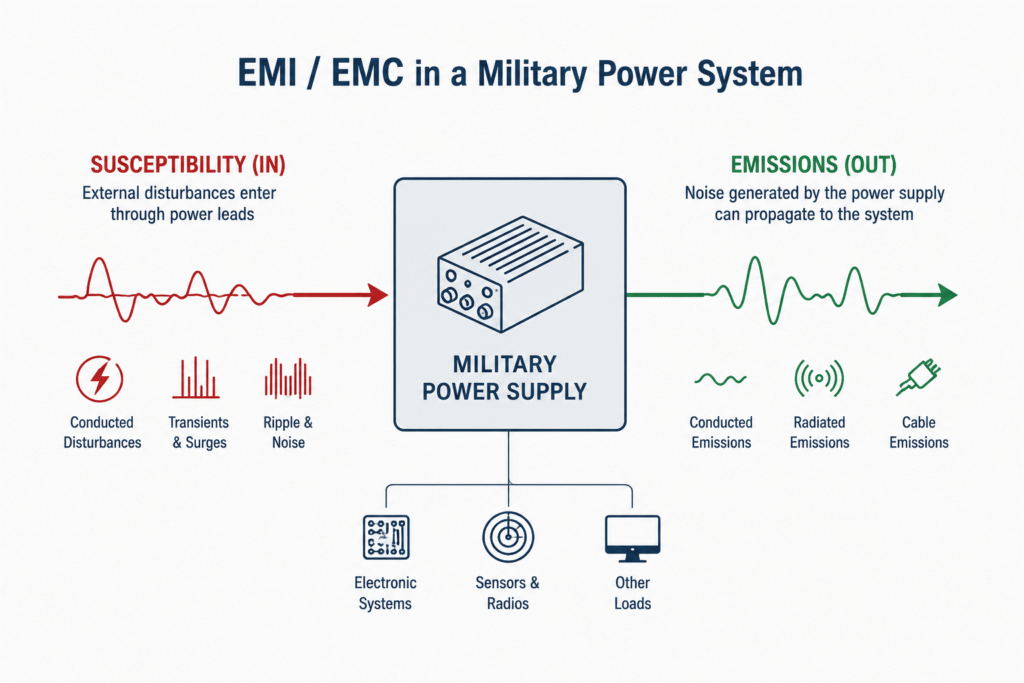
It operates within a complex electromagnetic environment, where disturbances can enter through power lines, cables, and the surrounding electromagnetic environment. At the same time, the power supply itself can generate interference that may affect other equipment in the system.

This is where MIL-STD-461 comes into play. It is one of the key military standards addressing EMI – Electromagnetic Interference and EMC – Electromagnetic Compatibility.

The standard addresses two main areas:

  • Emissions – how much electromagnetic interference the equipment generates and propagates into its surroundings.
  • Susceptibility – the ability of the equipment to continue operating properly when exposed to electromagnetic disturbances.

For power supplies and DC-DC converters, this is particularly important because the power lines form a two-way path: noise generated by the converter can propagate back into the power system, while disturbances from the power system can enter through the same lines and reach the power supply and its load.

One of the important tests in this context is CS101 – Conducted Susceptibility, Power Leads, which evaluates the equipment’s ability to withstand disturbances coupled onto its input power leads.

For power supply designers, CS101 can become a significant requirement in the design of the Input Filter and Power Front End. A conventional solution based simply on increasing the size of filtering components may come at the cost of additional volume, weight, power losses, and reduced efficiency.

Therefore, the engineering question is not only:

Does the power supply meet CS101?

But also:

How can CS101 compliance be achieved without making the Power Front End large, heavy, and inefficient?

This is exactly where proper Input Filtering and Power Front End design become a critical part of military power supply design.

What is MIL-STD-461?

MIL-STD-461 is a U.S. Department of Defense standard that defines requirements and test methods for controlling the EMI characteristics of electrical and electronic equipment and subsystems.

Unlike standards that focus primarily on power quality or environmental conditions, MIL-STD-461 focuses on the ability of equipment to operate within the electromagnetic environment of the system.

For a military power supply, therefore, it is not enough to ask:

Does it provide the required output voltage and power?

We must also ask:

Does it do so without interfering with other equipment, and does it continue to operate properly when exposed to external electromagnetic disturbances?

As of 2026, the latest revision of the standard is MIL-STD-461H, published in April 2026, which superseded MIL-STD-461G. However, existing systems and programs may still specify an earlier revision, so the applicable revision should always be determined by the specific project requirements.

EMI vs. EMC – What Is the Difference?

The two terms are closely related, but they are not the same.

EMI – Electromagnetic Interference refers to the electromagnetic interference itself.

For example, a switching DC-DC converter can generate noise due to its switching frequency and harmonics. This noise can propagate through the power lines or be radiated into the surrounding environment.

EMC – Electromagnetic Compatibility is the ability of equipment to operate properly within its electromagnetic environment without causing unacceptable interference to other equipment and without being excessively susceptible to external disturbances.

Simply put, a power supply with appropriate EMC performance needs to address both sides:

Do not interfere with other equipment – and continue operating when exposed to interference from other sources.

Emissions and Susceptibility in MIL-STD-461

MIL-STD-461 requirements are divided into several families of tests. For power supplies, four key concepts help provide a clear understanding of the overall picture:

  • CE – Conducted Emissions – interference generated by the equipment and conducted through power cables or other conductors.
  • RE – Radiated Emissions – electromagnetic interference radiated from the equipment and cables into the surrounding environment.
  • CS – Conducted Susceptibility – the ability of the equipment to withstand disturbances entering through cables and conductors.
  • RS – Radiated Susceptibility – the ability of the equipment to withstand externally radiated electromagnetic fields.

In a military power supply, CE and CS are particularly important because both involve the power lines.

On one side, a switching DC-DC converter may conduct Switching Noise back onto the Power Bus. On the other side, the same Power Bus can introduce disturbances into the power supply, originating from other systems or from the power source itself.

Therefore, the input power lines are not simply a “power connection.” They are part of the EMC interface and must be designed according to the system requirements.

Why Is a Power Supply Critical for EMI and EMC?

A switching power supply is inherently a potential source of electromagnetic noise.

A typical converter contains components and circuits such as:

  • Switching Devices
  • Magnetics
  • Input and Output Capacitors
  • Rectification Stages
  • Control Loops
  • Protection Circuits
  • EMI Filters

High-speed switching enables high efficiency and helps reduce converter size, but it also generates frequency components and harmonics that must be controlled.

At the same time, the power supply is connected directly to the platform Power Bus on one side and to the electronics it powers on the other.

In other words, it sits directly in the middle:

Platform Power Bus → Power Supply → Sensitive Electronics

For this reason, EMC design in a power supply is not necessarily something that can simply be “added at the end” using an external filter.

In an advanced military system, EMC should be considered from the beginning as part of the Power Front End design.

What Is a Power Front End?

When discussing a military power supply, it is easy to focus primarily on the DC-DC converter itself.

In practice, however, several additional circuits may be required before the actual power conversion stage:

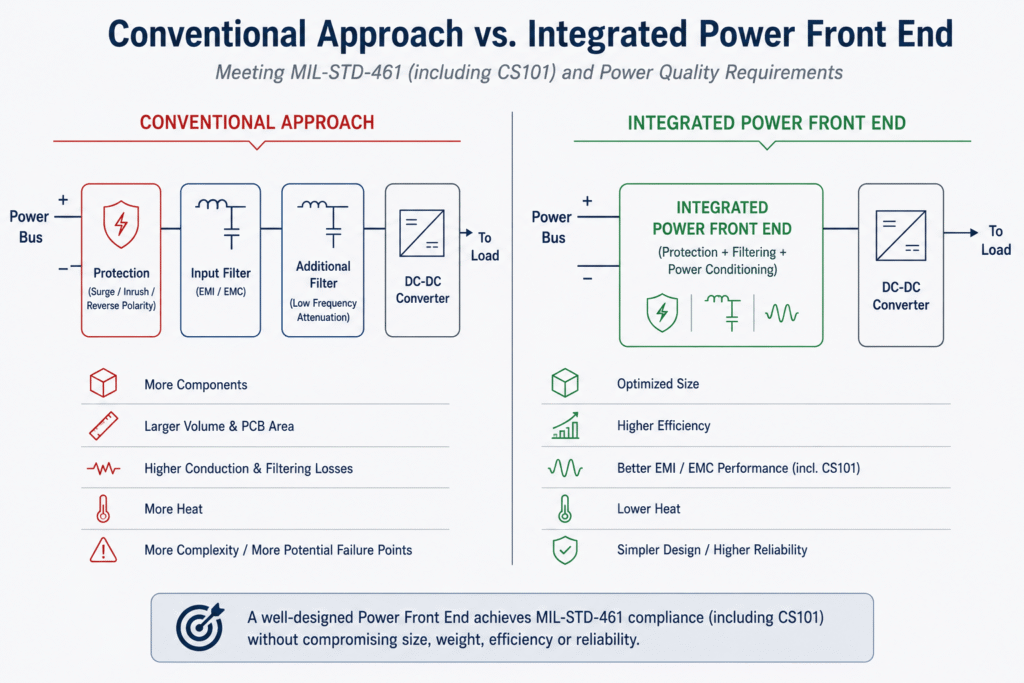
Power Bus → Protection → Input Filter → Power Conditioning → DC-DC Converter → Load

This front section of the power system is often referred to as the Power Front End.

Depending on the platform and project requirements, it may provide functions such as:

  • Input Filtering
  • EMI / EMC Filtering
  • Transient and Surge Protection
  • Reverse Polarity Protection
  • Inrush Current Control
  • Input Power Conditioning
  • Conducted Susceptibility Protection

The important point is that these functions interact with one another.

For example, a component selected to handle a Transient on the input power line does not necessarily solve a Conducted Susceptibility problem. Similarly, increasing the Input Filter to improve EMC performance can affect size, weight, power losses, and even the dynamic stability of the converter.

A good Power Front End, therefore, is not simply a collection of protection devices and filters.

It should be designed as a complete system.

CS101 – When the Disturbance Enters Through the Power Lines

This brings us to one of the most important tests discussed in this article:

CS101 – Conducted Susceptibility, Power Leads

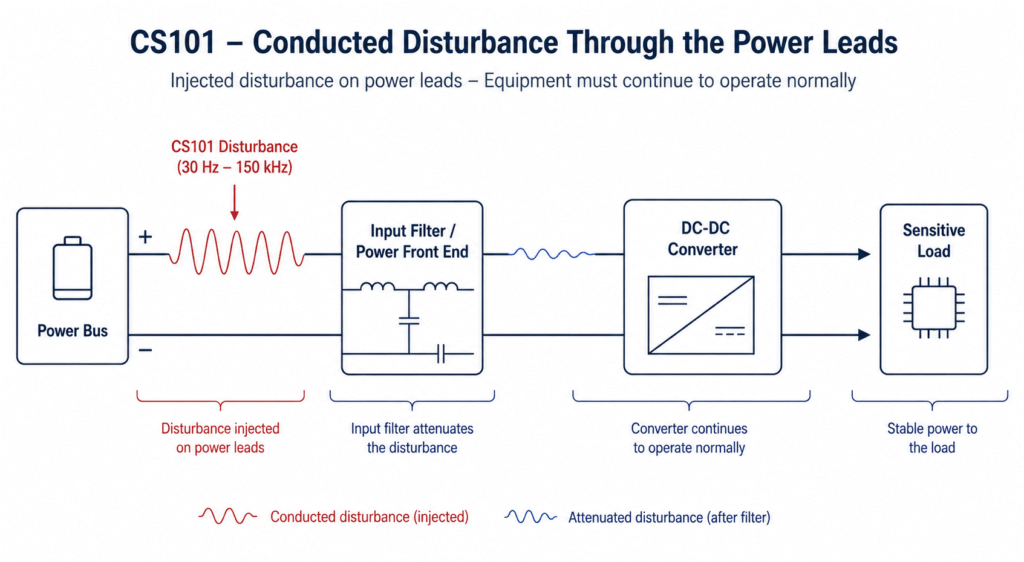
CS101 evaluates the ability of the equipment to continue operating according to its specified requirements when a low-frequency disturbance signal is coupled onto its input power leads.

In other words, the question is not simply whether the power supply can “survive” a momentary event.

The question is what happens when a conducted disturbance is actually present on the power line while the system is operating.

From the perspective of the power supply, the disturbance path can be represented approximately as:

Power Input + Disturbance → Input Filter / Power Front End → DC-DC Stage → Output / Load

This is exactly where the quality of the Input Filter and Power Front End design becomes critical.

Why Can CS101 Be Particularly Challenging for Power Supplies?

At first glance, the solution to disturbances on the input power lines may seem straightforward: add an Input Filter that attenuates the disturbance before it reaches the converter.

In practice, however, the challenge is more complex.

CS101 deals with disturbances at relatively low frequencies, and at these frequencies it is not always possible to achieve significant Attenuation using small filtering components.

A conventional passive solution may require:

  • Higher Inductance
  • Higher Capacitance
  • Multiple Filtering Stages
  • Damping Components
  • Components with Higher Current-Carrying Capability
  • Additional PCB Area and Volume

As system power and current increase, the filtering components themselves may become larger and heavier.

Efficiency is another important consideration.

Real-world inductors, capacitors, and protection components have losses. In a system carrying significant current, even a small resistance in the power path can result in additional power dissipation and heat.

Therefore, solving CS101 is not simply a matter of achieving sufficient Attenuation.

The design must balance:

EMC Performance + Size + Weight + Efficiency + Thermal Performance

In compact military systems, this balance can be critical.

Why Not Simply Increase the Input Filter?

An intuitive approach might be:

If the filter is not sufficient, increase the inductance or capacitance.

However, an Input Filter does not operate independently.

It is connected directly to the input of the DC-DC Converter, creating an interaction between the filter impedance and the converter’s dynamic behavior.

An improperly designed filter can introduce Resonance, affect system response, and in some cases compromise stability.

Damping can help address some of these issues, but it may also introduce additional power losses.

Proper design therefore requires the Input Filter and DC-DC Converter to be considered as an integrated system rather than as two independent blocks.

CS101 vs. MIL-STD-1275 – Not the Same Requirement

It is important to distinguish CS101 from Power Quality and Transient requirements such as those defined in MIL-STD-1275 for military vehicle electrical power systems.

MIL-STD-1275 addresses the characteristics and events associated with the vehicle electrical power system, while CS101 is a Conducted Susceptibility test defined under MIL-STD-461.

It is therefore not correct to make a general statement that CS101 is “more severe” than MIL-STD-1275, or vice versa.

They address different types of disturbances and use different test methods.

A system may be required to address both.

For example, a Power Front End designed for a military ground vehicle may need to handle Transients and Surges associated with MIL-STD-1275 while also meeting the Conducted Susceptibility requirements of MIL-STD-461.

This is exactly why a general requirement such as “Military DC-DC Converter” is not sufficient.

It is necessary to understand which standards, which tests, and which Limits apply to the specific system.

Integrated Power Front End – Instead of Separate Solutions

When several requirements apply simultaneously, one approach is to add a separate solution for each problem:

Transient Protection for one requirement, an EMI Filter for another, additional protection components for a third requirement, and so on.

However, every additional layer can add:

  • Volume
  • Weight
  • Components
  • Power Losses
  • Heat
  • Complexity
  • Potential Points of Failure

An alternative approach is to design the Power Front End from the outset as an integrated system that addresses multiple requirements simultaneously.

Instead of asking only:

Which filter should be added?

The question becomes:

How should the entire input power interface be designed so that the power supply meets both the electrical and EMC requirements of the system?

This approach is particularly important when the system is subject to significant SWaP constraints – Size, Weight and Power.

Figure 3 – Comparison between a conventional approach based on multiple separate protection and filtering stages, and an integrated Power Front End designed as a complete system. An integrated design can help balance EMI/EMC and CS101 requirements with constraints on size, weight, efficiency, and thermal performance.

What Is Actually Tested in CS101?

During a CS101 test, a controlled disturbance signal is injected onto the equipment’s input power leads while the system is operating.

The objective is not simply to determine whether the equipment “survives” or completely stops operating.

The requirement is that the EUT – Equipment Under Test – does not exhibit a malfunction, degradation of performance, or deviation from its specified performance while the test signal is applied.

For DC-powered equipment, CS101 covers the frequency range:

30 Hz to 150 kHz

For AC-powered equipment, the test range begins at the second harmonic of the power frequency and extends to 150 kHz.

For a power supply, this means that the system must continue to provide the required performance even when a conducted disturbance is present on its input power lines.

This is an important distinction: CS101 is not simply a test of a DC-DC Converter “on paper.” It evaluates the behavior of the equipment when the disturbance enters through its actual power interface.

Not Every Product Is Automatically Subject to Every MIL-STD-461 Test

Simply stating that a product is “MIL-STD-461 compliant” does not always provide enough information to understand its actual requirements.

MIL-STD-461 includes multiple test methods, and the applicable requirements depend on factors such as the type of equipment, its interfaces, the platform, and the specific project requirements.

Revision H also clarified the applicability of requirements associated with power leads. Among the changes, CE101, CE102, and CS101 were clarified as not applicable to power leads that do not connect directly to the Platform Power Bus.

Therefore, before selecting a power supply or Power Front End, it is important to determine:

  • Which revision of MIL-STD-461 is required?
  • Which Tests apply to the equipment?
  • What Limits are required?
  • What is the input voltage?
  • Is the input AC or DC?
  • Which Power Bus is the equipment connected to?
  • What are the input power and current?
  • What additional requirements apply to the same interface?

The key point is:

MIL-STD-461 is not a single requirement that a product simply “passes.” It is a framework of requirements and tests that must be applied according to the specific application.

CS101 Is Only Part of the EMC Picture

Although this article focuses on CS101, a military power supply may also be required to meet additional MIL-STD-461 tests.

Depending on the application, relevant requirements may include:

CE101 / CE102 – Conducted Emissions

These tests address noise conducted from the equipment onto the power leads.

CS101 – Conducted Susceptibility, Power Leads

This test evaluates the equipment’s ability to withstand disturbances coupled onto its input power leads.

CS114 – Conducted Susceptibility, Bulk Cable Injection

This test addresses immunity to RF disturbances injected onto cables.

CS115 / CS116

These tests address additional types of conducted disturbances and transient phenomena.

RE – Radiated Emissions

These requirements address electromagnetic emissions radiated from the equipment and its cables.

RS – Radiated Susceptibility

These requirements address the equipment’s ability to withstand externally radiated electromagnetic fields.

A complete EMI/EMC solution should therefore not focus on CS101 alone.

However, for a Power Front End, CS101 is particularly interesting because the disturbance enters directly through the same path from which the power supply receives its energy. CS101 is specifically intended to evaluate the ability of the EUT to withstand signals coupled onto its input power leads.

The Relationship Between MIL-STD-461, MIL-STD-1275 and MIL-STD-704

In a real military project, equipment may need to address more than one standard.

For example:

MIL-STD-1275 is relevant to the characteristics of military ground vehicle electrical power systems.

MIL-STD-704 is relevant to aircraft electrical power characteristics.

MIL-STD-461 addresses EMI/EMC requirements for equipment and subsystems.

These standards do not replace one another.

A power supply intended for a military platform may need to address both the electrical characteristics of the Platform Power Bus and the applicable EMI/EMC requirements.

As a result, the same Power Front End may need to address several types of requirements simultaneously.

For example:

Platform Power Requirements + Transient Protection + EMI Filtering + Conducted Susceptibility

This is one of the reasons why selecting a DC-DC Converter based only on input voltage, output voltage, and power is not sufficient for such systems.

The Challenge: Meeting the Requirements Without Paying a Heavy SWaP Penalty

One of the major challenges in military power system design is SWaP – Size, Weight and Power.

Filtering performance can sometimes be improved simply by adding components.

But every component comes at a cost.

A larger inductor adds volume and weight.

Additional filtering stages add components and PCB area.

Resistance and losses in power components can reduce efficiency.

Power losses become heat, and heat requires thermal management.

As a result, a solution that appears simple on the schematic can quickly become a mechanical and thermal challenge.

Especially in a compact military system, the question is not only:

Can we meet CS101?

But also:

Can we meet CS101 within the available size, weight, efficiency and thermal budget?

The Advantage of a Dedicated Power Front End

When the requirements are known in advance, the Power Front End can be designed to address them as an integrated system.

Instead of adding one protection layer after another, the following functions can be optimized together:

Protection + Filtering + Power Conditioning + DC-DC Conversion

This approach can be particularly valuable when MIL-STD-461 requirements must be combined with Power Bus requirements such as MIL-STD-1275 or MIL-STD-704.

The objective is not to “add as many filters as possible.”

The objective is to achieve the required level of protection and EMC performance while minimizing the impact on:

  • Size
  • Weight
  • Efficiency
  • Thermal Performance
  • Reliability

This is one of the areas in which Gilgal Power specializes.

Gilgal Power – Input Filtering and Power Front End Solutions

Gilgal Power specializes in the development of Power Conversion and Power Front End solutions for applications where electrical and EMC requirements cannot be adequately addressed by a simple off-the-shelf solution.

The focus is on a system-level approach to the input power interface, including the integration of functions such as:

  • Input Filtering
  • EMI / EMC
  • Conducted Susceptibility
  • Input Protection
  • Power Conditioning
  • DC-DC Conversion

One particularly important area is CS101, where conventional Filtering solutions may require significant volume and can affect overall system efficiency.

In such cases, the objective is to develop a Power Front End tailored to the actual system requirements rather than simply adding a large external filter in front of an existing converter.

This approach can be particularly relevant for systems with strict space, weight, or thermal constraints, as well as projects that must address multiple standards simultaneously.

One Solution for Multiple Requirements

In some systems, the Power Front End may need to address more than one electrical environment or multiple MIL-STD requirements.

For example, a system can be designed so that the same Power Front End addresses requirements associated with:

MIL-STD-461 + MIL-STD-1275

or:

MIL-STD-461 + MIL-STD-704

For specialized applications, a solution can also be evaluated against several groups of requirements within the same system.

Of course, meeting one standard does not automatically guarantee compliance with another.

Each project must be evaluated according to the applicable Revision, Test Methods, Limits, input voltages, and operating conditions.

Checklist for Selecting a Power Supply or Power Front End for MIL-STD-461

Before selecting a solution, it is recommended to clearly define the EMC requirements and the power environment.

Standard Revision

Determine which revision of MIL-STD-461 is required for the project.

Do not assume that the latest revision is necessarily the one specified in the existing system requirements.

Applicable Tests

Identify which Test Methods actually apply.

For example:

  • CE101
  • CE102
  • CS101
  • CS114
  • CS115
  • CS116
  • RE102
  • RS103

The actual list depends on the application and project requirements.

Power Source

Define:

  • DC or AC
  • Nominal Voltage
  • Input Voltage Range
  • Current and Power
  • Type of Platform Power Bus

Additional Power Quality Requirements

Determine whether additional requirements apply simultaneously, such as:

  • MIL-STD-1275
  • MIL-STD-704
  • Platform-Specific Requirements
  • Transient / Surge Requirements

CS101

If CS101 applies to the system, verify that the solution is evaluated at the complete Power Front End level and not only at the DC-DC Converter level.

Size, Weight and Efficiency

Compliance should not be evaluated separately from the mechanical and thermal constraints of the system.

A solution that meets the requirement but is too large, too heavy, or generates too much heat is not necessarily suitable for the application.

Evidence of Compliance

It is important to distinguish between:

Designed to meet

and:

Tested to

and:

Qualified / compliant to a defined requirement

If an official Test Report or Qualification is required, this should be defined at the beginning of the project.

Frequently Asked Questions – FAQ

What Is MIL-STD-461?

MIL-STD-461 is a U.S. Department of Defense standard that defines requirements and test methods for controlling the EMI characteristics of electrical and electronic equipment and subsystems intended for military applications.

What Is the Difference Between EMI and EMC?

EMI is the electromagnetic interference itself.

EMC is the ability of equipment to operate properly within its electromagnetic environment without generating unacceptable interference and without being unacceptably susceptible to external disturbances.

What Is CS101?

CS101 is a Conducted Susceptibility test applied to input power leads.

The test evaluates whether the equipment continues to operate according to its requirements when a disturbance signal is coupled onto its power leads. For DC-powered equipment, the test covers the frequency range from 30 Hz to 150 kHz.

Is CS101 a Transient Test?

Not in the sense of testing only a momentary Spike.

CS101 uses a test signal coupled onto the power leads and sweeps through the applicable frequency range while the EUT is monitored for degradation in performance.

Is a Standard Input Filter Enough to Meet CS101?

Not necessarily.

The result depends on the filter, converter, impedances, power level, current, test requirements, and the system as a whole.

In some cases, a simple passive solution may be sufficient. In others, a more carefully designed and tailored Power Front End may be required.

Does a Power Supply That Meets MIL-STD-1275 Also Meet MIL-STD-461?

No.

MIL-STD-1275 and MIL-STD-461 address different requirements.

Compliance with one does not automatically demonstrate compliance with the other.

Does MIL-STD-704 Replace MIL-STD-461 in an Aircraft System?

No.

MIL-STD-704 addresses aircraft electrical power characteristics, while MIL-STD-461 addresses EMI/EMC requirements for equipment and subsystems.

Depending on the project, equipment may need to address requirements from both standards.

Does Every Military Power Supply Have to Pass CS101?

Not necessarily.

Applicability depends on the project requirements, type of equipment, power interface, and the applicable revision of the standard.

MIL-STD-461H also introduced clarification that CS101 does not apply to power leads that do not connect directly to the Platform Power Bus.

Why Can CS101 Be Particularly Challenging for a Power Supply?

Because the disturbance is injected through the input power leads themselves, the solution must attenuate it without introducing new problems related to size, weight, losses, heat, or stability.

As greater Attenuation is required at lower frequencies, a conventional Filtering solution can become larger and more cumbersome.

What Information Should Be Provided to the Manufacturer When Selecting a Solution?

Whenever possible, provide:

  • Input Voltage
  • Output Voltage
  • Output Power
  • Required MIL-STD-461 Revision
  • Applicable Test Methods
  • CS101 Requirement
  • MIL-STD-1275 / MIL-STD-704 Requirements, if applicable
  • Size and Weight Limits
  • Cooling Conditions
  • Environmental Requirements
  • Required Test / Qualification Documentation

The earlier these requirements are defined, the better the Power Front End can be optimized for the application, reducing the need to add large Filtering solutions at later stages of the project.

Summary

MIL-STD-461 is much more than a general “EMI Filter” requirement.

For power supplies and DC-DC converters, it directly affects how the system’s input power interface should be designed.

On one side, the Emissions generated by the power supply must be controlled.

On the other side, the power supply must continue to operate properly when exposed to external electromagnetic disturbances.

CS101 clearly illustrates this challenge: the disturbance enters through the power leads themselves, which means that the Input Filter, Power Front End, and DC-DC Converter must work together as a complete system.

In applications where Size, Weight, Efficiency, and Thermal Performance are critical, simply adding larger filters is not always the optimal approach.

An integrated Power Front End design makes it possible to consider Power Bus requirements, protection, EMI/EMC, and power conversion together, and to develop a solution tailored to the actual requirements of the platform.

Gilgal Power, through Amironic, offers customized Power Conversion and Power Front End solutions for military applications, including projects where MIL-STD-461 and CS101 requirements must be addressed alongside standards such as MIL-STD-1275 and MIL-STD-704.

When defining a new system, it is recommended to provide the complete MIL-STD requirements from the beginning of the project, rather than only the input voltage, output voltage, and power requirements.

This allows the Power Front End to be evaluated as a complete system and enables EMI/EMC performance to be designed into the product from the outset, rather than attempting to solve it later with an external filter.

Key Terms

MIL-STD-461
A U.S. military standard that defines requirements and test methods for EMI and EMC characteristics of electrical and electronic equipment and subsystems.

EMI – Electromagnetic Interference
Electromagnetic interference that may propagate through conductors or be radiated into the surrounding environment and affect the operation of electronic equipment.

EMC – Electromagnetic Compatibility
The ability of equipment to operate properly within its electromagnetic environment without generating unacceptable interference to other equipment and without being unacceptably susceptible to external electromagnetic disturbances.

Emissions
Electromagnetic disturbances generated by equipment and propagated from the equipment into its surroundings.

Susceptibility
The sensitivity of equipment to external electromagnetic disturbances and its ability to continue operating as required in their presence.

Conducted Emissions – CE
Interference generated by equipment and conducted through cables and other conductors, including power leads.

Conducted Susceptibility – CS
Tests that evaluate the ability of equipment to withstand disturbances entering through cables and conductors.

Radiated Emissions – RE
Electromagnetic disturbances radiated from equipment or its cables into the surrounding environment.

Radiated Susceptibility – RS
The ability of equipment to withstand electromagnetic fields radiated from external sources.

CS101 – Conducted Susceptibility, Power Leads
A MIL-STD-461 test that evaluates the ability of equipment to continue operating as required when a disturbance signal is coupled onto its input power leads. For DC-powered equipment, the test covers the frequency range from 30 Hz to 150 kHz.

Input Filter
A filtering circuit located at the input of a power supply or DC-DC Converter, designed to attenuate disturbances and noise conducted through the power lines.

Power Front End
The front section of a power system, located between the power source and the power conversion stage. It may integrate Input Filtering, protection functions, Power Conditioning, Transient protection, and additional EMI/EMC functions.

DC-DC Converter
A converter that transforms one DC voltage level into another. In military systems, the converter may need to operate together with a Power Front End to meet the electrical and EMC requirements of the platform.

Power Bus
The platform’s electrical power distribution system from which the equipment receives power. Examples include a 28VDC electrical system in a military ground vehicle or DC/AC electrical systems in aircraft.

Transient
A rapid, short-duration change in voltage or current. A Transient should not be confused with the CS101 test, which is based on injecting a disturbance signal over a defined frequency range.

Ripple
An AC component or periodic variation superimposed on a DC voltage.

Attenuation
The reduction in the level of a signal or disturbance. In the context of an Input Filter, it refers to the filter’s ability to reduce the level of interference passing through it.

Damping
A technique used to reduce Resonance and undesirable dynamic behavior in filtering and power circuits.

SWaP – Size, Weight and Power
A term referring to system constraints related to size, weight, and power. In military Power Front End design, high EMI/EMC performance may need to be achieved while maintaining low SWaP.

EUT – Equipment Under Test
The equipment being evaluated during MIL-STD-461 testing.

Compliance
Conformance with the defined requirements of a standard or specification. It is important to distinguish between a product that is designed to meet a requirement, a product that has been tested against that requirement, and a product for which appropriate evidence of Compliance is available.

Tags: GilGal

Related Articles

Direct Current Adapter – Introducing the GIL‑75206‑24

30/07/2025amironicLTD

Intelligent Protection for Critical Electrical Systems: Smart Power Protector

16/07/2025amironicLTD

DC/DC Converter for MIL-STD-1275F: What a 24V→12V Power Supply That Truly Survives “Electrical Hell” Looks Like

02/02/2026amironicLTD

Recent Posts

  • MIL-STD-810 – Vibration, Shock and Environmental Conditions in Military Power Supplies
  • MIL-STD-461 for Military Power Supplies – EMI, EMC and CS101
  • MIL-STD-704 – Power Supplies for Military and Aerospace Systems
  • MIL-STD-1275 – Power Supplies and DC-DC Converters for Military Vehicles
  • Military Power Supplies and DC-DC Converters – A Guide to MIL-STD Standards

Categories

  • Air Switch
  • Circuit Breakers
  • Elapsed Time Indicator
  • Feedthrough
  • Footswitches
  • Gears & Transmission
  • Hour Meters
  • Infra Red Switches
  • INFRARED LAMPS
  • Low Noise Inertial MEMS
  • Mechanics
  • MEMS Gyroscope
  • MEMS Inertial
  • Microelectronics
  • Motors
  • Position Sensors
  • Power Supply
  • Pressure Sensors
  • Pressure Switch
  • Temperature Sensors
  • Tungsten and Molybdenum
  • Uncategorized
  • Vacuum Switches

Quick Contact

Fill out the form and our representatives will return to you

    Name (required)

    Email (required)

    Phone

    Message

    This site is protected by reCAPTCHA and the Google
    Privacy Policy and
    Terms of Service apply.

    Amironic Ltd.

    3 Rabinovich Street, Petah Tikva 4928144 , Israel. Tel: +972-3-9047744 E-mail: office@amironic.co.il
    Email
    Facebook
    Twitter
    LinkedIn
    YouTube
    Press on the ISO Certificate below for download
    ISO 9001:2015 Certification
    • MEMS Inertial
    • Circuit Breakers
    • Footswitches
    • Mechanical & Transmisions
    • Sensors
    • Motors
    • Electronics
    • Hand Control
    • Power Solutions

    News

    • MIL-STD-810 – Vibration, Shock and Environmental Conditions in Military Power Supplies
    • MIL-STD-461 for Military Power Supplies – EMI, EMC and CS101
    • MIL-STD-704 – Power Supplies for Military and Aerospace Systems
    • MIL-STD-1275 – Power Supplies and DC-DC Converters for Military Vehicles
    • Military Power Supplies and DC-DC Converters – A Guide to MIL-STD Standards
    About AmironicContactעברית
    © 2022 Amironic All rights reserved. All Trademarks are the property of their respective owners.
    • Increase Font
    • Decrease Font
    • Black & White
    • Inverse Colors
    • Highlight Links
    • Regular Font
    • Reset