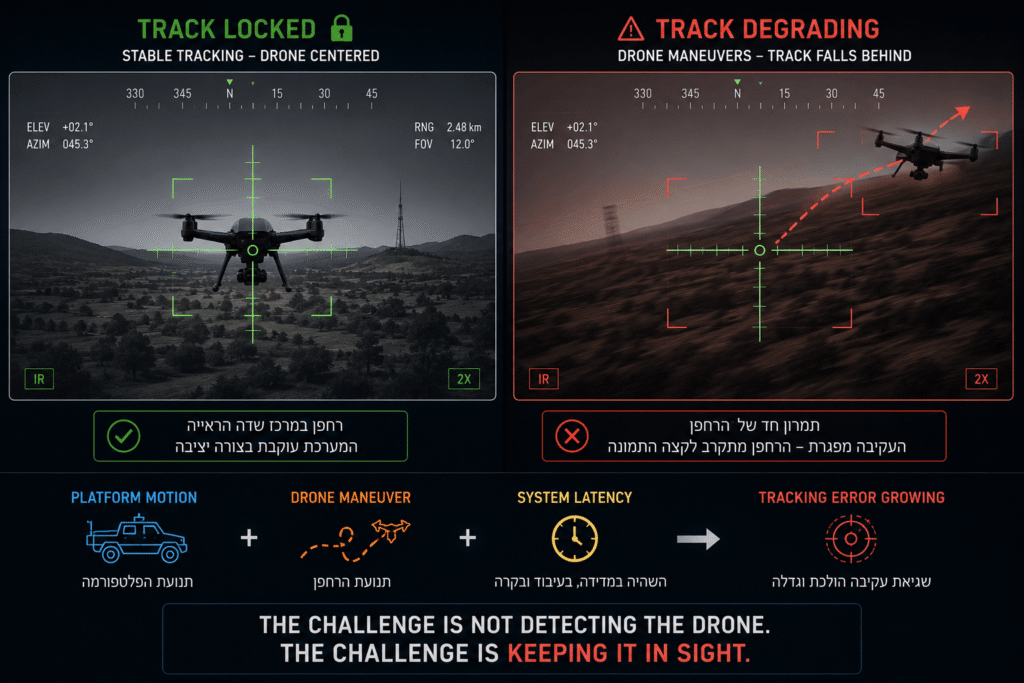
Detection Is Only the Beginning
A small drone approaches a strategic facility, a military force, or a moving convoy.
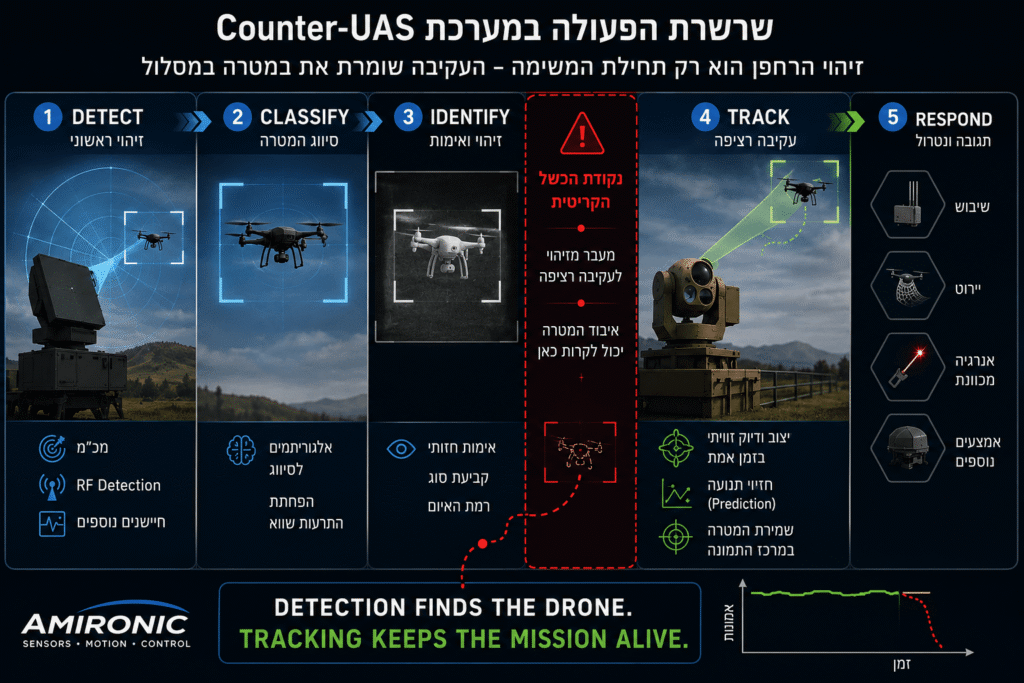
The radar detects a small aerial target. An RF sensor identifies a suspicious transmission. The EO/IR system is directed toward the area, and the image confirms that the target is indeed a drone.
At first glance, it seems that the hardest part is already over.
The target has been detected, classified, and handed over to the tracking system.
But this is precisely where one of the most demanding engineering challenges in a Counter-UAS system begins:
How do you keep the drone inside the field of view, maintain continuous tracking, and preserve a stable line of sight until the mission is complete?
A small drone is far from an easy target to track. It can rapidly change direction, dive, climb, accelerate, decelerate, and briefly disappear behind buildings, trees, or other obstacles. An FPV drone may perform aggressive and unpredictable maneuvers, fly at very low altitude, and approach along trajectories that make it difficult for both the radar and the EO/IR system to maintain continuous tracking.
At the same time, the Counter-UAS platform itself is rarely stationary.
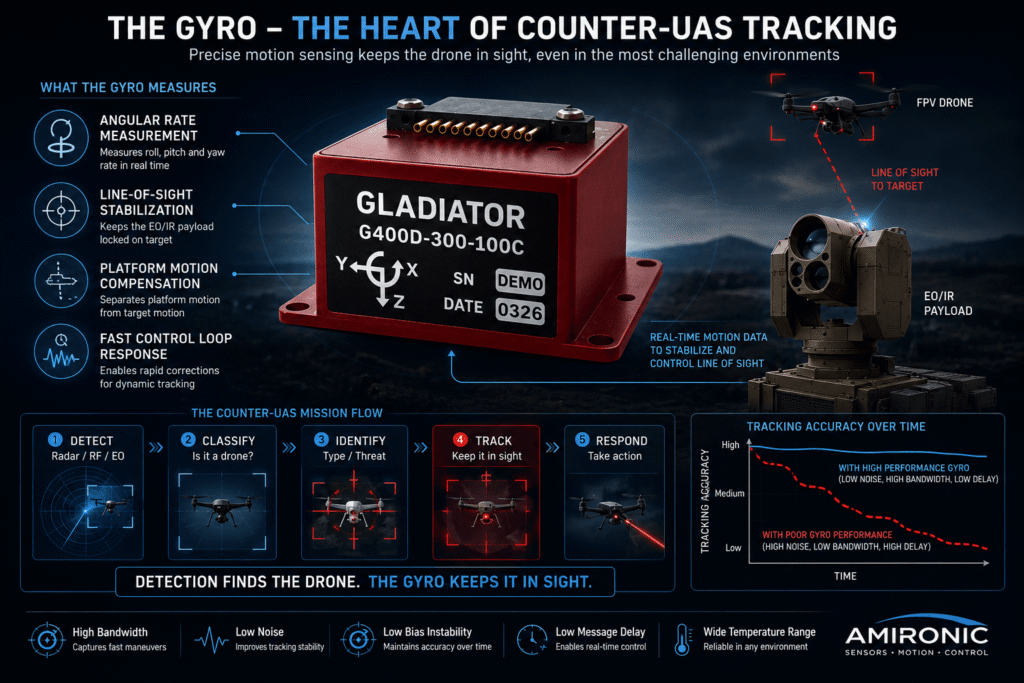
It may be installed on a moving vehicle, a naval vessel, a rotating turret, a mast exposed to strong winds, or another mobile platform constantly changing its orientation. As a result, the tracking system must simultaneously compensate for both the drone’s motion and the motion of the platform carrying the sensors.
This highlights one of the fundamental differences between Detection and Tracking.
Detection answers a relatively simple question:
Is there a target in the area?
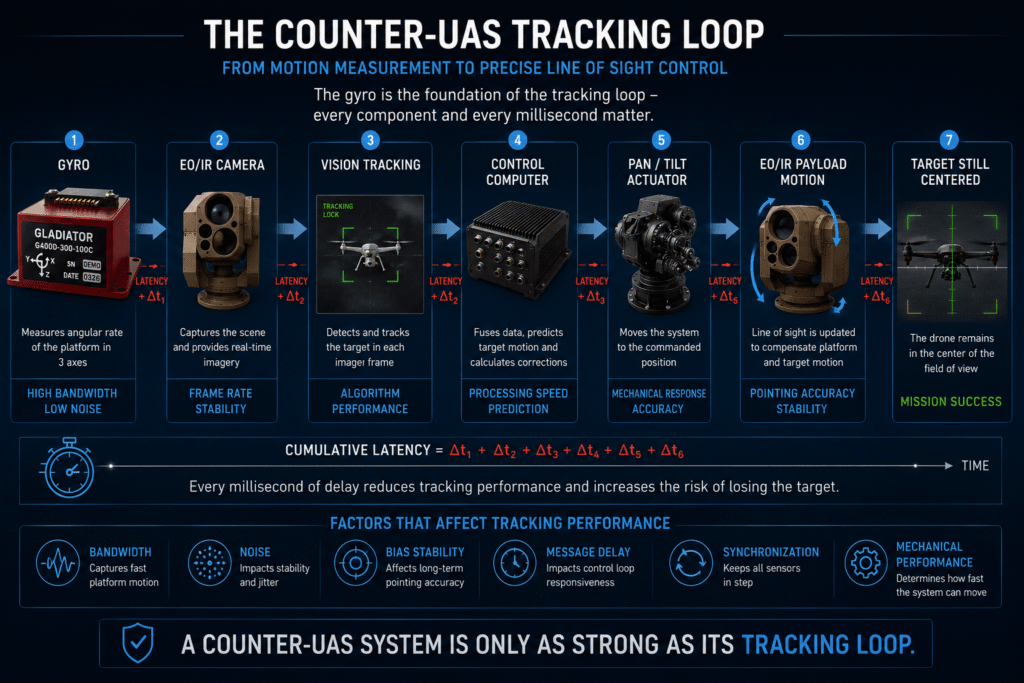
Tracking, however, must answer far more demanding questions dozens or even hundreds of times every second:
- Where is the target right now?
- In which direction is it moving?
- Where will it be a fraction of a second from now?
- Where is the sensor currently pointing?
- Which motion originates from the drone, and which originates from our own platform?
- Is the line of sight still accurately maintained on the target?
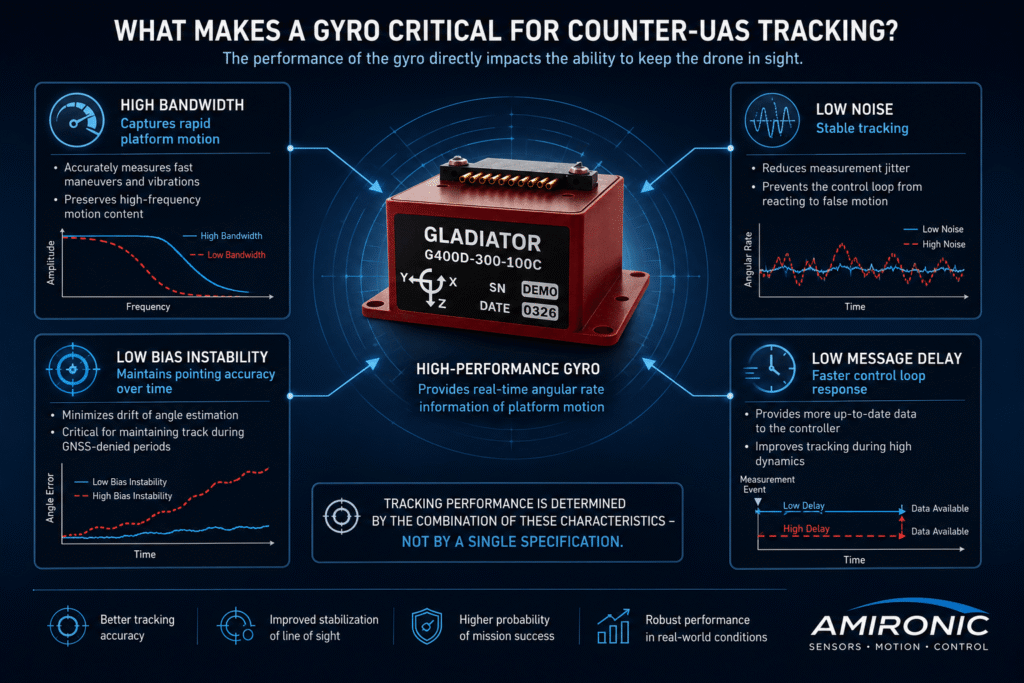
This is where gyroscopes and IMUs become essential.
Counter-UAS has become one of the fastest-growing investment areas in the defense industry. Governments and defense organizations worldwide are accelerating the development and deployment of systems capable of detecting, tracking, and defeating unmanned aerial threats. However, a Counter-UAS system is much more than a radar, an EO/IR camera, or a neutralization mechanism. It is an integrated chain of sensors, algorithms, and control systems that must operate continuously, from initial detection through target tracking and ultimately to mission response.
From Detection to Tracking – Where the System Can Fail
A modern Counter-UAS system typically consists of multiple sensing and processing layers.
Detection
Initial detection of a suspicious object using radar, RF sensing, EO/IR imagery, acoustic sensors, or a combination of multiple technologies.
Classification
Determining whether the object is a drone, a bird, another aircraft, or simply a false alarm.
Identification
Determining the type of drone, whether it is friendly or hostile, and evaluating the level of threat it represents.
Tracking
Maintaining a continuous target track, predicting its future motion, and keeping the sensors accurately pointed toward it.
Response
Activating the appropriate countermeasure, such as RF jamming, takeover, kinetic interception, directed energy, or another response depending on the system architecture and operational scenario.
The challenge is that every stage depends on the quality of the information produced by the previous one.
If the radar detects the drone but the EO/IR system fails to acquire it, visual confirmation is lost.
If the camera acquires the target but the stabilization loop cannot keep it centered within the image, tracking quality immediately begins to degrade.
If the tracking algorithm loses the target for even a few frames, it must estimate where the drone is likely to reappear.
And if the line of sight is not accurately known, even the most advanced computer vision algorithms may be forced to work with blurred, displaced, or outdated imagery.
For this reason, successful detection does not guarantee successful tracking.
A drone may be detected several kilometers away and still be lost only seconds later.
Modern Counter-UAS evaluation programs therefore treat Detection, Tracking, and Identification as separate performance metrics, each requiring independent verification at both the subsystem and system levels. This distinction is critical because a system with exceptional detection range is not necessarily capable of maintaining a stable and continuous track of a small, highly maneuverable aerial target.