flagעברית
flagEnglish
3 Rabinovich St., Petah-Tikva, Israel
+972 3 9047744
office@amironic.co.il
Facebook
Twitter
LinkedIn
YouTube
  • Products
    • MEMS Inertial
      • Gyros & Accels
      • IMU
      • Inertial Navigation
      • AHRS
    • Circuit Breakers
      • Airpax Circuit Breakers
      • Electronic Circuit Breakers
      • Aircraft Circuit Breakers
      • Thermal Circuit Breakers
      • Sealing Solutions & Guards
    • Footswitches
      • Pedals & Bellows
      • USB
      • Air Switches
      • Medical
      • Modular Bases System
      • Industrial
      • Foot Potentiometers
      • Wireless
    • Mechanical & Transmisions
      • Gears
      • Sealing Solutions
      • Gearboxes
      • Couplings
      • Shafts & Bearings
      • Fasteners
      • Mechanical & Springs
      • Linear Motion
      • Anti-Vibration
    • Sensors
      • Thermostats
      • Temperature
      • Position
      • Pressure
      • Speed
      • Level Sensor
      • Load Cells
      • Flex Sensors
      • Membrane Potentiometer
    • Motors
      • Geared DC
      • Brushless DC
      • Step Motors with Gearbox
      • Torque Motors & Brushless Servo
      • DC Motors
    • Electronics
      • Xenon & IR Lamps
      • Counters & Meters
      • Microelectronics Packaging
      • Waterproof Switches
      • Micro Switches
    • Hand Control
      • Operator Controls (JOYSTICK)
      • Electrical
      • Pneumatic (Medical)
      • USB Hand Control
      • Air Push Button
      • Pressure Switch
      • IR Switch
    • Power Solutions
      • Rugged & Military Power Supply
      • Input Power Protection
      • Sealed Military Power Adaptor
      • Triple Output Military Power Supply Series – up to 250 W
    • Materials
      • Molybdenum and Advanced Alloys (TZM, MOLA, HCT)
      • Tungsten (Wolfram) and Advanced Alloys – High-Performance Materials for Extreme Conditions
      • Materials for Gears
  • Shop
  • Companies
  • About Amironic
  • News
  • Contact
Product was added to your cart

Cart

waze

As AI Racks Demand More Power – What Happens to Circuit Breaker Protection?

Circuit Breakers14/09/2026amironicLTD

The rapid growth of AI and GPU-based computing is not only increasing computing performance – it is also changing the way Data Center power infrastructure needs to be designed.

A modern server rack built for AI workloads can concentrate significantly more power than a traditional rack. Higher power density brings a new set of engineering challenges: higher currents in parts of the power architecture, liquid cooling systems, dynamic loads, greater component density, and an increasing need to maintain extremely high system availability.

The result is not simply “more power.”

As the electrical environment changes, components that were once relatively straightforward to specify need to be reconsidered. One of them is the Circuit Breaker.

Selecting a circuit breaker based on rated current alone may no longer be sufficient. In an AI Data Center, engineers also need to consider ambient temperature, load characteristics, inrush current, installation density, the breaker’s location within the power architecture, and how the protection system is expected to behave during a fault.

So the engineering question is no longer simply:

Which Circuit Breaker is suitable for the required current?

It becomes:

Does the increasing power density of AI Data Centers require a different approach to Circuit Breaker selection and electrical protection?

Why Does an AI Data Center Change the Rules?

As computing power within the rack increases, so does the amount of electrical power that must be delivered to it – and the amount of heat that must be removed.

This affects an entire chain of systems: from power distribution and the Rack PDU, to the CDU – Coolant Distribution Unit, pumps, fans, power supplies, converters, and control electronics.

Each of these systems presents a different electrical load and may require a different protection strategy.

In other words, when an engineer is looking for a Circuit Breaker for an AI Data Center, the question can no longer be reduced to an ampere rating.

The real questions are: What exactly are we protecting? In what environment will the circuit breaker operate? And what happens to the rest of the system when it trips?
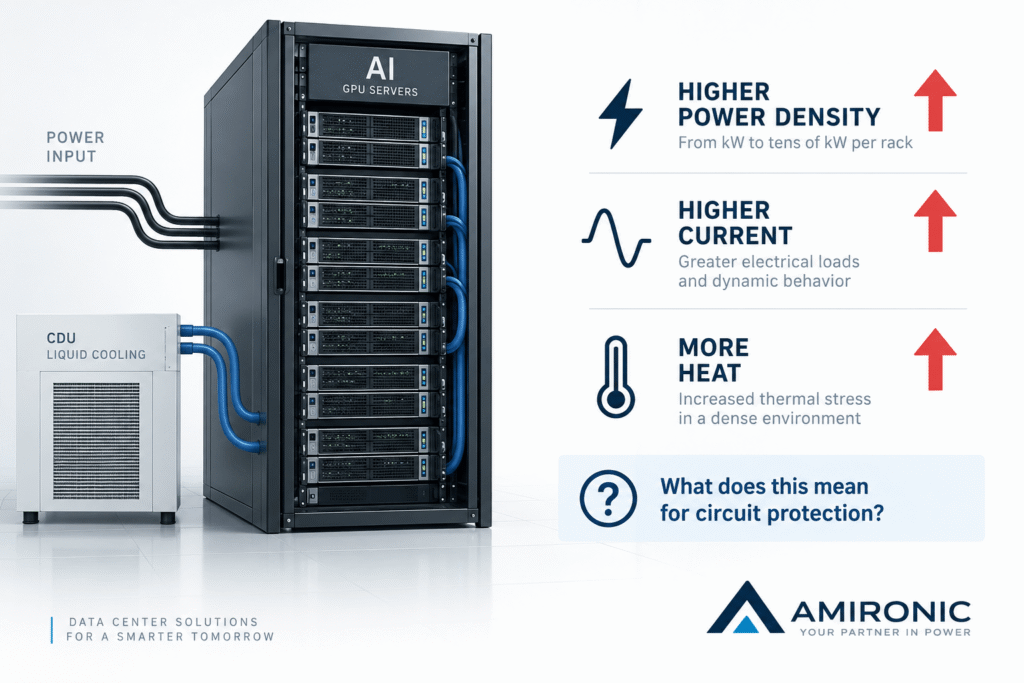
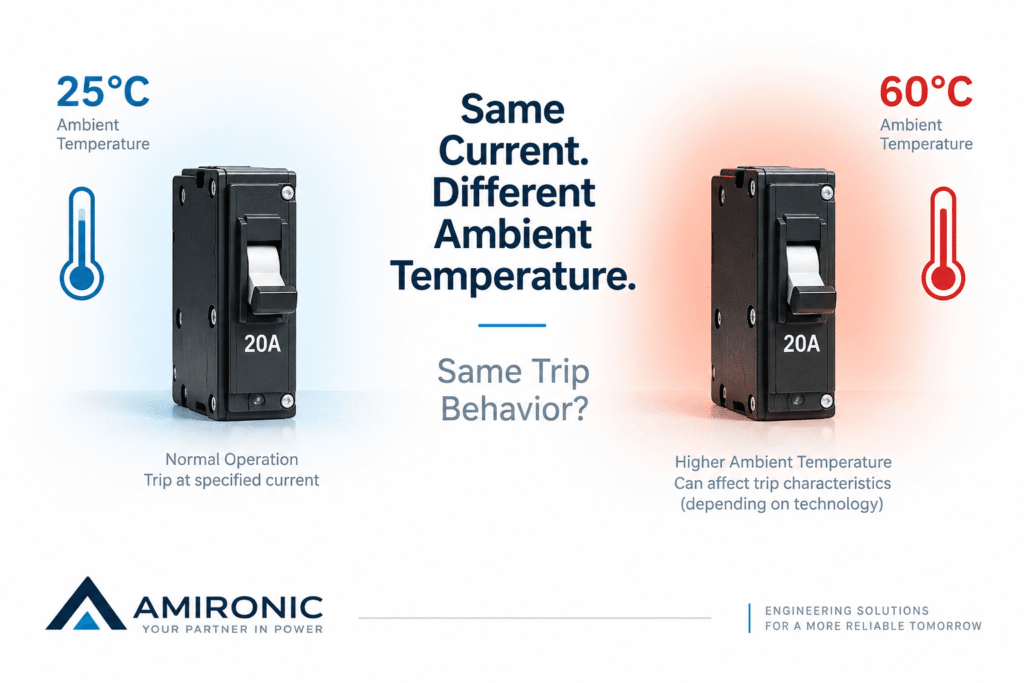
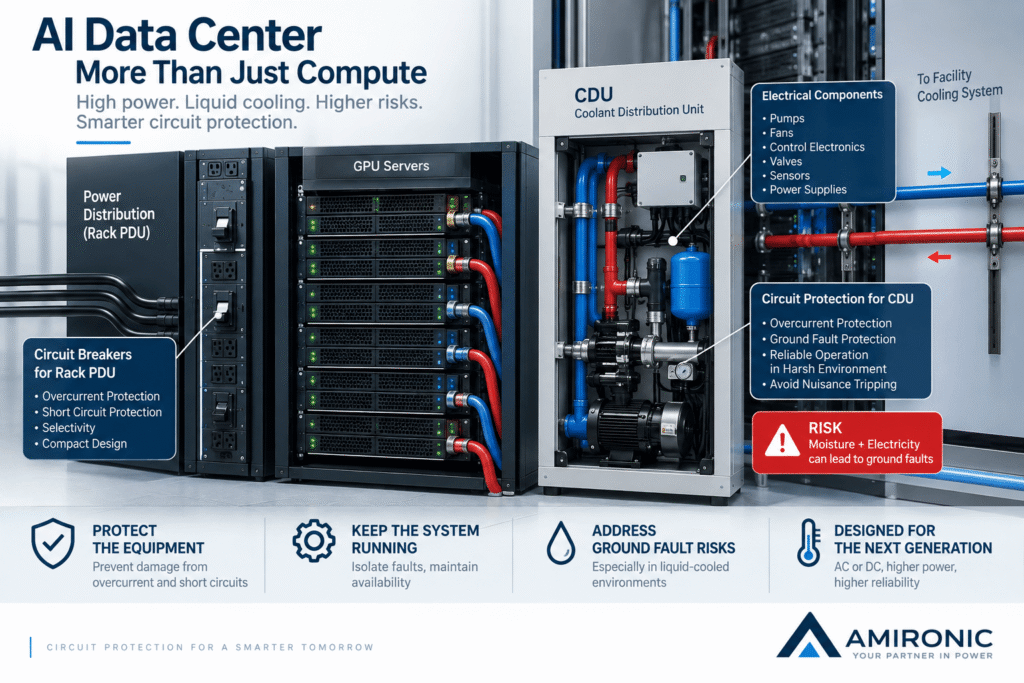
Figure 1 – High power density in an AI Data Center increases power and cooling demands, directly affecting protection system design and Circuit Breaker selection.

Not Every Electrical Load Behaves the Same Way

One common mistake in protection system design is looking at rated current alone.

Consider two circuits that both draw 20A during normal operation. Based on current rating alone, they may appear identical. In practice, however, they can place very different demands on the Circuit Breaker.

Loads that include power supplies, DC-DC converters, motors, pumps, or large capacitors can generate significant Inrush Current during startup – a short-duration current that may be considerably higher than the normal steady-state current.

In an AI Data Center, where many systems operate at high density and may start up or change operating states simultaneously, the dynamic behavior of the load becomes an important part of protection system design.

A Circuit Breaker selected too conservatively may cause Nuisance Tripping – unwanted interruptions that are not caused by an actual fault. On the other hand, a breaker that does not provide the appropriate protection may fail to trip under the fault conditions the protection system was designed to address.

For this reason, selecting a Circuit Breaker for an AI Data Center requires more than simply choosing a Current Rating.

Key parameters to consider include:

  • Circuit rated current
  • Inrush characteristics
  • Trip Curve
  • Operating voltage
  • Interrupting Capacity
  • Ambient temperature
  • Installation density
  • Load type and its location within the power architecture

The Hidden Challenge: Temperature Around the Circuit Breaker

There is another factor that can easily be overlooked.

As rack power density increases, thermal management becomes one of the major engineering challenges. Even when the GPUs themselves are cooled using Liquid Cooling, this does not mean that every electrical component around them operates at a constant, low temperature.

Rack PDUs, power supplies, converters, wiring, and protection devices may all be installed in environments where temperature varies according to load, airflow, and physical location within the system.

This matters because not all Circuit Breaker technologies respond to ambient temperature in the same way.

In a thermal circuit breaker, for example, the trip mechanism relies on heating. As a result, changes in ambient temperature can also affect tripping behavior.

In a system where both power density and temperature vary, the engineer needs to ask more than:

At what current should the Circuit Breaker trip?

There is another question:

Will it behave the same way when its operating environment gets hotter?

This leads to an important distinction between a Thermal Circuit Breaker and a Hydraulic-Magnetic Circuit Breaker – and helps explain why the protection technology itself can become particularly important in high power density systems.

The Problem Is Not Just Heat – The Power Architecture Is Changing

Ambient temperature is only part of the picture.

The larger challenge in an AI Data Center is that as compute density increases, the way power is delivered to the load and distributed throughout the system is changing as well.

In a traditional data center, the power chain could be viewed relatively simply: the power infrastructure feeds the Rack PDU, which then distributes power to servers and supporting equipment.

In high-density AI systems, the picture is more complex.

Alongside the GPU servers themselves, there are high-power supplies, Power Conversion systems, liquid cooling units, pumps, controllers, and other auxiliary equipment. As the total power concentrated within a rack increases, the impact of a fault in a single branch can become much more significant.

This raises an important question:

Is the purpose of the Circuit Breaker simply to protect the circuit – or should the protection architecture also prevent a local fault from becoming a wider system outage?

In an AI Data Center, a Trip Is an Event That Must Be Designed For

A Circuit Breaker is designed to disconnect a circuit when a fault occurs. But in a mission-critical system, what gets disconnected with it can be almost as important as when it trips.

Consider a fault in a single cooling pump, a specific power supply, or one branch of a Rack PDU.

If the protection architecture is not properly coordinated, a local fault may cause an upstream protection device to operate, taking a much larger group of loads offline.

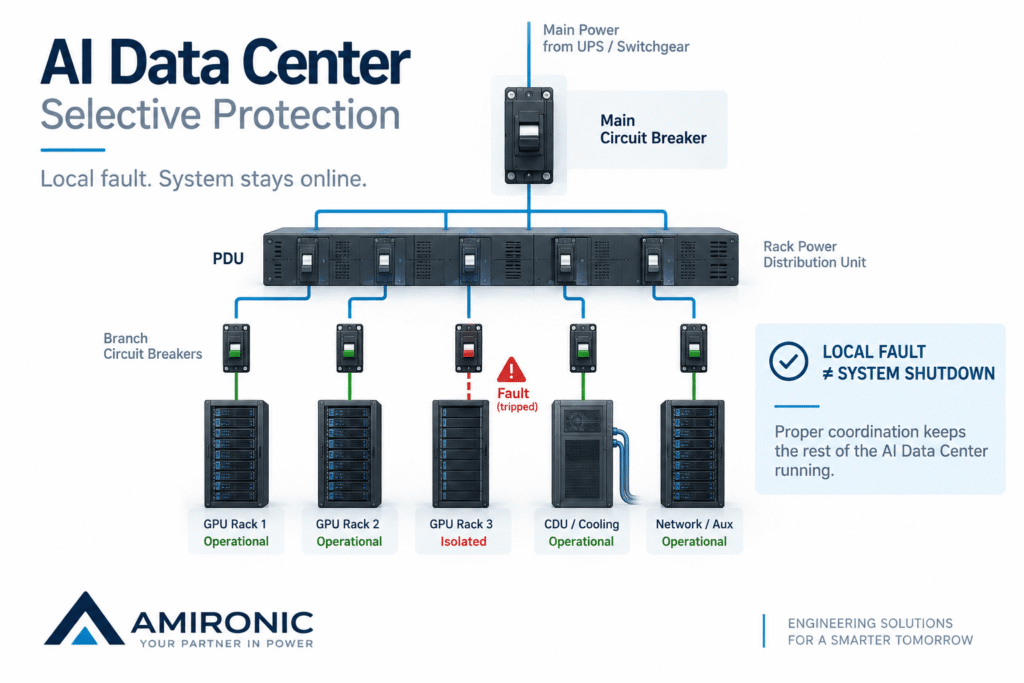
A properly coordinated protection system, on the other hand, can allow the Circuit Breaker closest to the fault to isolate the affected branch while keeping the rest of the system operational.

This principle is known as Selective Coordination, or Selectivity.

In simple terms:

We want the right Circuit Breaker to trip – not a larger upstream breaker that takes everything around it offline as well.

In an AI Data Center, where a single rack may contain a substantial amount of computing capacity, this principle becomes increasingly important. Electrical protection is no longer only about preventing damage to equipment – it becomes part of the system’s availability architecture.

Three Levels of Protection – Three Different Consequences

A power distribution system can be viewed as a series of protection layers.

At the highest level, protection is provided for the main system supply. Below that is protection for the PDU or a group of loads. Closest to the equipment is the individual branch circuit protection.

A fault in one branch should not necessarily cause every protection layer above it to trip.

For this reason, selecting a Circuit Breaker for an AI Data Center requires more than evaluating the Rated Current or Trip Curve of an individual breaker. Engineers also need to consider how multiple protection devices connected in series interact with one another.

The objective is to create a system in which:

Local Fault → Local Isolation → The Rest of the System Remains Operational

This represents an important shift in how we think about Circuit Protection in the AI era. The question is no longer only whether the Circuit Breaker will trip, but also which parts of the Data Center will remain operational after it does.

Figure 3 – Selective Protection in an AI Data Center: Proper coordination between Circuit Breakers helps isolate a fault at the affected branch while keeping the remaining GPU servers, cooling systems, and other critical equipment operational.

Electrical Protection Must Also Match the Cooling Architecture

The shift to AI is changing more than power distribution. It is also transforming the way Data Centers are cooled.

As the power density of GPU servers increases, air cooling alone becomes less practical for some high-density systems. As a result, AI Data Centers are increasingly adopting Liquid Cooling solutions.

This introduces another important component into the architecture: the CDU – Coolant Distribution Unit.

The CDU manages and circulates coolant between the cooling infrastructure and the computing equipment. From an electrical perspective, it may contain pumps, fans, controllers, power supplies, valves, and sensors – essentially an entire electrical system operating in close proximity to a liquid cooling system.

And that introduces a different type of risk.

When Electricity and Liquid Cooling Meet

In a Rack PDU, one of the primary functions of the Circuit Breaker is protection against Overload and Short Circuit conditions.

Within a CDU, another layer of protection may also need to be considered: Ground Fault Protection.

A ground fault can result from insulation failure, liquid ingress, damaged wiring, a faulty pump, or another electrical component. In an environment where electrical equipment and liquid cooling systems operate in close proximity, detecting this type of fault becomes an important part of the protection architecture.

But here too, greater sensitivity is not necessarily better.

Modern electronic systems can generate a certain amount of Leakage Current even during normal operation. When multiple power supplies, EMI filters, and electronic components are connected within the same system, these leakage currents can accumulate.

As a result, Ground Fault Protection designed without considering the behavior of the complete system may cause unwanted trips even when no hazardous fault is present.

On the other hand, setting the threshold too high may fail to provide the required level of protection.

Finding the right balance is an important part of designing Circuit Protection for AI Data Centers.

Not Every Circuit Breaker in an AI Data Center Has the Same Job

At this point, it becomes clear why the term Circuit Breaker for AI Data Center actually covers several different applications.

A Circuit Breaker installed in a Rack PDU may be selected primarily according to operating current, voltage, Trip Curve, Interrupting Capacity, physical dimensions, and Branch Circuit Protection requirements.

Protection within a CDU, by contrast, may require a combination of Overcurrent Protection and Ground Fault detection.

Further upstream in the power distribution system, another Circuit Breaker may need to handle significantly higher power levels while coordinating with the protection devices downstream.

So there is no single “Circuit Breaker for an AI Data Center.”

There is a Protection Architecture, and each Circuit Breaker within that architecture has a different role.

What Happens as Power Requirements Continue to Increase?

There is another important point to consider.

The response to increasing power density is not necessarily to push more and more current through the system at the same voltage.

As power requirements increase, higher current leads to greater conduction losses, requires larger conductors, and makes power distribution more challenging.

For this reason, one of the trends in AI infrastructure is the evaluation and adoption of higher-voltage power architectures, including higher-voltage DC systems, as a way to distribute significant amounts of power more efficiently.

From an electrical protection perspective, this is a fundamental change.

A Circuit Breaker suitable for AC does not automatically become suitable for DC simply because the rated current is the same. Arc interruption behaves differently, voltage ratings differ, and in some applications the number of poles and the way they are connected also become part of the protection design.

As AI Data Centers push power infrastructure toward higher power levels, Circuit Breaker selection is therefore moving beyond the relatively simple question:

“How many amps?”

Instead, engineers need to ask a much broader set of questions:

AC or DC? At what voltage? What is the available fault current? What type of load is being protected? What should happen in the event of a Ground Fault? And how much of the system can we afford to take offline when a fault occurs?

This is the key point: the Circuit Breaker in an AI Data Center is not simply a protection component. It is part of the design of the power, cooling, and availability architecture of the entire system.

So How Should You Select a Circuit Breaker for an AI Data Center?

After everything we have covered, it is clear that there is no single answer to the question: “Which Circuit Breaker is right for an AI Data Center?”

The selection process actually begins with the system itself.

Before choosing a product series, current rating, or Trip Curve, engineers need to understand where the Circuit Breaker sits within the architecture and exactly what it is expected to do when a fault occurs.

In a Rack PDU, for example, the focus may be on protecting multiple branch circuits in a high-density environment, maintaining Selectivity, and preventing a local fault from taking unrelated loads offline.

In a CDU, pumps, control systems, and the Liquid Cooling environment also come into play, which may require consideration of Ground Fault Protection.

At other points in the system, the primary considerations may instead be operating voltage, Interrupting Capacity, or suitability for AC versus DC operation.

A good selection process therefore starts with five questions:

  1. What load are we protecting? – GPU Server, Rack PDU, CDU, Pump, Power Supply, or another system.
  2. What are the operating voltage and current? – Including whether the circuit is AC or DC.
  3. What type of fault do we need to isolate? – Overload, Short Circuit, Ground Fault, or a combination of these.
  4. What can be allowed to go offline during a fault? – A single branch, an entire Rack, or a larger part of the system.
  5. What must happen after the trip? – Do the remaining loads need to continue operating without interruption?

The fifth question may be the most important.

In high-power AI systems, Circuit Protection is part of Availability design, not simply an electrical safety requirement.

From Component Selection to Protection Architecture

This is one of the major changes introduced by the AI era.

In the past, it was natural to begin the selection process with a question such as:

“I need a 20A Circuit Breaker – which model should I use?”

In a modern system, it makes more sense to reverse the process:

“Which part of the system am I protecting, what faults can occur, and what do I want the rest of the system to do when one of those faults occurs?”

Only then should the selection of the Circuit Breaker begin.

This approach makes it possible to evaluate protection as a complete system – Main Protection, Branch Protection, Rack PDU, CDU, Ground Fault Protection, and coordination between the different protection devices.

Instead of a collection of individual breakers, we get a Protection Architecture.

Where Does Airpax Fit In?

This is where we can move from the problem to the solution.

Sensata Technologies, through its Airpax product family, develops Circuit Breakers and protection solutions used in power distribution systems, communications equipment, and Data Center applications.

The advantage for the system designer is not that there is a special “AI Circuit Breaker.” Rather, different protection solutions can be selected for different points within the power architecture.

In a Rack PDU, for example, compact solutions can be used for Branch Circuit Protection, with different options for current rating, voltage, number of poles, and Trip Curves.

In CDU systems, Overcurrent Protection can be combined with Ground Fault detection solutions, depending on the system architecture and protection requirements.

And in applications where consistent performance is required under changing environmental conditions, Hydraulic-Magnetic Circuit Breaker technology can offer advantages over thermally operated solutions – a topic we explore in more detail in our separate article on Circuit Breaker selection for Data Centers.

AI Is Changing Power – And Protection Must Change With It

The evolution of AI Data Centers is about much more than installing more powerful servers.

It is changing power density, cooling methods, power distribution, Rack architecture, and the operational impact of every electrical fault.

As a result, the role of the Circuit Breaker is changing as well.

It still needs to perform its fundamental function – protecting the circuit against abnormal electrical conditions – but its selection must now fit within a broader strategy involving Power Distribution, Selectivity, Ground Fault Protection, and System Availability.

This may be the most important difference between selecting a Circuit Breaker for a conventional system and designing Circuit Breaker Protection for an AI Data Center:

The goal is not simply to disconnect power when something goes wrong. The goal is to disconnect the right part, at the right time, while keeping as much of the system operational as possible.

Summary

AI is rapidly increasing the power requirements of Data Centers, but the engineering challenge is not simply delivering more power.

That power also needs to be protected correctly.

High-density Rack PDUs, Liquid Cooling, CDU systems, GPU loads, AC and DC power architectures, and demanding availability requirements are making Circuit Protection an integral part of Data Center architecture.

For this reason, selecting a Circuit Breaker for an AI Data Center should begin with understanding the system – not with the ampere rating printed on the breaker.

By designing protection as a complete architecture – from the main power feed down to the individual branch circuit – engineers can isolate faults more effectively, minimize their impact on the rest of the system, and build power infrastructure that is ready for the next generation of AI Data Centers.

Case Study – Designing Electrical Protection for a High-Power-Density AI Rack

Consider a new computing rack being designed for an AI Data Center. The rack includes multiple GPU servers, a Rack PDU, and a DC power distribution system supplying high-power equipment.

The requirement is not simply to protect against Overload or Short Circuit conditions. If a fault occurs, the protection system should isolate the affected branch as locally as possible while maintaining the availability of the remaining equipment.

Step 1 – Branch Circuit Protection Inside the Rack PDU

The server branch circuits require compact Circuit Breakers with predictable trip behavior and the flexibility to match the current rating and Trip Curve to each load.

The Airpax IAG/IUG/IEG/CEG/LEG family uses Hydraulic-Magnetic technology and is available in a wide range of configurations, including multiple pole options, Auxiliary Switch, Shunt, and Relay functions. The family supports DC, 50/60Hz, and 400Hz applications.

For example, the LEG series provides UL 489 Circuit Breakers rated up to 30A in the AC configurations specified in the datasheet. This makes it suitable for Branch Circuit Protection applications where a UL 489 Circuit Breaker is required rather than a Supplementary Protector.

Step 2 – Protecting a High-Power DC Section

Now consider that the same AI Rack also includes a DC power system operating at significantly higher currents.

At this point, a 20A or 30A solution is no longer relevant.

The LELHP family is designed for High-Power DC applications and is available in 125A, 150A, 175A, and 200A versions. It uses a Parallel Current Sensing design to provide Overload Protection in a relatively compact package.

Depending on voltage and configuration, the approval tables also specify significant Interrupting Capacity ratings. For example, the datasheet lists certain LEL/LELHP DC configurations with Interrupting Capacity ratings of up to 50,000A, with the exact rating depending on voltage, number of poles, and configuration.

The Result – Don’t Just Select a Breaker, Design a Protection System

This Case Study illustrates an important point:

The same AI Data Center may require several different types of Circuit Breakers.

Within the Rack PDU, the priority may be compact Branch Circuit Protection. In a high-power DC section, the required current ratings and Interrupting Capacity can be completely different.

This is why the selection process should not begin with the name of a Circuit Breaker series.

It should begin with the power architecture:

Load → Voltage → Current → Fault Level → Required Standard → Trip Characteristics → Circuit Breaker

Only after the requirements at each point in the system have been defined can the appropriate Circuit Breaker solution be selected.

🧩 Further Reading:
To place this comparison in a broader engineering context, it is recommended to review the earlier articles in this series. These provide deeper insight into the MIL-PRF-39019 specification, the behavior and importance of trip curves in hydraulic-magnetic circuit breakers, and the real-world challenges of power protection in rugged military and aerospace platforms.

  • MIL-PRF-39019 Circuit Breakers: Selection, Trip Curves, and Aerospace Power Protection
  • Why M39019 Is Not Just a Standard – It’s an Identity
  • Understanding Trip Curves in Hydraulic-Magnetic Circuit Breakers
  • Power Protection in Military Ground Platforms: Electrical Stability Under Vibration, Shock, and 28V Vehicle Systems
  • The Airpax AP Series: The Engineering Logic Behind a Hydraulic-Magnetic Circuit Breaker That Became a Military Standard
  • Hydraulic-Magnetic vs Thermal Circuit Breakers
  • Airpax IULN and IUGN Circuit Breakers: Sealed Hydraulic-Magnetic Protection for Rugged Electronic Systems
  • How Engineers Choose Between Airpax AP, IUL, IUG, and Commercial Circuit Breakers
  • SNAPAK Circuit Protectors: When Circuit Protection Becomes a User Interface
  • DIN Rail Circuit Breakers – Why Industrial Systems Demand More Than a Standard MCB
  • Why MIL-PRF-39019 Circuit Breakers Still Appear in New Defense Programs
  • Why a 10A Circuit Breaker Is Not Always Suitable for a 10A Load
  • Keeping Data Centers Running: The Role of Circuit Protection
  • Circuit Breaker or Control Device? Why Military Circuit Breakers Do More Than Protect
  • A 30mA Ground Fault Could Bring Down Thousands of GPUs – Designing Ground Fault Protection for Data Center CDUs
  • What Can We Learn from 40-Year-Old Hydraulic-Magnetic Circuit Breakers Still in Service?
  • Why Military Power Distribution Is Becoming the New Battlefield
  • Why a Standard Thermal Circuit Breaker Isn’t Always the Right Choice for Data Centers

Frequently Asked Questions – FAQ

What is the difference between a standard Circuit Breaker and a Circuit Breaker for an AI Data Center?

There is no separate official category called an “AI Data Center Circuit Breaker.” The difference lies in the application requirements. AI Data Centers may involve higher power density, densely populated Rack PDUs, Liquid Cooling systems, dynamic loads, and demanding Availability requirements. Circuit Breaker selection therefore needs to consider more than Rated Current alone, including Trip Curve, Interrupting Capacity, Selectivity, operating voltage, and load characteristics.

Why is Selectivity especially important in an AI Data Center?

Selectivity, or Selective Coordination, is intended to ensure that when a fault occurs, the protection device closest to the fault operates while the rest of the system remains online. In a GPU-intensive Data Center, a fault in one branch should not necessarily take an entire Rack or an unrelated group of servers offline.

Can the same Circuit Breaker be used in both a Rack PDU and a high-power DC section?

Not necessarily. A Rack PDU may require Branch Circuit Protection at currents in the tens of amperes, while a high-power DC section may operate at significantly higher currents. For example, the Airpax LELHP family includes DC versions rated at 125A, 150A, 175A, and 200A, while the LEG family includes UL 489 configurations for lower-current applications.

Why is UL 489 important when selecting a Circuit Breaker?

UL 489 applies to Circuit Breakers intended for circuit protection in power distribution applications. It is important to distinguish UL 489 from UL 1077, which applies to Supplementary Protectors. For example, Airpax datasheets identify certain IUG/IEG models as UL 1077 Recognized, while LEG and LEL are available in UL 489 Listed configurations.

Is a Circuit Breaker rated for AC automatically suitable for DC?

No. AC and DC place different demands on the interruption mechanism, particularly when it comes to extinguishing the electrical arc. The specific DC rating of the Circuit Breaker must therefore be verified rather than relying on its AC rating.

What is Interrupting Capacity, and why is it important in an AI Data Center?

Interrupting Capacity is the maximum fault current that a Circuit Breaker can safely interrupt under its specified rating conditions. In high-power systems, where powerful energy sources and DC buses may produce high Fault Current, this becomes a critical parameter. The LEL/LELHP datasheet, for example, lists certain DC configurations with Interrupting Capacity ratings of up to 50kA, depending on voltage and the number of poles.

Is a Hydraulic-Magnetic Circuit Breaker always the better choice?

No. The correct choice depends on the system requirements. A Hydraulic-Magnetic Circuit Breaker can offer advantages where consistent behavior across a wide temperature range, accommodation of Inrush Current, or precise Delay Curve selection is required. The IAG/IUG/IEG/CEG/LEG family, for example, uses Hydraulic-Magnetic technology and is available in various AC and DC configurations.

What is the difference between Overcurrent Protection and Ground Fault Protection?

Overcurrent Protection protects against excessive current caused by conditions such as overloads and short circuits. Ground Fault Protection is intended to detect current flowing to ground or through an unintended current path. In CDU and Liquid Cooling systems, both types of protection may be required, depending on the system architecture and safety requirements.

Can a Circuit Breaker be selected based only on Rated Current?

No. Rated Current is only one of the parameters that must be considered. Engineers should also evaluate operating voltage, AC or DC operation, Trip Curve, Inrush Current, Interrupting Capacity, number of poles, Selectivity, applicable standards, and the Circuit Breaker’s location within the system.

What information should be defined before selecting a Circuit Breaker?

At minimum, define the operating voltage, AC or DC operation, continuous current, Inrush Current if applicable, expected Fault Current, number of poles, required standard, Selectivity requirements, and load type. For applications with high inrush, Sensata also recommends specifying the Peak Amplitude and Surge Duration to help determine the appropriate breaker rating and configuration.


Key Terms

AI Data Center – A Data Center designed for compute-intensive AI workloads, typically using GPUs or other accelerators, and often characterized by high power density and demanding cooling and Availability requirements.

Circuit Breaker – An automatic protection device that interrupts a circuit in the event of an overload or short circuit and can be reset after the fault has been addressed.

Branch Circuit Protection – Protection of a specific electrical branch within the power distribution system, such as a circuit running from a Rack PDU to a server or group of loads.

Rack PDU – Rack Power Distribution Unit – A power distribution unit installed within a server rack that distributes incoming power among multiple branch circuits or connected loads.

CDU – Coolant Distribution Unit – A unit used to manage and circulate coolant in Data Center Liquid Cooling systems.

Liquid Cooling – A cooling method in which heat is removed using liquid instead of, or in addition to, airflow.

Selective Coordination / Selectivity – Coordination between protection devices so that, when a fault occurs, only the protection device closest to the fault operates, where permitted by the system design.

Rated Current – The nominal current at which a Circuit Breaker is designed to operate under the conditions specified by the manufacturer.

Interrupting Capacity – The maximum fault current that a Circuit Breaker can safely interrupt under its specified rating conditions.

Fault Current – The current that may flow through a system during a fault condition, such as a Short Circuit or Ground Fault.

Short Circuit – An electrical fault that creates a very low-resistance current path and can result in extremely high current.

Overcurrent – A condition in which circuit current exceeds the permitted value due to an overload, short circuit, or another fault condition.

Ground Fault – A fault in which current flows through an unintended path to ground or to a conductive surface connected to ground.

Leakage Current – A small current that may be present even during normal operation of electronic equipment, including as a result of EMI filters and capacitive components.

Inrush Current – A short-duration high current that occurs when power supplies, capacitors, motors, or other equipment are energized.

Trip Curve – A curve describing the relationship between the magnitude of an overcurrent condition and the time required for the Circuit Breaker to trip.

Hydraulic-Magnetic Circuit Breaker – A Circuit Breaker in which a magnetic mechanism and hydraulic delay control the tripping behavior. Airpax offers multiple Circuit Breaker families based on this technology.

UL 489 – A U.S. standard covering Molded-Case Circuit Breakers, Molded-Case Switches, and Circuit Breaker Enclosures used for circuit protection within the scope of the standard.

UL 1077 – A standard covering Supplementary Protectors intended for use within electrical equipment. These devices do not necessarily replace Branch Circuit Protection provided in accordance with UL 489.

Availability – The ability of a system to remain operational and continue providing service with minimal unplanned downtime.

Protection Architecture – The overall design of the protection layers within a system, including Main Protection, Branch Protection, Ground Fault Protection, Selectivity, and the coordination between all protection devices.

Tags: Airpax

Related Articles

Auxiliary Switch – The Eyes of the Circuit Breaker

05/11/2025amironicLTD

Understanding MIL-PRF-39019 and MIL-PRF-55629: A Practical Guide to Military Circuit Breaker Standards

02/09/2025amironicLTD

Keeping Data Centers Running: The Role of Circuit Protection

24/06/2026amironicLTD

Recent Posts

  • As AI Racks Demand More Power – What Happens to Circuit Breaker Protection?
  • Military Temperature Sensors – How to Choose the Right Temperature Sensor for Harsh Environments?
  • How to Identify an Existing Gear Without a Drawing – A Practical Measurement Guide for Engineers
  • Standards for Power Supplies and DC-DC Converters – A Guide to Military, Aerospace, and Automotive Applications
  • How to Choose an IMU for a Dynamic System – Why “More Accurate” Doesn’t Always Mean “Better”

Categories

  • Air Switch
  • Circuit Breakers
  • Elapsed Time Indicator
  • Feedthrough
  • Footswitches
  • Gears & Transmission
  • Hour Meters
  • Infra Red Switches
  • INFRARED LAMPS
  • Low Noise Inertial MEMS
  • Mechanics
  • MEMS Gyroscope
  • MEMS Inertial
  • Microelectronics
  • Motors
  • Position Sensors
  • Power Supply
  • Pressure Sensors
  • Pressure Switch
  • Temperature Sensors
  • Tungsten and Molybdenum
  • Uncategorized
  • Vacuum Switches

Quick Contact

Fill out the form and our representatives will return to you

    Name (required)

    Email (required)

    Phone

    Message

    This site is protected by reCAPTCHA and the Google
    Privacy Policy and
    Terms of Service apply.

    Amironic Ltd.

    3 Rabinovich Street, Petah Tikva 4928144 , Israel. Tel: +972-3-9047744 E-mail: office@amironic.co.il
    Email
    Facebook
    Twitter
    LinkedIn
    YouTube
    Press on the ISO Certificate below for download
    ISO 9001:2015 Certification
    • MEMS Inertial
    • Circuit Breakers
    • Footswitches
    • Mechanical & Transmisions
    • Sensors
    • Motors
    • Electronics
    • Hand Control
    • Power Solutions

    News

    • As AI Racks Demand More Power – What Happens to Circuit Breaker Protection?
    • Military Temperature Sensors – How to Choose the Right Temperature Sensor for Harsh Environments?
    • How to Identify an Existing Gear Without a Drawing – A Practical Measurement Guide for Engineers
    • Standards for Power Supplies and DC-DC Converters – A Guide to Military, Aerospace, and Automotive Applications
    • How to Choose an IMU for a Dynamic System – Why “More Accurate” Doesn’t Always Mean “Better”
    About AmironicContactעברית
    © 2022 Amironic All rights reserved. All Trademarks are the property of their respective owners.
    • Increase Font
    • Decrease Font
    • Black & White
    • Inverse Colors
    • Highlight Links
    • Regular Font
    • Reset