flagעברית
flagEnglish
3 Rabinovich St., Petah-Tikva, Israel
+972 3 9047744
office@amironic.co.il
Facebook
Twitter
LinkedIn
YouTube
  • Products
    • MEMS Inertial
      • Gyros & Accels
      • IMU
      • Inertial Navigation
      • AHRS
    • Circuit Breakers
      • Airpax Circuit Breakers
      • Electronic Circuit Breakers
      • Aircraft Circuit Breakers
      • Thermal Circuit Breakers
      • Sealing Solutions & Guards
    • Footswitches
      • Pedals & Bellows
      • USB
      • Air Switches
      • Medical
      • Modular Bases System
      • Industrial
      • Foot Potentiometers
      • Wireless
    • Mechanical & Transmisions
      • Gears
      • Sealing Solutions
      • Gearboxes
      • Couplings
      • Shafts & Bearings
      • Fasteners
      • Mechanical & Springs
      • Linear Motion
      • Anti-Vibration
    • Sensors
      • Thermostats
      • Temperature
      • Position
      • Pressure
      • Speed
      • Level Sensor
      • Load Cells
      • Flex Sensors
      • Membrane Potentiometer
    • Motors
      • Geared DC
      • Brushless DC
      • Step Motors with Gearbox
      • Torque Motors & Brushless Servo
      • DC Motors
    • Electronics
      • Xenon & IR Lamps
      • Counters & Meters
      • Microelectronics Packaging
      • Waterproof Switches
      • Micro Switches
    • Hand Control
      • Operator Controls (JOYSTICK)
      • Electrical
      • Pneumatic (Medical)
      • USB Hand Control
      • Air Push Button
      • Pressure Switch
      • IR Switch
    • Power Solutions
      • Rugged & Military Power Supply
      • Input Power Protection
      • Sealed Military Power Adaptor
      • Triple Output Military Power Supply Series – up to 250 W
    • Materials
      • Molybdenum and Advanced Alloys (TZM, MOLA, HCT)
      • Tungsten (Wolfram) and Advanced Alloys – High-Performance Materials for Extreme Conditions
      • Materials for Gears
  • Shop
  • Companies
  • About Amironic
  • News
  • Contact
Product was added to your cart

Cart

waze

Why Run Electricity to the Button When Herga Can Switch It with Air?

Air Switch, Footswitches17/08/2026amironicLTD

In medical, aesthetic and industrial equipment, we tend to think of a button almost automatically: the user presses it, electrical contacts close, and the system receives a command.

But there are applications where bringing electricity all the way to the point of operation is exactly what we would rather avoid.

Consider a foot control next to a treatment bed, a button in an area that requires frequent cleaning, a hand-operated control held by the user, or an interface located where liquids may be present.

In all these cases, one simple engineering question is worth asking:

Do we really need an electrical switch at the point of operation, or do we simply need to tell the system that the user has pressed something?

This is where Herga Air Switches offer an elegantly simple solution.

Instead of running electrical wires all the way to the button or foot control, a thin pneumatic tube can carry the command.

The user presses the control.

A small change in air pressure is created.

That pressure travels through the tube.

And the actual electrical switching takes place safely elsewhere inside the equipment, using a Herga Air Switch.

In other words:

The user presses here. The electricity stays there.

It is a simple mechanical separation, but in the right application it can completely change the way engineers design the user interface and the system around it.

And with Herga’s extensive range of Air, Pressure and Vacuum Switches, this is not just a clever concept. It is a practical, proven design option available to OEM engineers today.

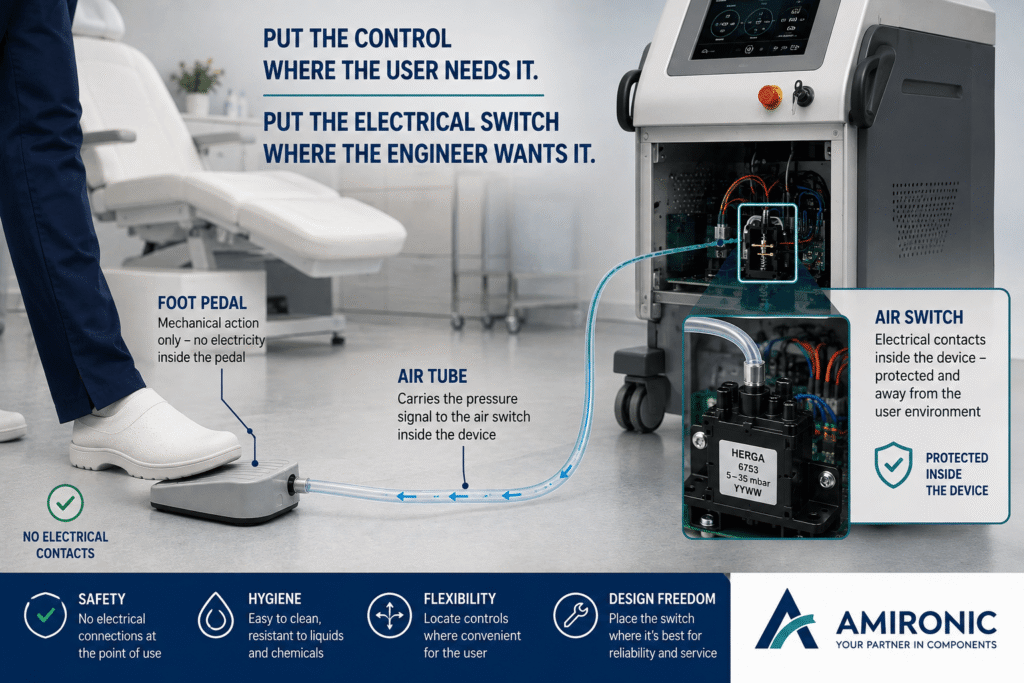
Figure 1: A pneumatic switch keeps the electrical switching safely inside the equipment, while only air pressure is transmitted from the point of operation through a pneumatic tube.

How Does a Herga Air Switch Work?

The principle is remarkably simple.

At one end of the system is the user control – a push button, foot pedal or pressure pad. A small pneumatic tube connects that control to a Herga Air Switch, which can be positioned safely elsewhere inside the equipment.

When the user presses the control, a change in air pressure is created inside the tube. That pressure travels to the Air Switch, where it activates a mechanical mechanism that opens or closes an electrical contact.

In other words, the air does not power the equipment and it does not carry electrical energy.

The air simply carries the command.

That distinction is important.

Think of the pneumatic tube as a control wire – except that instead of carrying an electrical signal, it carries a change in air pressure.

A good example is the Herga 6753 Low Pressure Air Switch, which offers an adjustable operating pressure of approximately 5 to 35 mbar.

That is an extremely low pressure range. There is no need for an industrial compressed-air supply or a compressor. A small mechanical action, such as pressing a suitable pneumatic button or foot control, can generate the pressure change required to operate the switch.

This is what makes the concept so useful when engineers want to physically separate the point where the user interacts with the equipment from the point where electrical switching takes place.

Instead of designing:

USER → ELECTRICAL SWITCH → WIRES → CONTROLLER

Herga allows engineers to consider:

USER → AIR → TUBE → HERGA AIR SWITCH → CONTROLLER

The command has not changed.

Only the way it reaches the electronics has changed.

Figure 2: How an Air Switch works – pressing the control creates a change in air pressure, which travels through the pneumatic tube to the switch and activates the electrical contacts inside the equipment.

Why Is This Particularly Valuable in Medical and Aesthetic Equipment?

So far, an Air Switch may sound like simply another way to operate a switch. But in medical and aesthetic equipment, separating the point of operation from the electrical switching point can solve several design challenges at once.

Consider a foot control used with a medical device.

It sits on the floor. It is stepped on with shoes, moved around the treatment room, cleaned regularly and may operate in an environment where liquids or cleaning agents are present.

If the electrical switch is located inside the foot control, electrical wiring has to reach the pedal, and the complete assembly must be designed accordingly.

But what if the foot control does not need any electrical switching inside it at all?

With a pneumatic approach, the pedal can simply act as a mechanical actuator that creates a change in air pressure. A pneumatic tube carries that pressure change back to a Herga Air Switch located safely inside the equipment.

The electrical switching point can therefore be moved away from the user and the surrounding environment and placed where the system designer actually wants it.

The same Herga switching principle can be applied to hand controls, pressure pads, wellness equipment, aesthetic systems and other applications where an operator or patient needs to provide a simple command to the equipment.

Another Major Advantage – Distance

The Herga Air Switch does not have to be located next to the point of operation.

The pneumatic tube physically separates the user interface from the electrical switch. For an OEM engineer, that creates much greater freedom when defining the product architecture.

The actuator can be positioned where it is most convenient for the user.

The Herga switch can be positioned where it makes the most sense for the electronics.

That leads to an important design principle:

The best place for the user to press a control is not necessarily the best place to install an electrical switch.

With a conventional electrical control, those two locations are usually tied together.

With a Herga pneumatic switching solution, they do not have to be.

Figure 3: Separation between the point of operation and the electrical switching point – the user activates a mechanical foot control, air pressure travels through the pneumatic tube, and the electrical switching takes place safely inside the equipment.

No Compressor Required – Sometimes a Few Millibars Are Enough

When engineers hear the words “pneumatic control”, it is easy to imagine an industrial environment filled with compressors, valves and high-pressure air lines.

But Herga Air Switches operate in a very different world.

Take the Herga 6753 Low Pressure Air Switch as an example. Its operating point can be adjusted from approximately 5 to 35 mbar.

To put that into perspective, 5 mbar is just 0.005 bar.

The purpose is not to use compressed air to generate significant mechanical force. All that is required is a small, controlled change in air pressure that the Herga switch can detect and convert into an electrical switching action.

That opens up a surprising range of possibilities.

A foot pedal can generate the pressure change. A pneumatic push button can generate it. And if pressure or vacuum already exists as part of the equipment’s process, a Herga switch can be used to detect when a defined operating point has been reached.

Herga Does More Than Detect a Button Press

This is where the Herga range becomes much more interesting.

Herga offers not only Air Switches for user-operated controls, but also a broad selection of Pressure and Vacuum Switches, including compact models designed for direct PCB mounting.

In these applications, the switch effectively becomes a simple binary interface between the physical pneumatic system and the electronics:

Is there sufficient pressure? YES or NO.

Has the required vacuum been achieved? YES or NO.

Not every application needs an analogue pressure sensor, A/D conversion, additional software and calibration just to answer a binary question.

If the controller only needs to know whether a defined threshold has been crossed, a Herga Pressure or Vacuum Switch may provide a much simpler solution.

For example, in medical equipment that relies on vacuum, a Herga switch can confirm that the required vacuum level has actually been achieved before the system allows the next stage of operation.

In another system, a switch could be used to detect loss of pressure, a blocked line, a disconnected tube or a condition where the required pressure has simply not been reached.

At this point, a Herga Air Switch is no longer just an alternative to an electrical button.

It becomes a simple and effective interface for converting a real pneumatic condition into an electrical command.

Figure 4: A Herga Pressure or Vacuum Switch detects a defined pressure threshold and provides a simple ON/OFF signal to the system, without the need for continuous pressure measurement.

Where Can Herga Switches Fit into a Real System?

So far, we have focused on the operating principle. Now let’s look at it from a system designer’s perspective.

There are essentially two different ways to use pneumatic switching.

The first is to receive a command from the user.

A foot pedal, push button or pressure pad creates a change in air pressure, and a Herga Air Switch converts that pneumatic action into an electrical command.

The second is to receive information from the system itself.

If pressure or vacuum already exists as part of the equipment’s process, a Herga Pressure or Vacuum Switch can be used to confirm whether the system has actually reached the required operating condition.

Example: Medical Suction System

Consider a medical system that uses vacuum for suction.

The controller can command a pump to start. But sending power to the pump does not necessarily mean that the required vacuum has actually been created.

A tube may be disconnected.

There may be a leak.

A line may be blocked.

Or the pump itself may not be performing as expected.

This creates an important distinction between two very different questions:

“Did I switch the pump on?”

and:

“Did the system actually achieve the vacuum I need?”

A Herga Vacuum Switch connected directly to the pneumatic line can provide a direct answer to the second question.

Once the vacuum crosses the defined set point, the switch changes state and provides confirmation to the controller.

The same principle works with positive pressure.

Where a process requires a defined pressure before operation can continue, a Herga Pressure Switch can confirm that the required condition has actually been reached before the controller proceeds to the next stage.

This creates a simple but powerful control sequence:

COMMAND → PROCESS → HERGA PRESSURE / VACUUM CONFIRMATION → NEXT STEP

And that takes Herga’s switching technology far beyond the role of a simple button.

Instead of relying only on what the controller has commanded, the system can use Herga Pressure and Vacuum Switches to confirm what is actually happening in the physical process.

Figure 5: A Herga Vacuum Switch allows the system to verify that the required vacuum has actually been achieved – rather than simply assuming that switching the pump on means the process is working.

When Is a Herga Pressure Switch a Better Choice Than an Electronic Pressure Sensor?

At this point, an obvious question arises: if you need to know what is happening with pressure or vacuum, why not simply use an electronic pressure sensor?

Sometimes, that is exactly the right solution.

If the system needs to know that the pressure is 22.4 mbar, display the value on a screen, record it, analyse it or continuously control the process based on that measurement, then you need a true pressure measurement. An electronic pressure sensor is the natural choice.

But many systems do not actually need to know how much pressure is present.

They only need to answer one question:

Has the required threshold been reached – yes or no?

For example:

Has sufficient vacuum been achieved to begin a treatment?

Has the pressure dropped below a level that should stop the system?

Has the operator pressed the pneumatic foot control?

Has the pneumatic line reached its required operating condition?

In applications like these, continuous pressure measurement may provide far more information than the controller actually needs.

An electronic pressure sensor typically requires power, wiring, a suitable controller input and, depending on the architecture, software to interpret and process the signal.

A Herga Pressure or Vacuum Switch takes a different approach.

Define the required set point, and when the pressure or vacuum crosses that threshold, the electrical contact changes state.

The controller receives exactly what it needs:

0 or 1.

Sometimes the Simpler Solution Is the Smarter Solution

This does not mean that a pressure switch is better than a pressure sensor.

They are designed to answer different questions.

A sensor asks:

“What is the pressure right now?”

A Herga switch asks:

“Have we reached the required pressure?”

That distinction can have a significant impact on the architecture of a new product.

If you need measurement, use a sensor.

But if all you need is a reliable decision at a defined pressure or vacuum threshold, it is worth asking whether you need to measure at all.

Before adding another sensor, another analogue input and another layer of software, consider whether a Herga Pressure or Vacuum Switch can give the system the answer it actually needs.

Figure 6: A pressure sensor provides continuous measurement of the actual pressure value, while a Herga Pressure Switch provides a simple answer – has the defined set point been reached or not?

What About PCB-Mounted Pressure and Vacuum Switches?

So far, we have described the Air Switch as a separate component installed inside the equipment and connected to the electronics by wiring.

But in compact OEM designs, Herga can take the same concept one step further.

Herga offers Pressure and Vacuum Switches designed for direct PCB mounting.

Instead of mounting the switch elsewhere in the enclosure, adding wires and routing them back to the controller, the switch itself can become an integral part of the electronic assembly.

The pneumatic tube reaches the PCB, pressure or vacuum operates the Herga switch, and the electrical contact is already exactly where the electronics need it.

Less Wiring. Fewer Connectors. Simpler Assembly.

In a product manufactured in volume, every wire and every connector matters.

They need to be purchased, assembled, routed, connected and tested. They consume valuable space inside the enclosure and introduce additional connection points into the system.

Where the application allows it, a PCB-mounted Herga switch can simplify the architecture considerably:

AIR TUBE → HERGA PCB MOUNT SWITCH → CONTROLLER

Herga offers several solutions specifically for this type of integration, including the 6761 and 6763 series, as well as the 6891 and 6893 series, with different pneumatic connection and switching configurations available.

Depending on the model, side or rear air connections can also be selected, giving the mechanical designer more freedom when routing tubing inside the equipment.

That may sound like a minor detail.

Inside a compact medical or aesthetic device, however, the PCB, pump, tubing, power supply and other components may all be competing for the same limited space.

A few millimetres and the direction of a pneumatic connection can make a real difference.

Where Pneumatics Meet Electronics

This is perhaps one of the most elegant aspects of Herga’s PCB-mounted switch technology.

On one side is something entirely physical:

Pressure or vacuum travelling through a tube.

On the other side is something the electronics can immediately understand:

An open or closed electrical contact.

No need to convert pressure into a numerical value when the system does not need one.

No unnecessary measurement chain.

Just a direct interface between the pneumatic process and the controller.

Pressure in. Logic out.

For OEM engineers looking to reduce wiring, save space and simplify integration, Herga PCB-mounted Pressure and Vacuum Switches offer an exceptionally clean way to connect the pneumatic and electronic sides of a product.

Figure 7: A Herga Pressure or Vacuum Switch mounted directly on the PCB converts a pneumatic condition into a simple ON/OFF signal, helping reduce wiring and connectors within the system.

But an Air Switch Is Not the Right Solution Everywhere

With all these advantages, it is equally important to understand where an Air Switch is not the right choice.

A pneumatic switch is not an automatic replacement for every push button, pressure sensor or electrical switch.

If the application requires accurate, continuous pressure measurement, then a suitable pressure sensor is the correct solution.

If the user interface needs to transmit more complex information, such as a variable level, multiple commands or digital communication, a simple pneumatic switch will not provide that functionality.

And even when a Herga Air Switch is the right technology, the pneumatic side of the system still needs to be properly engineered.

The Tube Is Part of the System

It is easy to think of the pneumatic tube as a minor accessory.

It isn’t.

The tube is the control path between the user or pneumatic process and the switch itself.

Its length, internal diameter, trapped air volume, connection integrity and routing inside the equipment all need to be considered.

A small leak in the tube or at a connection can affect how pressure reaches the switch.

A kinked or crushed tube can also influence operation.

And where response time matters, the length and volume of the pneumatic line become part of the system design.

The Set Point Matters Too

If the switch offers an adjustable operating point, choosing approximately the right pressure is not enough.

The designer should consider the normal operating pressure, the pressure generated during activation, expected system tolerances and what should happen as the pressure rises or falls around the switching threshold.

In other words, a simple solution still requires good engineering.

And that is exactly the point.

Simple does not mean primitive.

The best system is not always the one with another sensor, another cable and another layer of software.

Sometimes the better design is the one that achieves the required function with fewer components and a simpler architecture.

Which Herga Air Switch Is Right for Your System?

Once pneumatic switching has been identified as a good fit for the application, the next step is selecting the right Herga solution.

Herga offers several families of Air, Pressure and Vacuum Switches, giving OEM engineers options for different pressure ranges, mounting arrangements and system architectures.

Herga 6753 – For Low-Pressure Switching

The Herga 6753 Low Pressure Air Switch is particularly well suited to applications where switching needs to occur at very low air pressures.

Its operating point is adjustable from approximately 5 to 35 mbar, making it an excellent candidate for applications where a relatively small pressure change needs to become an electrical command.

Typical possibilities include pneumatic push buttons, foot-operated controls and systems that need to detect when a low-pressure threshold has been reached.

Herga 6761 / 6763 – Bring Pneumatic Switching Directly to the PCB

When enclosure space is limited and reducing wiring and connectors is a priority, the Herga 6761 and 6763 series provide direct PCB-mounting options.

Different air connection configurations are available, including side and rear connections, allowing the pneumatic interface to be integrated around the mechanical constraints of the equipment.

The result is a particularly clean architecture:

AIR TUBE → HERGA PCB SWITCH → ELECTRONICS

The pneumatic signal reaches the board and is converted into an electrical switching action exactly where the controller needs it.

Herga 6891 / 6893 – More PCB-Mounted Options

The Herga 6891 and 6893 families provide additional PCB-mounted Air Switch solutions, including options for vacuum switching.

This gives designers additional flexibility when the pneumatic function needs to be integrated directly into the electronic assembly.

But selecting the right Herga part should not begin with a part number.

It should begin with the application.

Ask the right questions first:

Are you detecting a user action or a pressure condition within the process?

Is the application based on positive pressure or vacuum?

What operating set point is required?

Should the switch be mounted directly on the PCB, on the chassis or elsewhere inside the equipment?

Which pneumatic connection orientation best suits the mechanical design?

And what should happen electrically when the required pressure threshold is reached?

Once these questions are answered, selecting the appropriate Herga solution becomes much easier.

Don’t Just Select a Switch – Design a Better Architecture

This is perhaps the most important way to think about Herga’s Air, Pressure and Vacuum Switch range.

An Air Switch is not simply another component to add to the BOM.

It gives the system designer another way to think about the entire product architecture:

Where is the user? Where is the pressure? Where are the electronics? And where does the electrical switching actually need to take place?

Sometimes a simple pneumatic tube can eliminate electrical wiring, connectors and switching hardware from a location where you never really wanted them in the first place.

And that is where Herga’s decades of experience in pneumatic switching technology becomes particularly valuable – not simply supplying another switch, but giving OEM designers another way to solve the control problem.

Conclusion – Do You Really Need Electricity at the Point of Operation?

We tend to think of a switch as an inherently electrical component.

The user presses here, so the contacts and wires must be here too.

But they don’t.

A Herga Air Switch allows engineers to separate where the action takes place from where the electrical switching takes place.

A foot pedal can turn a user action into a change in air pressure.

Vacuum within a process can become a simple ON/OFF confirmation.

A control located next to the operator or patient can communicate through a pneumatic tube with a Herga switch positioned safely inside the equipment.

And when the system does not need to know the exact pressure value, but simply needs to know whether a defined threshold has been reached, a Herga Pressure or Vacuum Switch can simplify the architecture even further.

Pneumatic switching is not the right technology for every application.

But before adding another sensor, another cable, another connector, another controller input and another layer of software, it is worth asking one very simple question:

Do I really need to measure what is happening here, or do I simply need to know that it happened?

The answer can eliminate a surprising amount of complexity.

And sometimes, instead of bringing electricity all the way to the point of operation, all you need to bring is air.

Designing a System with Pressure, Vacuum or Remote Operation?

Amironic represents Herga Technology in Israel, providing access to Herga’s extensive range of Air, Pressure and Vacuum Switches, including low-pressure switches, PCB-mounted solutions and general-purpose pneumatic switching products.

If you are developing a medical device, aesthetic system, industrial product or OEM platform, send us your application requirements:

  • Pressure or vacuum
  • Required operating set point
  • User-operated or process-operated switching
  • PCB, chassis or alternative mounting
  • Pneumatic connection requirements
  • Electrical switching requirements

We will help you identify the right Herga solution for your design.

Herga has been solving switching challenges for decades. Before designing another electrical control from scratch, talk to us about what can be done with air.

🧩 Further Reading

This article is part of a broader series exploring how footswitches function as critical human-machine control interfaces across medical and industrial systems. For additional technical context and application insights, you may also find the following articles useful:

  • HERGA Control Solutions: More Than a Footswitch – The Human Interface That Defines System Performance
  • HERGA Medical Footswitches: Engineering the Right Control Interface for Clinical Systems
  • HERGA Industrial Footswitches: Reliable Control Solutions for Harsh and High-Duty Environments
  • Pneumatic Footswitches in Medical and Aesthetic Equipment
  • Industrial Safety Footswitches: Reliable Machine Control for Heavy-Duty and High-Risk Environments
  • Wired vs Wireless (Bluetooth) Footswitches: When Does It Actually Matter?
  • Footswitches for Medical and Aesthetic Laser Systems – Not Just a Trigger, but a Critical Part of System Safety
  • Medical Footswitches for IEC / UL 60601-1 Systems – Safety, Reliability and Design Considerations Every Engineer Should Know
  • 6 Switching Technologies Every Systems Engineer Should Know – And How to Choose the Right One
  • Why Foot Switches Fail – And What Experienced OEM Designers Do Differently
  • Pneumatic Foot Bellows vs. Electrical Footswitch – Do You Really Need to Run Electricity to the Foot Pedal?
  • Momentary or Latching? How to Choose the Right Switch for Industrial, Medical, and OEM Applications
  • Why Did Your Footswitch Fail After Just Six Months – Even Though It Was Rated for One Million Operations?
  • USB Foot Pedals for Medical & Industrial Systems – Why the USB Connector Is Only Part of the Story
  • Don’t Design a New Footswitch – Build It from a Modular Platform
  • Why Wireless Footswitches Are Becoming the Standard in Mobile Medical Equipment
  • Why a Dirty Lens Is More Than Just an Optical Problem – It’s an Engineering Challenge in Endoscopy Systems
  • Hands on the Keyboard, Foot on the Radio – Why Push-to-Talk Is Moving to the Floor in Control Rooms

Frequently Asked Questions – FAQ

What Is an Air Switch?

An Air Switch is an electrical switch activated by a change in air pressure. The pressure is transmitted through a pneumatic tube to the switch, where the actual electrical switching takes place.

Herga offers a wide range of Air Switch solutions for medical, aesthetic, industrial and OEM applications.

Does Electricity Travel Through the Pneumatic Tube?

No.

Only air travels through the tube. The electrical contacts can remain inside the equipment, physically separated from the user-operated control.

This is one of the key advantages of using a Herga Air Switch instead of placing an electrical switch directly at the point of operation.

Does a Herga Air Switch Require a Compressor?

Not necessarily.

Some Herga switches are designed to operate at extremely low pressures. The Herga 6753, for example, offers an adjustable operating pressure of approximately 5 to 35 mbar.

This means that a suitable mechanical action, such as pressing a pneumatic foot control or push button, can generate the pressure change required to activate the switch without an industrial compressed-air supply.

What Is the Difference Between a Pressure Switch and a Pressure Sensor?

A pressure sensor measures the actual pressure value and provides continuous information to the system.

A Pressure Switch is typically used to detect whether a defined pressure threshold has been reached and then change the state of an electrical contact.

In simple terms:

Pressure Sensor – What is the pressure?

Herga Pressure Switch – Has the required pressure been reached?

If the system only needs the second answer, a Herga switch may offer a significantly simpler interface.

Can Herga Switches Detect Vacuum as Well?

Yes.

Herga offers Vacuum Switches designed to detect when a defined vacuum condition has been reached.

For example, a Herga Vacuum Switch can be used to confirm that a medical suction system has actually generated the required vacuum instead of simply assuming that the process is working because the pump has been switched on.

Can a Herga Air Switch Be Mounted Directly on a PCB?

Yes.

Herga offers several PCB-mounted Air, Pressure and Vacuum Switch solutions, including the 6761, 6763, 6891 and 6893 series.

Direct PCB mounting can help reduce wiring and connectors, save space and simplify integration within compact OEM equipment.

Are Herga Air Switches Only Suitable for Medical Equipment?

No.

Although pneumatic switching can be particularly attractive in medical, aesthetic and wellness equipment, the same principle can be used in industrial machinery and many other OEM applications.

Herga solutions can be considered whenever the designer needs to separate the point of operation from the electrical switching point or needs a simple way to detect a pressure or vacuum condition.

What Information Is Needed to Select the Right Herga Air Switch?

Start with the application rather than the part number.

Useful information includes:

  • Pressure or vacuum
  • Required operating set point
  • User-operated or process-operated switching
  • Electrical contact requirements
  • PCB, chassis or alternative mounting
  • Pneumatic tube connection and orientation
  • Available space and mechanical constraints

With these parameters, Amironic can help identify the appropriate Herga series and configuration for your application.

Key Terms

Air Switch
An electrical switch activated by a change in air pressure. The pneumatic signal carries the command, while the actual electrical switching takes place inside the switch.

Pressure Switch
A switch that changes the state of its electrical contacts when pressure reaches a defined threshold or set point.

Vacuum Switch
A switch designed to detect a defined vacuum condition and convert it into a change in electrical contact state.

Set Point
The pressure or vacuum level at which the switch changes state.

mbar – Millibar
A unit of pressure. 1,000 mbar is approximately equal to 1 bar. Low-pressure switches such as the Herga 6753 can operate with changes of only a few millibars.

Pressure Sensor
A device that measures pressure and provides an output representing the measured value. Unlike a Pressure Switch, it is intended to provide information about the magnitude of the pressure rather than simply detecting a threshold.

PCB Mount
A component designed to be mounted directly onto a printed circuit board. Herga PCB-mounted Pressure and Vacuum Switches can help reduce additional wiring and connectors inside the equipment.

Normally Open – NO
An electrical contact that is open in its normal state and closes when the switch is activated.

Normally Closed – NC
An electrical contact that is closed in its normal state and opens when the switch is activated.

Pneumatic Line
The tube that carries the pressure or vacuum change between the actuator or process and the Air Switch.

Diaphragm
A flexible internal element that responds to changes in pressure and operates the switching mechanism.

Tags: Herga

Related Articles

HERGA Medical Footswitches: Engineering the Right Control Interface for Clinical Systems

18/02/2026amironicLTD

🧠 Wired vs Wireless (Bluetooth) Footswitches: When Does It Actually Matter?

19/04/2026amironicLTD

The Role of Vacuum Switches in Fume Extraction Systems

25/02/2025amironicLTD

Recent Posts

  • Why Run Electricity to the Button When Herga Can Switch It with Air?
  • Fighter Aircraft Without a Pilot: How Do You Build a Nervous System for an Aircraft That Must Make Its Own Decisions?
  • Why a Standard Pressure Sensor Isn’t Always Suitable for Hydrogen Systems
  • Hands on the Keyboard, Foot on the Radio – Why Push-to-Talk Is Moving to the Floor in Control Rooms
  • Why Every Battery Pack Needs a Temperature Sensor – Not Just Electric Vehicles

Categories

  • Air Switch
  • Circuit Breakers
  • Elapsed Time Indicator
  • Feedthrough
  • Footswitches
  • Gears & Transmission
  • Hour Meters
  • Infra Red Switches
  • INFRARED LAMPS
  • Low Noise Inertial MEMS
  • Mechanics
  • MEMS Gyroscope
  • MEMS Inertial
  • Microelectronics
  • Motors
  • Position Sensors
  • Power Supply
  • Pressure Sensors
  • Pressure Switch
  • Temperature Sensors
  • Tungsten and Molybdenum
  • Uncategorized
  • Vacuum Switches

Quick Contact

Fill out the form and our representatives will return to you

    Name (required)

    Email (required)

    Phone

    Message

    This site is protected by reCAPTCHA and the Google
    Privacy Policy and
    Terms of Service apply.

    Amironic Ltd.

    3 Rabinovich Street, Petah Tikva 4928144 , Israel. Tel: +972-3-9047744 E-mail: office@amironic.co.il
    Email
    Facebook
    Twitter
    LinkedIn
    YouTube
    Press on the ISO Certificate below for download
    ISO 9001:2015 Certification
    • MEMS Inertial
    • Circuit Breakers
    • Footswitches
    • Mechanical & Transmisions
    • Sensors
    • Motors
    • Electronics
    • Hand Control
    • Power Solutions

    News

    • Why Run Electricity to the Button When Herga Can Switch It with Air?
    • Fighter Aircraft Without a Pilot: How Do You Build a Nervous System for an Aircraft That Must Make Its Own Decisions?
    • Why a Standard Pressure Sensor Isn’t Always Suitable for Hydrogen Systems
    • Hands on the Keyboard, Foot on the Radio – Why Push-to-Talk Is Moving to the Floor in Control Rooms
    • Why Every Battery Pack Needs a Temperature Sensor – Not Just Electric Vehicles
    About AmironicContactעברית
    © 2022 Amironic All rights reserved. All Trademarks are the property of their respective owners.
    • Increase Font
    • Decrease Font
    • Black & White
    • Inverse Colors
    • Highlight Links
    • Regular Font
    • Reset