Temperature measurement is one of the most fundamental measurements in almost any electronic, mechanical, or electromechanical system. However, when dealing with a military system, combat vehicle, propulsion system, ruggedized electronic assembly, or equipment operating in harsh environmental conditions, selecting the right Temperature Sensor becomes considerably more complex.
It is not enough to select a sensing element capable of measuring the required temperature.
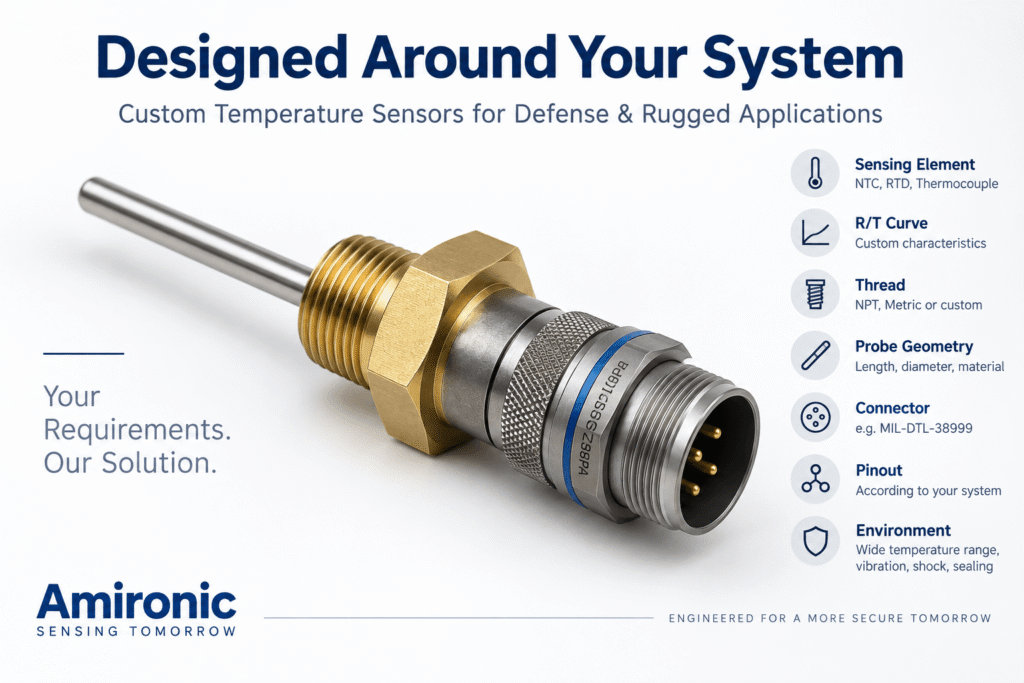
Other factors must also be considered, including the temperature range, accuracy and measurement characteristics, response time, mechanical design of the probe, thread type, housing materials, wiring, electrical connector, and the way the complete sensor assembly integrates into the system.
In some cases, a standard off-the-shelf temperature sensor simply does not meet the requirements. This is where a Custom Temperature Sensor, designed around the specific requirements of the system, becomes necessary.
What Is a Temperature Sensor for Military Applications?
The term Military Temperature Sensor does not necessarily describe a sensing technology that is fundamentally different from those used in industrial applications.
Military systems can use well-established temperature sensing technologies such as:
- NTC Thermistor
- RTD – Resistance Temperature Detector
- PT100 / PT1000
- Thermocouple
- Other temperature sensing technologies depending on the application
The main difference often lies in everything surrounding the sensing element.
The sensor must become an integral mechanical and electrical part of the system in which it is installed. Therefore, it is important to consider not only what measures the temperature, but also how the sensor is installed, how it connects to the system, and what environmental conditions the complete sensor assembly must withstand.
For example, a temperature sensor installed in a propulsion system or mechanical assembly may require a specific mounting thread, defined insertion depth, metal housing, rugged connector, and a wide operating temperature range.
It is also important to distinguish between a sensor designed for a military application and a sensor that has actually been qualified or tested to a specific military standard. The use of a military-grade connector or rugged construction alone does not constitute qualification to a MIL-STD requirement.
The Real Challenge: The Sensor Is an Assembly, Not Just a Sensing Element
When an engineer starts looking for a temperature sensor, it is easy to begin with specifications such as:
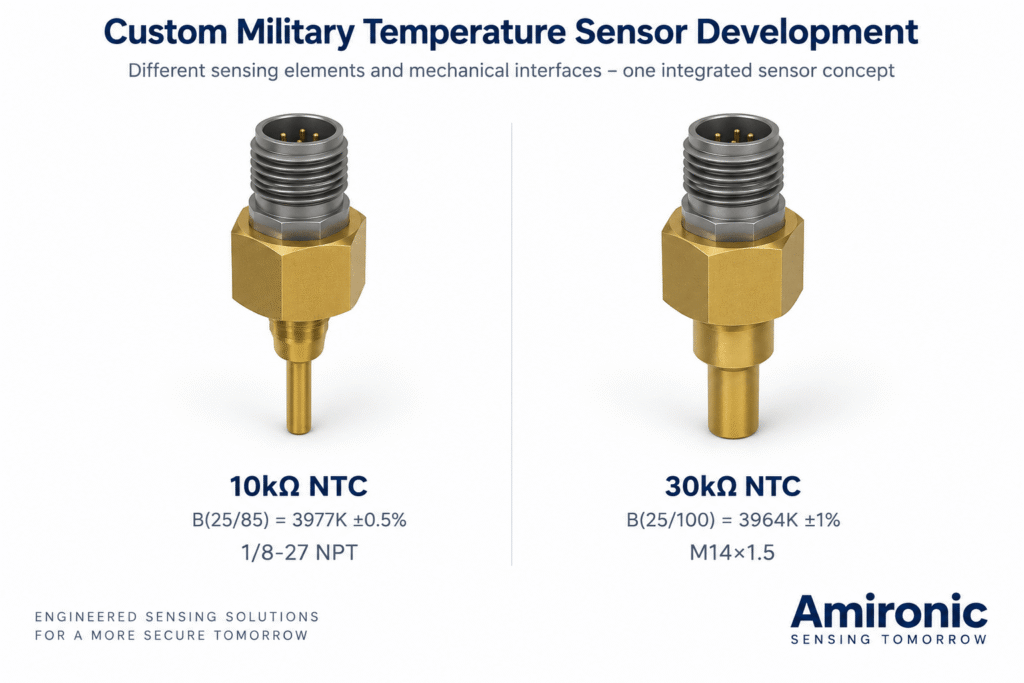
10kΩ NTC, 30kΩ NTC, PT100, or PT1000.
But the sensing element is only one part of the product.
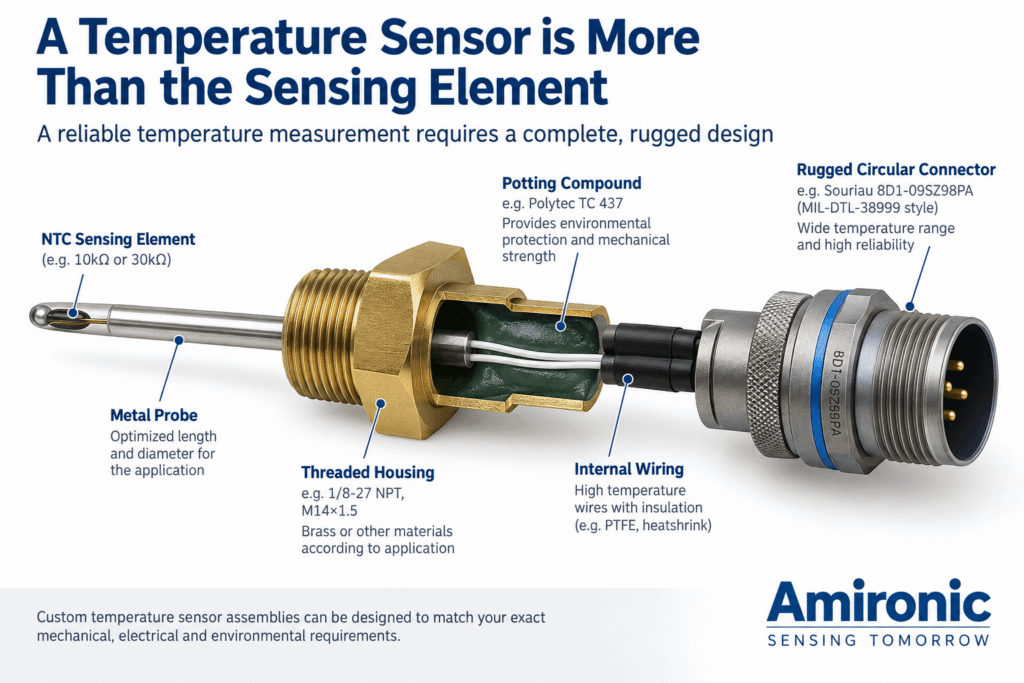
A complete temperature sensor may include the sensing element, probe, metal housing, insulation materials, potting compound, internal wiring, mounting thread, and electrical connector.
Each of these components can affect how well the sensor fits the application.
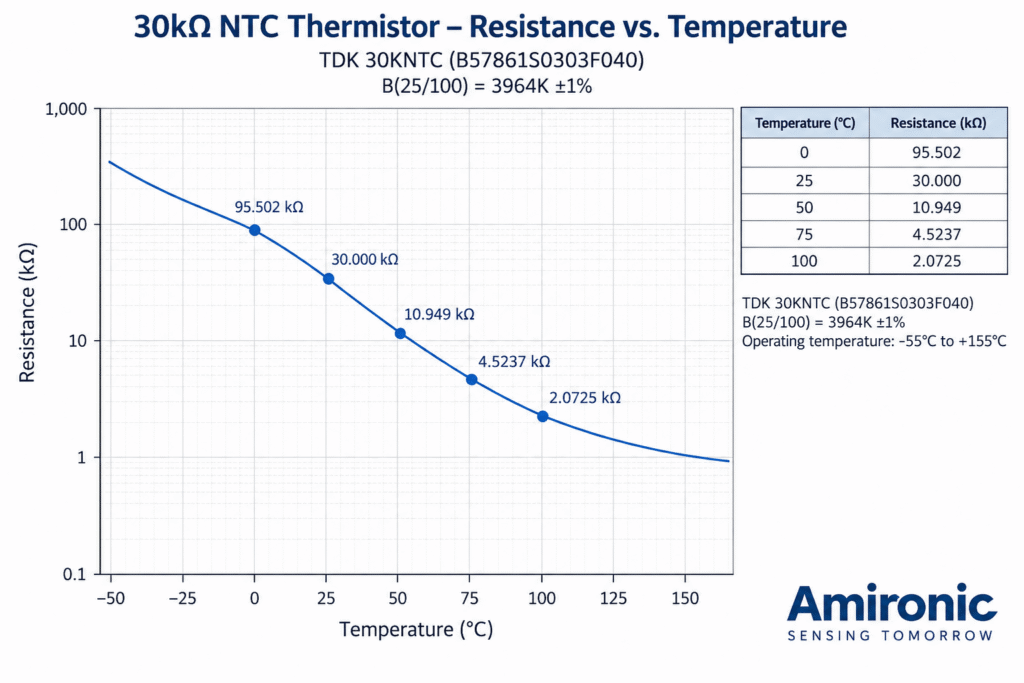
A good example is a sensor based on a 30kΩ NTC Thermistor. In a development carried out by Variohm Eurosensor, a TDK 30k Thermistor, part number B57861S0303F040, was selected with a Beta value of B(25/100) = 3964K ±1% and an NTC operating temperature range of -55°C to +155°C.
However, these electrical characteristics are only the starting point. The same sensing element was integrated into a custom brass housing with an M14×1.5 thread, Polytec TC437 potting compound, and a rugged Souriau connector as part of the complete sensor assembly.
This brings us to one of the most important parameters when working with an NTC Thermistor: the Resistance/Temperature (R/T) Curve.