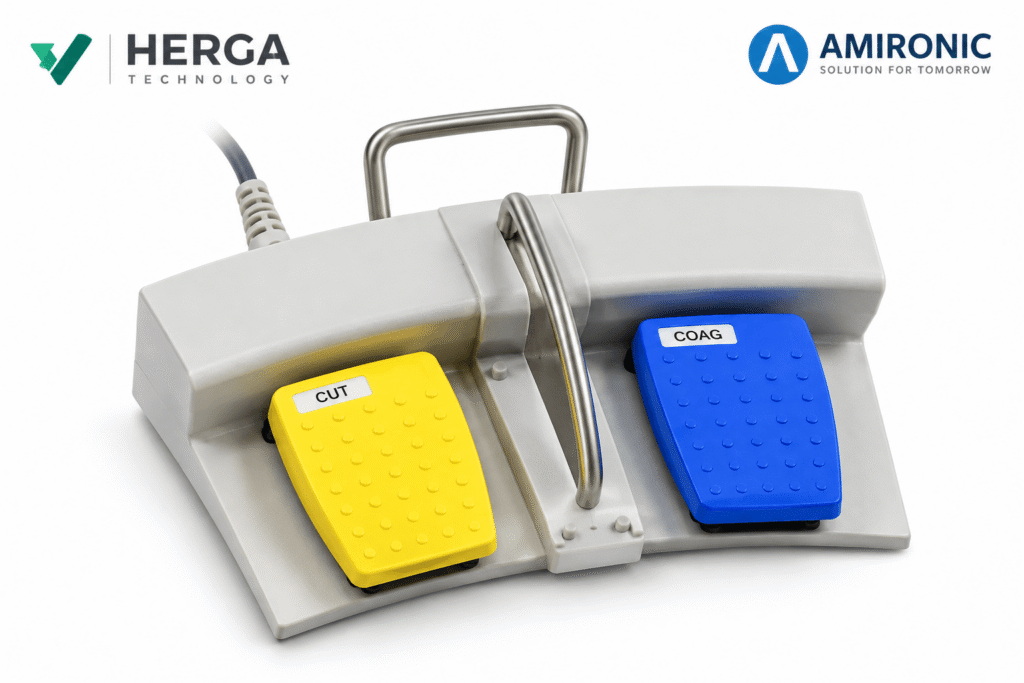
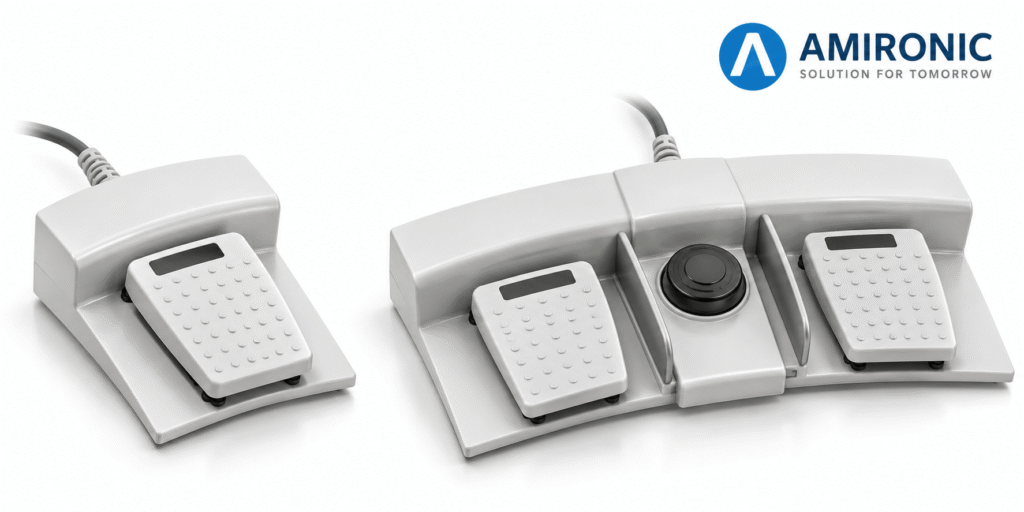
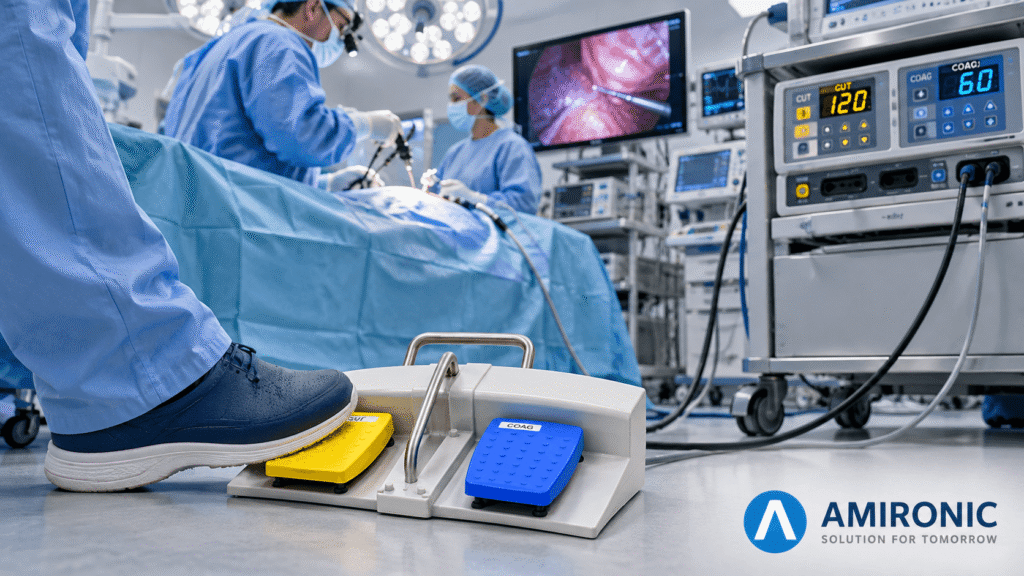
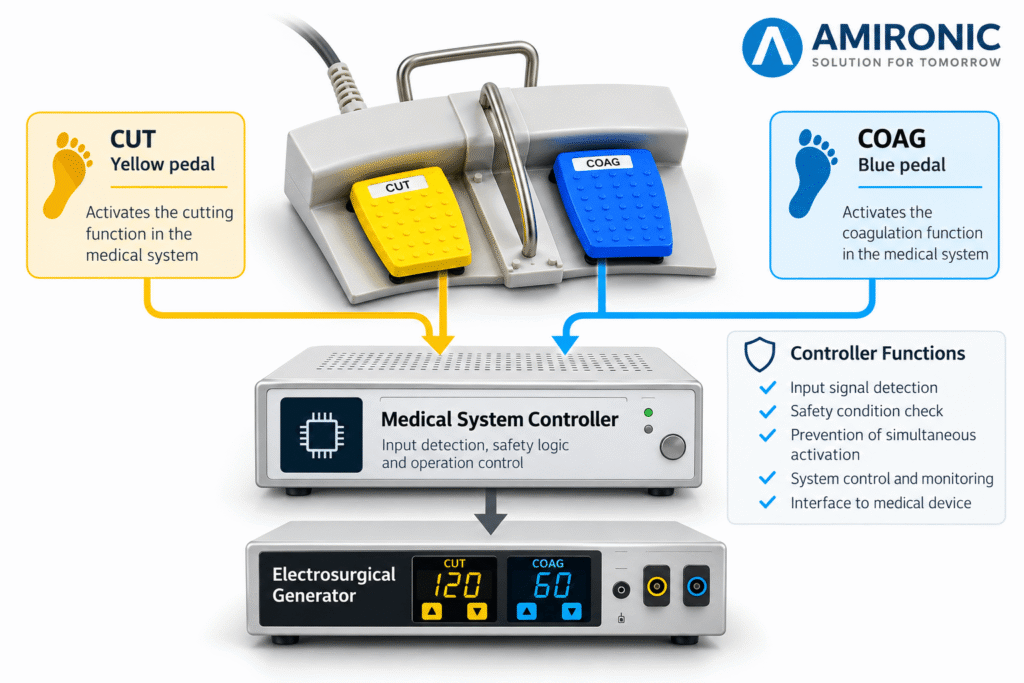
In a modern operating room, every action must be performed with precision and proper timing. Surgeons are required to control advanced medical equipment, often while using both hands, without diverting their attention from the procedure. In such situations, a footswitch is more than just an auxiliary control device. It is an integral part of the system’s control interface.
Medical footswitches from HERGA Technology, particularly the MD1G and MD2G series, are designed for medical applications that demand reliability, precise operation, durability in clinical environments, and compliance with medical electrical equipment safety requirements.
One of the key advantages of this platform is its UL certification to the 60601-1 family of medical safety standards, combined with modular design options that allow Original Equipment Manufacturers (OEMs) to customize the control interface to meet their specific system requirements.
Why Is a Medical Footswitch an Important Engineering Component?
Unlike a switch mounted on a control panel, a medical footswitch is often operated without the user looking directly at it. A surgeon or healthcare professional may be focused on an imaging monitor, a surgical microscope, or the treatment area itself.
Therefore, proper footswitch design requires careful consideration of several characteristics:
-
Intuitive Operation: Clear differentiation between functions through pedal positioning, colors, tactile feedback, and physical separation.
-
Predictable Response: Consistent correspondence between pedal activation and the electrical signal received by the control system.
-
Fluid Resistance: Protection against liquid ingress in environments where regular cleaning and disinfection are required.
-
Mechanical Stability: Minimizing unintended movement of the footswitch during operation.
-
Medical System Compatibility: Selecting the appropriate contact configuration, electrical rating, cable, and connection method according to the equipment’s requirements.
The combination of these characteristics is particularly important in medical systems that incorporate multiple functions, each requiring a separate and clearly defined activation command.